
Author: Andy north

  • Website Design for Startups: Guide to 2026 Success

    Website Design for Startups: Guide to 2026 Success

    You're probably in one of two spots right now.

    Either your startup has real work happening in the field, crews on job sites, trucks moving, phones ringing, and no website that matches the business. Or you have a basic site up, but it feels thin. It doesn't answer the questions serious buyers ask, it doesn't make your company look established, and it definitely isn't helping you hire welders, operators, drivers, or techs.

    That's common in industrial and contracting businesses. Founders put their energy into operations first. They should. But once prospects, partners, and job candidates start checking you out online, your website stops being a side project. It becomes the place where people decide whether your company looks real, capable, and worth contacting.

    Typical startup advice often emphasizes branding, flashy homepages, and app-style design trends. This approach overlooks the specific needs of contractors, oilfield service companies, trucking businesses, fabrication shops, and industrial startups. In these sectors, audiences demand concrete evidence. They seek information about your operational locations, your services, the individuals leading the company, and your responsiveness post-project commencement.

    A strong website design for startups in these industries has two jobs at once. It has to turn strangers into leads, and it has to help recruit the people you need to grow. If it can't do both, it's underbuilt.

    Table of Contents

    Your First and Most Important Business Asset

    A founder in contracting or industrial services usually sees the website after a long list of urgent needs. Trucks need decals. Insurance needs attention. Estimates need to go out. Hiring never stops. Then a prospect checks your site at 9:30 p.m., or a diesel tech looks you up between jobs, and your website becomes the first test of whether this company feels credible enough to contact.

    That is why the website should be treated as a business asset, not a branding accessory. Stanford University research on web credibility found that people often judge a company's trustworthiness by its site design and presentation, especially before any direct contact. For a startup without years of local reputation, that judgment happens fast and carries weight.

    A professional hand touching a digital launch button surrounded by business icons, watercolor splashes, and growth graphics.

    What founders usually get wrong

    The problem is rarely that the site looks terrible. The bigger issue is that it looks complete while failing to support sales, recruiting, or trust.

    I see the same pattern in early-stage service businesses. The homepage talks about passion and commitment, but never says what the company does, where it works, what types of jobs it takes, or why a buyer should believe the team can deliver. In labor-tight markets, the same problem shows up on the hiring side. A candidate cannot tell what roles are open, what equipment they will work on, whether the company looks stable, or how to apply from a phone in under two minutes.

    A weak startup site usually breaks down in four places:

    • Messaging is inward-looking: The copy focuses on the company story instead of customer problems, service lines, and service areas.
    • Calls to action are unclear: Visitors do not know whether to request a quote, call now, upload plans, or apply for a job.
    • Proof is missing: There are no project photos, crew photos, certifications, equipment shots, testimonials, or signs of active operations.
    • The build stops at design: The site may look polished, but it has no clear job in the business and no structure that supports lead flow or hiring.

    Founders who want a better handle on the business side of web projects should also read this guide to boosting revenue. It is useful because it shifts the conversation away from taste and toward outcomes.

    Why this matters more in contracting and industrial markets

    In these industries, buyers are screening for risk. They want to know whether you are insured, responsive, staffed, equipped, and capable of showing up on schedule. Job candidates are doing the same thing from a different angle. They want signs that the company is legitimate, busy, safe, and worth leaving their current employer for.

    Your website often has to answer both groups before anyone picks up the phone.

    For startups in high-friction markets, that creates a tougher standard than a generic software or ecommerce brand faces. The site needs to show operational reality. That means real service pages, real geography, real photos, real people, and a clear next step for both prospects and applicants. If those pieces are missing, the business can look smaller, newer, or less dependable than it is.

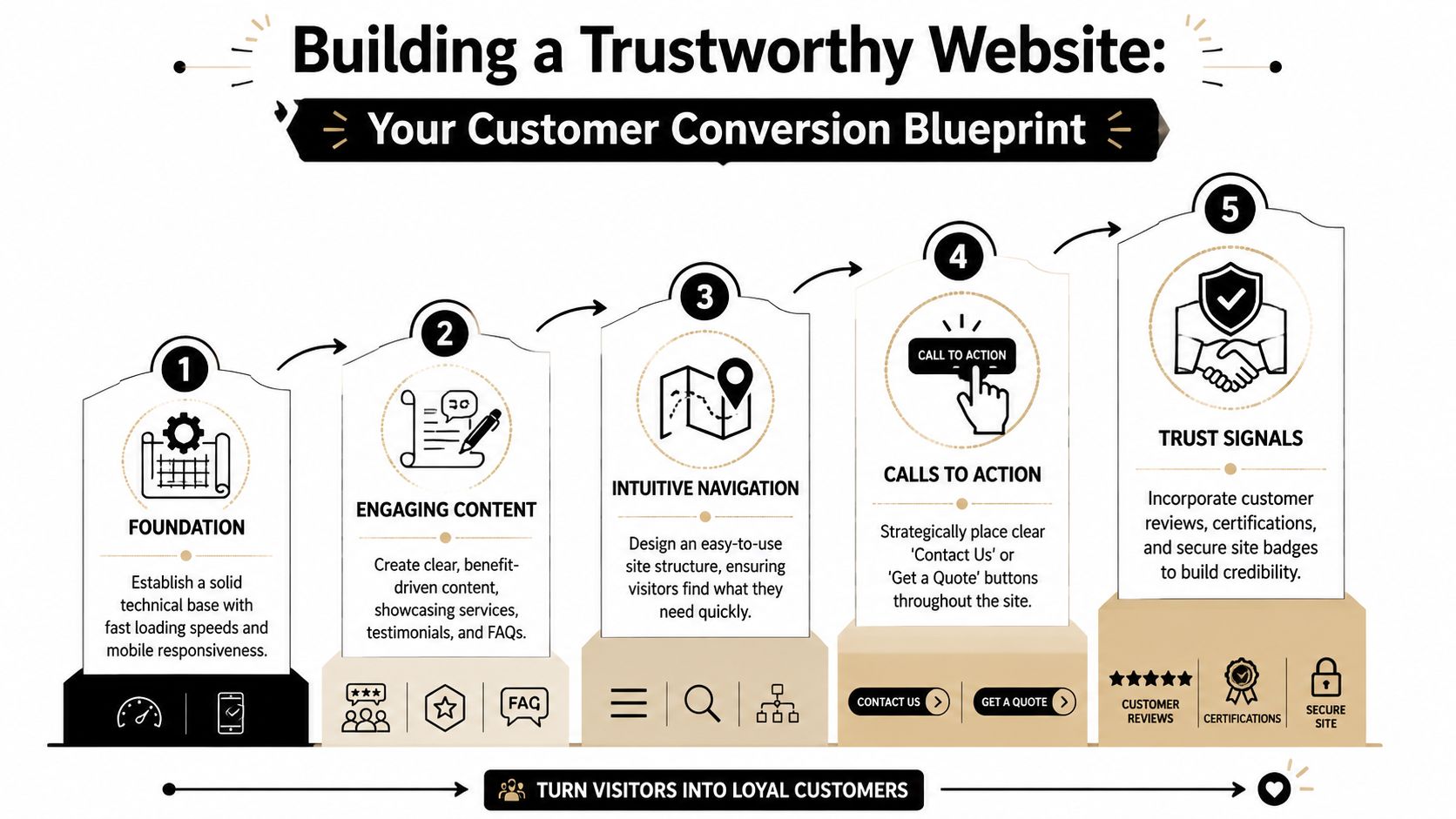
    This is also why many founders outgrow a design-only approach. A business site has to support positioning, user flow, search visibility, lead conversion, and recruiting. That is the reason many owners benefit from understanding why your website needs more than just a designer.

    A startup website should reduce doubt. When it does, quote requests come in warmer, applicants are more qualified, and the company spends less time overcoming skepticism in every sales and hiring conversation.

    The Blueprint Your Startup Website Strategy

    A startup website goes off track long before design starts. It usually happens when nobody makes the hard decisions early.

    If your homepage is trying to impress investors, explain technical services, rank in search, generate quote requests, and recruit operators all at once, the result is usually muddled. The better move is to decide what the site must do first, then build around that priority.
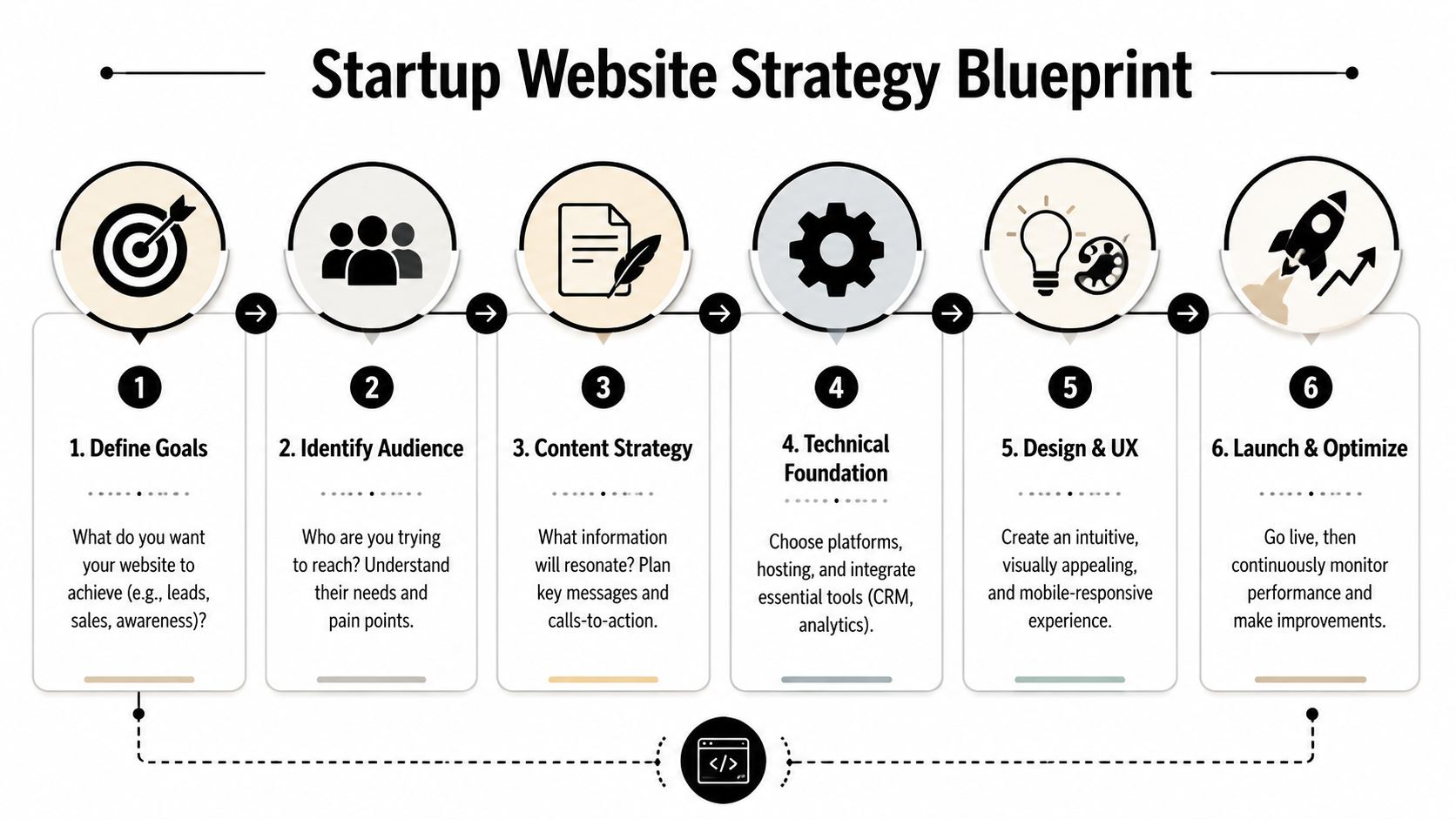
    A flowchart infographic outlining a six-step startup website strategy, from defining goals to launch and optimization.

    Start with the primary business objective

    Most startup sites have three possible priorities:

    1. Lead generation for sales conversations and quote requests
    2. Recruiting for field staff, drivers, technicians, and office hires
    3. Credibility for vendors, partners, lenders, and larger customers

    You can support all three. But one of them has to lead the structure.

    For example, an excavation startup that needs work now should build around service pages, location pages, trust signals, and quote calls to action. A trucking startup struggling to staff trucks may need a stronger careers section, faster mobile applications, and a homepage that speaks to both customers and drivers. A specialized industrial startup may need tighter positioning and stronger proof for procurement teams.

    Build the minimum viable website first

    The smartest startup websites launch lean. Not cheap. Lean.

    A practical workflow is to define the MVP scope first, keep the tech stack and navigation simple, launch with core pages plus analytics, and then test every form, link, and screen size before going live, as outlined in this guidance on affordable web design for startups.

    A solid MVP website usually includes:

    • Homepage: Clear positioning, top services, service area, and a direct action path.
    • Service pages: One page per core service, written for how customers search and evaluate.
    • About page: Team, experience, local roots, and why the company exists.
    • Contact page: Phone, email, address if appropriate, map or service area, and a simple form.
    • Careers page: Open roles, hiring message, and mobile-friendly apply flow if recruiting matters.
    • Basic tracking: Analytics and form tracking so you know what's happening after launch.

    Define audiences before you write copy

    Industrial startups usually have more than one audience, and they don't all want the same information.

    A general contractor may care about safety, schedule reliability, and capacity. A plant manager may want proof of technical competence. A CDL driver looking for work wants to know where the routes run, what equipment they'll operate, and how quickly they can apply. If you write one generic message for everyone, nobody feels directly addressed.

    One site can serve multiple audiences. It just needs distinct paths instead of one blended message.

    A practical content map often looks like this:

    Audience What they need first Best page type
    Buyers Services, proof, contact path Homepage and service pages
    Partners Capability, legitimacy, location About and contact pages
    Job candidates Roles, culture, apply process Careers and role pages

    Keep navigation boring in the best way

    Founders sometimes want clever labels. Don't.

    Use familiar words. Services. About. Careers. Contact. If you serve multiple regions or specialties, organize those clearly. Industrial buyers don't want to decode your menu. They want to find answers fast and decide whether to call.

    The blueprint phase isn't glamorous, but it prevents expensive rebuilds later. When the strategy is right, design has a job to do. When the strategy is fuzzy, design becomes decoration.

    Designing for Trust and Action

    In contracting and industrial markets, trust beats trend almost every time.

    That doesn't mean your website should look outdated. It means the design needs to make people feel they're dealing with a real operator, not an anonymous startup hiding behind stock photos and polished copy. Buyers in these industries are often evaluating risk as much as service. They're asking whether you'll show up, do the work, communicate clearly, and solve problems when conditions change.

    A professional handshake bridging industrial landscapes featuring construction equipment and factory buildings with abstract icons above.

    One reason this matters now is broader skepticism toward generic digital experiences. For startups in sectors like contracting or industrial services, website elements that prove operational legitimacy are critical. Only 44% of U.S. adults said they trust companies to use AI responsibly, which is one reason generic sites can increase skepticism unless they show human accountability, real project evidence, and clear contact details, as noted in this article on web design for startups.

    Trust signals that actually matter

    A lot of websites try to create trust with visual polish alone. That's not enough in a high-friction sale.

    What works better is visible proof:

    • Real team photos: Office staff, field crews, leadership, dispatch, estimators.
    • Actual equipment and project photos: Trucks, rigs, yards, job sites, fabrication work, before-and-after images where appropriate.
    • Specific service areas: Towns, counties, regions, and operating footprint.
    • Clear contact details: Phone number, email, business address or office location, and who to ask for.
    • Capability detail: Certifications, industries served, project types, response process, and what kind of work you take on.
    • Human language: Plain wording that sounds like a company with people behind it.

    A startup in welding or roustabout services should look operational. A site with abstract graphics and generic language about innovation usually creates distance instead of confidence.

    Navigation should reduce uncertainty

    Good navigation doesn't just help users move around. It lowers doubt.

    If a prospect lands on your site and immediately sees Services, Industries, Service Area, Careers, and Contact, they know where to go. If they see vague menu labels or scattered information, they start working harder than they should. Many won't bother.

    For B2B or technical startups, structure matters even more. Buyers and internal stakeholders often evaluate from different angles. The layout has to help both groups find what they need without friction.

    If a visitor has to hunt for proof, they often assume the proof isn't there.

    A useful way to think about page order is this: answer the buyer's first question first. What do you do. Where do you do it. Who have you done it for. How do I reach you. What happens next.

    Calls to action need to fit the job

    Not every visitor is ready for the same step. That's why industrial startup sites often need more than one call to action.

    Some examples that work:

    • For leads: Request a quote, schedule a call, send project details
    • For urgent work: Call now, speak with dispatch, request field response
    • For recruiting: Apply now, view open positions, talk to our hiring team

    The design should make those paths obvious without turning every page into a wall of buttons. This is especially important with forms. If your quote request or job application is awkward on mobile, people drop off. These form UX principles are a useful reference for keeping forms clear, short, and easier to complete.

    A short visual example helps here:

    What doesn't work

    Some patterns consistently hurt startup sites in industrial spaces:

    Weak choice Why it fails
    Generic stock imagery It removes the human and operational proof visitors are looking for
    Long mission statements above the fold Buyers want service clarity first
    Hidden phone numbers It adds friction when people want fast contact
    Overdesigned animations They distract from trust and can slow the site
    One broad contact form for everything Leads and job applicants usually need different paths

    The strongest design choice is usually the plainest one. Show the work. Show the people. Show the service area. Give visitors a direct action to take. That's what earns trust.

    Choosing Your Technical Foundation

    The platform decision shapes far more than launch day. It affects how easy the site is to update, how well it scales, how flexible your SEO setup can be, and whether future features become simple additions or expensive workarounds.

    For most startups, the comparison comes down to WordPress on self-hosted infrastructure versus website builders like Wix or Squarespace. Shopify belongs in the conversation if you're selling products directly, but most contractors and industrial startups are choosing between the first two paths.

    The simple version of the decision

    If you need to get online fast with a modest site and limited complexity, a builder can work.

    If you expect the site to grow into service-area pages, recruiting flows, SEO content, integrations, lead routing, and custom functionality, WordPress usually gives you more room to operate. That flexibility matters more than founders realize at the start.

    Here's the side-by-side view.

    Factor WordPress (Self-Hosted) Website Builders (Wix, Squarespace)
    Setup speed Slower at the beginning Faster to launch
    Design flexibility High Moderate
    Custom features Strong support for custom builds and integrations More limited
    SEO control Broad control over structure and content setup Often simpler, but with less flexibility
    Content scaling Better for larger content footprints Fine for smaller sites
    Ownership and portability Greater control More tied to platform rules
    Ongoing maintenance Requires active management Platform handles more of it
    Best fit Growth-focused businesses with evolving needs Simpler brochure-style sites

    When builders make sense

    Builders are attractive for obvious reasons. They're easier for nontechnical teams, they package hosting and editing together, and they remove some maintenance burden.

    That can be a rational choice when:

    • You need a short site fast: A home, about, contact, and a few service pages.
    • You won't need custom workflows soon: No recruiting portal, no advanced CRM behavior, no unusual lead routing.
    • Your internal team will edit everything: And they want the simplest possible interface.
    • You're validating the business: And need basic presence before investing further.

    A builder is often enough for an early-stage company that needs a clean online presence and has no near-term plans for aggressive SEO expansion.

    When WordPress is usually the better fit

    Industrial and contracting startups often outgrow simple builders faster than expected. That's especially true when the website becomes part of operations, not just marketing.

    WordPress usually fits better when you need:

    • Detailed service and location content
    • Flexible lead forms and CRM integration
    • A careers section with role-specific pages
    • Content marketing and SEO growth
    • Control over site structure and future development

    That doesn't mean WordPress is automatically right. It means founders should think beyond launch. A platform that feels easy in month one can feel restrictive once the business needs the site to do more.

    Pick the platform for the business you're building, not just the site you can launch this month.

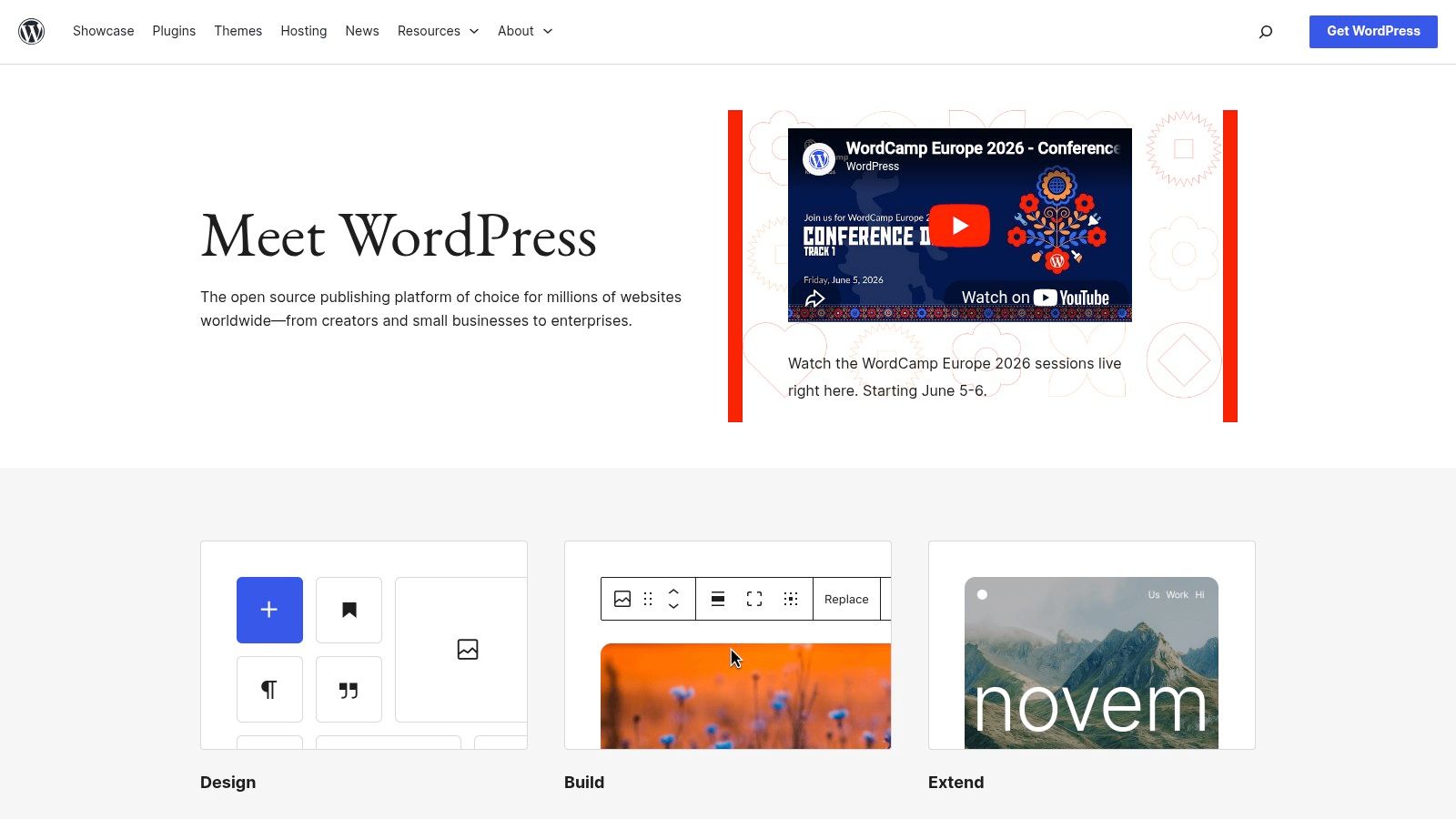
    There's also the practical issue of who will manage it. Some companies want a fully managed setup from an agency or partner. Others want internal control. Some use a provider like WordPress.com, a local web partner, or a service firm such as Northpoint Web for build and maintenance, depending on how much support they want after launch.

    If you're weighing platforms for a service business, this breakdown of small business website platforms is a useful next read.

    The cost of the wrong technical choice

    The biggest risk isn't that you choose a “bad” platform. It's that you choose one that doesn't match your operating model.

    A startup that needs to rank in multiple service areas, publish useful content, recruit staff, and integrate forms into internal workflows will usually want flexibility. A startup with a narrow service set and low update volume may value simplicity more.

    The right technical foundation should let you add pages, adjust offers, support recruiting, and improve search visibility without rebuilding the whole thing later. That's the defining standard.

    Getting Found Foundational SEO and Local Visibility

    A good-looking website that nobody finds won't move the business. For startups, especially local and regional service companies, foundational SEO is what turns a website from an online brochure into an acquisition channel.

    The key point is simple. SEO for a startup doesn't start with tricks. It starts with structure.

    For technical or B2B startup sites, a user-research-led structure is recommended. That includes mapping distinct user journeys and using semantic HTML for SEO and accessibility, which are core tenets of foundational SEO, as described in this piece on tech website design examples.

    Start with the pages people are actually searching for

    Many startup sites launch with one broad services page. That's rarely enough.

    If you're an excavation contractor, drilling service, trucking company, or fabrication shop, your website should reflect the actual ways customers search and compare. That usually means separate pages for core services, and often separate pages for key service areas if geography matters to the business.

    A practical structure might include:

    • Core service pages: One page per major offering
    • Industry pages: If you serve different customer types with distinct needs
    • Location pages: If your service area is regional and search intent is local
    • Contact and quote pages: Built for action, not filler

    Use language your customers use

    Founders know their industry vocabulary. Buyers don't always use it the same way.

    An internal label like “integrated field support solutions” may sound polished in a meeting. It's much less useful than plain language such as hydrovac services, roustabout crews, excavation, welding repair, heavy haul transport, or pipeline support if that's what your market says.

    Good startup SEO copy does three things at once:

    1. It names the service clearly
    2. It answers practical questions fast
    3. It leads toward contact

    That's true on the homepage, but it matters even more on service pages. The best pages help a prospect confirm fit without forcing them to call just to understand what you do.

    Local visibility often starts with your business profile, not your homepage

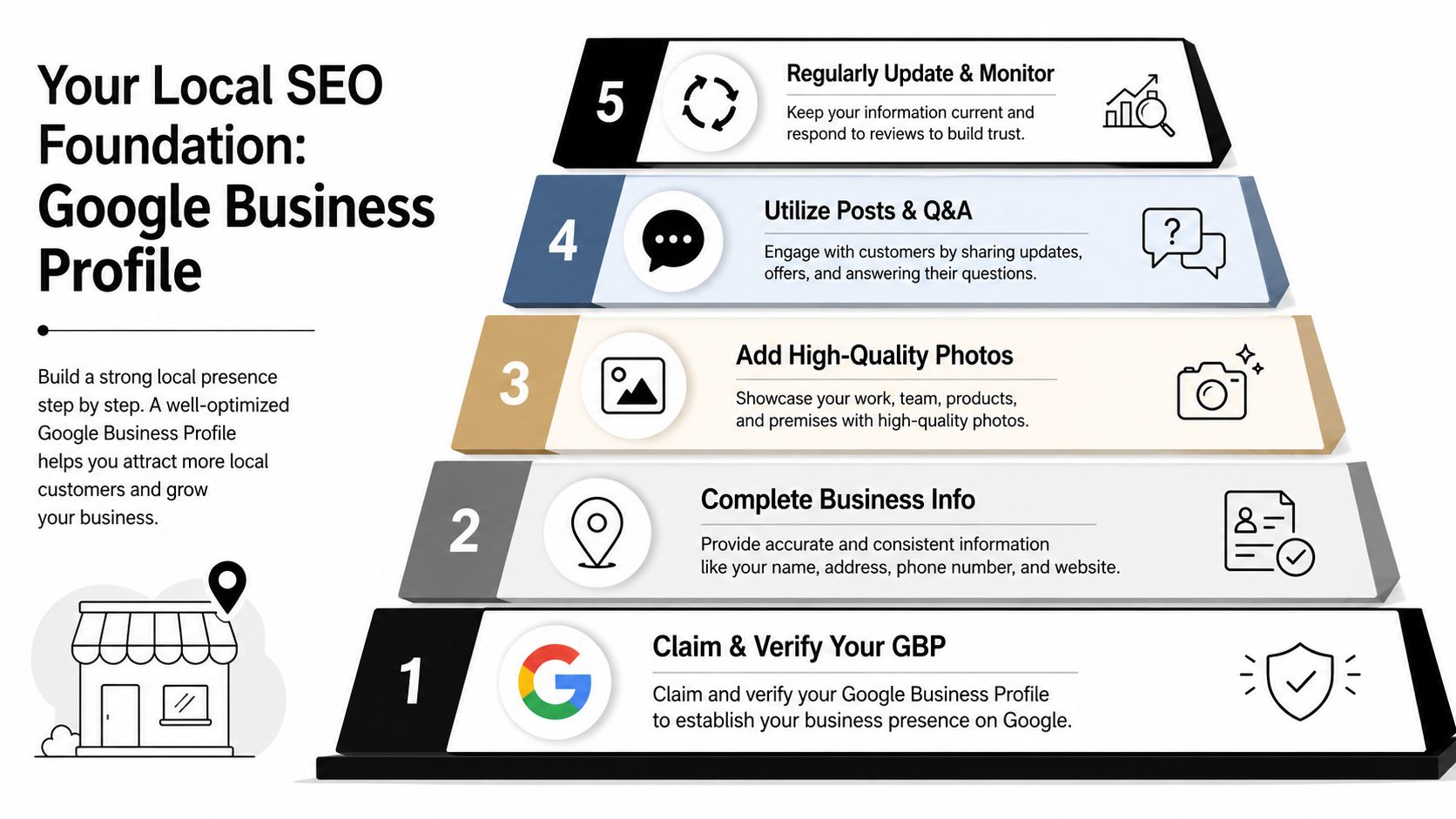
    For local and regional startups, your Google Business Profile can be one of the fastest ways to gain visibility with nearby searchers. That's especially true for contractors, trucking companies, and service businesses that depend on map-based searches and direct calls.

    Make sure your profile matches the business you're operating:

    • Business name: Use the official operating name consistently
    • Categories: Choose categories that reflect core services
    • Service area: Define the area you serve as accurately as possible
    • Photos: Add authentic team, equipment, office, yard, and project images
    • Contact details: Keep phone and business information current
    • Website link: Send people to the most relevant page, not just by default to the homepage if a service page fits better

    Search visibility improves when the site structure and local business information support each other instead of pulling in different directions.

    Don't skip the basics that make SEO work later

    A lot of startup owners want to jump straight to blog topics and ranking ambitions. That's fine, but only after the foundation is in place.

    Check these first:

    SEO foundation Why it matters
    Clear page hierarchy Helps users and search engines understand the site
    Descriptive page titles Supports relevance and click decisions
    Internal linking Connects related pages and improves navigation
    Semantic HTML Supports accessibility and crawl clarity
    Useful page copy Gives each page a reason to rank
    Mobile usability Supports real-world use and lead flow

    Foundational SEO isn't flashy. It's disciplined. The companies that win in local and industrial search are usually the ones that make it easy for search engines and buyers to understand exactly who they help, where they work, and what action to take next.

    Building a Website That Recruits

    Most founders still think of the website as a sales tool first. In a tight labor market, that's incomplete.

    If you need CDL drivers, operators, welders, laborers, mechanics, or technicians, your website should function like a recruiting asset every day. It should help candidates discover you, understand the kind of company you are, and apply without jumping through hoops. Generic startup content rarely addresses that well, even though the hiring pressure is often as urgent as the sales pressure.

    A major underserved angle in website design for startups is recruiting. With 68% of job seekers using mobile devices, but only 58% of job postings being mobile-friendly, a startup's website needs candidate-facing pages and fast-loading, mobile-friendly apply flows, according to this article on why good web design for startups matters.

    A diverse group of professionals walking towards a colorful, artistic portal featuring the text Grow With Us.

    Why a careers page matters more than founders expect

    A lot of startup sites bury hiring in a footer link or an email address. That's a mistake.

    Candidates evaluate your business the same way customers do. They want to know whether the company looks stable, whether the work sounds legitimate, and whether applying will be worth the effort. If the website feels outdated or thin, strong candidates may assume your operation is disorganized before they ever talk to you.

    A good careers section should do more than list openings. It should answer practical questions:

    • What kind of work do you do
    • Where do employees work
    • What kinds of roles are you hiring for
    • What's the company environment like
    • How quickly can someone apply from a phone

    Build for job seekers on the move

    Industrial and trade candidates often aren't sitting at a desk with time to fill out long forms. They're on a lunch break, in a truck, between jobs, or looking after hours from a phone.

    That changes what a good apply flow looks like.

    The strongest recruiting websites usually include:

    • Short mobile-first forms: Name, contact info, relevant experience, certifications or license notes, and resume upload if available
    • Role-specific pages: Driver roles, operator roles, welders, laborers, mechanics, office support
    • Clear work details: Schedule expectations, travel expectations, service area, and equipment or work type
    • Fast contact options: Apply now, call to ask about a role, or start the conversation by text if your process supports it

    A recruiting page should remove hesitation, not add paperwork.

    Sell the company honestly

    Founders sometimes avoid talking about culture because they think it sounds soft. For hiring, it matters.

    That doesn't mean generic language about being a family. It means being concrete. Talk about steady work, local projects, growth opportunities, field conditions, team standards, safety expectations, and what kind of person succeeds in the company.

    For an industrial startup, recruiting content should feel grounded. Examples help:

    Weak recruiting copy Stronger recruiting copy
    Join our dynamic team Work on excavation and utility projects across our service area
    Competitive environment Clear expectations, steady workload, and direct communication from supervisors
    Growth opportunities Room to move into lead, specialty, or equipment-based roles as the company grows

    Keep sales and recruiting from competing with each other

    One concern founders have is whether recruiting content distracts from lead generation. Usually it doesn't, if the structure is handled correctly.

    The answer is separation, not suppression. Your primary navigation can support both business goals without confusing either audience. Buyers should have a direct path to services and quotes. Candidates should have a clear path to careers and applications. The homepage can acknowledge both, but the deeper pages should stay focused.

    A startup website that helps you win work but can't help you staff that work is incomplete. For contractors and industrial businesses, recruiting isn't secondary. It's part of capacity.

    The Launch Plan Costs Timelines and Hiring Help

    A startup in contracting or industrial services usually feels the pressure at launch from two sides at once. Sales needs the site to start generating quote requests. Operations needs it to look credible enough that a plant manager, GC, or municipal buyer does not hesitate. In a tight labor market, the same site may also need to help bring in operators, techs, drivers, or field labor.

    That pressure is why launch planning matters. A website that goes live half-finished often creates more cleanup work than momentum.

    Budget conversations go better when founders understand what they are buying. The number is not just for design files and a homepage. It usually covers strategy, page planning, writing support, design, development, technical setup, and launch review. For founders used to website builders, that can feel expensive. In practice, the true cost comes from getting the structure right early so the site can support leads, recruiting, and local visibility without a rebuild three months later.

    What the budget usually covers

    A professional startup site often includes work that is easy to miss during early planning:

    • Discovery and scoping: Clarifying services, priority audiences, goals, and calls to action
    • Site architecture: Deciding which pages are needed and how buyers and job candidates move through them
    • Content planning: Organizing messaging, proof points, service details, and conversion paths
    • Design and development: Building the site, templates, forms, and mobile layouts
    • Technical setup: Analytics, basic SEO settings, performance work, and security basics
    • Launch review: Checking forms, links, devices, page consistency, and indexing settings

    Scope grows fast when the site has to do more than look respectable. A contractor that needs service pages, location pages, a careers section, and job application handling is building a more useful asset than a five-page brochure. It should be scoped that way from the start.

    A realistic timeline without pretending every project is the same

    The biggest delays usually come from decisions, not code.

    If the founder is still changing service lines, has no project photos, or has not agreed internally on what jobs to recruit for, the timeline stretches. If those inputs are ready, the build moves much faster. In my experience, the cleanest launches happen when one person on the client side owns approvals and gets feedback back quickly.

    A practical launch rhythm usually looks like this:

    Phase What happens
    Discovery Goals, audiences, site map, platform choice
    Content planning Messaging, page priorities, calls to action
    Design Layout direction, homepage and key page design
    Development Build, responsiveness, forms, tracking
    QA Review links, forms, page rendering, devices
    Launch Final checks, publishing, post-launch monitoring

    That sequence matters because each phase affects the next. If a startup skips content planning and tries to solve everything in design, the site often looks polished but says very little.

    Pre-launch checks that should never be skipped

    Launch day should not be the first real test.

    Before publishing, verify:

    • Every form works: Quote forms, contact forms, careers forms
    • Every link resolves correctly: Buttons, menus, footer links, document links
    • Mobile pages are usable: Navigation, tap targets, form fields, and page speed
    • Core pages are complete: No placeholder copy, missing images, or unfinished sections
    • Tracking is active: Analytics and key conversion events
    • Local details are consistent: Phone, address, service area, and contact information

    A separate review for essential SEO for new websites is also worth doing before launch. It helps catch missed basics like indexing settings, metadata, redirects, and page-level details that do not show up in a visual review.

    DIY or hire help

    Some startups should build the first version themselves. That makes sense when the site is temporary, the offer is still changing, and the business only needs a credible placeholder while it proves demand.

    Hiring help makes more sense when the website has to support several jobs at once. That is common in industrial and contracting startups. The site may need to explain technical services clearly, rank in a local market, convert visitors into calls, and give job seekers a reason to apply. That kind of build usually benefits from tighter planning and stronger execution.

    A simple way to decide:

    • DIY if: You need a first version quickly and can live with limits
    • Hire a freelancer if: The scope is modest and you already know what the site needs to say
    • Hire a web partner if: The site needs strategy, content structure, technical execution, and alignment with sales and hiring goals

    If you want a clearer picture of scope before making that call, this breakdown of what's really included in a $7,500 website build gives a practical explanation.

    A startup website succeeds when it helps the business win trust, generate qualified inquiries, and support hiring capacity. For firms in the trades and industrial services, those outcomes are tied together. If the site helps you win work but not staff it, the launch solved only half the problem.

    If you need a website that helps your startup win trust, generate leads, and recruit employees in a competitive market, Northpoint Web builds practical websites for contractors, oilfield service companies, trucking businesses, and industrial firms that need more than a digital brochure.

  • 8 Strategies: Example of Business to Business Marketing

    8 Strategies: Example of Business to Business Marketing

    Business to business marketing—also called company to company marketing—helps one organization become easier for another organization to find, evaluate, and contact. For contractors, industrial firms, trucking companies, and other Uinta Basin businesses, that process often starts with a website, Google visibility, reviews, and clear proof of capability.

    This guide explains eight practical B2B marketing strategies and how to apply them without wasting time on broad, generic promotion. The right mix depends on who you sell to, how buyers research you, and whether your immediate priority is leads, recruiting, reputation, or long-term visibility.

    This guide explains eight practical B2B marketing strategies and how to apply them without wasting time on broad, generic promotion. The right mix depends on who you sell to, how buyers research you, and whether your immediate priority is leads, recruiting, reputation, or long-term visibility.

    That's an example of business to business marketing for the Uinta Basin. It isn't flashy branding for venture-backed software. It's a welding shop proving capability, a trucking company recruiting drivers, an excavation contractor showing service areas, or an oilfield service firm building enough credibility online to make the shortlist.

    B2B isn't a small side market. The global B2B eCommerce market was valued at $36.16 trillion in 2026 and is projected to reach $41.40 trillion by 2027, a projected 14.5% CAGR, according to SellersCommerce B2B marketing statistics. The same dataset notes that customer referrals account for 54% of all B2B leads, which fits what rural Utah businesses already know. Reputation still drives sales.

    Table of Contents

    1. Account-Based Marketing (ABM)

    A professional man and woman discussing a target illustration and a personalized envelope in a collaborative setting.

    The simplest example of business to business marketing is targeting the companies you want, instead of hoping the right people stumble across you. That's ABM. For a crane company, hydrovac contractor, or web partner serving industrial firms, that means building outreach around named accounts in Uintah and Duchesne counties instead of broad “Utah businesses” messaging.

    A lot of small firms think ABM is only for large sales teams. It isn't. In the Basin, a short target list often works better because a few accounts can change the year.

    Build around target accounts, not broad audiences

    Start with a list of companies that fit your best work. Maybe it's oilfield operators expanding crews, trucking companies struggling with recruiting, or civil contractors bidding larger jobs. Then build one page, one message, and one offer around each type.

    For example, if you're marketing to an oilfield service company, don't send them to your homepage. Send them to a page that speaks directly to field recruiting, equipment capability, safety credibility, and fast contact paths. If you're trying to win excavation accounts, show earthwork photos, service area pages, and proof that you understand bid-driven timelines.

    Practical rule: If your outreach could be sent to twenty different companies with no edits, it's too generic for ABM.

    A Uinta Basin ABM example

    A practical version looks like this:

    • Pick high-value account groups: Focus on operators, subcontractors, rental companies, and industrial service firms already active in your service area.
    • Create account-specific landing pages: Build one page for trucking recruitment, one for excavation leads, one for oilfield hiring support.
    • Align sales and marketing: Decide who follows up, what gets sent first, and what counts as a qualified response.
    • Use LinkedIn for research: Check who owns, manages, or influences the buying decision before you reach out.

    What doesn't work is pretending personalization means dropping a company name into a cold email. Real ABM means the page, the proof, and the offer all match the account.

    2. Content Marketing and Thought Leadership

    A professional setup with a laptop, smartphone, whitepaper, and notebook representing B2B business marketing strategies.

    Content marketing gets oversold and under-executed. Many contractors hear “start a blog” and picture generic posts nobody reads. That's not thought leadership. Good B2B content answers the exact questions buyers, estimators, project managers, and job seekers already have.

    This shift matters because buyers are doing more homework before they ever talk to you. According to Corporate Visions B2B buying behavior statistics, 81% of buyers initiate first contact with sellers, 61% prefer an overall rep-free buying experience, and 73% avoid suppliers that send irrelevant outreach. If you're invisible during the research stage, you're late.

    Teach what your buyers already ask

    For Basin businesses, strong content usually falls into a few buckets. Service explainers. Recruiting pages. Case studies. Safety and process videos. Location pages. Capability pages.

    An excavation company might publish pages on trenching, site prep, utility work, and emergency response. A trucking company might create hiring content around routes, equipment, home-time expectations, and what a new driver can expect during onboarding. A welding shop might post project galleries with short writeups explaining material type, use case, and turnaround.

    One detail many companies miss is image optimization. Even your project photos should support search visibility. Northpoint Web's guide on naming pictures for SEO is a good example of the kind of small technical fix that adds up over time.

    A simple content template for rural contractors

    Use this structure for nearly any service article:

    • Problem: Name the issue the buyer is trying to solve.
    • Process: Explain how your crew handles the work.
    • Proof: Add photos, certifications, service areas, or a short result summary.
    • Action: Give one next step, such as call, request quote, or apply now.

    If you want a broader framework for publishing, this B2B content planning checklist is useful.

    What doesn't work is posting trend pieces that have nothing to do with your actual sales process. If your buyers need confidence, publish proof.

    3. Search Engine Optimization (SEO) and Local SEO

    A welder standing in front of a shop representing local business marketing and search engine optimization services.

    For most industrial and construction companies in the Uinta Basin, SEO isn't about chasing vanity rankings. It's about showing up when someone searches “welding contractor Vernal,” “excavation company Duchesne,” or “CDL jobs Roosevelt Utah.” Local SEO is often the clearest example of business to business marketing because it connects a business need to a local provider at the moment of intent.

    A well-built Google Business Profile, solid service pages, and clear location targeting often outperform a fancy site with weak structure.

    Local visibility wins practical searches

    Buyers in long-cycle industries don't always convert on the first visit. They compare. They return. They verify. That's why your local presence has to do more than exist. It has to reduce doubt.

    A contractor searching for a subcontractor wants to know where you work, what you do, and whether you look established. A job seeker wants to know if you're active, legitimate, and hiring. Local SEO supports both.

    The guide on local SEO for contractors covers the fundamentals contractors need to clean up first.

    What to fix first

    If your local visibility is weak, start here:

    • Claim your Google Business Profile: Fill out services, business categories, hours, and contact details.
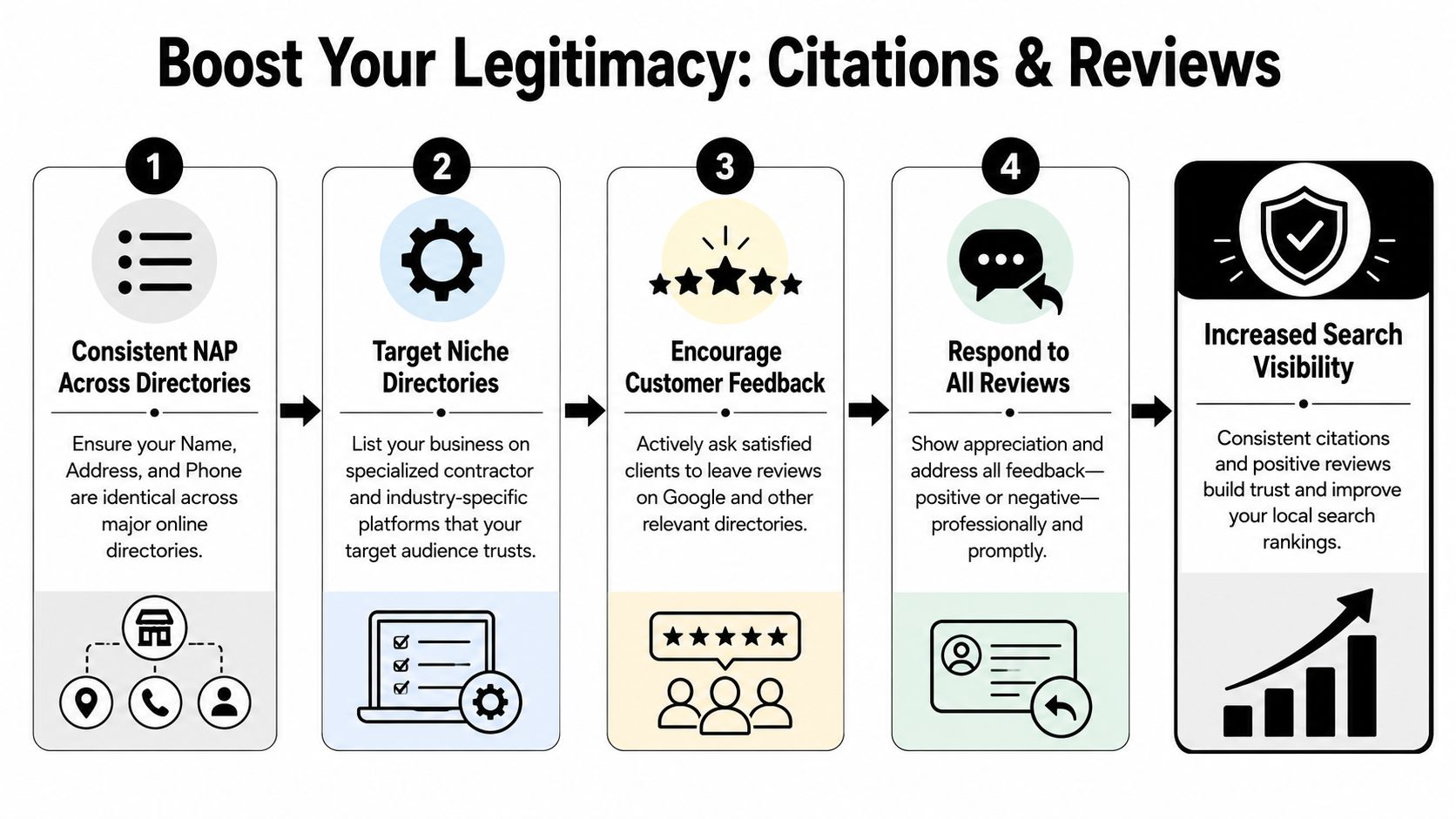
    • Match your NAP everywhere: Your name, address, and phone need to match across listings.
    • Build service and location pages: Don't lump everything into one generic services page.
    • Collect reviews consistently: Reviews support trust, especially for firms buyers haven't worked with before.

    Buyers don't need your website to be clever. They need it to be clear, current, and easy to verify.

    What doesn't work is stuffing city names into thin pages. Search visibility improves when each page helps the visitor.

    4. LinkedIn Sales Development and Professional Networking

    LinkedIn is one of the few places where B2B networking, recruiting, credibility, and direct outreach all live in the same channel. For oilfield service owners, trucking operators, and industrial suppliers, that's useful because the same platform can help you stay visible to decision-makers and future hires.

    Still, LinkedIn gets misused all the time. Owners either ignore it completely or treat it like a billboard for company slogans.

    LinkedIn works when you use it like a jobsite introduction

    The best approach is straightforward. Optimize your company page. Make sure leadership profiles are complete. Post enough to show the company is active and competent. Then use direct outreach carefully.

    A welding or fabrication shop can connect with plant managers, contractors, and procurement contacts. A trucking company can use LinkedIn to support recruiting by posting fleet updates, hiring messages, and team spotlights. A construction manager can stay in front of suppliers and subcontractors without making every interaction a pitch.

    The trade-off is time. LinkedIn works best with consistency, but most rural companies don't have a full-time marketing person. That means leadership should focus on a small number of useful posts instead of trying to mimic national brands.

    What to post if you hate posting

    Start with practical content:

    • Project updates: Share what your team completed and where.
    • Hiring posts: Show the work environment, equipment, and expectations.
    • Operational insight: Talk about process, safety, scheduling, or coordination.
    • Customer proof: Share a short success story without overcomplicating it.

    For a broader tactical approach, RepurposeMyWebinar's LinkedIn playbook offers ideas worth adapting.

    What doesn't work is generic connection requests followed by immediate sales messages. That burns trust fast, especially in small regional markets where people know each other.

    5. Email Marketing and Lead Nurturing

    Email still matters because most B2B deals don't close on first contact. A contractor might ask for pricing, go quiet for weeks, then return when a project is approved. A trucking prospect may visit your jobs page now and apply later. Email gives you a way to stay present without chasing people.

    That's where many businesses get it wrong. They either never follow up, or they send repetitive “just checking in” messages that add no value.

    Stay in front of buyers without being annoying

    Useful B2B email is segmented and relevant. Prospects should get different emails than past customers. Applicants should get different emails than project leads. If you're sending the same blast to everyone, you're wasting the channel.

    This matters even more now because digital buyers are screening vendors on relevance. Strong nurture emails can support the self-education buyers already prefer, especially when your sales cycle involves approvals, scheduling, and multiple stakeholders.

    A practical nurture sequence

    A simple sequence for a Basin contractor or industrial company might look like this:

    • Email one: Thank them for reaching out and explain the next step.
    • Email two: Share a related service page, project example, or capabilities sheet.
    • Email three: Address a common concern such as scheduling, safety, or mobilization.
    • Email four: Invite a call, site visit, or quote request.

    For recruiting, the same principle applies. Send applicants a clear follow-up, company overview, and job expectations instead of leaving them in the dark.

    Send emails people can use. If every message asks for something but gives nothing, replies will dry up.

    If you need a broad overview of setup, list building, and campaign basics, this complete email marketing guide is a solid reference.

    6. Lead Generation and Conversion Rate Optimization (CRO)

    Lead generation is where strategy meets reality. If your website gets traffic but doesn't produce calls, quote requests, or applications, the problem usually isn't “more marketing.” It's friction. CRO fixes that friction.

    This is one of the most useful examples of business to business marketing because the gains come from making your current traffic more likely to act. You don't always need more visitors first. You may need a better path for the right ones.

    Your website has one job

    Most contractor websites try to say everything at once. They cram all services onto one page, bury contact info, use weak headlines, and ask visitors to hunt for the next step. That hurts conversions.

    A stronger page says who you help, what you do, where you work, and how to contact you. Fast. Then it backs up the claim with proof.

    Northpoint Web's page on lead generation for contractors lines up with that practical approach.

    A better page structure for contractors

    A service page for an excavation or oilfield company should usually include:

    • Clear headline: State the service and service area immediately.
    • Short capability summary: Explain the work in plain language.
    • Proof section: Add project photos, certifications, equipment, or testimonials.
    • Strong contact path: Use a short form, visible phone number, and simple CTA.

    Case studies matter here too, but only if they show business impact. Visable notes that a strong B2B case study should document measurable before-and-after outcomes because decision-makers use quantified results to judge whether the solution could apply to their own business, as explained in Visable's guide to case studies in B2B.

    What doesn't work is sending paid traffic or SEO traffic to a homepage with no focused offer.

    7. Paid Search Advertising (Google Ads, PPC) and Local Services Ads

    Paid search is useful when you need visibility now. SEO takes time. Referrals fluctuate. Bids open and close. Hiring needs can hit all at once. Google Ads can put a contractor, trucking company, or industrial service business in front of searchers already looking for help.

    That said, paid search gets expensive fast when the setup is sloppy. Broad keywords, weak landing pages, and no negative keyword list will burn budget.

    Use paid search for intent, not awareness

    The best paid campaigns target commercial intent. Someone searching for “roustabout services Vernal” or “excavation contractor near Duchesne” is much closer to action than someone searching broad industry terms.

    For local service businesses that qualify, Local Services Ads can also be worth testing because they sit high in results and lean heavily on trust signals. For other firms, standard search campaigns often make more sense, especially when paired with focused landing pages built around one service and one location.

    Where paid campaigns usually go wrong

    Common mistakes are predictable:

    • Sending traffic to the homepage: The ad promise and landing page need to match.
    • Ignoring search terms: Bad traffic hides inside broad campaigns.
    • Running one ad group for everything: Separate services and locations.
    • Not tracking calls and forms: If you can't tie leads back to campaigns, you can't improve them.

    One real B2B e-commerce example shows what can happen when digital infrastructure supports growth. Adobe reports that after moving to Adobe Commerce, FoodServiceDirect.com achieved a 40% increase in new customer acquisition, a 110% increase in repeat purchases, and 40% growth in B2B sales, while managing a 250,000-SKU catalog through a headless-commerce architecture in Adobe's B2B e-commerce case studies. Most Basin companies don't need that level of complexity, but the lesson holds. Better digital systems make paid traffic more valuable.

    8. Video Marketing and YouTube for B2B

    A drilling superintendent in the Uinta Basin is comparing vendors after hours. He is not looking for a clever brand film. He wants to see your crew, your iron, your shop standards, and whether your team looks ready to show up safely and do the work.

    That is why video works so well in industrial B2B. It gives buyers proof before the first call. For oilfield service companies, trucking firms, and construction contractors around Vernal, Roosevelt, Duchesne, and surrounding job corridors, that proof matters more than polished messaging.

    Show the work buyers actually care about

    The best B2B videos for Basin companies are simple and specific. A welding shop can record a fabrication sequence with a short explanation of tolerances, materials, and turnaround times. An excavation contractor can show site prep, trenching, and finished grade. A trucking company can film a driver recruiting video that covers truck specs, haul types, home time, and what a new hire should expect in the first two weeks. An oilfield service company can walk through field readiness, safety process, dispatch speed, and mobilization capacity.

    Production quality matters less than usefulness. A clear phone video with decent audio, steady shots, and a supervisor who speaks plainly will usually do more for trust than a glossy promo full of drone footage and generic claims.

    Here's a practical example to study:

    Video formats that fit Basin businesses

    Use formats that help sales conversations, bid support, and recruiting:

    • Jobsite walkthroughs: Show equipment, crew coordination, staging, and finished results.
    • Capability videos: Explain one service, one process, or one piece of specialized equipment.
    • Recruiting videos: Cover schedule, expectations, safety culture, equipment quality, and who is a good fit.
    • FAQ clips: Answer the questions buyers ask before they request a quote or issue a bid invite.

    Keep each video focused on one topic. A three-minute video on hydro excavation in winter conditions is more useful than a vague company overview that tries to cover everything at once.

    A practical way to implement this

    Start with five videos, not twenty. Pick the services that drive the highest-value jobs or the hardest-to-fill roles. Write a rough outline with three parts: what the service is, how your team handles it, and what the customer or applicant should do next. Record on-site when possible. Real conditions beat a conference room every time.

    Then publish with plain titles buyers would search for, such as "Vac truck services in the Uinta Basin," "How our pipeline excavation crew handles remote sites," or "CDL driver jobs in Vernal, Utah." Add a short description, list the service area, and mention the equipment or job types shown in the video.

    A lot of brand videos fail for one reason. They stay abstract. Industrial buyers want evidence that your company can perform the work safely, professionally, and on schedule. Video gives them that evidence fast.

    8-Point Comparison of B2B Marketing Strategies

    Strategy Implementation Complexity 🔄 Resource Requirements ⚡ Expected Outcomes 📊 Ideal Use Cases 💡 Key Advantages ⭐
    Account-Based Marketing (ABM) High, multi-stakeholder research & alignment 🔄🔄 High, CRM, automation, dedicated account teams ⚡⚡ Targeted high-value conversions; stronger ROI per account 📊⭐ B2B industrial clients targeting specific companies or hires Highly personalized outreach; faster close for qualified accounts ⭐
    Content Marketing & Thought Leadership Medium, ongoing editorial process 🔄 Medium, writers, SEO, multimedia production ⚡ Increased organic traffic, authority, long-term lead flow 📊 Firms building regional authority or recruiting skilled labor Evergreen assets; credibility and sustained inbound leads ⭐
    SEO & Local SEO Medium–High, technical + content upkeep 🔄🔄 Medium, technical expertise, tools, local listings ⚡ Sustained organic visibility and high-intent local leads 📊 All local service businesses competing for regional work Cost-effective, long-lasting visibility in "near me" searches ⭐
    LinkedIn Sales Development & Networking Medium, profile strategy and outreach routine 🔄 Low–Medium, time, Sales Navigator, content ⚡ Direct access to decision‑makers; relationship-based leads 📊 Recruitment, B2B networking, supplier/customer outreach Precise prospecting and credibility building via professional network ⭐
    Email Marketing & Lead Nurturing Low–Medium, setup of segments and automations 🔄 Low–Medium, email platform, content creation ⚡ High ROI; consistent lead nurture across long sales cycles 📊 Lead nurturing, recruitment campaigns, customer retention Owned channel with measurable engagement and conversions ⭐
    Lead Generation & CRO Medium, iterative testing and analytics 🔄 Medium, analytics tools, design, testing platforms ⚡ Higher conversion rates from existing traffic; clearer lead quality 📊 Websites needing better ROI (quotes, applications, bookings) Data-driven improvements; cost-efficient uplift in leads ⭐
    Paid Search (PPC) & Local Services Ads Medium, campaign setup and optimization 🔄 High, ad spend and management expertise ⚡⚡ Immediate visibility and measurable leads; scalable results 📊 Time-sensitive or seasonal services; urgent recruitment Fast, targeted traffic; top-of-search placement (LSA) ⭐
    Video Marketing & YouTube for B2B Medium–High, planning, filming, editing 🔄🔄 Medium–High, equipment or production support ⚡ Higher engagement, improved conversions and recruitment impact 📊 Demonstrations, safety training, recruitment, complex services Humanizes brand; strong engagement and SEO benefits ⭐

    Your Next Move Turning Examples into Action

    These eight examples of business to business marketing work because they match how real buyers behave in industrial, construction, trucking, and oilfield markets. People still buy from companies they trust. That hasn't changed. What has changed is where that trust starts. It starts on Google, on your website, on your company profile, in your videos, in your reviews, and in the clarity of your message.

    For Uinta Basin businesses, the biggest mistake isn't doing too little marketing. It's doing disconnected marketing. A contractor runs ads to a weak homepage. A trucking company posts jobs on social but has no recruiting page worth visiting. An oilfield service firm has solid field capability but no useful proof online. A welding shop relies on referrals but gives referred prospects nothing strong to validate the recommendation. That gap costs work.

    There's also a practical local reality here. Many Basin companies don't have in-house marketing teams. The owner handles sales. The office manager updates Facebook when there's time. Hiring needs are urgent. Project opportunities come in waves. That means your marketing has to be simple enough to run, but strong enough to support long sales cycles and reputation-based buying.

    The better move is to choose the one strategy tied to your biggest current constraint.

    If leads are the issue, fix SEO, local visibility, service pages, and conversions first. If recruiting is the issue, build a proper careers section, create job-specific landing pages, and support them with video and paid search. If credibility is the issue, publish project proof, case studies, reviews, and capability content that helps buyers feel safe choosing you.

    A practical rollout for most companies looks like this:

    • Month one: Fix the website structure, contact paths, and core service pages.
    • Month two: Clean up Google Business Profile, location pages, and local SEO signals.
    • Month three: Add case studies, recruiting pages, and a basic content plan.
    • Month four and after: Layer in email, paid search, LinkedIn outreach, and video.

    That sequence works because it builds on itself. Each channel performs better when the website and messaging are already doing their job.

    Northpoint Web works with the kinds of businesses that keep the Basin moving. Contractors. Oilfield service companies. Trucking operations. Fabricators. Industrial firms. The job isn't to make your marketing look trendy. The job is to help you win more bids, attract better applicants, and build a digital presence that holds up when serious buyers check you out.

    If you've been looking for a practical example of business to business marketing that makes sense in rural Utah, this is it. Start with the channel that solves the most immediate business problem. Then build from there.


    If you're ready to turn your website into a real sales and recruiting asset, talk with Northpoint Web. We help Uinta Basin contractors, oilfield service companies, trucking businesses, and industrial firms build stronger websites, better local SEO, and practical digital marketing systems that support growth.

    What Is Business to Business Marketing?

    Business to business marketing is the process of promoting products or services to another organization rather than directly to an individual consumer. It can include search engine optimization, educational content, account-based outreach, LinkedIn networking, email, paid search, and video.

    In practice, company to company marketing supports several stages of the buying process: becoming visible during research, explaining what you do, reducing perceived risk, and making it easy to request information or start a conversation.

    • Visibility: Appear when a buyer searches for a service, supplier, or local provider.
    • Evaluation: Show capabilities, service areas, process details, and relevant proof.
    • Conversion: Provide a clear phone number, form, quote request, or other next step.

    1. Account-Based Marketing: Build Around Target Companies

    Account-based marketing focuses on specific companies or account groups instead of a broad audience. A contractor, industrial supplier, or marketing partner could create messaging for named account types such as oilfield operators, trucking companies, rental companies, or civil contractors.

    Start with the accounts that fit your best work, then align the page, offer, proof, and follow-up process to that group. Sending every prospect to a generic homepage makes personalization difficult. A focused service or industry page can speak more directly to the buyer’s priorities.

    • Choose a manageable list of target account groups.
    • Create a page or message for each meaningful group.
    • Coordinate outreach with the person responsible for follow-up.
    • Use LinkedIn and other public information for research, not superficial name insertion.

    2. Content Marketing and Thought Leadership

    B2B content should answer questions that buyers, estimators, project managers, and job seekers already have. Useful formats include service explainers, capability pages, recruiting pages, project galleries, process content, location pages, and case studies when documented evidence is available.

    A practical content structure is simple: identify the problem, explain the process, add supported proof such as photos or certifications, and provide one next action. Avoid publishing unrelated trend articles that do not help a potential buyer understand your work.

    For image-related improvements, see Northpoint Web’s SEO guide for contractors and apply descriptive, useful naming and optimization to project images.

    3. SEO and Local SEO for B2B Companies

    Search engine optimization helps a company appear when buyers research a service, supplier, or local provider. For Uinta Basin businesses, searches may include a service and place, such as a contractor category with Vernal, Duchesne, Roosevelt, or another service area.

    Start with the fundamentals before pursuing broad visibility:

    • Keep your Google Business Profile, services, hours, and contact information current.
    • Make your business name, address, and phone details consistent across listings.
    • Create useful service pages and location pages instead of one thin, generic page.
    • Collect legitimate customer reviews consistently.
    • Make every page clear about what you do, where you work, and how a buyer can contact you.

    Use Northpoint’s local SEO checklist for Uinta Basin contractors for a more detailed starting point.

    Turn the Right B2B Strategy Into a Practical Plan

    If your website or local visibility is not helping buyers understand your services, Northpoint Web Solutions can help you identify the most useful next step. Contact us to discuss your current website, search visibility, content needs, or broader digital marketing priorities.

    What Is Business to Business Marketing?

    Business to business marketing is the process of promoting products or services to another organization rather than directly to an individual consumer. It can include search engine optimization, educational content, account-based outreach, LinkedIn networking, email, paid search, and video.

    In practice, company to company marketing supports several stages of the buying process: becoming visible during research, explaining what you do, reducing perceived risk, and making it easy to request information or start a conversation.

    • Visibility: Appear when a buyer searches for a service, supplier, or local provider.
    • Evaluation: Show capabilities, service areas, process details, and relevant proof.
    • Conversion: Provide a clear phone number, form, quote request, or other next step.

    1. Account-Based Marketing: Build Around Target Companies

    Account-based marketing focuses on specific companies or account groups instead of a broad audience. A contractor, industrial supplier, or marketing partner could create messaging for named account types such as oilfield operators, trucking companies, rental companies, or civil contractors.

    Start with the accounts that fit your best work, then align the page, offer, proof, and follow-up process to that group. Sending every prospect to a generic homepage makes personalization difficult. A focused service or industry page can speak more directly to the buyer’s priorities.

    • Choose a manageable list of target account groups.
    • Create a page or message for each meaningful group.
    • Coordinate outreach with the person responsible for follow-up.
    • Use LinkedIn and other public information for research, not superficial name insertion.

    2. Content Marketing and Thought Leadership

    B2B content should answer questions that buyers, estimators, project managers, and job seekers already have. Useful formats include service explainers, capability pages, recruiting pages, project galleries, process content, location pages, and case studies when documented evidence is available.

    A practical content structure is simple: identify the problem, explain the process, add supported proof such as photos or certifications, and provide one next action. Avoid publishing unrelated trend articles that do not help a potential buyer understand your work.

    For image-related improvements, see Northpoint Web’s SEO guide for contractors and apply descriptive, useful naming and optimization to project images.

    3. SEO and Local SEO for B2B Companies

    Search engine optimization helps a company appear when buyers research a service, supplier, or local provider. For Uinta Basin businesses, searches may include a service and place, such as a contractor category with Vernal, Duchesne, Roosevelt, or another service area.

    Start with the fundamentals before pursuing broad visibility:

    • Keep your Google Business Profile, services, hours, and contact information current.
    • Make your business name, address, and phone details consistent across listings.
    • Create useful service pages and location pages instead of one thin, generic page.
    • Collect legitimate customer reviews consistently.
    • Make every page clear about what you do, where you work, and how a buyer can contact you.

    Use Northpoint’s local SEO checklist for Uinta Basin contractors for a more detailed starting point.

    Turn the Right B2B Strategy Into a Practical Plan

    If your website or local visibility is not helping buyers understand your services, Northpoint Web Solutions can help you identify the most useful next step. Contact us to discuss your current website, search visibility, content needs, or broader digital marketing priorities.

  • Lead Generation for Contractors: 2026 Guide

    Lead Generation for Contractors: 2026 Guide

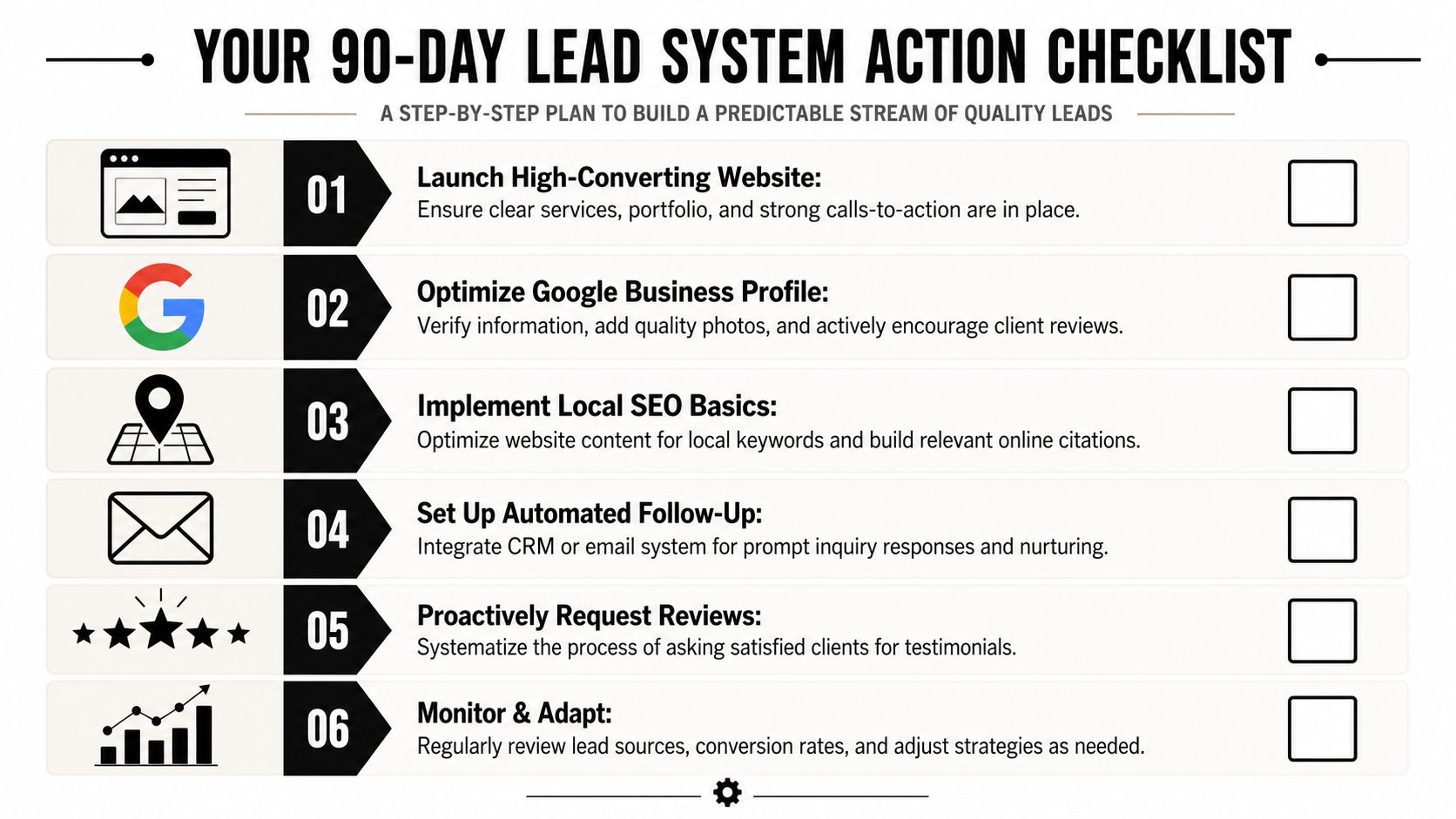
    Contractor lead generation is the process of consistently attracting, capturing, and following up with potential customers who need the work you actually provide. It combines your website, Google Business Profile, local SEO, paid campaigns, and response process into one system instead of relying only on referrals.

    This guide explains how contractors can build that system, identify high-intent opportunities, reduce missed inquiries, and create a more dependable pipeline without losing the local trust that makes a contracting business competitive.

    That cycle is common for contractors across the Uinta Basin. I see it with excavation outfits, welding shops, roustabout crews, trucking support companies, and general trades that built their reputation the old-fashioned way. Word of mouth still matters, but it doesn't give you control. A real lead system does. It gives you a way to bring in the right calls, track where they came from, and turn your website, Google presence, and follow-up process into a business asset instead of a guessing game.

    Table of Contents

    From Feast or Famine to Predictable Growth

    A lot of contractors don't have a lead generation problem. They have a system problem.

    The typical pattern looks like this. A company gets busy from a referral, a repeat client, or one large industrial job. While that work is underway, nobody updates the website, nobody asks for reviews, nobody watches incoming forms, and nobody tracks what generated the last few good leads. Then the project wraps up and the owner shifts from production mode straight into panic mode.

    That happens whether you're pouring concrete in Roosevelt, hauling water for oilfield activity near Vernal, or running an excavation crew in Duchesne County. The trade changes. The pattern doesn't.

    What feast or famine looks like on the ground

    One month, the phone rings enough to keep the schedule full. The next month, leads slow down and every missed call suddenly matters. That's why resources like SkipCalls addresses missed calls are worth paying attention to. A contractor can do strong field work and still lose business because incoming calls hit voicemail, go unanswered, or sit too long before someone follows up.

    A referral-only model also creates blind spots:

    • You can't forecast well. Work appears in bursts, not in a managed pipeline.
    • You don't control timing. Good referrals may come in when you're overloaded, then disappear when you need them.
    • You don't know what's working. If leads come from "people hearing about you," you can't scale that on purpose.

    The strongest contractor brands still benefit from referrals. They just don't depend on them as the only engine.

    A lead system changes the conversation

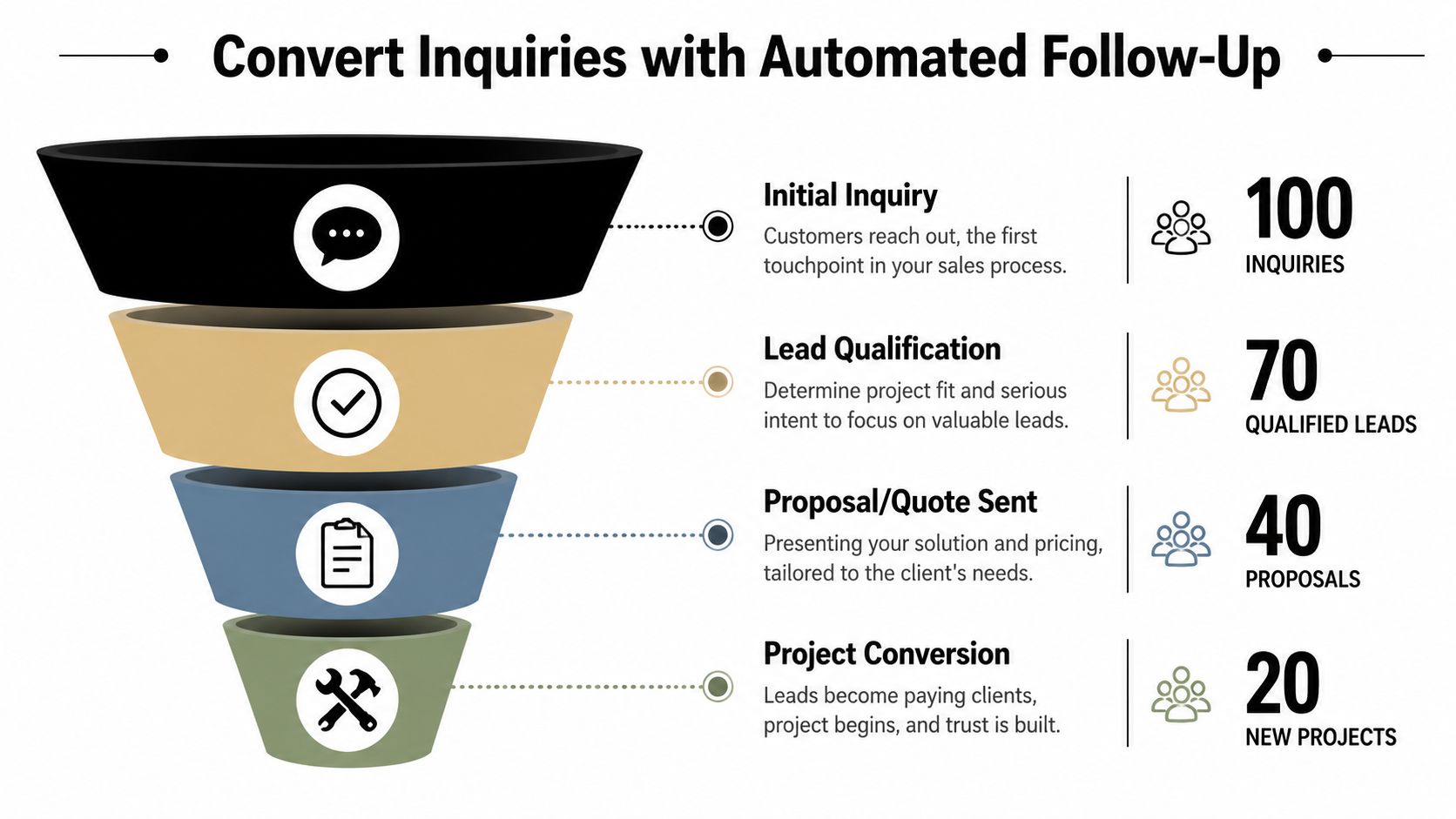
    A real lead generation system gives you structure. Your website answers basic buyer questions. Your Google presence helps local prospects find you. Your intake process captures calls and form submissions. Your follow-up workflow keeps leads from going cold. Then you track which channels produce qualified jobs.

    That turns lead generation for contractors from a stressful monthly scramble into a repeatable operating function.

    For local examples of how a basic online asset can generate more demand, this Uinta Basin website case study roundup is useful because it shows how small website issues often block growth more than owners realize.

    What predictable growth actually means

    Predictable growth doesn't mean every week looks the same. Contracting won't work that way. Seasons shift, bid cycles move, and industrial demand can change fast.

    It means you know where leads come from, you have assets that keep working when you're in the field, and you stop rebuilding your pipeline from zero every time a big project closes.

    Build Your Digital Foundation for Local Trust

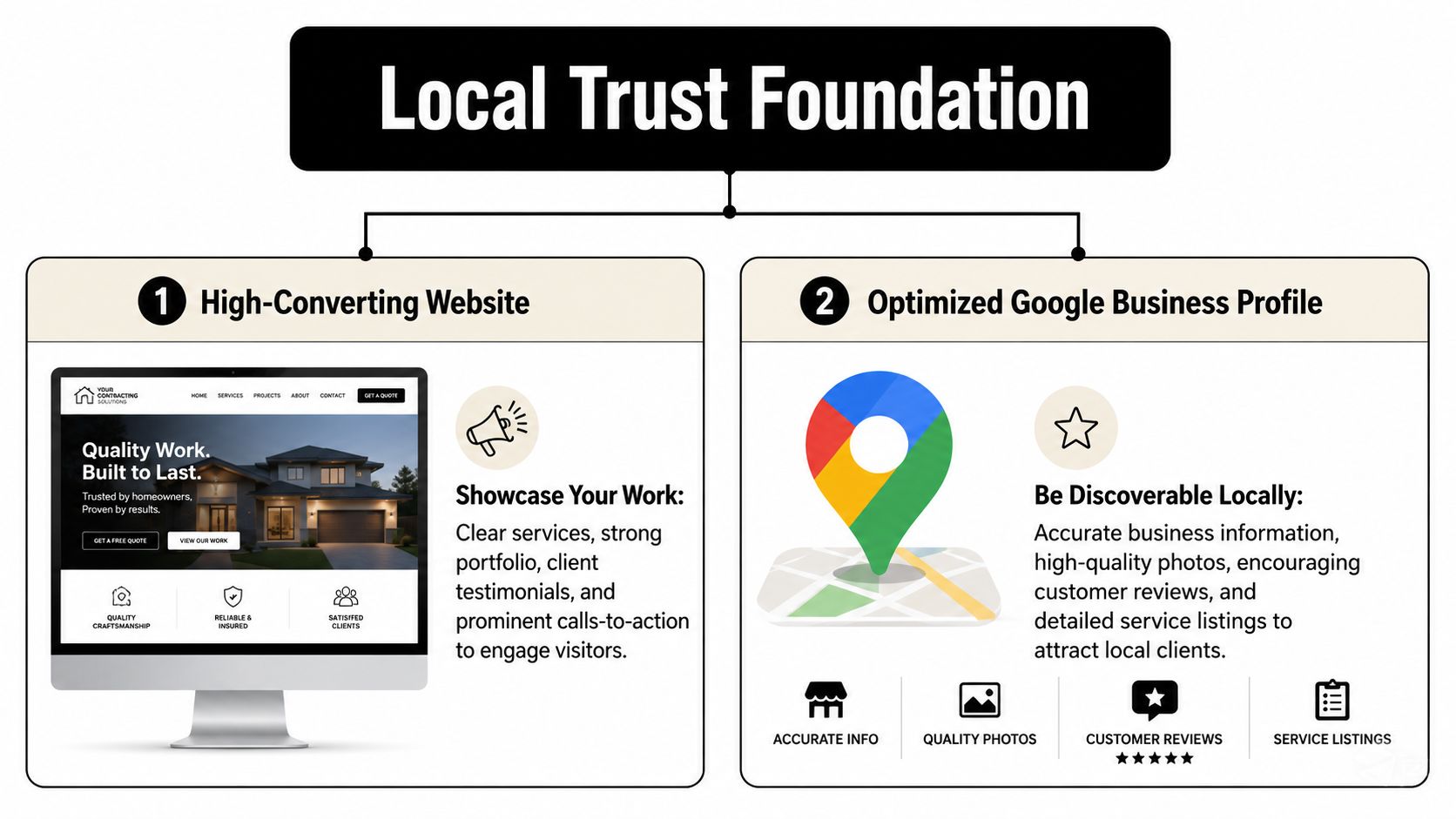
    Before you spend money or time trying to drive traffic, your digital presence has to be ready to convert. I think of this as your digital job site. If the place looks disorganized, unsafe, or unfinished, people don't trust what happens next.

    For contractors, two assets matter most. Your website and your Google Business Profile.

    A diagram illustrating two core strategies for local contractor lead generation: high-converting websites and optimized Google profiles.

    Industry reporting notes that 46% of all Google searches are for local information, which is why a contractor's website and Google profile need to be built to capture nearby search demand, not just exist online for appearances (contractor website fixes for better lead generation).

    Your website is the first estimator

    A contractor website should answer the same questions a serious prospect asks in the first few minutes of a call.

    For an oilfield service company in the Uinta Basin, that might include service area, equipment capability, safety posture, emergency availability, and the type of work handled. For an excavation contractor, it may be trenching, site prep, utility work, trucking support, and whether the company serves residential, commercial, or energy-sector clients.

    If your site hides those basics, visitors leave.

    A strong contractor website needs:

    • Clear service pages that match the actual work you want more of
    • Visible contact options at the top of the page and again near each call to action
    • Real photos from projects in places like Roosevelt, Vernal, Duchesne, or surrounding service areas
    • Proof elements such as testimonials, project examples, certifications, or capabilities
    • Simple conversion paths so a visitor can call, submit a form, or request an estimate without hunting

    A generic "Welcome to our website" homepage doesn't help much. A page that says "Hydrovac Services in the Uinta Basin" or "Excavation and Site Prep in Duchesne County" does.

    For businesses that need a flexible platform to build this properly, this overview of a WordPress website for business lays out why so many contractor sites use WordPress as the backbone.

    Your Google profile needs to do real work

    Google Business Profile is not a set-it-and-forget-it listing. It's often the first place a buyer checks after seeing your name in search or on a map result.

    For local contractors, a weak profile usually has one or more of these problems:

    Problem What prospects assume
    Few or poor photos The company may be inactive or unproven
    Incomplete service list They may not handle the work I need
    Old reviews or none at all Nobody has used them recently
    Wrong hours or bad contact info Calling them will be a hassle

    That profile should include accurate business details, service categories, updated photos, a defined service area, and reviews that reflect the type of work you want more of. If you're trying to win more industrial or commercial opportunities, the visuals and descriptions should support that. If you want residential excavation or dirt work, that should be obvious too.

    Practical rule: If a prospect can't tell where you work, what you do, and how to reach you in less than a minute, your foundation is leaking leads.

    What local trust looks like in practice

    Local trust online isn't built with clever wording. It's built with specifics.

    Use examples like these:

    • Trade-specific proof such as "pipe yard prep," "produced water hauling support," or "shop fabrication for field repairs"
    • Service geography that names actual counties, towns, and regions you cover
    • Project context that shows whether you handle one-off jobs, recurring service, or bid-based work

    A welding and fabrication shop in Roosevelt shouldn't look like a suburban handyman service. An excavation company serving oilfield and civil work shouldn't have a homepage full of vague stock photos and generic copy.

    When lead generation for contractors works, the digital foundation does one job well. It makes the right buyer say, "These are the people I should call."

    Attract High-Intent Customers with Local SEO

    Local SEO gets talked about like it's a technical side task. It isn't. It's digital territory.

    If your company does solid work in the Uinta Basin, local SEO is how you place signs on the roads your buyers already travel. Not physical roads. Search paths. The goal is to show up when somebody types the exact problem, service, or location that matches the work you want.

    A professional contractor standing in front of his service truck next to a map with location pin.

    Recent industry guidance makes an important point. When lead marketplaces get crowded or low quality, contractors often do better by strengthening owned channels like their website, local SEO, reviews, and Google Business Profile, with paid platforms serving as a supplement rather than the core system (construction lead generation methods and channel tradeoffs).

    Own the searches that match your actual work

    Most contractor sites are too broad. They lump all services onto one page and expect Google to figure it out.

    That rarely works well.

    If you want better local visibility, build dedicated pages around real buyer intent. Think in terms of service plus location plus use case. For example:

    • Uinta Basin hydrovac services
    • Excavation contractor in Roosevelt
    • Oilfield trucking support in Vernal
    • Welding and fabrication in Duchesne County
    • Utility trenching contractor near Uintah County

    Those pages shouldn't be thin keyword pages. They need job photos, service details, areas served, common project types, and a direct path to call or request a quote.

    Build service area pages that prove local relevance

    A lot of local SEO advice says "create city pages." That's only partly true. The useful version is this. Create pages for places you serve, then make each page specific enough that a real customer sees themselves in it.

    For an excavation business, that may mean one page for Roosevelt, another for Vernal, and another for broader Uinta Basin industrial support. The Roosevelt page might feature residential pads, trenching, and septic-related work. The Vernal page may highlight industrial access roads, equipment support, and oilfield-adjacent services.

    What matters is relevance, not volume.

    A simple content framework works well:

    1. Name the service and location clearly
    2. Describe the type of work done there
    3. Show real project photos from that area
    4. Add trust signals and contact options
    5. Link to closely related services

    If every town page says the exact same thing except the city name, buyers notice and search engines usually do too.

    A lot of contractors also benefit from understanding where Local Services Ads fit into the broader visibility picture. This 2026 Local Service Ads playbook gives useful context on how that channel works alongside local search.

    Use project proof to rank and convert

    Google cares about relevance. Buyers care about proof. Project content helps with both.

    Add completed job write-ups to your site. They don't need to be polished magazine case studies. A straightforward summary is enough:

    • Project type and location
    • Scope of work
    • Challenges handled
    • Photos
    • Next step for similar prospects

    For a local contractor, this is one of the best long-term assets you can build. A page about "Site prep and trenching for a commercial yard in Roosevelt" can support rankings, sales conversations, and trust all at once.

    Later in the funnel, video helps too. A short explanation of how local search visibility turns into real inquiries is often easier to understand when you can watch the process.

    The contractors who win organic visibility don't usually have the fanciest brand. They have the clearest digital footprint. They tell Google and the buyer exactly what they do, where they do it, and why they're credible.

    Accelerate Growth with Targeted Paid Campaigns

    Once your foundation and local SEO are in place, paid ads can help you fill schedule gaps, launch a new service line, or push harder in a target market. Used correctly, they accelerate what already works. Used badly, they burn money fast.

    The two channels most contractors should compare first are Google Local Services Ads and Google Search Ads.

    Local Services Ads versus Google Search Ads

    These platforms look similar to many owners because both show up in Google results. They behave very differently.

    Channel Best fit Main advantage Main tradeoff
    Local Services Ads Call-driven service demand Strong local visibility and direct phone inquiries Less control over how broad or narrow the lead mix can be
    Google Search Ads Specific services, project types, or commercial intent More control over keywords, messaging, and landing pages Requires tighter management to avoid wasted spend

    For many trade contractors, Local Services Ads work well when the buyer wants to talk now. Think urgent service, estimate requests, or straightforward local jobs. Search Ads usually make more sense when the work is more specialized, the scope is larger, or the prospect is searching with more detailed phrases.

    When each channel makes sense

    A simple way to decide:

    • Use Local Services Ads if your team can handle incoming calls quickly and your work is sold through conversation.
    • Use Search Ads if you need to target narrow service lines, separate residential from commercial intent, or route traffic to specific landing pages.
    • Use one before using both if your tracking is still weak. Two ad channels without lead tracking create confusion fast.

    An excavation company might run Search Ads for site prep, trenching, or utility work because the queries are more specific. A general service contractor may prefer Local Services Ads if the phone call is the main conversion event.

    What breaks paid campaigns

    Paid campaigns fail for predictable reasons. The ad platform usually isn't the main problem.

    Common failure points include:

    • Bad landing pages that don't match the ad message
    • Weak intake when calls go unanswered or forms disappear into email
    • Broad targeting that pulls in low-fit leads
    • No source tracking so nobody knows which campaigns bring qualified jobs
    • No operational filter for service area, job size, or project type

    Paid traffic doesn't fix a weak system. It exposes it.

    The smartest move is usually not "run more ads." It's "run a tighter campaign connected to a stronger intake process." If you're generating residential handyman calls but you really want industrial excavation bids or oilfield support work, the targeting, the ad copy, and the landing page all need to reflect that. Otherwise you'll buy noise instead of opportunity.

    Automate Follow-Up to Convert More Inquiries

    Most contractors think the lead is won by the ad, the ranking, or the referral source. A lot of the time, it's won by whoever responds first and handles the next step cleanly.

    This is the part of lead generation for contractors that gets ignored because it's operational, not flashy. But it's where a lot of revenue gets lost.

    A sales funnel infographic showing the process of converting contractor inquiries into paying client projects.

    One industry guide reports that contractors who respond to online leads within 5 minutes see conversion rates up to 400% higher than those who wait longer, and that 89% of homeowners start their contractor search online (home services lead generation platforms guide). Those numbers explain why speed isn't a nice extra. It's part of the sales process.

    Fast response wins real jobs

    Think about how inquiries happen in the real world. A prospect finds your website after hours, fills out a form, then keeps looking. Or they call from a Google listing, don't get an answer, and move to the next contractor. They are not waiting around for your office to catch up.

    This is especially true in competitive trades. Roofing, remodeling, excavation, trucking support, and industrial field services all have buyers who may contact more than one company in a short window.

    A fast response does three things:

    • It confirms you're active
    • It lowers buyer uncertainty
    • It gets you into the conversation before competitors do

    What a simple contractor follow-up system looks like

    You don't need an enterprise setup. A practical CRM and a few automations go a long way.

    Use a system that does the following:

    1. Captures every lead source from forms, calls, or ad campaigns
    2. Sends an immediate acknowledgment by text or email
    3. Assigns follow-up responsibility to an actual person
    4. Tracks status from inquiry to quote to won or lost
    5. Logs source quality so you know which channels produce real work

    For smaller operations, even modest automation helps. This guide to AI-powered business tools is useful for contractors who want practical automation without turning the office into a software experiment.

    A fast acknowledgment isn't impersonal. It tells the prospect their request didn't disappear into a black hole.

    Where contractors usually lose the lead

    The breakdown usually happens in ordinary places:

    • The missed call when the owner is in the field
    • The buried form fill sitting unread in a shared inbox
    • The delayed estimate that goes out after the buyer has moved on
    • The untracked source that keeps draining time without producing good jobs

    A clean follow-up process doesn't have to sound robotic. The automated reply can be simple and direct. "Thanks for reaching out. We received your request and will contact you shortly." Then a real person follows up with the right questions.

    If you want more jobs from the leads you already get, this is usually the fastest operational fix.

    Your Action Checklist for a Predictable Lead System

    A contractor lead system doesn't need to be built all at once. It needs to be built in order. The most useful approach is to treat the first three months like a field rollout. Foundation first. Then visibility. Then acceleration and tracking.

    A six-step checklist for building a predictable lead generation system for service contractors and businesses.

    A practical contractor funnel should be measurable from the start: optimize Google Business Profile, launch one high-intent channel, connect sources to a CRM, and audit lead quality, quote speed, and close rates so you can see what produces qualified work instead of just activity (how contractors get more leads with a measurable funnel).

    Days 1 through 30

    Start with assets you own.

    • Clean up your website so services, locations, photos, and calls to action are clear.
    • Complete your Google Business Profile with accurate categories, service areas, contact details, and recent project images.
    • Set one intake path for all inquiries so leads aren't scattered across personal phones, old inboxes, and sticky notes.

    Days 31 through 60

    Build visibility around the work you want.

    • Create focused service pages for your highest-value trade work.
    • Add local pages for the towns and counties you serve.
    • Publish project examples that show real jobs, not generic promises.
    • Ask for reviews consistently after completed work so your public reputation keeps compounding.

    Days 61 through 90

    Add controlled acceleration.

    • Launch one high-intent paid channel rather than spreading budget across too many platforms.
    • Connect forms and calls to a CRM so every inquiry gets tracked and followed up.
    • Review your recent leads and ask basic questions: Which channel brought them in? How fast did you respond? Did the job fit your target work? Did it close?

    A lot of owners make this too complicated. Keep it simple. Build one durable system that helps your company show up, earn trust, capture inquiries, and follow through.

    If you do that well, lead generation stops being a series of random marketing tasks. It becomes part of how the business runs.


    If you're a contractor, oilfield service company, trucking operation, or local business that needs a stronger website and a practical lead system, Northpoint Web helps companies across the Uinta Basin build digital assets that generate inquiries, support recruiting, and improve local search visibility without the fluff.

    What contractor lead generation includes

    Lead generation is more than getting a contractor website online. A workable system connects several steps:

    • Visibility: appear when people search for the services and locations you actually serve.
    • Trust: show clear services, service areas, project context, photos, reviews, and capabilities.
    • Capture: make it easy to call, submit a form, or request an estimate.
    • Response: follow up quickly and consistently when an inquiry arrives.
    • Measurement: record where qualified inquiries came from and which opportunities become jobs.

    Referrals can remain an important source of work, but a connected system gives you more visibility into demand and reduces dependence on unpredictable bursts of activity.

    Start with a contractor website built to convert

    Your website should help a serious prospect decide whether to contact you within the first few minutes. Make the actual services, service areas, customer types, and contact options easy to find.

    • Create individual service pages for the work you want more of.
    • State the towns, counties, or regions you serve where that information is accurate.
    • Explain relevant capabilities, equipment, project types, and industries without using vague claims.
    • Place visible phone and form options near the top of the page and again after important decision points.
    • Use real project photos and documented examples when available; do not substitute unsupported claims or generic proof.

    A page such as “Hydrovac Services in the Uinta Basin” or “Excavation and Site Prep in Duchesne County” is more useful to a qualified visitor than a generic welcome message.

    Use Google Business Profile and local SEO to capture demand

    Local SEO helps your business become visible when prospects search for a contractor, service, or trade in a specific area. Your Google Business Profile should contain accurate business details, appropriate categories, current photos, a defined service area, and reviews that reflect the work you want to attract.

    Connect the profile to useful website pages rather than sending every visitor to a generic homepage. Each service-area page should make the local connection clear through accurate service information, project context, and a straightforward contact path.

    • Match each priority service to a dedicated page.
    • Use consistent business name, phone, and location or service-area information.
    • Request honest reviews from appropriate customers and never manufacture review content.
    • Publish useful project or service updates when you have genuine information to share.

    Northpoint’s local SEO resource can support this part of the strategy, while the contractor-specific checklist should remain focused on the actions most relevant to the business.

    Build pages for high-intent contractor searches

    Prioritize searches that reveal a real need rather than trying to rank for every construction-related phrase. Useful page themes may combine an actual service with an accurate location, industry, or project type.

    • Service plus location, such as a specific excavation service and county.
    • Service plus customer type, such as industrial, commercial, residential, or energy-sector work when applicable.
    • Problem or project language, such as site preparation, hauling support, fabrication, or field repair when those are genuine services.
    • Estimate and contact language for visitors who are ready to discuss a project.

    Every page should explain what the service involves, who it is for, where it is available, what a prospect should provide when contacting the company, and what happens next. Add only real project examples, certifications, capabilities, and customer feedback that can be verified.

    Want a more dependable contractor lead system?

    Northpoint Web Solutions can help you evaluate the website, local SEO, and follow-up gaps that may be limiting qualified inquiries. Contact us to discuss what your contractor business offers, where you serve, and which parts of the current system need attention.

  • Local SEO for Contractors: A Guide to Winning More Jobs

    Local SEO for Contractors: A Guide to Winning More Jobs

    You're probably in one of two spots right now.

    Either your crew does solid work, your schedule depends too much on referrals, and you know you should be showing up better online. Or you already paid for a website, maybe even tried some SEO, and nothing changed except your inbox got a few agency pitches.

    That gap is common in contracting. The best excavator in town can still lose work to a competitor with a cleaner Google Business Profile, stronger city pages, and more recent reviews. A welding shop can have better turnaround, better field work, and better pricing, then get outranked by a shop that made itself easier for Google to understand.

    For contractors, online visibility isn't abstract branding. It's whether a plant manager, homeowner, or project superintendent finds your business when they need trenching, hydrovac, fabrication, hauling, or repair work near them. Google has reported that 76% of people who search on a smartphone for something nearby visit a business within 24 hours, and 28% of those searches lead to a purchase, which is why local search visibility can turn into calls and booked jobs fast, especially for local service businesses (local search benchmark details).

    If you want another practical perspective, HearBack's guide to local marketing is worth a read because it stays focused on contractor realities instead of generic marketing talk.

    Table of Contents

    Why Your Best Work Is Invisible Online

    A lot of contractors have the same problem. Their reputation exists in the field, not in search.

    An excavation company might have operators who can handle difficult ground, a reliable trucking setup, and years of local project experience. But when someone searches for “excavation contractor near me” or “site prep in Roosevelt,” Google doesn't see reputation the way the local market does. Google sees categories, proximity, consistency, page relevance, reviews, and whether the business has made its services clear.

    A construction worker looking at a smartphone with a confused expression next to a large yellow excavator.

    That's why a smaller competitor can win the click. Not because they do better work, but because they're easier to find and easier to trust in the search results.

    Local intent is where contractors win or lose

    A homeowner with a broken water line isn't browsing for fun. A superintendent needing a welder on a shutdown job isn't researching brands for a month. These are high-intent searches with short decision cycles.

    When your business shows in Google Maps, the local pack, and organic results for the right services and towns, you're meeting demand when the buyer is ready to act. That matters even more in trades where speed, location, and availability drive the decision.

    Practical rule: If your company is invisible in local search, your market may still know your name, but new customers and new project managers won't.

    The real issue usually isn't skill

    The issue is usually one of these:

    • A weak Google presence: The profile exists, but categories are off, service areas are incomplete, or photos are outdated.
    • A vague website: One generic services page tries to cover excavation, trucking, welding, reclamation, and rentals all at once.
    • Thin local proof: No city pages, no project photos tied to place, and no review process.
    • No recruiting visibility: The company needs CDL drivers or welders, but the website gives job seekers nothing useful to find.

    Contractor SEO works best when it matches how buyers and job seekers search. People don't type “full service industrial solutions.” They search for “hydrovac contractor Vernal,” “pipe welding Duchesne,” or “CDL driver jobs Uinta Basin.”

    That's the shift. Local SEO for contractors is less about clever marketing and more about operational clarity online.

    Build Your Unshakable Foundation on Google

    Most local SEO failures start here. Contractors try to fix rankings with new pages, blog posts, or ads before their Google Business Profile is fully built out.

    That's backwards. A practical contractor local SEO workflow should start with a fully completed Google Business Profile, exact NAP consistency across every citation, and location or service-area setup, then add city-specific service pages, reviews, photos, and ongoing posts. One contractor SEO source also notes that meaningful results often take 3-6 months to emerge in competitive markets, which is a realistic timeline for local SEO work that's done correctly (contractor local SEO workflow).

    A five-step pyramid graphic showing the essential steps to build and optimize a Google Business Profile.

    Start with the profile that controls local visibility

    If you do one thing first, do this.

    Claim the Google Business Profile. Verify it. Then complete every field that applies to the business. Contractors leave money on the table when they rush through this and treat it like a directory listing instead of a lead asset.

    Your setup should include:

    • Accurate business identity: Use your real business name. Match it everywhere else online.
    • Primary and supporting categories: Pick the category closest to your core service. An excavation contractor should not default to a broad category if a more precise one fits.
    • Service areas: Set the cities, counties, or regions you serve.
    • Business description: Write a direct summary of what you do, where you work, and who you help.
    • Phone and website: Send traffic to the right contact points, not to an old number or placeholder page.

    For newer companies, this often overlaps with basic business setup. If you're still working through state paperwork, contractor license requirements can help you sort out the licensing side so your public information stays clean from the beginning.

    Get the details right before you chase rankings

    NAP consistency means your business name, address, and phone number must match across your website, your Google profile, and your citations. Even small differences create avoidable confusion.

    A common contractor problem looks like this:

    Location Business Name Used Phone Used Result
    Website footer Basin Welding & Fabrication Main office Correct
    Google profile Basin Welding Cell number Mismatch
    Directory listing Basin Welding and Fab LLC Old office line Mismatch

    That kind of inconsistency weakens trust. It also makes it harder for Google to connect all your local signals to one business entity.

    A half-finished profile tells Google and customers the same thing. This business may be active, but it's not organized.

    Here's what usually deserves attention before anything else on the website:

    1. Categories and services
    2. Service area accuracy
    3. Matching NAP across the web
    4. Photos of real jobs, crews, trucks, and equipment
    5. Review generation process

    Keep the profile active after setup

    A completed profile isn't a one-time job. Contractors who stay visible usually keep feeding the profile with proof that the business is active and local.

    Use photos from recent trenching jobs, welding repairs, aggregate hauling, shop fabrication, or equipment mobilizations. Add updates when you open a new service area, finish a notable project type, or answer common customer questions.

    This video gives a useful overview of profile optimization in practice:

    A simple maintenance rhythm works well:

    • Weekly photos: Fresh jobsite images, trucks, crews, or completed work.
    • Ongoing Q&A: Answer the questions customers keep asking by phone.
    • Routine review responses: Thank satisfied clients and handle criticism professionally.
    • Periodic service checks: Make sure listed services still match what the company wants to sell.

    The goal isn't activity for its own sake. The goal is to make your company the most complete, credible local option when Google chooses who to show.

    Turn Your Website Into a Local Lead Magnet

    A contractor website often fails for one reason. It tries to say everything on one page.

    One “Services” page with a paragraph about excavation, another sentence about welding, and a short list of towns served rarely ranks well for high-intent local searches. It's too broad for Google and too shallow for the buyer.

    A laptop screen displaying a construction company website with digital house illustrations connected by colorful paint splashes.

    Why generic service pages usually underperform

    Contractor local SEO guidance recommends pages that are optimized for relevance and crawlability, including 200+ words per location or service page, natural keyword placement at roughly 1-2% density, descriptive image alt text, and schema markup for services, reviews, and locations. The same guidance also points to a better strategic question: should you build a large set of city pages, or a smaller number of stronger pages that actually help users, especially in rural service areas where thin location pages can start looking like doorway pages (guidance on contractor page structure).

    That lines up with what works in the field. A page titled “Services” doesn't do much for searches like “hydrovac services in Vernal” or “mobile welding in Duchesne County.” A focused page can.

    For example, these pages make more sense than one broad catch-all page:

    • Hydrovac Services in Vernal
    • Excavation and Site Prep in Roosevelt
    • Pipeline Welding in Duchesne
    • CDL Dirt Hauling Services in the Uinta Basin

    A clean build on a flexible platform matters here. If your site structure fights you every time you need a new service or city page, a better WordPress website for business setup usually makes local expansion much easier.

    How to build location pages that deserve to rank

    A good local page needs more than a city name swap.

    It should prove that your company operates there, understands the service, and can solve the searcher's problem. Think less like a template and more like a field-ready sales page.

    Include elements like these:

    • A clear service plus location title: “Excavation Contractor in Roosevelt, Utah” is better than “Welcome.”
    • Specific scope details: Say whether you handle grading, trenching, pad prep, utility excavation, or cleanup.
    • Local project evidence: Add job photos, equipment photos, and references to the kind of work common in that area.
    • Strong calls to action: Make it easy to request a quote or call from the field.
    • Schema markup: Help search engines understand your services, locations, and review content.

    A useful way to think about it is to model the specificity you see in strong local business pages in other trades. For example, this Phoenix AZ landscaper page works because it is narrow, place-based, and service-specific rather than generic.

    If the only local detail on the page is the city name in the headline, the page probably isn't useful enough.

    Choose fewer stronger pages when your territory is rural

    At this point, many contractors in places like the Uinta Basin get led in the wrong direction.

    In dense metro areas, a business may justify more location pages because each city has enough search demand and enough distinct context to support them. In rural regions, creating a long list of near-duplicate pages for every small town usually backfires. You end up with thin content that doesn't help the user and doesn't build trust.

    A better decision framework looks like this:

    Situation Better move
    Core services with strong local demand Build dedicated service pages
    Major towns you serve repeatedly Create unique city pages with local proof
    Small surrounding areas with little distinction Mention them naturally on stronger regional pages
    Multiple pages with nearly identical copy Consolidate and improve them

    For a welding shop, one excellent “Mobile Welding in the Uinta Basin” page with real photos, service details, and nearby town references can outperform a pile of weak city pages. The same goes for excavation, roustabout work, and hauling.

    Your website should narrow the buyer's choice, not make Google guess what you do.

    Earn Authority with Citations and Reviews

    Once your Google profile and service pages are in better shape, outside trust signals start to matter more. Two of the biggest are citations and reviews.

    Citations are simple. They're mentions of your business details on other websites. Reviews are public proof that people hired you and were willing to say so.

    A four-step infographic showing how local SEO citations and customer reviews improve business search visibility.

    Clean citations build trust faster than most contractors think

    Most contractors don't need hundreds of directory listings. They need the right listings, and they need them to match.

    Start with the places that matter most to your market. That usually includes major business directories, contractor-relevant platforms, local chambers, and regional business listings. If you're in industrial services, niche directories or association listings can matter more than broad consumer platforms.

    Use this checklist when cleaning citations:

    • Match the business name exactly: Don't switch between LLC, shorthand names, and old branding unless you have a reason.
    • Use one primary phone number: Avoid mixing office, dispatch, and cell numbers across listings.
    • Keep the website URL consistent: Point listings to the strongest relevant page.
    • Check service descriptions: Make sure they reflect what you want to sell now, not what you used to do.

    A contractor with mismatched citations often sees confusion show up in real life. Customers call the wrong line. Old addresses stay live. Former services still appear in search results.

    Reviews influence both ranking and response

    Reviews do more than decorate your profile. They help buyers decide whether to call.

    For contractors, the best review strategy is operational, not awkward. Ask after a successful milestone. That might be after a pad is finished, after a repair gets signed off, or after a homeowner says the crew did a great job. Don't wait until months later when the customer barely remembers the details.

    A workable review process looks like this:

    1. Choose the moment: Ask when the customer is clearly satisfied.
    2. Make it easy: Send the direct review link by text or email.
    3. Give light guidance: Ask them to mention the service and town if they're comfortable doing so.
    4. Respond to every review: Short, professional, and specific is enough.

    Field note: Reviews that mention the actual service performed often do more for credibility than generic praise.

    Negative reviews need a steady hand. Don't argue in public. Acknowledge the issue, stay professional, and move the conversation offline when needed. Buyers read those responses closely, especially in higher-trust trades like construction, welding, and hauling.

    If your business is doing good work and still has very few reviews, that's usually a process failure, not a reputation failure.

    Use SEO to Recruit a Winning Team

    A lot of contractor websites act like the only audience that matters is the customer. That's a miss.

    For many contractors, the bottleneck isn't demand. It's labor. You may have enough work for another truck, another welding rig, or another excavation crew, but you can't find the right CDL drivers, operators, or welders. Local SEO can help with that if you build for it on purpose.

    Most contractor websites ignore hiring intent

    Job seekers search with local intent too. They type phrases like “CDL driver jobs Uinta Basin,” “welder jobs Roosevelt Utah,” or “equipment operator jobs near me.” If your site only has a single “Careers” link with no detail, it won't do much for those searches.

    Recruiting-focused SEO means building pages that answer what skilled applicants need to know:

    • What kind of work they'll be doing
    • Whether the role is local or travel-based
    • What equipment or certifications matter
    • Whether the company works steady projects or seasonal jobs
    • How to apply without jumping through hoops

    A stronger contractor hiring strategy usually starts with a real careers section and expands into role-specific pages. For companies in industrial and trade markets, a focused construction SEO approach should account for both customer searches and hiring searches because both affect growth.

    Build job pages like service pages

    Think about job pages the same way you think about lead pages. Specific pages rank better, convert better, and filter people better.

    Instead of one vague hiring page, build pages like:

    • CDL Driver Jobs in the Uinta Basin
    • Experienced Welder Careers in Roosevelt
    • Heavy Equipment Operator Jobs in Duchesne County
    • Field Laborer Jobs for Oilfield and Construction Projects

    Each page should include the role, location, work type, application steps, and what kind of person fits the crew. If you use JobPosting schema, you also give search engines clearer information about the opening.

    A short comparison makes the point:

    Weak hiring page Strong hiring page
    “We're hiring. Apply today.” “CDL Driver Jobs in the Uinta Basin for side dump and equipment hauling”
    No location info Clear local geography and routes
    No role detail Equipment, duties, schedule, and expectations
    Generic form Simple application path

    Good recruiting pages don't just attract more applicants. They attract applicants who understand the work before they call.

    This matters in rural markets. Skilled labor is limited, and job boards alone often bring a pile of weak-fit applications. Search-driven recruiting gives you another lane to reach people already looking for local trade work.

    Measure What Matters and Plan Your Next Move

    A contractor doesn't need more reporting. A contractor needs to know whether the phone is ringing more often from the right places.

    That's why the best local SEO measurement is tied to lead quality and business activity, not vanity charts. Contractor SEO guidance recommends tracking local-search traffic, Google Business Profile interactions, conversion rates, and keyword positions in Google Analytics and Search Console, with attention on outcomes like calls, direction requests, and quote submissions rather than rankings alone (practical contractor SEO measurement).

    Track lead signals instead of vanity metrics

    If you own or manage the business, start with the signals closest to revenue:

    • Phone calls from local search: Are more prospects calling from the towns you want?
    • Quote form submissions: Which service pages are producing real inquiries?
    • Direction requests: Useful for shops, yards, and local offices.
    • Google Business Profile interactions: A direct sign that people are engaging with your listing.
    • Keyword visibility by service and town: Helpful when tied back to lead quality.

    You don't need a fancy dashboard to spot progress. A simple monthly review can tell you a lot.

    Metric Why it matters
    Calls Immediate lead intent
    Quote requests Sales opportunity volume
    Direction requests Local buyer action
    Page-level traffic Which services and towns draw demand
    Search queries How customers actually describe the work

    Your next gains usually come from local proof

    Once the basics are in place, the next layer is often local proof.

    That might mean sponsoring a local rodeo, supporting a county event, joining a regional association, getting listed by a local business group, or earning mentions from suppliers and partner companies. It can also mean publishing stronger project pages with location details, better photos, and clearer explanations of what your crew handled.

    Your mobile site speed and usability still matter too. A superintendent checking your site from a truck or a homeowner searching after hours won't wait around for a clunky page to load.

    What matters most is consistency. Local SEO for contractors isn't a one-time cleanup. It's a system. You tighten the profile, improve the pages, earn reviews, watch the lead signals, then keep building from there. If you want support with the strategy, execution, or ongoing improvement, a specialized SEO team for contractors can help turn that system into something repeatable.


    Northpoint Web helps contractors, industrial companies, and local businesses build websites and SEO systems that generate leads and attract employees in markets like Duchesne, Roosevelt, Vernal, and the wider Uinta Basin. If your company needs a stronger Google presence, better local service pages, or recruiting-focused SEO for roles like CDL drivers and welders, Northpoint Web is built for that kind of work.

  • Naming Pictures for SEO: A Contractor’s Guide

    Naming Pictures for SEO: A Contractor’s Guide

    You've probably got a folder full of job site photos right now. A mini excavator cutting grade in Roosevelt. A roustabout crew on location near the Uinta Basin. A welding truck parked beside pipe racks. When those pictures make it to your website, most business owners upload them exactly as they came off the phone. IMG_4031.jpg, DSC0087.jpg, final-photo-2.jpg.

    That looks harmless, but it wastes a real SEO opportunity.

    For contractors and oilfield companies, photos do more than fill space on a page. They prove you do the work. They show your equipment, your crews, your service area, and the kind of projects you want more of. If the filename is vague or sloppy, Google gets less context. If the filename is clear and relevant, that image can support the page it sits on and help reinforce what your business does.

    This matters even more in local service industries where buyers want proof. A landowner looking for excavation in Duchesne or a production company searching for oilfield support in Vernal isn't impressed by stock photography. They want to see the actual truck, the actual crew, the actual job.

    Table of Contents

    Why Naming Your Pictures Matters More Than You Think

    A drilling contractor in the Uinta Basin wraps a long day, sends over photos of a vac truck, a daylighting crew, and a well site cleanup. By the time those images hit the website, they are still called IMG_8842.jpg and IMG_8843.jpg. The page may still rank, but those photos are doing almost nothing to support it.

    File names are a small signal, but they help search engines connect an image to the job, service, and location shown in it. For local contractors, that matters. A name like vernal-hydrovac-daylighting.jpg gives clear context. duchesne-excavation-trench-box-install.jpg gives even more. IMG_4031.jpg gives none.

    That matters on service pages built to win local searches.

    If you want an excavation page for Roosevelt or an oilfield services page for Vernal to pull its weight, the supporting images should match the topic of the page. The copy talks about trenching, pad prep, site cleanup, or utility work. The internal links support those services. The photos should back that up with names that fit the same subject. That is part of a broader construction SEO strategy for contractors, not a separate task somebody cleans up later.

    I see this problem all the time with field photography. The photos themselves are strong. The crew has real equipment, real job sites, and real local proof. What gets lost is the label.

    A gallery image named roosevelt-ut-trencher-service.jpg can reinforce a service page about trenching in Roosevelt. A photo named uinta-basin-pipe-yard-cleanup.jpg gives useful context on an oilfield cleanup page. A shot of a mini excavator digging around utilities in Naples, Utah should not be buried as DSC00917.jpg if that page is trying to rank for utility excavation.

    The trade-off is simple. Renaming files takes a few extra minutes before upload. Leaving them generic saves a little time once and wastes the value of every image after that.

    For contractors, that adds up fast. You already paid for the truck, the crew, the fuel, and the time on site. Naming pictures correctly helps those job photos support your pages instead of sitting in the media library as anonymous files.

    The Key Components of Image SEO

    On contractor sites, image SEO usually breaks down because the wrong field gets all the attention. A shop manager uploads photos from a pipe yard in Vernal, someone pastes the target keyword into every box, and the page still gives Google mixed signals. Each image field has a separate job. Handle them that way.

    A diagram comparing and explaining the differences between filename, alt text, and title for image SEO optimization.

    Filename

    The filename is the base label attached to the image file itself. It helps with organization, and it gives search engines an early clue about the subject before they process the rest of the page.

    For a contractor, this matters most on pages tied to a specific service and market. A photo from a tank battery cleanup near Naples should carry a name that matches the work shown. A generic file like IMG_4438.jpg wastes that context. A clear file like naples-ut-tank-battery-cleanup.jpg keeps the image aligned with the page topic and makes the media library easier to manage later.

    This is also where platform choice can help or hurt. Some site setups make media management easy. Others turn the library into a junk drawer. If your team is still deciding between platforms, this guide to small business website platforms for managing content cleanly is worth reviewing before hundreds of job photos pile up.

    Alt text

    Alt text describes what is in the image. Its first purpose is accessibility. It gives screen readers useful information, and it provides fallback context if the image fails to load.

    It also supports relevance when it is written plainly and tied to the photo's subject. For example, alt text like "Excavator trenching for utility line installation in Roosevelt" works because it describes the image directly. Stuffing the same service phrase into every image on the page does the opposite. It reads poorly and signals low-quality optimization.

    Contractors tend to get this wrong in two ways. They skip alt text completely, or they turn it into a keyword field. Neither helps.

    Title

    The title field has limited SEO value on most sites. In practice, it is more useful for internal organization, especially when a company has years of field photos from excavation jobs, roustabout work, weld repairs, and site prep spread across different markets.

    Use titles if they make the media library easier for your team to sort and identify. Do not expect the title field to carry the page.

    Caption

    Captions are visible. That changes their role.

    On project galleries, service pages, and case studies, a caption can clarify what the visitor is looking at. That is useful for photos that need context, such as a dozer building a pad in the Uinta Basin or a vac truck handling fluid cleanup outside Duchesne. A short caption can reinforce the service, location, or job type without sounding forced.

    Some images do not need one. If the photo is decorative or the page text already explains it, leave the caption blank.

    Element Main job Priority
    Filename Labels the file clearly for search engines and site organization High
    Alt text Describes the image for accessibility and context High
    Title Internal labeling or occasional hover text Low to moderate
    Caption Gives visible context to readers Situational

    Contractor sites usually do not suffer from a photo shortage. They suffer from weak labels and inconsistent image handling.

    How to Create the Perfect Image Filename

    A good filename isn't clever. It's accurate.

    The basic workflow is simple: identify the image's actual subject, remove stop words, separate terms with hyphens, keep the filename concise, and rename the file before upload. Industry guidance commonly converges on about 3 to 5 words and warns that long filenames, keyword stuffing, underscores, and default camera names reduce clarity and can look spammy, as outlined in this step-by-step image naming guide.

    A person types on a transparent keyboard, creating an SEO-friendly filename for a scenic nature image.

    A simple naming formula

    Use this formula:

    subject + service or equipment + location if relevant

    Not every filename needs all three parts. But this keeps you from guessing.

    Examples:

    • Excavation photo becomes basement-excavation-roosevelt
    • Oilfield support image becomes roustabout-crew-vernal
    • Equipment photo becomes trackhoe-site-prep-duchesne
    • Shop image becomes welding-shop-team

    Keep everything lowercase. Use hyphens between words. Skip underscores, spaces, and filler words.

    Good and bad contractor examples

    Here's where a lot of businesses go sideways. They either leave the default filename alone, or they overdo it and turn the file into a keyword list.

    Bad filename Better filename Why
    IMG_2291.jpg duchesne-site-prep.jpg Default names add no context
    excavator.jpg mini-excavator-trenching.jpg Too vague versus specific
    oilfield-service-best-contractor-utah-image.jpg oilfield-truck-loading.jpg Stuffed versus natural
    welding_shop_photo.JPG welding-shop-fabrication.jpg Underscores and generic wording hurt clarity
    final-final-new-3.jpg pipe-yard-cleanup-vernal.jpg Internal naming doesn't help SEO

    When location belongs in the filename

    Local relevance matters, but only when the location helps describe the image accurately.

    If the image was taken at a real project in Roosevelt, Vernal, Duchesne, or the Uinta Basin, include that place when it fits naturally. If it's a generic stock shot of a dump truck, don't cram in vernal-utah just because you want to rank there.

    That trade-off matters. A filename should describe the image first. SEO comes from accurate context, not from squeezing every target keyword into one string.

    A lot of businesses also run into platform issues because they rename inconsistently across uploads, galleries, and page builders. If your site setup already feels messy, it usually helps to tighten the process before you scale. That's one reason many companies simplify around more manageable small business website platforms.

    A quick gut check works well here. Read the filename out loud. If it sounds like something a normal person would label the photo, you're on the right track. If it sounds like a search term pileup, fix it.

    Here's a short walkthrough if you want to see the process visually.

    Writing High-Impact Alt Text for People and Search Engines

    A contractor uploads a jobsite photo to a service page. The filename is clean, the page targets the right town, and the image looks good. Then the alt text gets filled with scraps like excavation contractor vernal, oilfield services utah, or truck. That wastes the image for the people who rely on alt text, and it weakens the page context at the same time.

    Alt text should describe what the image shows and why it matters on that page. For a local contractor in the Uinta Basin, that usually means naming the equipment, the task, and sometimes the location if the location is clearly visible or relevant.

    Write for the person who cannot see the image

    If a screen reader reads the page aloud, the alt text needs to carry useful meaning. If the image fails to load, the description still needs to make sense beside the headline, copy, and call to action.

    That changes how you write it.

    A bad alt text field reads like a keyword dump:

    • truck
    • excavation
    • oilfield services
    • construction company vernal utah excavation contractor

    A useful alt text field sounds like a real description:

    • Hydrovac truck exposing utility line at a commercial site in Vernal
    • Excavator grading building pad for a new shop in Duchesne
    • Pipe crew unloading drill stem at an oilfield yard in the Uinta Basin
    • Water truck controlling dust on a road base project near Roosevelt

    Those examples do two jobs well. They help a person understand the image, and they give search engines clearer context without sounding forced.

    What to include, and what to leave out

    Strong alt text usually includes the subject first. Then it adds the action or setting if that context matters.

    For contractor and oilfield sites, the useful details are often:

    • equipment type, such as excavator, side dump, hydrovac, dozer, rig, or welding truck
    • the work being done, such as trenching, grading, reclamation, daylighting, hauling, or pipe handling
    • the place, only when it is part of the actual image or project context

    That last point matters. If the photo is from a real tank battery job outside Naples or a site prep project in Vernal, say so if it helps the user. If it is a generic stock image of a yellow excavator, adding Uinta Basin just to chase rankings makes the alt text worse.

    One rule works well in practice. Write what a project manager would say if he had to identify the photo quickly over the phone.

    Keep it specific, not exhaustive

    Alt text is not a caption and it is not a place to narrate every object in frame. Contractors often overdo this with yard photos and equipment shots.

    For example, this is too much:

    • White pickup truck parked next to red tool chest beside a yellow excavator near gravel pile under blue sky

    This is better:

    • Excavator parked at gravel yard ready for loading

    The second version keeps the point. On a page about excavation services, that is enough. On a recruiting page, you might choose a different angle, such as the crew or work environment. Context decides the best alt text.

    If your site runs on WordPress, the alt field is easy to update during upload or while editing the page. A properly set up WordPress website for business makes that process a lot easier to keep consistent across service pages, location pages, and project galleries.

    AI can speed up drafts, but it cannot know the job

    Tools can help with volume. If your team is sorting through hundreds of project photos, Alt Text Generation can give you a starting point.

    Still review every draft.

    A tool might identify truck or construction site. It may miss the difference between a hydrovac exposing utilities, a dozer cutting grade, and a vac truck working an oilfield cleanup job. For local SEO, that difference is the whole point. Accurate alt text comes from knowing the service, the equipment, and the job type shown in the image.

    Practical Workflows in WordPress and Bulk Editing Tools

    Most contractors don't need a complicated media workflow. They need one that somebody will follow on a busy week. That usually means doing the important work before upload, then finishing the page-level details inside WordPress.

    A hand selecting watercolor mountain landscape images within a WordPress digital media library management interface.

    What to handle before upload

    Do these steps before the image ever hits the Media Library:

    • Rename the file first so the URL starts clean.
    • Compress and size the image for web use so it doesn't drag down page speed.
    • Group images by project or service in folders on your computer before uploading.

    This avoids the common mess where a company uploads fifty photos, then tries to clean them up inside WordPress after the fact.

    SEO guidance also converges around 2 to 5 words for filenames and places that inside a broader best-practice stack of filename, matching alt text, relevant page content, and structured data, as discussed in this image naming SEO guide. WordPress can handle that stack well if you stay disciplined.

    What to edit inside WordPress

    Once the image is uploaded, open the attachment details in the Media Library and check the fields that matter.

    Focus on these:

    • Alt text for the image description
    • Title if your internal organization benefits from it
    • Caption when the reader needs visible context on the page

    For example, if you upload vernal-pipe-yard-cleanup.jpg, the alt text might describe the cleanup crew and equipment, while the caption might say the project took place near Vernal during site remediation work.

    If you're building on WordPress and want the platform to support better content structure from the start, a purpose-built WordPress business website makes this process easier to manage.

    How to deal with older image libraries

    Often, people get overwhelmed. If your site already has hundreds of images with sloppy filenames, don't try to fix everything in one sitting.

    Start with:

    1. Service pages that bring in leads
    2. Location pages that target core markets
    3. Project galleries with strong original photography
    4. Homepage images that show your main services

    If you also need to resize, clean up, or standardize batches of photos before upload, it helps to automate your photo editing workflow so the file prep doesn't turn into a bottleneck.

    The best workflow is the one your office staff can repeat without asking what the rule is every time.

    A simple naming convention document solves a lot. One page. A few examples. Clear rules. Then stick to it.

    Your Image SEO Checklist for Every Project

    Once you've got the basics down, the goal is consistency. Naming pictures for SEO works best when it becomes part of your normal website process, not a cleanup task you remember twice a year.

    A five-point infographic titled Image SEO Success outlining essential steps for optimizing website images for search engines.

    The repeatable checklist

    Run through this every time you add new job photos, service images, team shots, or equipment pictures:

    • Choose the right image that supports the page topic.
    • Rename the file before upload using a concise, descriptive, hyphenated filename.
    • Keep the filename natural and centered on the subject.
    • Add clear alt text that describes the image for a person first.
    • Use a caption only when helpful for readers on the page.
    • Place the image near relevant copy so the page context matches the visual.
    • Stay consistent across the page so the filename, alt text, and surrounding content all point to the same service or location.

    Do this and avoid that

    Do Avoid
    Use real subject names like hydrovac-truck-vernal.jpg Use camera defaults like IMG_5521.jpg
    Keep it short and readable Turn it into a keyword list
    Use hyphens between words Use underscores or spaces
    Describe the actual image Name the image for a service it doesn't show
    Add alt text that helps users Stuff city names and service terms unnaturally
    Rename before upload Rely on cleanup later

    For contractors, the long-term win isn't one perfect filename. It's a repeatable standard across every gallery, every service page, and every new project update. A clean process gives Google better context, keeps your media library organized, and makes your website look like it's run by a business that pays attention to details.

    That matters. Buyers notice details online the same way they notice them on a jobsite.


    If your contractor or oilfield business needs a website that helps you get found, generate leads, and showcase real project work the right way, Northpoint Web builds websites and SEO systems for companies across the Uinta Basin and beyond.

  • 10 Website Security Best Practices for Contractors in 2026

    10 Website Security Best Practices for Contractors in 2026

    Your Website: Is It a Lead-Gen Asset or a Security Risk?

    If you run a contractor shop, trucking company, welding outfit, excavation business, or oilfield service company in the Uinta Basin, your website probably does two jobs at once. It brings in quote requests, and it helps you find hard-to-hire people like CDL drivers, mechanics, welders, and operators. That makes it a business tool, not just an online brochure.
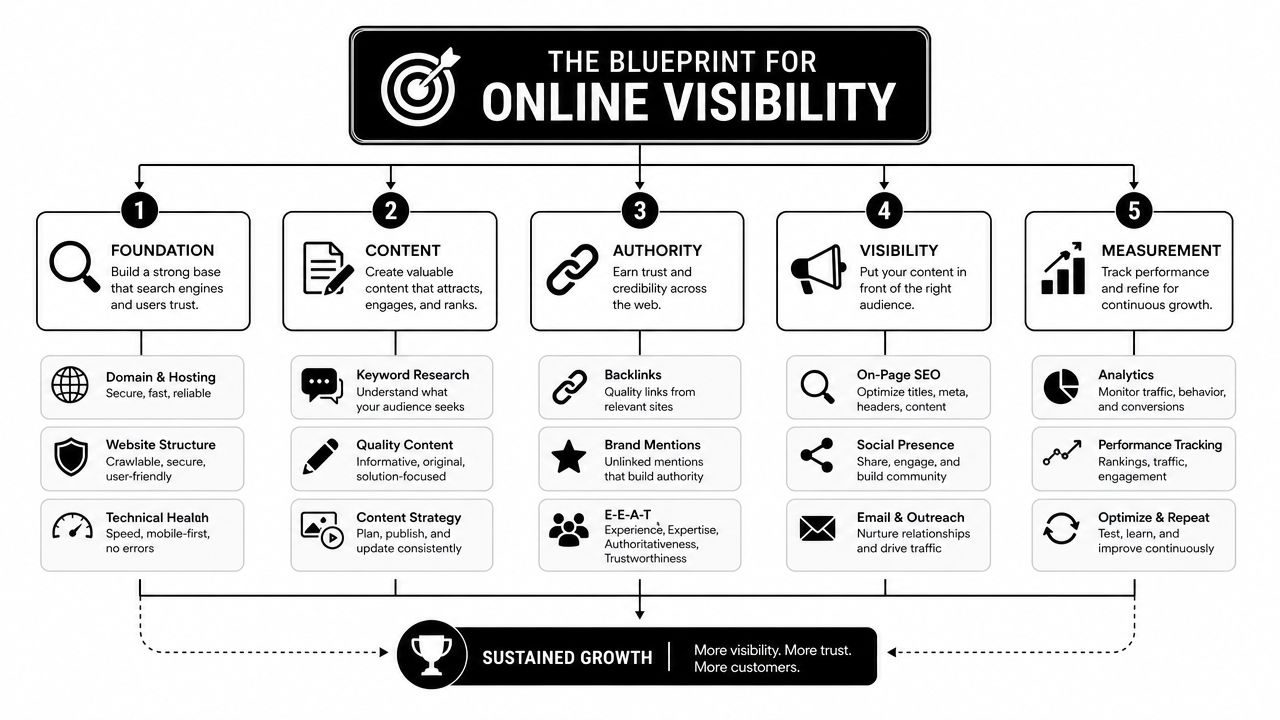
    It also makes your site a target.

    When a website gets compromised, the damage usually shows up in plain business terms. Contact forms start pushing spam. Applicant submissions disappear or get intercepted. Bid request details end up exposed. Customers see browser warnings, or your site starts redirecting to junk pages you didn't create. Then your crew is chasing a website mess while still trying to run jobs, answer phones, and keep equipment moving.

    That's the core problem for rural businesses. Most owners don't have an in-house security team, and most attacks don't care whether your office is in Duchesne, Roosevelt, Vernal, or out on a county road with spotty service.

    The good news is you don't need enterprise complexity to get the basics right. You need disciplined website security best practices, applied in a way that works for a field-based business with limited time and real operational pressure.

    Table of Contents

    1. SSL/TLS Certificates and HTTPS Implementation

    A conceptual illustration of web security featuring a digital certificate, a padlock, and a secure https browser bar.

    Trusted encryption on every page

    If your website has a contact form, quote request form, hiring page, login screen, or payment connection, HTTPS is the floor. It encrypts data moving between the visitor's browser and your server, which matters when someone is sending job history, phone numbers, driver qualification details, or project information through your site.

    For contractors and oilfield service companies, this isn't theoretical. A driver application on a recruiting page carries personal data. A bid request can include project scope and location details. If your site still loads over HTTP, or if parts of it load with mixed content, you're telling browsers and visitors that your setup isn't buttoned up.

    If you're building on WordPress, a good business WordPress website setup should include HTTPS from day one, not as an afterthought.

    What to check in the real world

    A lot of owners think, “I have the padlock, so I'm done.” Not quite. I've seen sites with a valid certificate but broken redirects, old image links still loading over HTTP, or subdomains left unsecured.

    Use a trusted certificate authority, force all traffic to HTTPS, and enable HSTS so browsers stop trying the insecure version first. If you run multiple subdomains, a wildcard certificate can make management cleaner. For teams that also secure remote connections between staff and systems, this guide for service providers on VPNs is a useful companion read.

    Practical rule: If an applicant, customer, or vendor can submit information on your site, every form page and every asset on that page should load over HTTPS. No exceptions.

    2. Web Application Firewalls

    A web application firewall (WAF) protecting a server from malicious traffic depicted as red binary code.

    Why a WAF matters for small business sites

    A truck is out on a job near Roosevelt, the office manager is handling payroll, and your website starts getting hammered with fake form submissions and repeated login attempts. Nobody on your crew has time to babysit server logs. A Web Application Firewall helps by screening traffic before it hits your site, your forms, or your hosting account.

    That matters for contractors, oilfield service companies, and other rural businesses that rely on a website but spend their day in the field. Job application forms attract spam bots. Bid request pages can be scraped. Old plugin URLs get probed whether your company has ten employees or a hundred. Public websites get targeted because they are public, not because the attacker knows your business by name.

    Cloudflare recommends protections such as DDoS mitigation, bot management, Zero Trust access controls, and security analytics for internet-facing properties, all of which point to the same practical conclusion. A WAF is one of the simplest ways to reduce junk traffic and block common web attacks before they turn into downtime or cleanup work (Cloudflare application security guidance).

    How to use one without breaking your site

    Start with a service that fits your stack and your budget. Cloudflare and Sucuri are common picks for small business sites. AWS WAF makes sense for teams already on Amazon infrastructure. Wordfence can help on WordPress, but plugin-level protection is not the same as filtering traffic before it reaches the server.

    Set the WAF up in monitoring mode first if the provider allows it. That gives you a chance to see normal traffic patterns before you start blocking requests. I recommend paying close attention to login pages, contact forms, application forms, XML-RPC, and any page where someone can upload a file or submit project details.

    The trade-off is straightforward. Loose rules let more junk through. Aggressive rules can block a legitimate customer, vendor, or applicant.

    That matters here in the Basin, where owners often need to log in from a truck, a job trailer, a hotel, or a cell connection that does not look consistent from day to day. If you use country blocks, IP reputation rules, or strict bot filters, test them against how your staff and partners access the site.

    A few settings usually deliver the most value:

    • Rate limit admin and login URLs: This cuts down brute-force attempts and reduces server strain.
    • Protect forms with bot controls: Quote requests, job applications, and equipment inquiries are common spam targets.
    • Restrict access to unused features: If you do not need XML-RPC or certain API endpoints, block or limit them.
    • Review logs weekly: Look for repeated hits on old plugin paths, suspicious query strings, and spikes tied to specific pages.
    • Pair WAF rules with business password best practices: Filtering bad traffic helps, but weak admin credentials still create avoidable risk.

    A WAF does not replace patching, access control, or strong login security. It buys time, reduces noise, and stops a lot of low-effort attacks from ever reaching the parts of your website that matter to the business.

    3. Strong Password Policies and Authentication

    A smartphone showing a verification code, a laptop with a password field, a key, and a safe.

    Lock down the accounts that matter most

    A lot of website break-ins in small business start with a login, not some Hollywood-style hack. On a contractor or oilfield services site, that can mean access to job applications, bid details, contact forms, invoices, or the admin tools that control your whole online presence.

    Start with the accounts that can do real damage. WordPress admin matters. So do your hosting account, domain registrar, business email, page builder login, and any service that can change DNS, publish content, reset passwords, or add users. If you are still deciding what kind of site setup fits your business, your choice of small business website platforms affects how easy it is to manage authentication, user roles, and account recovery.

    WordPress deserves extra attention because it is common, heavily targeted, and often managed by busy owners who are also running crews, bidding jobs, and handling hiring. One stolen admin password combined with sloppy account habits can turn into a poisoned site, fake invoices, or a locked-out owner by the end of the day.

    Use a password manager such as 1Password, Bitwarden, or LastPass. Give every important account its own long, unique password. Then turn on MFA with an authenticator app instead of SMS when you can. SMS is better than nothing, but app-based MFA usually gives you better protection.

    Authentication that still works for busy crews

    The hard part is not knowing what to do. The hard part is setting it up so your office manager, estimator, outside marketer, and after-hours web helper can still get in without sharing one admin login.

    Better account structure solves most of that.

    • Separate ownership from daily use: Keep one owner-level account for emergencies and major changes. Use lower-permission accounts for normal updates, hiring posts, and content edits.
    • End shared logins: If multiple people use the same credentials, you lose accountability the minute something changes or breaks.
    • Remove access the same day someone leaves: That includes employees, freelancers, and temporary help brought in for a hiring push or a redesign.
    • Review who has access every quarter: Rural businesses often add vendors and forget them. Old accounts stay behind long after the project ends.

    One plain rule works well here in the Basin. If a password lives in a notes app, spreadsheet, text thread, or email chain, treat that account as exposed and replace the credentials.

    For a broader look at cleaning up weak credential habits, this piece on business password best practices is worth reading.

    4. Regular Software Updates and Patch Management

    Updates are where many breaches start or stop

    A lot of site owners say they “keep things updated,” but when you dig in, it usually means they click update when they remember. That isn't patch management. That's gambling.

    OWASP says its current released version is the OWASP Top Ten 2025, and it remains the most widely recognized baseline for web application risk awareness. One reason it stays useful is that it keeps attention on issues like vulnerable and outdated components, insecure configuration, authentication failures, and access control problems. That maps directly to how business websites get compromised.

    WordPress sites need a routine, not good intentions. Core updates, plugin updates, theme updates, PHP compatibility, and hosting stack updates all matter. If your website runs your hiring funnel or lead generation, patching isn't optional maintenance. It's part of operations.

    A patching routine that works

    A good patching system is simple enough that someone follows it. For many small businesses, that means a staging site, scheduled update windows, and a clear priority order.

    Recent operational guidance for small business sites also points out a gap most generic lists miss. Unused plugins and themes should be removed, backups should be frequent and tested, and patching SLAs should be defined so critical fixes are applied in 24 to 48 hours (small business website security guidance).

    If you're still deciding what platform gives you the best control over updates and security, this comparison of small business website platforms can help you avoid setups that become hard to maintain.

    • Update by risk first: Security fixes, login-related plugins, form tools, and anything touching payments or file uploads come first.
    • Remove what you don't use: Disabled plugins and forgotten themes still create exposure.
    • Test before and after: Check forms, menus, mobile layouts, and admin access after updates. Don't assume the site is fine because the dashboard says “success.”

    5. Regular Backup and Disaster Recovery

    Backups are only real if you can restore them

    Most owners feel good once they hear “the site is backed up.” I don't. I want to know where the backup lives, how often it runs, whether it includes both files and database content, and whether anyone has tested a restore.

    If your site gets hacked, corrupted, deleted, or broken during an update, the backup is what keeps a bad day from turning into a business outage. That's especially true if your site stores quote requests, applicant submissions, or customer inquiries that your office depends on.

    A strong backup plan includes the website database, uploaded files, theme files, plugin files, configuration, and any critical settings. Tools like UpdraftPlus, BackWPup, JetBackup, and Acronis can help, but the tool isn't the strategy. The strategy is what matters.

    What a practical backup plan looks like

    For a contractor or field-service business, I'd keep it boring and dependable. Automated backups, offsite storage, encryption where sensitive data is involved, and written restore steps that someone can follow under pressure.

    A backup you've never restored is a theory, not a recovery plan.

    Use the 3-2-1 mindset if you can. Keep multiple copies, use different storage locations, and make sure at least one copy sits offsite. Then test restoration on a staging copy so you know the backup boots, displays correctly, and preserves your forms and database content.

    The biggest miss I see is not backup frequency, but backup confidence. Owners assume the host has it handled. Sometimes they do. Sometimes they only keep partial snapshots, short retention windows, or server-level copies that don't solve a clean restore problem after malware spreads.

    6. Principle of Least Privilege and User Access Control

    Give access by job role

    Not everyone who touches your website needs admin rights. Your office manager might need access to form submissions. Your marketing person might need blog access. A third-party ad vendor might only need analytics or landing page access. A developer might need temporary higher privileges, but not forever.

    Least privilege means every user gets only the access needed to do the job. No more.

    That matters even more for companies with remote operators, distributed teams, outside bookkeepers, or multiple vendors touching the same site. Research on cybersecurity adoption in SMEs found that adoption improves when tools fit existing workflows, are easy to use, and have support from management and trusted vendors, which lines up with what works in the field. Security controls stick when they don't fight daily operations (SME cybersecurity adoption research).

    Where contractors usually get this wrong

    The usual problems are predictable. Shared admin accounts. Old vendor logins that never got removed. An employee who only edits pages but still has plugin and theme access. A former marketing freelancer with access to DNS. Those aren't edge cases. They're common.

    Use WordPress roles properly. Subscriber, Contributor, Author, Editor, and Administrator exist for a reason. If you need more control, tools like User Role Editor can narrow permissions further.

    • Review access quarterly: Ask who still needs access and who doesn't.
    • Use separate admin accounts: One for sensitive changes, another for routine work.
    • Disable accounts immediately on exit: Don't wait for the end of the week.

    For businesses with remote crews and outside partners, the hard part is balancing security with usability. Guidance aimed at current website threats also points out that teams need practical controls like MFA, logging, minimized permissions, input validation on both front-end and back-end systems, and turning off directory browsing, without making the business unusable for people working offsite (website security guidance for 2025 threats).

    7. Security Headers and Content Security Policy

    Quiet protections that matter

    Security headers aren't flashy, but they close off a lot of unnecessary risk. They tell browsers how to behave when rendering your website and handling content. Done right, they reduce exposure to clickjacking, content sniffing, and sloppy downgrade behavior.

    Start with the practical basics. HSTS helps force secure connections. X-Frame-Options helps stop your site from being embedded in malicious iframes. X-Content-Type-Options reduces content-type guessing by the browser. Referrer policy settings can reduce information leakage.

    A lot of contractor sites run extra scripts from chat widgets, form plugins, analytics tools, map embeds, and ad platforms. That creates convenience, but it also expands the client-side attack surface.

    Here's a good walkthrough on the browser side of that work:

    Roll out CSP carefully

    Content Security Policy is where many teams either give up or overdo it. A strict CSP can block malicious scripts, but it can also break half your site if you launch it without knowing what resources the site needs.

    Start in report-only mode. Review what the browser says it's trying to load. Then tighten your script-src, style-src, img-src, and frame-src rules over time. If your hiring page needs an embedded form or your map page needs a trusted external script, allow that specific source and nothing broader than necessary.

    • Avoid inline scripts when possible: External files are easier to manage and secure.
    • Use self-hosted resources when practical: Fewer third-party dependencies usually means fewer surprises.
    • Retest after redesigns: New builders, widgets, and plugins often introduce new external calls.

    8. Input Validation and Output Encoding

    Forms are attack surfaces

    If your website accepts any user input, it has to treat that input as untrusted. Every contact form, hiring form, quote form, search box, comment field, and file upload can become a path for abuse if validation is weak.

    This is especially important for Basin businesses using websites to recruit skilled labor. Job applications often include resumes, licenses, certifications, and free-text work history. If your site accepts any file type, trusts only front-end validation, or echoes submitted data back onto a page without encoding it properly, you're inviting trouble.

    Input validation checks whether the data matches what you expect. Output encoding makes sure the site displays that data safely in HTML, JavaScript, or other contexts. You need both.

    Practical validation rules

    The fastest way to improve this area is to stop being permissive.

    • Validate on the server: Browser-side checks are helpful for users, but attackers can bypass them.
    • Use allowlists: Accept known-good formats for phone numbers, email fields, dates, and ZIP codes instead of trying to block every bad input.
    • Restrict uploads hard: Check file type by content, not just extension. If a hiring form only needs PDF resumes, don't allow everything else.
    • Use prepared statements: Database queries should never paste raw user input directly into SQL.
    • Encode before display: If a user types HTML or script-like content into a form field, the browser should display text, not execute anything.

    A common local example is a quote request form that allows a message box plus document upload. That setup is useful. It also needs tighter rules than most cheap form plugins use out of the box. Good website security best practices don't just say “have a contact form.” They make sure the form can't become the weak link.

    9. Security Monitoring and Logging

    You can't respond to what you don't see

    A lot of small businesses find out about a compromise from a customer. That's too late.

    You need logs and alerts that tell you when something unusual is happening. Repeated failed logins. New admin users. File changes where nothing should have changed. Spikes in blocked traffic. Form abuse. Plugin changes. DNS changes. Those events create the trail you'll need if you ever have to figure out what happened and how far it went.

    This is also where many owners realize their website needs ongoing technical management, not just a designer who launched it and disappeared. That's one reason I tell businesses to read this piece on why your website needs more than just a designer. Design gets the site live. Monitoring helps keep it safe.

    What to monitor first

    Start simple if you have to. Wordfence, Sucuri, hosting logs, Cloudflare logs, and server access logs can provide enough visibility to catch obvious issues. If your environment grows, centralized tooling becomes more useful, and platforms for centralized log management can make investigations a lot easier.

    Use alerts sparingly at first. Too many alerts and nobody reads them. Too few and you miss the signal.

    Watch for changes to admin users, plugin installs, login behavior, file integrity, and traffic spikes before you worry about fancy dashboards.

    Store logs somewhere attackers can't easily tamper with. Rotate them so they don't eat disk space. And make sure whoever is responsible for the site knows what an alert means and what the first response should be. Logging without action is just digital clutter.

    10. Employee Security Awareness and Training

    Your staff can open the door or shut it

    Technical controls matter, but people still make or break your setup. If someone on your team clicks a fake Microsoft 365 login page, reuses the same password everywhere, or hands over access to the wrong “vendor,” your website security can come apart fast.

    This shows up in ordinary business routines. A dispatcher gets an email that looks like it came from hosting support. An office employee gets asked to “verify” a domain login. A manager working from the road uses a weak hotspot and sends credentials the wrong way. None of that feels like a movie-style cyberattack. It feels like a normal workday until it isn't.

    Training should cover the basics clearly. Phishing awareness. Password hygiene. MFA prompts. Secure handling of applicant data. How to report something suspicious. What not to send over plain email. Who is allowed to approve website or domain changes.

    Train for the jobs people actually do

    Generic annual training videos don't stick because they don't match the work. A field-heavy company needs role-specific guidance. Office staff need one level of training. Managers with approval authority need another. Outside marketing help and admin users need more.

    Keep it practical.

    • Use real examples: Fake invoices, fake hosting renewals, fake login reset emails, and impersonation messages are common.
    • Teach reporting early: People should know who to call when something looks off.
    • Make it easy to ask: Staff stay quiet when they think they'll get blamed for raising a concern.

    The goal isn't to turn your crew into security analysts. It's to make sure they recognize obvious traps and know how to react before a small mistake becomes a website outage, data exposure issue, or business email mess.

    10-Point Website Security Best Practices Comparison

    Item Implementation Complexity 🔄 Resource Requirements ⚡ Expected Outcomes ⭐📊 Ideal Use Cases Key Advantages / Tips 💡
    SSL/TLS Certificates and HTTPS Implementation 🔄 Low→Medium, initial config and renewal management ⚡ Low, free CA options; minor TLS handshake overhead ⭐ High, encryption, trust, SEO boost, PCI readiness 📊 All public sites, e‑commerce, lead forms, login pages 💡 Use trusted CA, enable HSTS, redirect HTTP→HTTPS, monitor expirations
    Web Application Firewalls (WAF) 🔄 Medium→High, deployment mode and rule tuning required ⚡ Moderate, service fees, possible latency if misconfigured ⭐ High, blocks OWASP vectors, DDoS mitigation 📊 Sites under automated attacks; e‑commerce; WordPress targets 💡 Start in monitor mode, tune rules, choose cloud vs appliance
    Strong Password Policies and Authentication 🔄 Low→Medium, policy enforcement and MFA rollout ⚡ Low, minimal cost; password managers/MFA apps may require subscriptions ⭐ High, reduces account takeover risk; compliance aid 📊 Admin panels, hosting, email, multi‑user sites 💡 Enforce 12+ chars, use authenticator apps, deploy password managers
    Regular Software Updates and Patch Management 🔄 Medium, testing, staging, rollback planning needed ⚡ Moderate, dev/test effort and maintenance windows ⭐ High, closes known vulnerabilities; improves stability 📊 Plugin‑heavy CMS sites, servers, apps with third‑party components 💡 Enable auto‑updates where safe, test in staging, keep backups
    Regular Backup and Disaster Recovery 🔄 Low→Medium, setup and periodic restore testing ⚡ Moderate, storage costs and management overhead ⭐ High, fast recovery from ransomware or failure 📊 Any site with data (e‑commerce, bookings, client records) 💡 Implement 3‑2‑1 strategy, encrypt backups, test restores regularly
    Principle of Least Privilege and User Access Control 🔄 Medium, role design and regular review required ⚡ Low, configuration time; IAM tooling optional ⭐ High, limits blast radius and aids audits 📊 Multi‑user sites, agencies, sites with sensitive workflows 💡 Use separate admin accounts, review access quarterly, use RBAC
    Security Headers and Content Security Policy (CSP) 🔄 Medium, careful testing to avoid breaking features ⚡ Low, simple config changes; negligible performance cost ⭐ Medium→High, reduces XSS/clickjacking and improves audits 📊 Sites using third‑party scripts, forms, embedded content 💡 Start with report‑only CSP, use reporting endpoints, test with tools
    Input Validation and Output Encoding 🔄 Medium→High, consistent implementation across app layers ⚡ Moderate, dev time for validation, encoding, and testing ⭐ High, prevents SQL injection, XSS, command injection 📊 Any site accepting user input: forms, uploads, search features 💡 Validate server‑side with whitelists, use parameterized queries and encoders
    Security Monitoring and Logging 🔄 Medium→High, SIEM setup and alert tuning required ⚡ High, storage, tooling, and skilled analysts needed ⭐ High, enables rapid detection, forensics, compliance 📊 High‑risk or regulated sites, frequent attack targets 💡 Centralize logs, retain 90+ days, protect logs from tampering, automate alerts
    Employee Security Awareness and Training 🔄 Low→Medium, program creation and continual refresh ⚡ Low→Moderate, training platform time and admin effort ⭐ Medium→High, reduces human error; improves reporting 📊 All organizations, especially dispersed or high‑touch staff 💡 Run phishing simulations quarterly, make training role‑specific and interactive

    Build Your Digital Fortress with a Local Partner

    Website security is never “done.” That's the truth most business owners learn the hard way. A site goes live, everyone feels good, and then the ongoing work starts. Plugins change. Hosting environments change. Employees come and go. Forms get added. Vendors need access. Browsers tighten standards. Attackers keep testing whatever is public.

    For contractors, oilfield service companies, trucking operations, fabrication shops, and rural businesses, the challenge is even more practical. You're not sitting around looking for extra IT projects. You're running jobs, dealing with customers, trying to hire good people, and keeping equipment and crews moving. Website security has to fit that reality or it won't happen consistently.

    That's why solid website security best practices matter more than flashy promises. You need HTTPS set up correctly. You need a WAF filtering junk before it reaches your site. You need MFA on the accounts that matter, a real update process, tested backups, limited user permissions, safer forms, meaningful logs, and employees who know how to spot obvious problems. None of those steps are glamorous. All of them are effective.

    The other reality is that website security is part of reputation management. If your hiring form breaks, applicants stop applying. If your contact page gets spammed or your site gets flagged, leads dry up and trust takes a hit. If bid requests or applicant details are exposed, the damage isn't just technical. It's operational and personal.

    Northpoint Web works with the kinds of businesses that deal with these issues in practice. Contractors. Oilfield service companies. Industrial businesses. Local companies that need websites to generate leads, recruit employees, and hold up under day-to-day use. That local context matters because the right answer for a Basin contractor usually isn't the same as the right answer for a giant metro e-commerce brand.

    If you want your website to act like a dependable business asset instead of a lingering risk, put systems around it. Treat updates like maintenance. Treat forms like entry points. Treat admin access like keys to the shop. And if you don't want that burden sitting on your desk every week, hand it to a team that handles it for you.

    A secure site protects more than pages and plugins. It protects your leads, your hiring pipeline, your credibility, and the time you'd rather spend running your business.


    If you want a website that's built for Uinta Basin business realities and maintained with security in mind, talk to Northpoint Web. We help contractors, oilfield service companies, trucking businesses, and local companies protect their sites, keep them updated, and turn them into reliable tools for leads, recruiting, and growth.

  • Local SEO for Small Businesses: Uinta Basin

    Local SEO for Small Businesses: Uinta Basin

    You're probably in one of two spots right now. Either your company does solid work but Google barely shows you, or your phone rings from referrals and repeat customers, but you know that pipeline gets shaky the second work slows down, a foreman leaves, or a competitor gets more visible online.

    That's the core issue with SEO for small businesses in the Uinta Basin. It's not about chasing vanity rankings or sounding smart in a marketing meeting. It's about getting the phone to ring for jobs in Vernal, Roosevelt, Duchesne, and the surrounding area. And for a lot of trades and industrial businesses, it's also about getting qualified job applications from people who are motivated to work.

    If you're a contractor, trucking company, welding shop, excavation outfit, or oilfield service business, your online presence needs to do two jobs at once. It needs to bring in customers and help you recruit. Most SEO advice only handles the first half. That's a mistake.

    Table of Contents

    Why Your Competitor Is Getting All the Calls

    A lot of business owners in the Basin still think the company with the best crew, best equipment, or best reputation should naturally get the work. That's not how search works. The company that shows up first gets the first look, the first call, and often the job.

    If someone searches for welding, excavation, water hauling, roustabout services, or CDL jobs near them, they're usually not starting with a list of names they already trust. They're starting with Google. A 2026 SEO industry roundup reports that 68% of online experiences begin with a search engine, and the top three organic Google results receive 68.7% of all clicks. That same roundup says 74% of small businesses invest in SEO. That should tell you everything you need to know. Your competitors aren't ignoring this anymore.

    Search visibility decides who gets considered

    If you're buried below the top results, you're not just losing website traffic. You're losing the chance to even be compared. Most buyers don't investigate ten contractors. They check the businesses Google puts in front of them, skim reviews, glance at photos, and make a call.

    That's why SEO for small businesses matters so much in a market like the Uinta Basin. The service area may be regional, but the buying behavior is the same as anywhere else. People search. Google filters. The visible companies get the action.

    Practical rule: If your business isn't showing up when a customer searches for the service you want to sell, your reputation alone won't save you.

    A lot of owners waste time blaming the market, seasonality, or price shoppers. Sometimes that's fair. But often the simpler answer is this: your competitor is easier to find.

    Good work is not enough if nobody sees it

    Local contractors often get tripped up. They assume SEO is some big-city tactic for software companies and online stores. It isn't. It's basic visibility. If your website and Google presence don't clearly show what you do and where you do it, Google has no reason to send people your way.

    If you want a practical breakdown of implementing SEO for SMBs, that resource is worth reviewing because it lays out the process in plain language. But the local takeaway is simpler. Your company needs to be findable for the exact services and locations that pay your bills.

    Here's the blunt version:

    • If you depend on local jobs, you need local search visibility.
    • If you serve a niche trade, you need pages built around that trade.
    • If you want steady hiring, you need to show up for job-related searches too.

    The contractor who understands that will keep taking market share from the one who doesn't.

    Your Digital Storefront Mastering Google Business Profile

    Your Google Business Profile is usually the first thing people see. Before they hit your website, they see your business name, category, reviews, photos, hours, service area, and phone number. That profile does a lot of the selling before your homepage even gets a chance.

    A friendly handyman pointing at a watercolor illustration of a local business with Google search review icons.

    Guidance for small businesses with limited budgets points to Google Business Profile as the local SEO cornerstone because it can produce the fastest lift in calls and form fills for a tight geographic service area, especially for local service companies in smaller markets like ours, as noted in this local SEO guidance for small businesses.

    Why Google Business Profile comes first

    If your budget is limited, don't start with a fancy website rebuild just because an agency says you need one. Start with the asset closest to the search result. For local contractors, that's usually your Google Business Profile.

    A weak profile creates friction fast. Wrong category. Incomplete services. Old phone number. No recent photos. No jobsite updates. No review responses. That makes your company look inactive, even if your crew is slammed every day.

    Your profile should answer these questions immediately:

    • What do you do
    • Where do you work
    • Can I trust you
    • How do I contact you right now

    If those answers aren't obvious, fix that before you touch anything else.

    What to fix on your profile this week

    Here's the checklist I'd use for a contractor in Duchesne, Roosevelt, or Vernal.

    • Pick the right primary category: Don't settle for something broad if a more precise option exists. If you're an excavation contractor, use that. If you're a trucking company, don't hide behind a vague construction label.
    • Set real service areas: Use the towns and counties you serve. Don't sprawl into areas you never work just because you think it will help.
    • List specific services: Add excavation, grading, hydrovac, reclamation, welding, fabrication, hauling, roustabout work, or whatever services you want more of.
    • Upload current photos: Use real equipment, real crews, real trucks, real projects. Stock photos weaken trust.
    • Keep hours and contact info current: This sounds basic because it is. It still gets messed up constantly.
    • Answer reviews: A short, professional response shows the profile is active and monitored.

    For businesses trying to tighten up local visibility, Northpoint Web has also published resources related to Google Business Profile optimization that are relevant if you want to compare your setup against a contractor-focused approach.

    After you've cleaned up the basics, use short updates to prove the business is active.

    How to post like an active local company

    Most contractors never touch Google Posts. That's a miss. You don't need polished ad copy. You need evidence that your company is alive and doing work.

    Post things like:

    • Recent jobs: Finished a pad, completed a weld-out, delivered a haul, wrapped a reclamation project.
    • Equipment updates: Added a truck, upgraded a trailer, brought on new gear.
    • Seasonal notes: Mud season scheduling, winter access, summer project availability.
    • Hiring notices: CDL openings, operator positions, welders needed.

    A quick visual walkthrough helps if you've never managed a profile seriously:

    A complete Google Business Profile won't fix a bad business. It will stop a good business from looking invisible.

    Keep the posts plain. One photo, one short description, one clear action. Call. Request a quote. Apply now. That's enough.

    Building a Website That Wins Jobs and Builds Trust

    Your Google profile gets the click. Your website decides whether that click turns into a lead. If your site looks dated, loads poorly on a phone, buries your services, or makes people hunt for contact info, you're leaking opportunity.

    A small business website does not need to be massive. It needs to be clear. It needs to match what people searched for. And it needs to make contacting you easy.

    Stop trying to rank for everything

    The right SEO model for most small businesses is simple. Define a focused set of 20 to 50 phrases, map them to specific pages, then monitor performance in Google Search Console and Google Analytics 4 before making changes, as outlined in this small-business SEO workflow guide.

    That means you don't need a bloated site with random pages for every possible phrase. You need a controlled list of high-intent keywords tied to real services and real locations.

    A five-step guide on how to build a trustworthy website for customer conversion and business success.

    A solid starter set might include service phrases, location phrases, and a few combination terms. Think in plain English. The way a customer talks on the phone is usually close to the way they search.

    Examples:

    • commercial welding Vernal
    • excavation contractor Roosevelt
    • water hauling Uinta Basin
    • hydrovac services Duchesne
    • CDL driver jobs Vernal

    That's manageable. That's trackable. That's useful.

    A simple page structure that works

    Most contractor websites should have dedicated pages for core services. Not one giant “Services” page stuffed with everything from welding to trucking to reclamation to rentals.

    Build pages around the jobs you want more of. Then make each page answer the basic buying questions fast.

    Here's a structure that works well:

    1. Headline with service and location fit
    2. Short intro saying who the service is for
    3. List of specific jobs or scopes
    4. Photos from real projects
    5. Trust signals like reviews, certifications, or experience
    6. Clear call to action

    If you're reworking a site from scratch, this kind of small business web design approach is usually more effective than trying to patch an old site with scattered pages and vague messaging.

    What your service pages should actually say

    Don't write like a brochure. Write like you're explaining the work to a serious buyer.
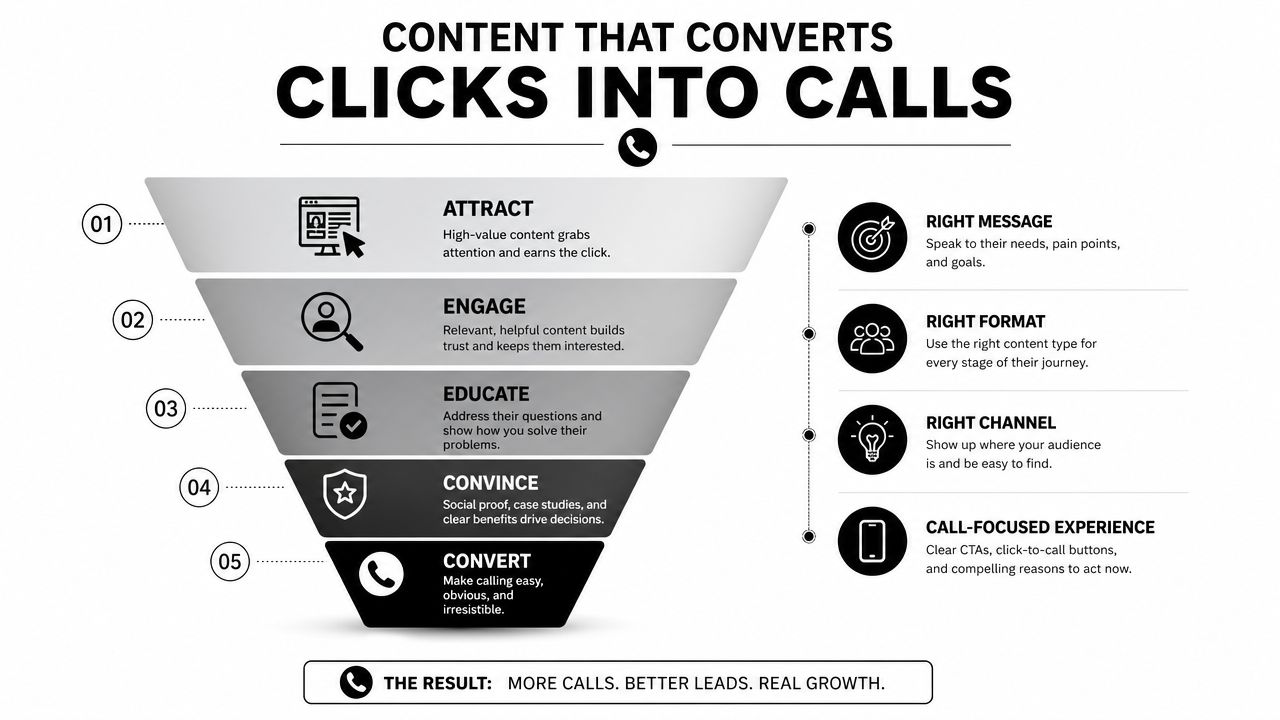
    Use page titles and headings like these:

    Page type Example title
    Excavation page Excavation Contractor in Vernal for Site Prep, Utilities, and Earthwork
    Welding page Commercial Welding in Roosevelt for Field Repairs and Fabrication
    Trucking page Water Hauling and Trucking Services in the Uinta Basin
    Careers page CDL Driver Jobs in Duchesne with Local and Regional Work

    Then make the body copy specific. Name the work. Name the service area. Name the kinds of clients you serve. If you do industrial, say industrial. If you do oilfield support, say oilfield support. If you handle emergency field repair, say that plainly.

    Don't make a prospect guess whether you handle their type of job. If it's profitable work you want, put it on the page.

    Also, every service page should have a visible phone number, a contact form, and a next step that doesn't sound vague. “Request a quote” beats “Learn more.” “Talk to our team” beats “Submit.”

    Using Your Website to Recruit Skilled Workers

    A lot of contractor websites are built like the company is only trying to sell jobs. That's half the battle. In the Basin, a business can lose just as much money from a labor shortage as it does from a weak sales pipeline.

    That's why SEO for small businesses needs to include hiring. If you need operators, CDL drivers, welders, mechanics, laborers, or field hands, your site should help recruit them every day of the week.

    Most contractors ignore recruiting SEO

    Many small businesses in trades and industrial markets overlook SEO for hiring, even though a recruiting-focused strategy can turn a website into a hiring funnel for roles like CDL drivers, welders, and operators, according to this BDC guide on SEO for small businesses.

    That gap is your opening.

    Most competitors still treat hiring like a Facebook post and a prayer. They post “now hiring,” maybe throw up a basic job ad, and wonder why weak applicants trickle in. Meanwhile, a candidate is searching Google for local driving jobs, welding jobs, or operator jobs and landing on whichever company built pages for those searches.

    A digital illustration of skilled tradespeople working with a tablet displayed in the foreground.

    If you need skilled people, your website shouldn't just say “we're hiring.” It should give applicants a reason to choose you.

    What a hiring page needs to include

    Your careers page should not be a dead-end paragraph with an email address. Build pages around real roles if you hire for them repeatedly.

    Good recruiting pages include:

    • Job title and location: CDL Driver in Duchesne, Welder in Vernal, Equipment Operator in Roosevelt.
    • Type of work: local hauling, oilfield support, shop fabrication, field repair, civil work, reclamation.
    • What the day looks like: candidates want to know the actual environment.
    • Requirements: licenses, experience, schedule expectations, travel if applicable.
    • Why someone would want the job: equipment quality, steady work, crew culture, project type.
    • Simple application path: no clunky maze, no broken forms.

    If you need a lightweight way to collect applications on your own site, this guide on how to build application forms with HTML is useful for understanding the structure of a clean application form without making the process more complicated than it needs to be.

    Project pages can help you hire

    This is the part most companies miss. A strong project page can attract clients and future employees at the same time.

    If you publish a jobsite recap about a reclamation project, pipeline support job, trucking contract, or custom fabrication job, you're showing more than capability. You're showing your standards. Applicants see your equipment, your work environment, your safety mindset, and the type of jobs they'd be walking into.

    That matters.

    A bare careers page says, “We have openings.” A good project gallery says, “Here's the kind of operation you'd be joining.”

    Use a few simple content types:

    • Project spotlights: before and after photos, scope, location, challenges, outcome
    • Crew features: introduce welders, operators, drivers, shop leads
    • Equipment pages: trucks, trailers, rigs, support equipment
    • FAQ content: scheduling, overtime expectations, travel radius, application process

    The companies that recruit well online make the business look real, active, and worth joining.

    Building Authority with Local Citations and Reviews

    Google trusts businesses it can verify across the web. That's where citations and reviews come in. This isn't glamorous work, but it affects whether your company looks established or sketchy.

    A citation is your business name, address, phone number, and sometimes your website listed somewhere online. Reviews are public proof that real customers have dealt with you. Both matter because they support trust.

    Get listed where your industry actually looks

    A lot of cheap SEO vendors chase quantity. They'll dump your business into generic directories nobody uses. That's lazy work.

    You want relevance and consistency. Your business details should match everywhere they appear, and the places that mention you should make sense for your trade and region.

    Focus on listings like these:

    • Local business organizations: chamber listings, community directories, local associations
    • Industry-specific sites: contractor directories, transportation directories, trade associations
    • Major business platforms: the core places customers already use to verify businesses
    • Partner mentions: vendors, associations, sponsorship pages, subcontractor directories

    If your business name is written one way on Google, another way on Facebook, and your old phone number still lives on some directory from years ago, clean that up. Mixed signals create doubt.

    Ask for reviews without sounding desperate

    A lot of owners either never ask for reviews or ask in a way that feels awkward. Keep it simple and send the request right after a successful job, while the experience is still fresh.

    Use a short message like this:

    Thanks again for the opportunity to work with you. If you were happy with the job, would you mind leaving us a quick Google review? It helps other local customers find our business and lets them know what it's like working with us.

    That's enough. No hard sell. No guilt. No long speech.

    A few practical habits help:

    • Ask after a positive outcome: don't wait two months.
    • Make it easy: send the direct review link by text or email.
    • Reply to reviews: thank people, mention the service, keep it professional.
    • Don't script every response: robotic replies look fake.

    One honest review from a real customer in your market does more for trust than a pile of weak directory listings ever will.

    Measuring Success and Choosing Your Path Forward

    Most business owners get lost in SEO because they start staring at the wrong numbers. They obsess over traffic, rankings, or reports full of charts they'll never use. That's not how a contractor should judge online marketing.

    Track what ties back to revenue and hiring. If visibility goes up but calls, quote requests, and job applications don't, something is off.

    Track the numbers that matter

    For most small contractors, the scoreboard is pretty simple:

    • Are more people finding you in Google and Maps
    • Are more qualified leads calling or filling out forms
    • Are more applicants coming through for the roles you need

    An infographic titled Measuring Small Business SEO Success explaining how to track leads, bookings, and local visibility.

    You can monitor a lot of this with free tools. Google Search Console shows what searches trigger your pages. Google Analytics 4 shows what people do on your site. Your Google Business Profile shows calls, messages, and visibility trends inside the profile interface.

    That's enough to make smart decisions.

    Look for patterns like:

    • service pages that get impressions but few clicks
    • pages that get traffic but no contact form submissions
    • job pages that attract visits but no applications
    • map visibility improving after profile updates or review activity

    DIY SEO vs. Working with an Agency

    You can absolutely handle parts of this yourself. A lot of owners should. But be honest about what will get done once work picks up.

    Factor DIY Approach Agency Partnership
    Time You save money but spend your own hours learning, writing, updating, and tracking You trade budget for speed and consistency
    Control You control every change and every message You need a clear process and good communication
    Execution Often strong at the start, then slips when operations get busy Usually better for regular updates, content, and follow-through
    Local knowledge Best if you know your customers and write plainly about the work Best when the agency understands your market and service area
    Technical work Harder if your site has structural issues or tracking gaps Easier if you need site fixes, page builds, and reporting
    Hiring support Usually neglected unless someone owns it internally Easier to build recruiting pages and application flows if it's part of the scope

    If you're comparing options, contractor-focused providers that handle website structure, local search strategy, and lead generation support, like SEO services for contractors, make more sense than generic agencies that don't understand rural service businesses.

    Pick the path you will actually follow through on

    Here's the honest test.

    DIY works if you're disciplined enough to keep your Google Business Profile updated, publish service and hiring pages, ask for reviews, monitor Search Console, and improve pages over time. Most owners start with good intentions and then get buried in actual work.

    Hiring help makes sense when your time is worth more on operations, estimating, sales, crew management, or job execution. It also makes sense if your current site is weak enough that piecemeal fixes won't cut it.

    The worst option is sitting in the middle. Half-finished profile. Thin website. No service pages. No careers page. No review process. No follow-up. That's how businesses stay invisible.

    SEO for small businesses is not complicated when you strip away the fluff. Show up in Google. Build pages around real services and real locations. Make it easy to contact you. Make it easy to apply. Keep your information current. Track leads and applications. Repeat what works.


    If your business needs a website and SEO setup that brings in local leads and supports hiring at the same time, Northpoint Web works with contractors and local companies in the Uinta Basin on exactly that kind of practical digital foundation.

  • SEO for Construction: Win More Bids in 2026

    SEO for Construction: Win More Bids in 2026

    If you're running a construction company in Roosevelt, Vernal, or anywhere across the Uinta Basin, you've probably felt the shift already. Referrals still matter, but they aren't carrying the whole load anymore. A property owner hears your name, then Googles you. A company needs excavation, welding, trucking, or site work, then compares three contractors on a phone before making a call. A potential CDL driver or equipment operator checks your reputation online before filling out an application.

    That's why SEO for construction matters now. WebFX reports 1.7 million online searches per month for independent contractors in its construction statistics roundup, which tells you the market is already searching online at scale, not just asking around at the coffee shop or job trailer (construction search demand data from WebFX). For a contractor in a regional market, that changes the game. Your website, your Google Business Profile, your reviews, and your service pages all become part of how you win bids and attract workers.

    The bigger opportunity is resilience. Good SEO for construction doesn't just help you get found for one service this month. It builds a system that supports better project inquiries, stronger credibility, and more qualified job applicants, even while Google keeps changing the search results.

    Table of Contents

    The Blueprint for Online Visibility

    Construction companies get in trouble online the same way they get in trouble in the field. They start building before the plan is clear. A homepage goes up, a few service blurbs get added, maybe a contact page and some photos, and then everyone wonders why the site isn't bringing in useful leads.

    Good SEO for construction starts before design. It starts with figuring out what buyers and job seekers are typing into Google.

    Start with search intent, not website design

    A contractor in Roosevelt shouldn't begin with a generic phrase like "construction services." That's too broad, too vague, and usually disconnected from how real people search. A better starting point is the kind of phrase tied to actual buying intent, like excavation in a specific town, welding for a specific industry, or trucking tied to a local service area.

    In practical terms, you're looking for the intersection of service + location + intent. That means phrases such as excavation contractor Roosevelt UT, welding and fabrication Vernal UT, CDL driver jobs Uinta Basin, or oilfield trucking company Duchesne County. Those searches reveal what kind of page you need to build.

    Practical rule: If one page tries to rank for everything, it usually ranks for nothing important.

    Many contractor websites often break down because of this. They have one "Services" page carrying excavation, site prep, trenching, demolition, trucking, reclamation, and hiring. That's like trying to pour footings, frame walls, and finish electrical from one set of instructions.

    A diagram illustrating the five key steps for online visibility, including foundation, content, authority, visibility, and measurement.

    Build a site structure that matches real demand

    A strong contractor site works like a blueprint. Each room has a purpose. Each page should do one clear job.

    One practical workflow from Padula Media is to map one core keyword to one dedicated page, then build long-tail and location variants around it. That reduces keyword cannibalization and helps each page match a single search intent (construction page mapping workflow from Padula Media).

    Here's what that often looks like:

    Page type Purpose Example
    Service page Capture high-intent local searches Excavation Contractor in Roosevelt, UT
    Location page Support nearby markets Excavation Services in Vernal
    Project page Show proof Pipeline trenching project in Duchesne County
    Careers page Recruit workers CDL Driver Jobs in the Uinta Basin
    About or trust page Reduce friction Safety, equipment, service area, certifications

    That structure helps both Google and your visitors. The search engine understands relevance. The visitor understands where to click next.

    If you're thinking beyond search alone, it also helps to connect web visibility with digital and offline lead strategies. Contractors don't win work from one channel in isolation. SEO works best when your website, trucks, referrals, sales follow-up, and local visibility all point in the same direction.

    Keep every page on one job

    Once the structure is clear, the build becomes simpler.

    Use descriptive URLs. Keep a clean heading hierarchy. Make sure important pages are only a few clicks from the homepage. Submit an XML sitemap through Google Search Console and Bing Webmaster Tools. Those are basic site-structure tasks, but they matter because they help search engines discover and understand the pages you've invested in.

    A simple planning checklist works well here:

    • Pick one core term per page: Don't make your excavation page fight your sitework page.
    • Add local variants naturally: Mention Roosevelt, Vernal, Duchesne, or the Uinta Basin where relevant.
    • Support the page internally: Link from the homepage, related services, project pages, and careers pages.
    • Match the visitor's next step: Bid request, call button, equipment inquiry, or job application.

    The companies that usually struggle with SEO for construction aren't lacking effort. They're lacking a blueprint. Once the site structure matches how people search, the rest of the work starts compounding instead of competing with itself.

    Dominate Your Service Area with Local SEO

    For most contractors, local SEO is the closest thing to low-hanging fruit. Not easy, but direct. When someone searches for a contractor with a local need, Google often shows the map, the business profiles, the review signals, and the nearest relevant providers before anything else gets attention.

    That's why your Google Business Profile deserves more respect than most companies give it. It isn't just a listing. It's your digital front door.

    Treat your Google Business Profile like a field office

    A weak profile usually looks familiar. Bare description. Few photos. No updates. Services listed loosely, if at all. Maybe a handful of old reviews. That kind of profile tells Google very little and tells a prospect even less.

    A strong profile does the opposite. It describes what you do, where you do it, and why someone should trust you enough to call. Modern construction SEO guidance puts Google Business Profile optimization, reviews, local citations, mobile usability, page speed, backlinks, and project-specific content at the center of the strategy, not on the sidelines (construction SEO evolution and timing guidance from Get Found Fast).

    One useful detail from that same source is timing. It says low-competition construction keywords may move in 24 hours to a few days, while more competitive terms can take 30 to 90 days, and highly competitive terms 90 to 180 days to show meaningful movement. That's one reason local SEO often produces the first visible traction for contractors.

    Your profile should answer the same questions a customer would ask at the counter. What do you do, where do you work, and how do I contact you right now?

    What a strong local profile looks like

    Take a hypothetical company called Uinta Basin Welding. A high-functioning profile would include:

    • Accurate business category: Welding contractor, metal fabricator, or the closest fit to actual work performed.
    • Service-focused description: Mention field welding, shop fabrication, repair work, structural steel, mobile service, or industrial support if those are the offerings.
    • Actual project photos: Trucks, welds, crews, equipment, shop images, and finished work.
    • Defined service areas: Roosevelt, Vernal, Duchesne, and nearby communities if that reflects operations.
    • Clear contact paths: Phone, website, hours, and service information that matches the website.

    Then add regular Google Posts. Most contractors ignore them. That's a mistake. Posts can highlight a completed project, announce a new piece of equipment, share a hiring notice, or answer a common service question. They show activity, and activity helps.

    For businesses trying to sharpen this part of their visibility, Northpoint Web publishes local search content under its local SEO tag that covers many of the same practical issues contractors run into in smaller regional markets.

    Reviews and posts move the job forward

    Reviews aren't just for optics. They affect click behavior because they reduce uncertainty. A property owner wants evidence that you finish work well. A commercial buyer wants signs that you're responsive and legitimate. A potential employee wants to know if the company looks stable.

    A basic review system is enough to outperform most competitors:

    1. Ask at the right moment: Right after successful completion, not months later.
    2. Make it easy: Send the direct review link by text or email.
    3. Guide the feedback naturally: Ask clients to mention the service and location in their own words if they're comfortable.
    4. Respond to every review: Short, professional, and specific.

    Local SEO also rewards consistency. Your business name, address, phone number, service area details, and core services should align across your website, directories, and profile. When that information drifts, Google gets mixed signals.

    For a contractor in the Uinta Basin, local SEO isn't abstract. It's the difference between showing up when someone searches for a crew nearby and getting passed over for a competitor with a cleaner profile and stronger review trail.

    Content That Converts Clicks into Calls

    A lot of contractor websites have traffic problems, but many have conversion problems disguised as traffic problems. The page gets a visit. Nothing happens. No call, no quote request, no application. That usually isn't because the visitor had no interest. It's because the page gave them too little to act on.

    The before-and-after difference is easy to spot.

    The difference between a weak page and a useful one

    Before: a generic service page titled "Services." It lists excavation, trucking, welding, and site prep in one short block of text. No service area detail. No project examples. No explanation of equipment, process, or job types. The only call to action says "Contact us."

    After: a dedicated page for excavation in Roosevelt, UT. It explains what kinds of excavation jobs the company handles, the equipment involved, what project sizes fit well, what areas are served, and what the next step looks like for getting a bid. It includes photos of actual work and a clear contact path.

    That second page works because it answers practical questions buyers ask before they call:

    • Can this company handle my kind of job
    • Do they work in my area
    • Do they look established and capable
    • What should I do next

    A marketing funnel infographic illustrating steps to convert online clicks into sales calls for business growth.

    A useful service page usually includes a few core elements:

    Element Weak version Strong version
    Page focus All services on one page One service, one intent
    Trust signal Stock language Real project photos and specifics
    Local relevance Broad service area mention Towns, counties, or region served
    Conversion path Generic contact form Quote request, call button, or scope discussion

    Project pages do more than show photos

    Many contractors have project photos sitting on phones, in text threads, or in a Facebook album. That's wasted proof. Those photos can become project pages that help close work.

    A solid project page doesn't need to reveal confidential details. It just needs enough information to demonstrate capability. State the type of work, the location or region if appropriate, the scope, the equipment used, any constraints you solved, and what kind of client the project served. That gives both Google and the visitor useful context.

    If your service page is the promise, your project page is the evidence.

    This matters more than most owners realize. Search visibility gets you in the conversation. Proof helps you survive the comparison.

    Use content to recruit, not just to sell

    This is the part many construction companies miss. They build pages for customers and ignore pages for workers, even though labor is often the tighter bottleneck.

    A major underserved angle in SEO for construction is recruiting SEO, not just lead generation. One industry source notes that construction job openings remain high relative to employment in the U.S., which makes recruiting-focused search content a practical strategy for contractors trying to hire CDL drivers, equipment operators, welders, laborers, and skilled tradespeople (recruiting SEO perspective from Construction News and Report).

    The weak version of a careers page says, "We're hiring. Apply now."

    The stronger version builds a hiring funnel:

    • Role-specific pages: CDL Driver Jobs Vernal UT, Heavy Equipment Operator Jobs Roosevelt UT, Welding Jobs Uinta Basin
    • Culture and expectations pages: What the work is like, typical schedules, equipment, standards, and who fits well
    • Benefits and pay information: Be as clear as you're comfortable being
    • Application flow: Short, mobile-friendly, and fast

    That last point matters. If your phone lines get missed after hours or during busy periods, search traffic can leak out before anyone on your team gets back to the lead. For companies trying to tighten that gap, a service like professional call answering for home services can support the handoff between website inquiry and live conversation.

    The contractors who win online over time usually do two things well. They publish pages that help customers trust them, and they publish pages that help workers picture themselves on the crew. That's how content becomes operational, not just promotional.

    Building Your Digital Reputation and Authority

    A contractor in Roosevelt can have a solid crew, good equipment, and years of real project experience, then still lose work online to a company with a weaker track record but cleaner digital proof. That gap shows up before the first phone call. Owners, property managers, and potential hires check reviews, business listings, project photos, and third-party mentions to decide whether your company looks established or risky.

    Google evaluates those same signals.

    Consistency builds trust

    Start with the basics. Your business name, address, phone number, website, and service area need to match across your Google Business Profile, local directories, trade listings, chamber pages, and supplier profiles. If one site shows an old number, another lists a different company name, and a third sends visitors to the wrong website, people hesitate. Search engines do too.

    This is foundation work.

    A clean citation profile will not impress anyone at the shop. It will prevent avoidable confusion that costs estimates, callbacks, and applications. I have seen contractors spend money driving traffic to a site, then lose leads because an outdated directory still routed calls to a disconnected line.

    If your website needs a more stable base before you start cleaning up authority signals, this guide to a WordPress website for business lays out what that setup should support.

    Relevant links carry real weight

    Link building gets a bad name because plenty of it deserves one. Buying junk links from unrelated websites is the SEO version of pouring a slab on loose soil. It may look finished for a minute, but it does not hold up.

    The links that help a construction company usually come from real business relationships and visible local involvement. Good examples include:

    • Chamber of Commerce and local business association listings
    • Supplier and manufacturer dealer pages
    • Trade association member directories
    • Local news coverage of projects, expansion, awards, or community work
    • Sponsorship pages for rodeos, school programs, youth sports, and scholarship funds
    • Partner mentions from subcontractors, engineers, or equipment vendors

    These links do more than pass authority. They confirm that your company exists in the local business community and has ties that make sense offline. That matters in smaller markets where reputation still travels by word of mouth, even when the first impression happens on a screen.

    A simple test helps. If a link would make sense to show a customer, banker, or project partner, it is probably worth pursuing.

    Reviews shape both trust and operations

    Reviews affect click-through rates, map visibility, and conversion. They also expose patterns inside the business. If several reviews mention missed callbacks, unclear scheduling, or poor site cleanup, that is not just a marketing issue. It is an operations issue showing up in public.

    The companies that handle reviews well usually build a repeatable process:

    1. Ask for feedback after a clear win, such as a completed phase, final walkthrough, or successful service call.
    2. Make it easy for the customer with a direct link or QR code.
    3. Respond to every review in a professional tone.
    4. Share recurring feedback with the office and field team so the same issue does not keep resurfacing.

    Negative reviews are part of the job if you stay in business long enough. The goal is not a perfect profile. The goal is a believable one. A measured response to a complaint often helps more than another five-star review with no detail, because it shows how the company acts when a project hits friction.

    Authority should support sales and hiring

    This section is not only about winning more leads. A strong digital reputation also helps you recruit people who want steady work with a company that looks organized and credible. Skilled operators, welders, foremen, and laborers research employers the same way customers research contractors. They look for signs that the business is active, respected, and likely to keep the schedule full.

    That is why digital authority matters more now than it did a few years ago. Search results change. Map packs shift. AI summaries may answer basic questions before a prospect clicks. Reputation signals still hold their value because they are harder to fake and easier to verify.

    Build those signals like you would build a shop foundation. Get the details straight. Use materials that hold up. Make sure the structure supports the weight you plan to put on it.

    The Technical Tune-Up for a Faster Site

    Technical SEO sounds complicated until you strip it down to business terms. For a contractor, the easiest analogy is heavy equipment maintenance. If a machine starts slow, stalls under load, or has controls that don't work right, the crew loses time and confidence fast.

    Your website works the same way. Three questions matter most. Is it fast? Does it work well on a phone? Is it secure?

    Fast enough to keep the visitor

    A slow site creates friction before your sales message even has a chance. That problem hits harder in rural markets, where people may be checking your site from the field, from a truck, or on a weaker mobile connection.

    Common speed problems include oversized images, cluttered themes, too many unnecessary plugins, and bloated page builders. The fix usually isn't exotic. Compress images, simplify layouts, remove junk, and use solid hosting.

    A professional man optimizing website performance on a laptop, illustrated with page speed analytics and tools.

    A contractor doesn't need to memorize technical jargon to judge performance. Open the site on your own phone. If the page drags, jumps around, or takes too long to become usable, your prospects are feeling that too.

    Mobile usability matters on real job sites

    Most contractor traffic isn't happening from a desktop in a quiet office. It's happening on phones. That means your site has to work for people with one hand free, little patience, and a specific task in mind.

    Check these basics:

    • Tap targets: Can someone hit the phone button without zooming?
    • Readable text: Can they scan the service page quickly on a smaller screen?
    • Short forms: Does the estimate form ask only for what you really need?
    • Sticky contact options: Is the call button visible without hunting for it?

    A lot of small business sites fail here because they were designed visually, not functionally. If you're evaluating platforms or rebuild options, Northpoint Web has a practical overview of what matters in a WordPress website for business, especially for companies that need flexibility, local SEO control, and service-page growth over time.

    Security is basic professionalism

    HTTPS isn't a fancy upgrade anymore. It's table stakes. People notice when a site throws browser warnings or looks outdated. Even if they don't understand the technical details, they understand when something feels off.

    Security also supports trust in quieter ways. Contact forms feel safer. Browsers behave better. The site looks maintained rather than abandoned.

    Here's a quick owner-level audit:

    Check What to look for Business impact
    Speed Pages load cleanly and quickly Fewer drop-offs
    Mobile Buttons, forms, and text work on phones More calls and applications
    Security HTTPS and no browser warnings More trust

    Technical tune-up work rarely gets applause, but it removes friction from every other part of your SEO. If the site is slow, clumsy, or untrustworthy, your local rankings and content quality have to fight uphill just to keep attention.

    Measuring SEO Success and Adapting to the Future

    Construction companies don't need prettier reports. They need evidence that SEO is producing business results. Rankings matter, but only as a means to something else. The key question is whether your online presence is helping you win better bids, generate more qualified calls, and bring in stronger applicants.

    That shift in mindset matters even more as search results keep changing.

    Track business outcomes first

    A contractor can sit on decent rankings and still have a weak SEO program. That happens when the site brings in the wrong traffic, sends visitors to thin pages, or makes it hard to convert.

    Start with metrics tied to actual operations:

    • Phone calls from the website
    • Quote request form submissions
    • Career applications
    • Google Business Profile actions
    • Service pages that generate real inquiries

    Those are the numbers your office can tie back to pipeline and hiring. Everything else supports them.

    For owners who need a practical framework for reporting, this guide for proving SEO impact is useful because it focuses on connecting visibility work to measurable business outcomes instead of stopping at vanity metrics.

    Use Search Console like an operator dashboard

    Google recommends using Search Console and analytics to monitor crawl status, indexation, traffic, and conversions, then improving pages that rank in positions 11 to 15 because those pages are often close enough to page-one movement to justify targeted work (Search Console optimization guidance summarized by Moore Tech Solutions).

    That advice is practical for contractors because it tells you where to spend effort next. If a service page is already close, you usually don't need to reinvent the site. You need to strengthen the page.

    Useful actions include:

    1. Improve the title and headings: Make them clearer and more aligned with actual search intent.
    2. Add proof: Project photos, scope details, service area context, and stronger calls to action.
    3. Tighten internal linking: Link from related service pages, project pages, and navigation areas.
    4. Refresh stale content: Update equipment lists, service areas, or process explanations.

    An infographic titled Measuring SEO Success and Adapting to the Future, featuring key performance indicators and growth strategies.

    One of the biggest mistakes in SEO for construction is treating the website like a one-time build. It isn't. Rankings shift, competitors update their pages, reviews come in, service areas expand, and hiring needs change. The companies that stay visible treat SEO more like equipment maintenance or safety management. Ongoing, scheduled, and tied to real-world conditions.

    AI search changes the format, not the need for proof

    Many contractors are asking a fair question now. If Google keeps adding AI Overviews and more zero-click features, does SEO still matter?

    Yes, but the target is changing. One recent construction marketing source notes that AI-generated search experiences are expanding across informational queries, while Google still shows local business profiles and map results for high-intent contractor searches. That makes a mixed strategy more valuable. Local pack visibility for direct service intent, and proof-based FAQ content for citation-style visibility in AI-driven results (AI Overviews and local visibility perspective from Percepture).

    That means your content should become more specific, not more generic.

    Instead of broad pages that say, "We offer quality construction services," publish material that answers concrete questions:

    • What kinds of excavation jobs do you handle
    • What equipment do you run
    • Which towns and counties do you serve
    • What should a customer expect before requesting a bid
    • What does a CDL driver role at your company look like

    AI systems and traditional search engines both respond better to content with clear structure, useful detail, and visible proof. They have less use for filler than ever.

    For contractors who want outside help implementing that process, Northpoint Web offers SEO services for contractors focused on local visibility, service-page development, technical improvements, and recruiting-oriented website strategy.

    The companies that hold up best through search changes are usually not chasing tricks. They are documenting their work clearly, showing evidence, staying active in their market, and measuring what produces actual business value. That's what makes SEO durable.


    If your construction company needs a website and search strategy built for real outcomes, not just rankings, Northpoint Web helps contractors in Roosevelt, Duchesne, Vernal, and across the Uinta Basin improve local visibility, generate bid opportunities, and attract qualified job applicants with practical SEO and high-performance websites.

  • Small Business Website Platforms: Top 10 Reviewed

    Small Business Website Platforms: Top 10 Reviewed

    A lot of owners reach this point after the same kind of week. A prospect checks your site before calling, the homepage looks dated, the service pages are thin, and the contact form sends nothing useful to your team. Or you need a site quickly because the business still depends on referrals, Facebook, or a placeholder page someone set up years ago.

    The platform choice affects more than design. It affects how fast you can launch new service pages, how easy it is to update hiring content, whether your site can support local SEO, and how much you will spend fixing limitations a year from now.

    That trade-off looks different by industry. A construction company may need location pages, project galleries, and quote forms tied to specific services. An oilfield services company may care more about credibility, recruiting, and the ability to add equipment or safety content without calling a developer every week. A local retailer may need inventory, pickup, and POS integration before anything else.

    This guide focuses on those practical differences. It compares the major small business website platforms with an eye toward lead generation, hiring, content control, and long-term cost, not just templates and monthly pricing. If WordPress is on your shortlist, this breakdown of a WordPress website for business will help frame where it fits.

    It also gives you a simple way to decide whether to build it yourself or hire a professional agency like Northpoint Web. DIY can work for a newer business with a narrow service list, limited content needs, and someone on staff who will keep the site updated. Hiring a team usually makes more sense when the website needs to support SEO, recruiting, paid traffic, multiple locations, or a sales process that cannot afford missed leads.

    If you are comparing platforms based on generic feature grids, that will only get you part of the way there. Even broad comparisons like this best website builder for 2025 overview tend to miss the operational details that matter once your website has to help the business grow.

    Table of Contents

    1. WordPress.org (self-hosted)

    WordPress.org (self-hosted)

    If you want the most control, this is still the platform to beat. WordPress.org is the option I'd point to for companies that need their website to do more than sit online and look respectable. It handles marketing pages, service pages, location pages, blogs, hiring pages, quote forms, and e-commerce without locking you into one vendor's ecosystem.

    For construction companies, trucking businesses, excavation contractors, and industrial service firms, that flexibility matters. A lot of these companies start with a basic brochure site, then later need career pages, CRM-connected forms, landing pages for service lines, and content built around local SEO. WordPress grows into that better than almost anything else.

    Why it wins for long-term growth

    The biggest advantage is ownership. You control hosting, plugins, performance setup, SEO tooling, and how the site evolves. If your business eventually needs custom lead routing, gated documents, recruiting workflows, or a deeper content strategy, WordPress gives you room to build without starting over.

    That doesn't mean it's automatically the right choice for everyone. Self-hosted WordPress works best when somebody is responsible for updates, backups, plugin quality, and security. If nobody owns that, the site can get sloppy fast.

    • Best for growth-minded businesses: Strong fit for contractors, oilfield services, and companies planning to publish content, add service areas, or expand hiring.
    • Best for SEO control: You can shape URLs, metadata, page structure, schema, speed work, and content architecture with much more freedom than most closed builders.
    • Worst fit for hands-off owners: If you don't want to think about hosting, updates, or plugin governance, a managed platform may be easier.

    Practical rule: If your website will likely need custom forms, recruiting pages, ongoing SEO content, and long-term ownership, self-hosted WordPress is usually the safer bet.

    If you're considering this route for a lead-focused business site, Northpoint Web's guide to a WordPress website for business is a useful next step.

    2. Wix

    Wix

    Wix fits the owner who needs a site live soon, wants to manage it personally, and has no interest in dealing with hosting or plugin maintenance. For a business with a short service list, a contact form, a gallery, and maybe scheduling or light ecommerce, that can be the right call.

    I usually recommend Wix for businesses that value speed and simplicity over technical control. A local retailer, salon, startup contractor, or solo service company can get a professional-looking site up without a developer and keep it updated in-house.

    Where owners get into trouble is assuming a fast launch solves the long-term website question. Wix is strongest when the site is mainly a digital brochure with lead capture. It gets harder when the website needs to support a serious SEO program, location growth, hiring funnels, or custom integrations.
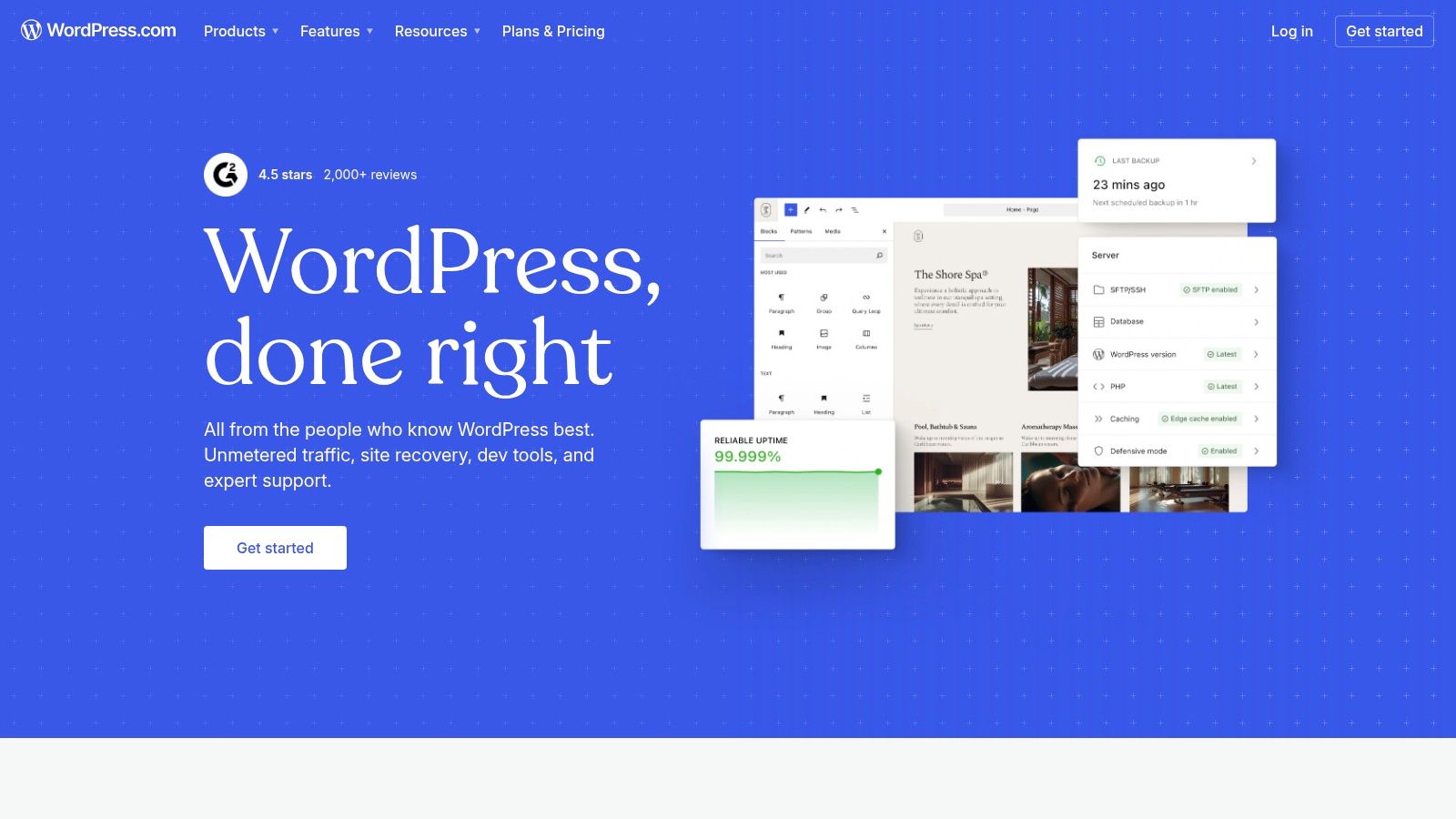
    That matters in industries like construction and oilfield services. Those companies often start with a simple need, then add service area pages, equipment pages, recruiting content, safety documentation, and quote workflows. Wix can handle the early stage. It is less comfortable once the site becomes a core sales and operations tool.

    A practical way to judge fit is to ask who will own the website six months from now. If the answer is the business owner or office manager, Wix is often manageable. If the answer is a marketing team, agency, or growth-focused business that expects ongoing optimization, a more flexible platform usually holds up better.

    • Best for fast DIY launches: Good fit for businesses that need a clean site, basic forms, galleries, and easy day-to-day edits.
    • Works well for simple local sites: Strong option for retail, personal services, and smaller service businesses without complicated workflows.
    • Weakest on portability and customization: Rebuilding later is common once SEO, recruiting, or lead routing become bigger priorities.

    For owners deciding between DIY and professional help, the primary question is not whether Wix can work. It can. The question is whether a quick self-build will still support the business a year from now. If you want the simplicity of a builder but need clearer strategy on structure, content, and conversion paths, a small business web design partner can help you avoid building a site that has to be replaced too soon.

    3. Squarespace

    Squarespace is the cleanest answer for business owners who care about presentation and don't want maintenance headaches. Its templates are polished, its editor is more controlled than Wix, and the overall experience is usually smoother for people who aren't technical.

    That controlled environment is exactly why some owners love it and others outgrow it. You're less likely to create a chaotic layout, but you're also less likely to build highly customized systems later without friction.

    Best fit for presentation-first businesses

    Squarespace works well for local contractors with a small set of core services, boutique retailers, design-oriented businesses, consultants, and businesses that need a sharp online presence more than a complex architecture. If your site is mostly home, about, services, gallery, testimonials, and contact, Squarespace does that well.
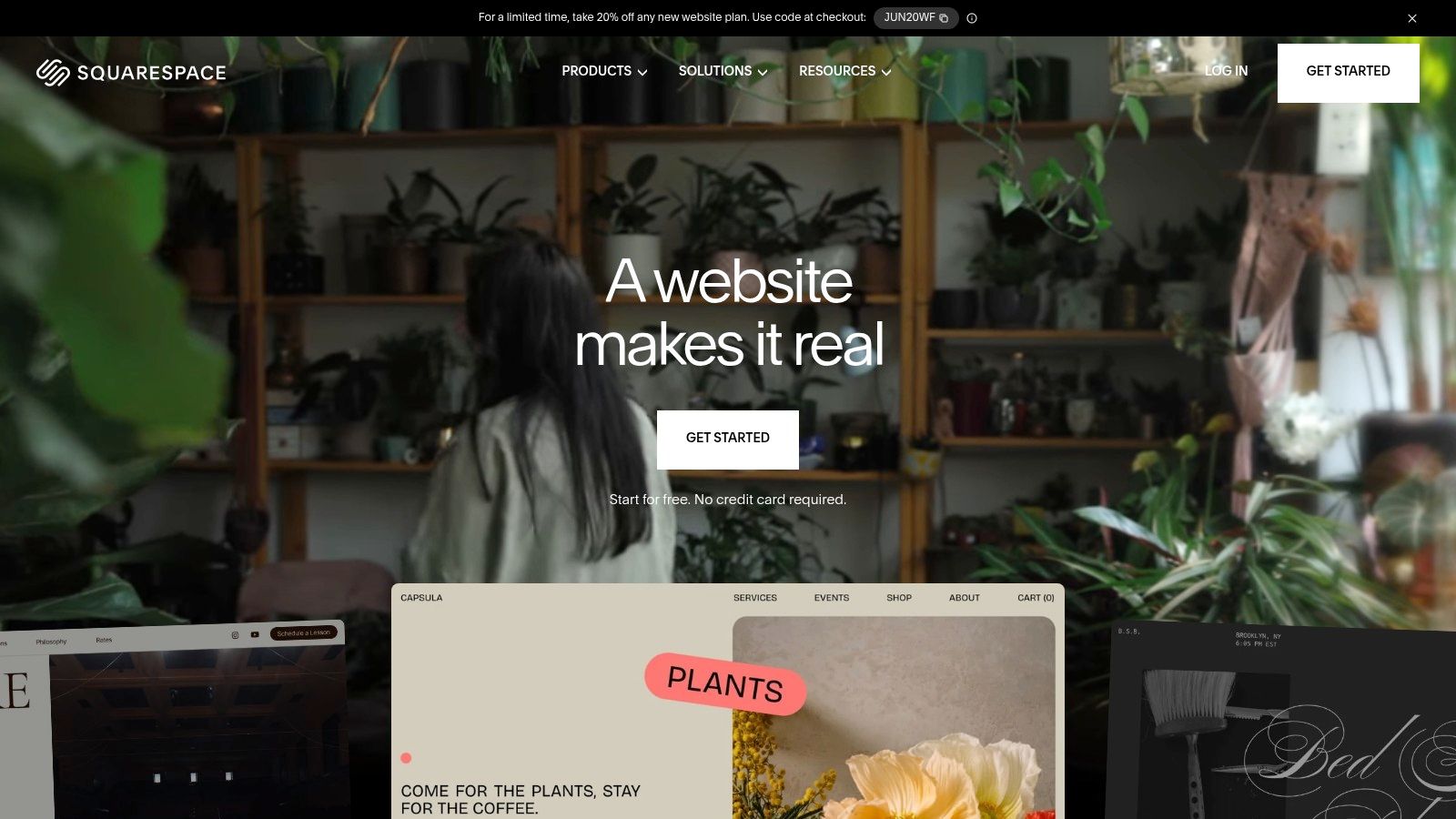
    It also works for owners who want fewer moving parts. Hosting, security, templates, and core site functionality are bundled together, which reduces maintenance compared with self-hosted systems.

    A simple platform is often the right choice when the business model is simple. It becomes the wrong choice when the company expects the website to support recruiting, content expansion, and custom workflows later.

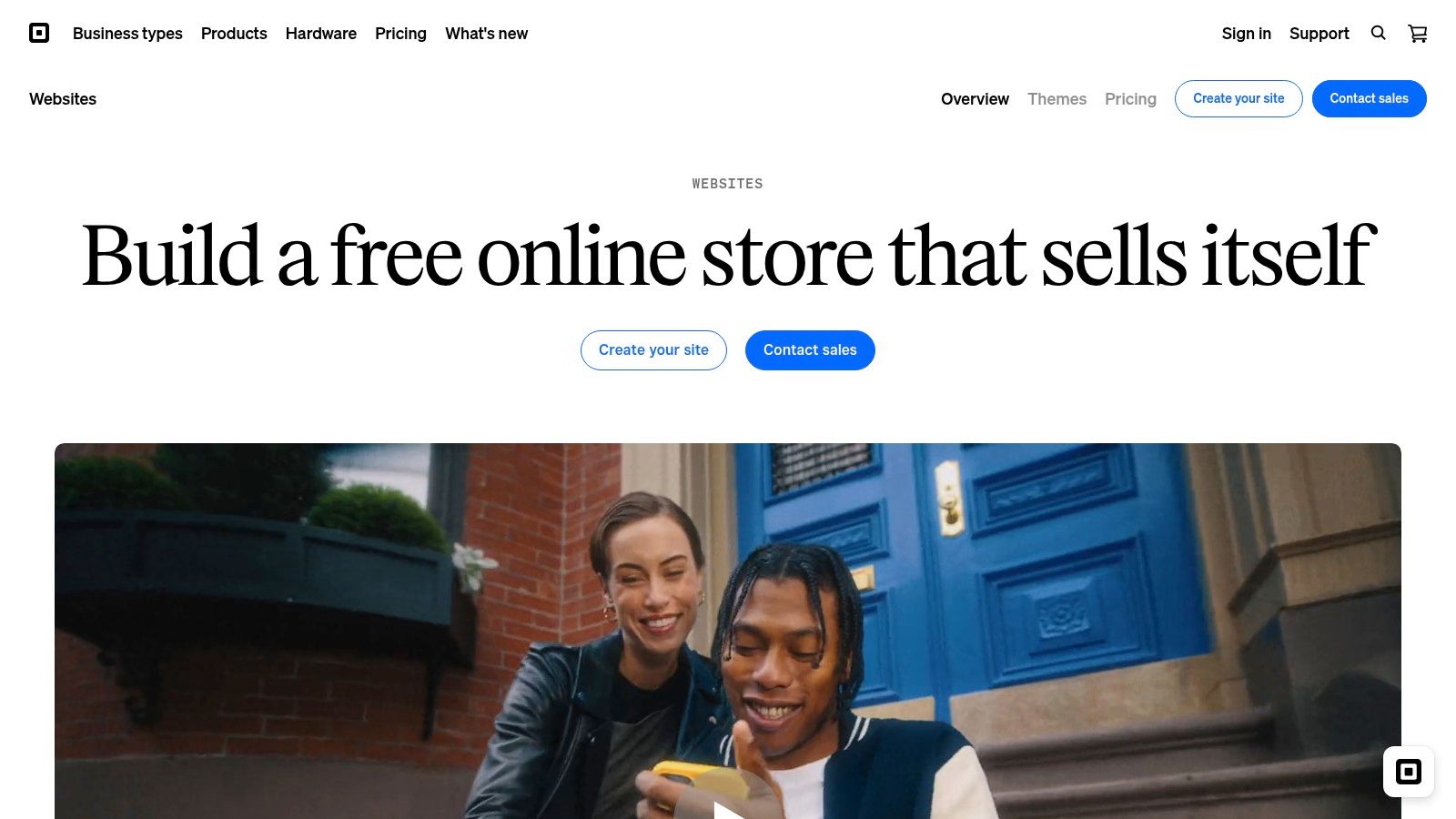
    Where I get cautious is with industrial and field-service companies that think they only need a five-page site forever. Many don't. Once hiring becomes difficult or local search matters more, they often need more page depth and more content flexibility than they planned for.

    4. Shopify

    Shopify

    If you sell products first and market your business second, Shopify belongs near the top of your list. It's built for commerce from the ground up. Product management, checkout, payments, shipping, taxes, and point-of-sale workflows are all stronger here than on general-purpose builders.

    For local retailers, apparel brands, food businesses, specialty stores, and parts sellers, Shopify usually makes more sense than trying to force a brochure platform into being a store. It's also worth considering for contractors or industrial suppliers selling branded merchandise, replacement parts, or standard packaged products online.

    When Shopify is the right move

    Shopify shines when the catalog, the cart, and the checkout experience matter. If the website's main job is helping customers browse products and complete purchases, this platform is hard to beat. It also scales well when in-store and online inventory need to work together.

    The caution is that Shopify can become app-heavy. That's not always bad, but business owners should budget for feature expansion and keep the stack organized.

    • Best for retail-first businesses: Strong online store and POS support.
    • Good for hybrid operations: Useful when you sell online and in person.
    • Less ideal for content-heavy lead generation: It can handle content, but it's not the first choice for businesses built around quote forms, recruiting pages, and local service SEO.

    For a local gift shop, niche retailer, or equipment seller, Shopify can be the operationally cleanest option. For an excavation contractor or trucking company, it usually isn't.

    5. Webflow

    Webflow

    Webflow sits in an interesting middle ground. It gives designers a lot of layout control and cleaner maintenance than a plugin-heavy self-hosted site, but it also asks more from the user than Wix or Squarespace. For the right business, that's a fair trade.

    This is a good platform for brand-conscious companies that want a custom marketing site without managing a traditional CMS stack. Webflow is often a strong fit for firms that care about presentation, speed, structured content, and a polished front-end experience.

    Who should choose Webflow

    I'd look hard at Webflow if the site needs to feel custom but the business doesn't want the ongoing maintenance of WordPress. It's useful for professional service firms, higher-end local brands, and companies building focused lead-generation sites with a controlled set of templates and CMS content types.

    It's less ideal when the owner wants to jump in casually and make major layout edits without understanding how the system works. Webflow is visual, but it's not beginner-simple.

    Build decision: Webflow makes sense when design quality and maintenance control matter more than plugin flexibility.

    If you're comparing DIY costs against agency work, it helps to understand what goes into strategy, structure, copy, SEO setup, and technical implementation. Northpoint Web breaks that down in what's really included in a $7,500 website build.

    6. HubSpot Content Hub (formerly CMS Hub)

    HubSpot Content Hub (formerly CMS Hub)

    HubSpot Content Hub fits a specific kind of business. A sales-driven company with multiple follow-ups, estimate requests, booked demos, and handoff between marketing and sales can get real value from having the site, forms, CRM, email automation, and reporting in one system.

    That matters more than design freedom for some owners.

    I usually recommend HubSpot Content Hub for companies where the website's main job is to generate, route, and track leads. That includes commercial construction firms, oilfield service companies, industrial suppliers, and other B2B service businesses with longer sales cycles. If your process includes quote requests, territory assignment, nurture emails, and visibility into which pages and campaigns produced the lead, HubSpot is built for that workflow.

    Best for lead management and reporting

    The trade-off is straightforward. HubSpot gives you tighter control over lead handling and attribution, but you give up some front-end flexibility compared with WordPress.org or Webflow. For many small businesses, that is a fair deal. For a design-led brand site or a highly custom local marketing site, it can feel restrictive and expensive.

    The price only makes sense if the team will use the system. A company that logs deals, tracks source data, responds to form fills quickly, and builds follow-up automation can justify HubSpot. A company that just wants a brochure site with a contact form usually cannot.

    This is also one of the clearer lines between DIY and agency help. If you already have a sales process, a CRM owner, and someone on staff who can manage campaigns, HubSpot can work well in-house. If your team is still figuring out lifecycle stages, lead routing, content structure, and reporting, setup mistakes get expensive fast.

    7. Square Online (by Block/Square)

    Square Online (by Block/Square)

    Square Online is one of the simplest options for businesses already using Square in person. If your store, food truck, rental counter, coffee shop, or small retail operation runs on Square POS, this platform removes a lot of friction.

    Inventory, payment processing, pickup, delivery, and order management feel much more connected than they do when you bolt a site onto a separate commerce system. That convenience is the whole point.

    A strong option for local retail and food service

    Square Online is a practical choice when you don't need elaborate design freedom. It's not the platform for highly custom brand sites, but it handles the basics well for businesses that care more about selling than styling.

    This is the kind of platform I'd recommend to owners who say, “I need online ordering, gift cards, and product sync, and I don't want to think about much else.” That's a reasonable use case.

    • Best for Square users: Existing POS users get the most value.
    • Good for operational simplicity: Fewer moving parts between in-person and online sales.
    • Not built for complex marketing sites: If content strategy or local SEO becomes central, you may hit limitations faster.

    For local retail, that trade-off is often acceptable. For industrial service firms, it usually isn't.

    8. BigCommerce

    BigCommerce

    BigCommerce is the platform I'd bring into the conversation when the catalog starts getting messy. If you sell parts, equipment, product variants, industrial supplies, or a wider product set that's harder to manage in entry-level builders, BigCommerce deserves attention.

    It's not usually the first platform small businesses start with. It's often the one they look at after they realize simple store builders don't handle product complexity as well as they hoped.

    Best when the catalog is the hard part

    BigCommerce is strongest for businesses with heavier commerce requirements. Industrial suppliers, parts sellers, multi-category retailers, and B2B-oriented stores are the obvious candidates. Native commerce depth is one of its biggest strengths.

    The downside is that it can feel like more platform than a very small business needs. If you only sell a limited set of items and want a simple site, Shopify or Square Online may feel easier day to day.

    For the right company, though, BigCommerce can prevent a later rebuild. That matters when the site is becoming operational infrastructure, not just a storefront.

    9. WordPress.com

    WordPress.com exists for business owners who like the idea of WordPress but don't want to self-manage the technical side. It strips away some of the mess of hosting and maintenance while keeping more familiarity with the WordPress ecosystem than a typical website builder.

    This can be a solid middle ground. You get a simpler setup path, bundled hosting and updates, and a more approachable experience than fully self-hosted WordPress. But you also give up some freedom.

    Good middle ground for simpler businesses

    I'd consider WordPress.com for businesses that want room to grow beyond a basic builder but aren't ready to manage a full custom stack. It's a practical fit for service businesses, local organizations, and owners who want to publish content but prefer a more controlled environment.

    The main thing to understand is that WordPress.com is not the same as WordPress.org. Plugin access, infrastructure control, and customization flexibility depend much more on plan level and platform rules.

    If you know you want full ownership later, starting with self-hosted WordPress is usually cleaner. If you mainly want less maintenance today, WordPress.com can make sense.

    This is often a better fit for smaller, less complex businesses than for aggressive growth-stage companies.

    10. Duda

    Duda

    Duda is a platform I usually think about from the agency side first. It's built for repeatability, client permissions, governance, and producing multiple sites efficiently. That makes it useful for teams deploying many similar projects, especially when process matters more than total customization freedom.

    For a single business owner, that agency-first DNA can be either helpful or unnecessary. It depends on how the site is being managed.

    Why agencies like it more than owners do

    Duda is strongest when a team is building and maintaining sites at scale. Multi-location businesses, franchise-like structures, and agencies serving many local businesses can get real value from that setup. It's organized, controlled, and efficient.

    For one local business owner building one website, it may feel less natural than Wix, Squarespace, or WordPress. That doesn't make it weak. It just means the platform shines more in managed environments than in solo-owner DIY use.

    One broader issue applies here and across the category. Bain's small-business research argues providers should align support models with customer size and have a way to move businesses into the right support as they grow, which is one reason platform choice should be treated as a scaling decision, not only a launch decision, as discussed in Bain's research on underserved small businesses.

    Top 10 Small Business Website Platforms, Feature & Pricing Comparison

    A contractor may need quote requests, hiring pages, and location-based service pages. A local retailer may need inventory sync and in-store pickup. An oilfield service company may care more about lead routing, crew recruiting, and proof of capability than design effects. That is why the right platform depends less on popularity and more on how the site supports revenue, operations, and future changes.

    This comparison is meant to help owners choose faster and choose with fewer surprises. It also helps draw the line between a platform that works for a true DIY build and one that usually needs professional setup from an agency such as Northpoint Web.

    Platform Core Strength ✨ Best For 👥 SEO & Performance ★ Value/Cost 💰 Standout 🏆
    WordPress.org (self‑hosted) Unlimited control, plugins and integrations ✨ Contractors, oilfield, lead‑gen and recruiting 👥 ★★★★★, top technical SEO control 💰 Flexible, hosting and development costs vary 🏆 Best for SEO, scalability and ownership
    Wix Drag‑and‑drop builder with apps ✨ Small service businesses wanting fast launch 👥 ★★★, decent basics 💰 Subscription, add‑ons can raise cost 🏆 Fastest to publish with vertical templates
    Squarespace Polished responsive templates ✨ Portfolios, local contractors, simple e‑commerce 👥 ★★★, solid basics 💰 Predictable plans, low maintenance 🏆 Consistent design and simple upkeep
    Shopify Complete commerce stack and POS ✨ Retailers, parts sellers, omnichannel stores 👥 ★★★★, commerce‑focused 💰 Subscription plus apps and payment fees 🏆 Best checkout and retail workflows
    Webflow Pixel‑perfect visual CMS and clean code ✨ Marketing sites, lead‑gen, brand sites 👥 ★★★★, high performance output 💰 Mid to high, plan structure takes care to price correctly 🏆 Designer control plus clean production code
    HubSpot Content Hub CRM‑connected CMS and automation ✨ Lead‑driven service firms and sales teams 👥 ★★★★, CRM‑linked SEO and analytics 💰 Premium pricing as contacts and hubs scale 🏆 Unified CRM, marketing and sales flow
    Square Online Square POS and online ordering ✨ Local retail, rentals, food trucks 👥 ★★★, local commerce fit 💰 Free to start, processing costs apply 🏆 Easy POS integration for local sellers
    BigCommerce Deep B2B and complex catalog support ✨ Industrial and equipment sellers, growth stores 👥 ★★★★, built for catalogs 💰 Higher base pricing, no platform fees 🏆 Strong native catalog and B2B features
    WordPress.com Hosted WordPress with upgrades ✨ Small businesses wanting WordPress without server management 👥 ★★★★, WordPress capability with less infrastructure work 💰 Bundled tiers, predictable 🏆 Low‑maintenance WordPress experience
    Duda Agency multisite, white‑label tools ✨ Agencies or teams deploying many contractor sites 👥 ★★★★, optimized for scale 💰 Agency pricing, efficient at scale 🏆 Best for multi‑site governance and workflow

    Beyond Platforms: When to Partner with an Agency

    A business owner picks a platform on Friday, launches a site two weeks later, and still gets weak lead quality, few quote requests, and almost no organic traffic. I see that pattern often. The problem usually is not WordPress, Wix, Shopify, or Webflow. The problem is that the site was never planned around sales, service pages, trust signals, hiring, and local search.

    A platform gives you the tools. It does not decide what pages to create, how to explain a specialized service, where forms should go, or how to turn a visitor into a call, quote request, or applicant.

    That gap matters. Buyers research companies before they call. They compare options, scan reviews, look for proof, and decide fast whether a business looks credible. If your site is thin, hard to use, or vague about what you do, they move on.

    For service businesses, the bigger issue is fit. A local boutique with five core product lines and simple store hours can often do well with a DIY build. The same is true for a solo consultant, a new service company testing demand, or a restaurant that mainly needs menus, hours, and online ordering.

    Construction, oilfield services, trucking, excavation, fabrication, and industrial service companies usually need more. They need service pages that match how customers search. They need location relevance, clear contact paths, estimate forms that collect useful job details, and content that answers practical buying questions. Many also need a hiring path because the website has to support recruiting as much as sales.

    That is usually where DIY starts to break down.

    The main limit is not intelligence or effort. It is time, structure, and experience. Owners know their business. They often do not know how to map services to search intent, write copy that qualifies leads, set up analytics correctly, or build pages that support both SEO and conversion. Website builders make publishing easy. They do not remove the need for strategy.

    Launch speed creates its own trap. AI site generators and quick templates can get a business online fast, and that has value. But speed at launch is different from long-term fit. Once you add locations, separate service lines, team recruiting, case studies, or a stronger content program, the wrong setup starts costing time and money. Even broad website builder coverage such as Webnode's website builder article shows how much attention the category gives to fast setup. For many small businesses, the harder question is whether the site will still support growth a year from now.

    A simple rule works well here. DIY is usually a reasonable choice if the site is small, the offer is easy to explain, the sales process is straightforward, and someone on your team can keep the site updated. Hiring a professional agency makes more sense when the website needs to support multiple services, multiple locations, local SEO, lead routing, recruiting, ongoing content, or CRM and marketing integrations.

    That distinction matters even more in rural and industrial markets. In Utah, the Uinta Basin, and similar regions, businesses rarely need a flashy site. They need a site that helps them get calls, quote requests, credibility, and applicants from the right people. That requires good structure and practical messaging more than visual effects.

    Northpoint Web is one option for companies that need website design, SEO, hosting, and lead-focused implementation for contractors, oilfield service companies, industrial businesses, and local service companies. The value of that kind of agency relationship is not just design work. It is having a team handle platform selection, page structure, search visibility, conversion setup, and ongoing maintenance so the owner can stay focused on operations.

    If your business needs more than a template and you want a website built to support leads, credibility, and recruiting, contact Northpoint Web to talk through the right platform and whether a DIY build or managed project makes more sense for your company.

  • Is Your Uinta Basin Business Ready to Sell Online? A 3-Question Test for Local Owners

    Let me tell you something surprising.

    A small gift shop in Duchesne County made over $8,000 in online sales last year. Not a big retailer. Not a national brand. A local shop with a handful of products and a simple website.

    How? They stopped being afraid of “e-commerce” and started treating it like what it really is: a way to keep getting paid after you lock the front door.

    If you own a business in Vernal, Roosevelt, or anywhere else in the Basin, you’ve probably thought about selling online. And then you talked yourself out of it because:

    • “It’s too expensive.”
    • “I’m not a tech person.”
    • “Nobody will buy from my website anyway.”

    I get it. But here’s what I’ve learned from working with local businesses: Most of you are ready to sell online today. You just don’t know it yet.

    Take this 3-question test. Answer honestly. And then I’ll tell you exactly what to do next.


    Question #1: Do you have 5+ products or services that people ask you about from out of town?

    Think about the last year. How many times has someone called or messaged you asking:

    • “Do you have this in stock?”
    • “Can you ship that to Salt Lake?”
    • “My cousin in Colorado wants one. How does she buy it?”

    If that happens more than once a month, you have demand. People outside the Basin want what you have. Right now, you’re probably handling each request manually—answering DMs, sending photos, taking payment over the phone.

    That works. But it’s also exhausting.

    What selling online changes: Those customers help themselves. They see what’s in stock. They pay. You ship or hold for pickup. No back-and-forth. No missed messages at 10 PM.


    Question #2: Do you currently turn away customers after hours or on weekends?

    Your business has open hours. Your customers have 24/7 access to their phones.

    That’s a mismatch.

    Every night after you close, every Sunday you’re off, every holiday you’re closed—someone out there wants to give you money. And they can’t.

    I talked to a hardware store owner in Roosevelt last month. He told me about a guy who drove from Vernal on a Sunday morning, stood at the locked front door, and bought the same item online from a big box store while standing on the sidewalk.

    That sale went to a competitor. Not because the product was better. Because the website didn’t work.

    What selling online changes: That customer buys from you at 7 PM on a Sunday. You get the notification on your phone. Monday morning, you pull the product and hand it to them. Money stays in the Basin.


    Question #3: Do you spend time manually answering “Do you have [X] in stock?” messages?

    Be honest. How many times a week do you type out:

    • “Yes, we have that in medium.”
    • “That one is $47.99.”
    • “We’re out of that color but the blue one is available.”

    Each one of those messages takes a minute. Ten of them take ten minutes. A hundred of them take almost two hours. That’s time you could spend helping customers who are already in your store, or actually running your business.

    What selling online changes: Your website shows what’s in stock. Right now. No messages required. Customers check for themselves. You only hear from them when they’re ready to buy.


    How Did You Score?

    Number of “Yes” AnswersWhat It Means
    0You’re probably not ready yet. That’s fine. Focus on getting your core website working first.
    1You’re close. One of these problems is costing you real money.
    2 or 3You are actively losing sales right now. Every week. And the fix is simpler than you think.

    If you scored 1 or higher, keep reading.


    What “Selling Online” Actually Looks Like (Not Scary, I Promise)

    When most business owners hear “e-commerce,” they imagine:

    • A $10,000 custom build
    • A warehouse full of shipping supplies
    • Managing 500 products
    • Fighting with Shopify or Amazon

    That’s not what I’m talking about.

    For most Basin businesses, “selling online” looks like one of these three options:

    OptionBest ForMonthly CostSetup Time
    Social marketplace (Facebook/Instagram shop)Testing the waters, 1–5 productsFree1 hour
    Simple product page with “Call to order”Local pickup, variable pricing$0–$15 (hosting)2 hours
    Basic online store (5–20 products)Real sales, shipping or local delivery$29–$501–2 days

    None of these require a degree in computer science. None require a big budget. And you can start with the smallest option and grow.

    The gift shop in Duchesne County that made $8,000? They started with option #2 (simple product page with a phone number). Then they added PayPal buttons. Then they upgraded to a basic store.

    They didn’t start big. They started smart.


    Real Talk: What’s Actually Stopping You?

    If you scored 2 or 3 on the test but you haven’t started selling online, there’s a reason. Let me guess which one it is:

    “I don’t have time to figure it out.”
    Fair. You’re busy running a business. That’s exactly why you pay someone like me to handle the tech part.

    “What about shipping? That sounds complicated.”
    You don’t have to offer shipping. Many Basin businesses start with “online ordering, in-store pickup only.” No boxes. No labels. Just a way for customers to pay ahead and grab their stuff.

    “My products change too often.”
    That’s actually easier to manage online than you think. A simple store with 5–10 items takes minutes to update.

    “My customers aren’t online.”
    Someone is. The person moving to Vernal next month is looking for you right now. The tourist planning a trip is searching. The local who wants to shop but hates crowds is waiting.


    Your Next Step (Takes 2 Minutes)

    Here’s what I’m offering to any Basin business owner who reads this post:

    Email me your answers to the three questions.

    That’s it. Just send me a quick message that says:

    “Yes to #1 and #3. Hardware store in Roosevelt.”

    Or:

    “Just #2. Small gift shop near Vernal.”

    I’ll reply within one business day with:

    • One specific recommendation based on your answers
    • What it would cost (usually less than you think)
    • Whether it’s worth doing yourself or hiring help

    No pressure. No sales call. Just a local web person giving you an honest opinion.

    📞 Call or text: 435-733-0406
    📧 Email: andy@northpointweb.com


    One Last Thought

    That gift shop in Duchesne County didn’t make $8,000 online because they had a fancy store.

    They made it because they had a simple website, five products, and a willingness to let customers buy when they wanted to.

    You have customers who want to give you money after hours, on weekends, and from outside the Basin.

    The only question is whether your website will let them.


    — Andy, Northpoint Web
    Serving Vernal, Roosevelt, Duchesne, and the whole Uinta Basin