
Industrial companies still earn business through referrals, repeat customers, and long-standing relationships. But when a project manager needs a contractor in a new service area, a procurement contact verifies your capabilities, or a skilled worker researches where to apply, the process often starts with Google.
SEO for industrial companies helps your business show up for the services, equipment, certifications, locations, and job-specific solutions your market is already searching for. The goal is not more traffic at any cost. It is better visibility with buyers and applicants who may be ready to take the next step.
SEO for industrial companies helps your business show up for the services, equipment, certifications, locations, and job-specific solutions your market is already searching for. The goal is not more traffic at any cost. It is better visibility with buyers and applicants who may be ready to take the next step.
That still matters. It probably always will.
But the gap shows up when a project manager needs a contractor in a new service area, when a procurement contact has to verify capabilities before sending an RFQ, or when a welder or CDL driver is deciding which company to apply to. They don't start with your reputation if they don't know you yet. They start with Google. They search for the service, the equipment, the certification, the location, or the exact problem they need solved.
That's where SEO for industrial companies stops being a marketing buzzword and starts becoming a business issue. If your company doesn't show up when those searches happen, you're invisible to buyers and applicants who were ready to take the next step.
Table of Contents
- Beyond Word-of-Mouth Why SEO is Your Next Big Growth Engine
- The Industrial Keyword Blueprint From Services to Part Numbers
- Owning Your Service Area with Local SEO and Google Business Profile
- Your Website as a Hard-Working Digital Asset
- Content for Contracts and Crews Attracting Leads and Talent
- Building Digital Authority Through Industry Partnerships
- Tracking Real Results From Website Clicks to Signed Contracts
- Frequently Asked Questions About Industrial SEO
Beyond Word-of-Mouth Why SEO is Your Next Big Growth Engine
Word-of-mouth is still one of the best sales channels in industrial markets. It brings trust with it. If a drilling superintendent, plant manager, or general contractor sends work your way, you start the conversation with credibility that no ad can buy.
The problem is that referrals rarely close the whole gap anymore. Buyers still verify what they hear. They search your company name, review your service pages, look for project photos, and check whether they work in their region. If they can't find much, or what they do find looks outdated, that referral gets weaker fast.

Why industrial search behaves differently
Industrial search isn't about broad consumer traffic. It's about a smaller number of people making bigger decisions. They don't type vague phrases when they need a real vendor. They search for things like service capabilities, tolerances, certifications, delivery areas, equipment classes, and jobsite-specific solutions.
One reason this matters is simple. Search is where many B2B buying journeys begin. According to this manufacturer SEO guide from Market Veep, 57% of B2B marketers say SEO generates more leads than any other marketing initiative, and 49% of B2B marketers who have strategically used SEO believe it delivers better ROI than any other channel. For industrial companies, that value comes from showing up for precise, high-intent searches rather than chasing mass visibility.
If you run a welding shop, excavation outfit, trucking company, or oilfield service business, the best search visitor isn't the one casually browsing. It's the one searching with a problem and a spec sheet in hand.
Practical rule: In industrial SEO, less traffic can be better traffic if it brings quote requests, phone calls, and serious applicants.
What skeptical owners usually get wrong
The common objection is fair. “Our customers don't find us online. We get jobs through relationships.” In practice, both are usually true. Relationships open doors, and search confirms whether you belong on the shortlist.
A strong online presence helps in three places:
- Referral validation: Someone hears your name and immediately checks your site.
- New market expansion: A buyer outside your current network searches for a contractor in your area.
- Recruiting support: Drivers, operators, mechanics, and laborers search employers before they apply.
That's why SEO for industrial companies works best when it supports the way industrial sales already happen. It doesn't replace relationships. It strengthens them and fills the gaps between them.
If you want a contractor-specific view of how this plays out in service industries, this overview of SEO services for contractors is worth a look.
The Industrial Keyword Blueprint From Services to Part Numbers
Most industrial companies start keyword planning too broad. They target terms like “construction company,” “oilfield services,” or “machine shop,” then wonder why the traffic doesn't turn into work. Those phrases are usually too vague, too competitive, or too early in the buying process.
The better approach is to build keyword targets around how industrial buyers search. They usually know more than the average consumer. Often, they already know the process, the material, the job condition, the compliance requirement, or the exact component they need.
The three intent layers that matter
A strong industrial keyword strategy needs three layers. As Konstruct Digital explains in its industrial SEO guide, those layers are capability terms, technical-specification terms, and application-specific terms. Industrial buyers also search by part numbers, material grades, and certification standards, which makes those entities especially valuable for high-intent SEO.
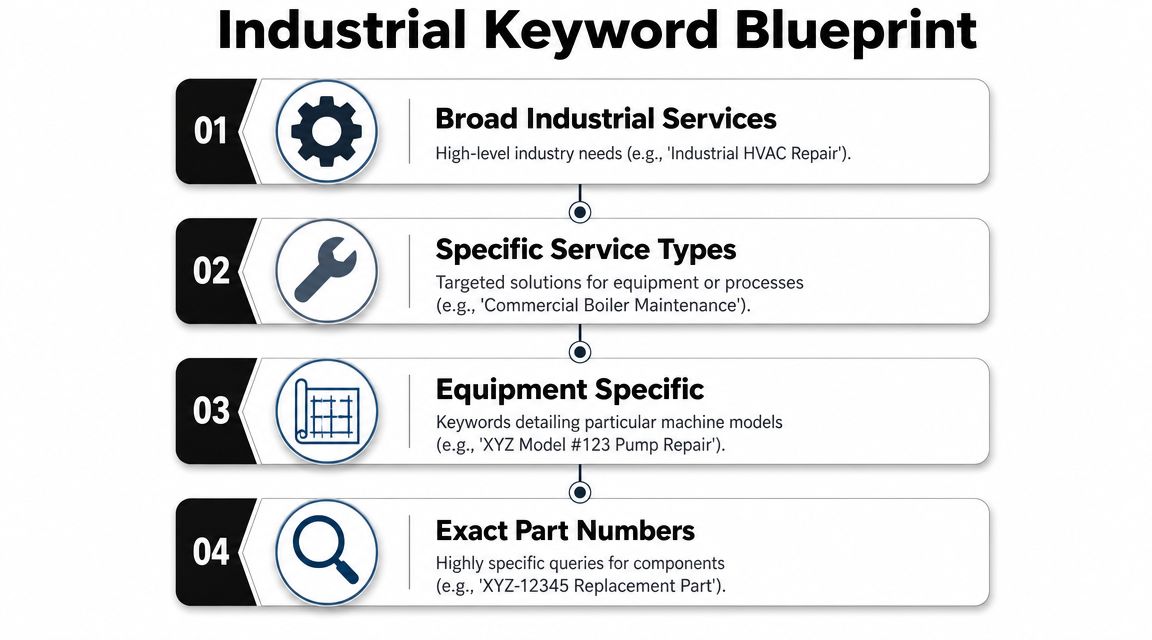
Here's what that looks like in plain terms:
Capability terms
These are your core services. Think “hydrovac contractor Vernal Utah,” “roustabout services Uinta Basin,” or “structural steel fabrication Utah.” They tell Google and buyers what you do.Technical-specification terms
Real commercial intent becomes apparent. Examples might include material grades, pressure classes, axle types, pipe sizes, lifting capacities, or welding processes. Buyers using these searches usually aren't window shopping.Application-specific terms
These connect your service to a real use case. “Pipeline reclamation contractor,” “tank battery maintenance contractor,” or “aggregate hauling for road construction” tells you what problem the searcher is trying to solve.
How to build a list that actually brings leads
A good keyword list usually starts in the field, not in an SEO tool. Listen to how your estimator, dispatcher, shop manager, and sales rep describe jobs on the phone. Then compare that language with how buyers phrase needs in RFQs, bid requests, and procurement emails.
Use a simple filter when you review any search term:
| Question | Good sign | Bad sign |
|---|---|---|
| Does it describe a real service? | Matches a revenue line | Sounds general or academic |
| Does it include a technical detail? | Material, equipment, certification, location | No buying signal |
| Could a buyer search this before contacting you? | Yes, especially near RFQ stage | More likely student or hobby traffic |
A generic keyword may get impressions. A specific keyword gets the right phone call.
For oilfield, construction, trucking, and industrial service firms, the strongest terms often combine service + geography, service + equipment, or service + application. That's how you move from “we need traffic” to “we need the right searches.”
Owning Your Service Area with Local SEO and Google Business Profile
Most industrial companies don't need to dominate the whole internet. They need to win in the places they serve. If your crews work Duchesne, Roosevelt, Vernal, the Uinta Basin, or a defined regional footprint, your local search presence needs to reflect that clearly.
A lot of owners overlook this because they think local SEO is only for restaurants, plumbers, or retail stores. That's a mistake. For industrial contractors and service-area businesses, local visibility often determines who gets the first call.
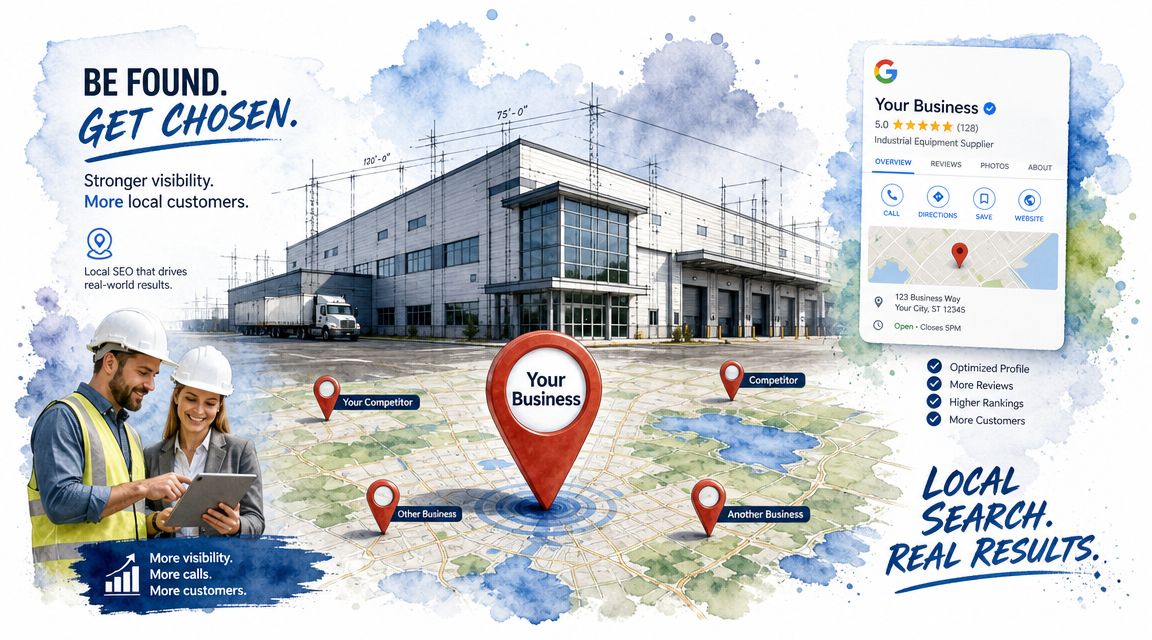
What your Google Business Profile should do
Your Google Business Profile is often the first branded asset a prospect sees. It should answer basic trust questions immediately. Are you real? Are you active? Do you work in my area? What kind of projects do you handle?
For industrial companies, that means treating the profile like an operations snapshot, not just a directory listing.
Focus on these basics:
- Define your service area clearly: If you travel across counties or operate throughout a basin or regional corridor, set that up properly instead of relying on a single office address.
- Use real jobsite and equipment photos: Show trucks, crews, fabrication work, equipment fleets, yards, and field conditions. Skip stock imagery.
- Collect relevant reviews: Reviews from actual customers, vendors, and project partners help validate reliability and responsiveness.
- Keep categories and services aligned: Your listed services should match the language on your website.
If you want extra ideas that overlap well with contractor-type businesses, Pipeline On has a useful guide on local SEO strategies for home service businesses. The market isn't identical, but the practical GBP habits carry over well.
Local pages beat generic coverage
A single “Service Areas” page usually isn't enough. If you serve multiple cities, counties, or regions, create useful pages for those places. Not thin copies. Real pages that explain what work you do there, what types of customers you serve, and what equipment or response capabilities matter in that geography.
That's especially important when buyers search location-first. They may search the service plus the basin, county, or city before they ever look for your company name.
A useful companion read on that side of the work is this collection of local SEO articles, especially if your business depends on map visibility and regional landing pages.
Here's a quick video that shows the mindset behind stronger local visibility:
Trust signals that matter locally
Industrial buyers don't need flashy branding. They need confidence.
A local search presence gets stronger when it shows:
- Current activity: Recent photos, updated hours, and active profile management
- Operational proof: Equipment, trucks, crews, certifications, and types of work
- Geographic clarity: Towns, counties, and service regions you cover
- Responsiveness: Prompt replies to reviews and clear contact options
Local SEO works best when it mirrors the way work gets awarded in the field. Buyers look for coverage, credibility, and evidence that your company can show up and perform.
Your Website as a Hard-Working Digital Asset
A lot of industrial websites still function like digital brochures. They have a homepage, an about page, a short services page, and a contact form. That may check a box, but it doesn't do much selling, ranking, or recruiting.
Your website should work more like a critical piece of equipment. It should be reliable, easy to operate, and built for output. In this case, the output is qualified leads, stronger credibility, and better applicants.
Structure pages around real services
If your company offers excavation, hydrovac, roustabout work, welding, hauling, reclamation, or equipment rentals, each one deserves its own page. Not a bullet on a general services page. A dedicated page.
That page should clearly cover:
- the service itself
- the types of customers or projects it fits
- the geographic area you serve
- the equipment, certifications, or capabilities involved
- the next step, such as a call or RFQ
This is one reason many industrial sites underperform. They bury valuable services under broad headings and force both Google and buyers to guess what they do.
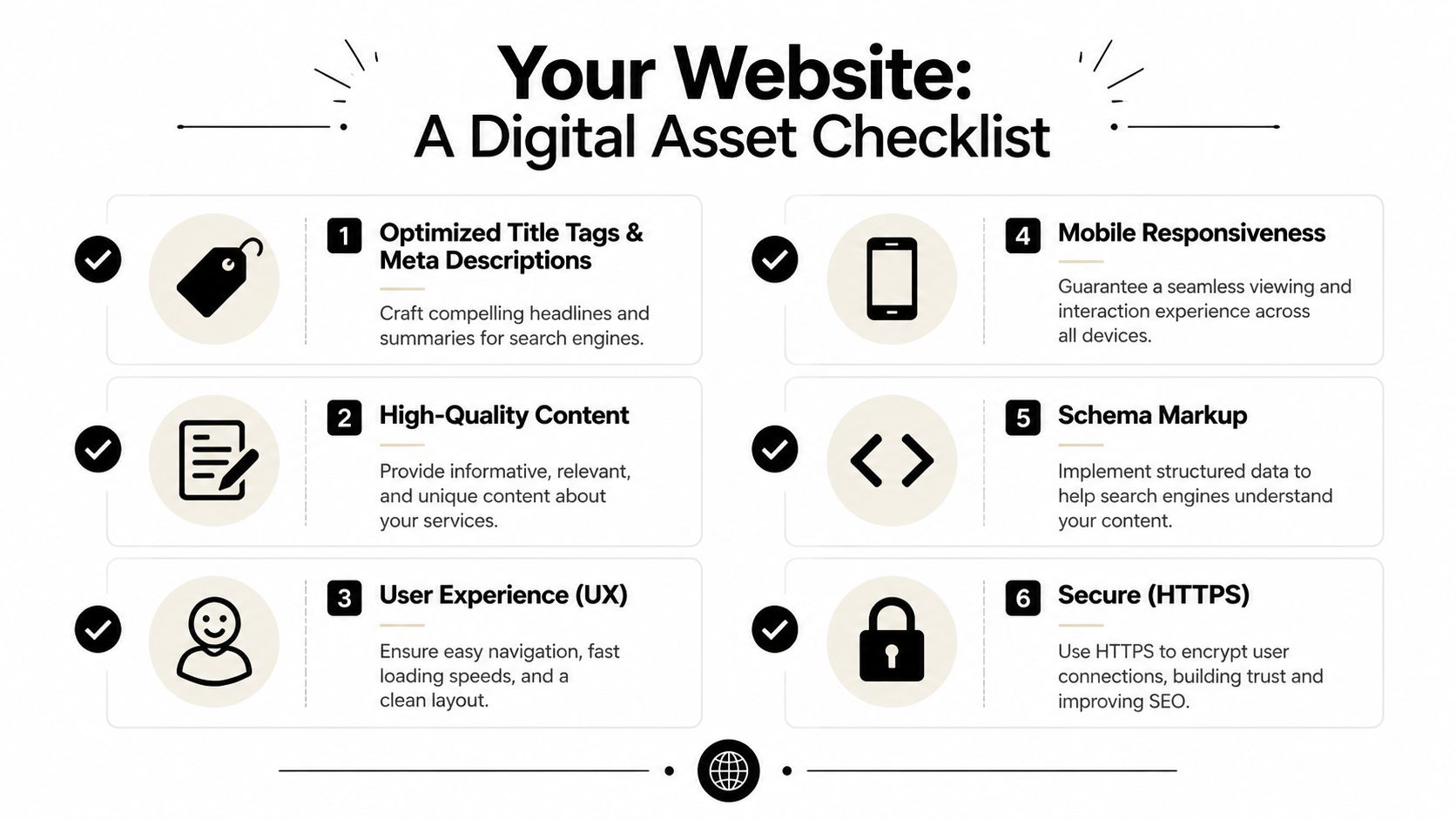
Technical SEO matters more than most owners think
A good industrial site also has to be crawlable. That matters even more for manufacturers, distributors, and companies with larger service or product catalogs. As Nopio notes in its industrial SEO article, search engines handle faceted navigation poorly, so best practice is to use canonical tags, noindex directives for low-value filters, and publish specification tables directly in HTML instead of only in PDFs. The same source also notes that adding schema fields such as mpn can help part-number searches map to the correct listing.
That's technical language, but the business takeaway is simple. If your most useful information is buried in PDFs, duplicate filter pages, or messy navigation, Google has a harder time understanding your site.
Field-tested advice: Put key specs, capabilities, materials, and equipment details on the page itself. PDFs can support the page, but they shouldn't be the only place the information lives.
Mobile speed changes who stays and who leaves
A foreman checking a vendor between stops, a project engineer on site, or a candidate applying from a phone won't fight through a slow or clumsy website. If your site takes too long, hides contact info, or makes forms difficult, you lose good opportunities before a conversation starts.
Think of your website in operational terms:
| Website element | What it should do |
|---|---|
| Service pages | Match high-intent searches to specific offerings |
| Technical content | Prove competence and answer buyer questions |
| Mobile usability | Make it easy to call, request a quote, or apply |
| Site architecture | Help search engines find and understand important pages |
If your site looks decent but doesn't produce much, the issue is often structure, not just design. That's why this piece on why your website needs more than just a designer hits the right point. Industrial sites need performance, not just appearance.
Content for Contracts and Crews Attracting Leads and Talent
Industrial content has two jobs. It needs to help buyers trust you enough to contact you, and it needs to help workers trust you enough to apply. Most companies only build for the first one, and many don't build for either with much intention.
The better model is straightforward. Publish content that answers serious buyer questions and serious applicant questions. If both groups can quickly tell what you do, where you work, and why your company is solid, the website starts pulling more weight.
Content that helps win contracts
Say a project manager is comparing contractors for pipeline support work, site prep, fabrication, hauling, or environmental cleanup. They're not looking for a fluffy blog post. They want enough detail to know whether your company belongs on the bid list.
The strongest pages usually follow a layered approach. Zero Gravity Marketing's article on industrial SEO challenges notes that industrial buying journeys involve multiple stakeholders, and content should serve engineers, procurement teams, and field users at the same time. A strong page leads with concise business outcomes, then goes deeper into technical detail, certifications, and downloadable resources. The same source also notes that industrial buyers increasingly research from phones and that pages slower than 3 seconds can lose visitors.
That layered format works because different people look for different proof:
- An engineer wants methods, tolerances, materials, and specifications.
- Procurement wants scope clarity, service area fit, and confidence you can deliver.
- Operations or field teams want to know you understand real-world site conditions.
A useful contract-focused content mix often includes:
- Detailed service pages: One page per service line, not one generic catch-all page
- Project galleries: Real photos with captions that explain the work
- Capability pages: Equipment lists, certifications, materials, and service regions
- FAQ content: Straight answers to jobsite, scheduling, safety, and scope questions
Content that helps hire better people
Now look at the same site from a welder's, driver's, or operator's perspective. Most industrial careers pages are thin. They list a job title, maybe a sentence or two, and an email address. That's not enough if you want better applicants.
Strong recruiting content gives candidates a reason to choose your company over the next one. It should explain the work environment, expectations, locations, schedule realities, and what kind of person does well there.
A more effective hiring section usually includes:
- A real careers page: Explain the company, the work, and the kind of roles you hire for
- Position-specific pages: CDL drivers, equipment operators, welders, mechanics, laborers
- Mobile-friendly application flow: Short, usable forms that don't frustrate field applicants
- Work culture proof: Photos of crews, trucks, shop conditions, and project environments
If your website can convince a buyer you're reliable, it can also convince a good employee that you're worth applying to.
One foundation, two outcomes
Consequently, SEO for industrial companies becomes more valuable than many owners expect. The same technical structure, local visibility, and page quality that help generate RFQs also support recruiting. Service pages attract buyers. Location pages build regional trust. A strong mobile experience helps both quote requests and job applications.
That makes your website more than a sales tool. It becomes part business development system, part recruiting platform.
Building Digital Authority Through Industry Partnerships
A lot of business owners hear “link building” and think of spam emails, cheap directory sites, and shady SEO tactics from fifteen years ago. That approach isn't useful for industrial companies, and it usually creates more noise than value.
A better way to think about it is digital networking. You already have real-world authority through suppliers, associations, chambers, project partners, vendors, and customers. SEO works better when you translate those relationships into credible online mentions and links.
Start with relationships you already have
Most industrial companies don't need to manufacture authority from scratch. They need to document the authority they already have.
That can include:
- Trade associations: Membership directories, profile listings, or featured member pages
- Manufacturers and suppliers: Vendor pages, dealer locators, or customer spotlights
- Local business groups: Chamber of Commerce listings, regional business organizations, economic development sites
- Project partners: Joint announcements, subcontractor acknowledgments, or case summaries
The key is relevance. A link from an organization tied to your market, region, or service type is usually worth more than a random mention on an unrelated site.
What works and what wastes time
The strongest authority-building efforts usually feel normal from a business standpoint. If you'd do it for reputation even without SEO, it's often a good sign.
Good examples include:
| Tactic | Why it works |
|---|---|
| Give a testimonial to an equipment vendor | They may publish it with a company link |
| Sponsor a local trade event | You often earn a relevant listing or mention |
| Publish technical insights with a partner | Both companies gain useful visibility |
| Maintain directory profiles in real industry organizations | Buyers and search engines both use them |
What usually doesn't work is chasing volume for its own sake. Low-quality directories, paid junk listings, and generic outreach rarely help industrial firms build trust with the right audience.
Your best SEO authority often comes from the same people who already know your work is solid.
Authority is also a branding signal
There's another practical benefit here. When a prospect checks your company and sees your name connected to trade organizations, local business groups, suppliers, and community partners, your credibility goes up. That's not only an algorithm issue. It affects how buyers and applicants perceive risk.
For industrial businesses, the cleanest authority strategy is simple. Be visible in the places your industry already respects.
Tracking Real Results From Website Clicks to Signed Contracts
Industrial SEO goes sideways when reporting focuses on rankings and raw traffic instead of business outcomes. Being number one for a broad search term doesn't help much if the people landing on the site were never going to request a quote or apply for a job.
That's why BlackBean Marketing's industrial manufacturing SEO article gets the priority right. It warns that ranking number one isn't useful if the traffic is unqualified, and says the better success metrics are a mix of qualified organic sessions, RFQ submissions, and pipeline attribution, not traffic alone.
Industrial SEO KPI Scorecard
| Metric | Why It Matters for Industrials | How to Track It |
|---|---|---|
| Qualified organic sessions | Shows whether the right visitors are landing on service, location, or careers pages | Review organic landing pages and filter for pages tied to real buying or hiring intent |
| RFQ submissions | Direct lead signal from search traffic | Track form submissions tied to quote or estimate forms |
| Phone calls from organic traffic | Many industrial buyers still prefer calling first | Use call tracking or tagged click-to-call events |
| Careers form submissions | SEO can support hiring as well as sales | Track completed job applications from organic sessions |
| Pipeline attribution | Connects leads to actual revenue opportunities | Match CRM records to original organic source when possible |
If you need a sharper framework for scoring inquiry quality, this guide on how to define lead quality KPIs is useful because it pushes the conversation beyond simple lead counts.
What to ignore first
Don't obsess over vanity metrics in isolation. Broad rankings, total impressions, and non-converting traffic can look good in a report and still do nothing for the business.
A better monthly review asks:
- Are the right pages getting found?
- Are quote requests improving in quality?
- Are more applicants coming through the careers funnel?
- Can sales trace serious opportunities back to organic search?
That's the level where SEO becomes an operating asset instead of a marketing line item.
Frequently Asked Questions About Industrial SEO
How is SEO for industrial companies different from consumer SEO
Industrial SEO targets a smaller audience with much higher intent. Buyers often search with technical language, specific service needs, certifications, material grades, part numbers, and locations. The goal isn't mass traffic. It's getting found by the right person at the right stage of a buying or hiring decision.
Do we need separate pages for every service
Usually, yes. If excavation, hauling, welding, fabrication, reclamation, rentals, and roustabout work all sit on one page, both buyers and search engines have to guess what matters most. Dedicated pages make your capabilities clearer and improve relevance for specific searches.
Should we focus more on Google Business Profile or the website
Both matter, but they do different jobs. Google Business Profile helps with local visibility, map presence, and quick trust signals. Your website closes the gap by showing capabilities, project proof, locations served, and clear quote or application paths.
Can SEO help with hiring too
Yes. It's one of the most overlooked benefits. Many workers search employers before they apply. A strong careers section, mobile-friendly applications, and visible location and service pages can help attract better applicants, especially in competitive labor markets.
What if our industry is too niche for search volume
That's often a good sign, not a problem. In industrial markets, narrow search demand can still produce valuable opportunities. A handful of highly specific searches from engineers, procurement contacts, or field supervisors can be worth far more than broad, unqualified traffic.
How long does industrial SEO take
It depends on your starting point, your market, and how much work gets implemented. What matters most is consistency. Industrial SEO tends to compound when service pages, local visibility, technical improvements, and content quality all improve together.
If your company needs a website that brings in better leads, supports recruiting, and reflects the quality of your operation, Northpoint Web helps contractors, oilfield service companies, and industrial businesses build digital assets that work effectively. They're based in the Uinta Basin and understand how rural Utah businesses compete, hire, and grow.
Why industrial SEO is different from consumer SEO
Industrial search is usually narrower and more technical than consumer search. Buyers may search by service, geography, equipment class, material, certification, application, or part number. That means the most valuable opportunities may come from specific searches rather than high-volume generic terms.
Build the strategy around the language used in RFQs, procurement conversations, estimating calls, dispatch, and recruiting. Those real-world terms are more useful than relying only on broad phrases such as “construction company” or “industrial services.”
Build an industrial keyword map around buying intent
Organize target topics into three practical groups:
- Capability terms: the services your company sells.
- Technical terms: materials, processes, specifications, certifications, or equipment.
- Application terms: the job, environment, or problem the buyer needs solved.
Combine these topics with relevant service areas when appropriate. Review each target by asking whether it represents a real revenue line, a genuine buyer need, and a reasonable path to contact.
Make your service area visible without creating thin pages
Industrial service-area businesses should clearly explain where they work and what they do there. Keep location pages useful by including actual service coverage, relevant capabilities, operating limitations, and a clear inquiry path. Do not create near-duplicate pages for every town unless each page provides genuinely distinct information.
Review your Local SEO presence, including your Google Business Profile, business details, service descriptions, photos, and review process. These assets should reinforce the same services and locations shown on your website.
Turn the website into a useful sales and recruiting asset
Each important service should have a page that explains what is provided, who it is for, the situations it supports, the areas served, and how to start a conversation. Capability details should be specific enough for a buyer to decide whether contacting you makes sense.
Recruiting content can support the same foundation by explaining the kinds of work, roles, locations, and application steps that are genuinely available. Use clear calls to action for both commercial inquiries and employment inquiries when both audiences matter.
Industrial buyers and applicants start with Google
Industrial companies still win business through relationships, referrals, and repeat customers. But buyers, procurement contacts, project managers, and potential employees often verify a company online before they call or apply. If your services, locations, capabilities, or certifications are difficult to find, a referral may not be enough to keep you on the shortlist.
A search strategy built around how industrial buyers actually search
Industrial SEO should connect real revenue lines to the searches your market uses. That may include services, equipment, materials, certifications, applications, service areas, and technical specifications. The goal is not broad traffic for its own sake; it is qualified visibility for searches that can lead to RFQs, calls, project conversations, or applications.
What a stronger industrial search presence can support
- Help prospective buyers validate your company after a referral.
- Make important services and capabilities easier to discover.
- Support visibility in the locations your crews or teams serve.
- Give recruiting prospects a clearer understanding of your company.
- Create measurable paths from search visits to calls, forms, and other inquiries.
Use evidence and operational detail instead of generic marketing language
Industrial buyers need specific information before they reach out. Explain the services you provide, the equipment or processes you support, the areas you serve, and the types of projects you accept. Add real project examples, photos, certifications, or capability details only when they are accurate and approved for publication.
SEO does not replace relationships or industry expertise
SEO is not a replacement for referrals, sales relationships, estimating, or field experience. It supports those channels by helping people find and validate your company when they are outside your existing network. A focused strategy can also prioritize specific commercial searches instead of pursuing general traffic that has little connection to your work.
Find the next opportunities in your industrial website
Northpoint can review how your services, locations, and conversion paths are represented online, then identify practical opportunities to improve search visibility and qualified inquiries. Direct readers to the services page for the appropriate next step rather than making unsupported promises about rankings or lead volume.
See where your industrial website can improve
If buyers or applicants are searching for your services but finding competitors, start with a review of your current website structure, service coverage, local visibility, and inquiry paths. Explore Northpoint's services to identify an appropriate next step.
Why industrial SEO is different from consumer SEO
Industrial search is usually narrower and more technical than consumer search. Buyers may search by service, geography, equipment class, material, certification, application, or part number. That means the most valuable opportunities may come from specific searches rather than high-volume generic terms.
Build the strategy around the language used in RFQs, procurement conversations, estimating calls, dispatch, and recruiting. Those real-world terms are more useful than relying only on broad phrases such as “construction company” or “industrial services.”
Build an industrial keyword map around buying intent
Organize target topics into three practical groups:
- Capability terms: the services your company sells.
- Technical terms: materials, processes, specifications, certifications, or equipment.
- Application terms: the job, environment, or problem the buyer needs solved.
Combine these topics with relevant service areas when appropriate. Review each target by asking whether it represents a real revenue line, a genuine buyer need, and a reasonable path to contact.
Make your service area visible without creating thin pages
Industrial service-area businesses should clearly explain where they work and what they do there. Keep location pages useful by including actual service coverage, relevant capabilities, operating limitations, and a clear inquiry path. Do not create near-duplicate pages for every town unless each page provides genuinely distinct information.
Review your Local SEO presence, including your Google Business Profile, business details, service descriptions, photos, and review process. These assets should reinforce the same services and locations shown on your website.
Turn the website into a useful sales and recruiting asset
Each important service should have a page that explains what is provided, who it is for, the situations it supports, the areas served, and how to start a conversation. Capability details should be specific enough for a buyer to decide whether contacting you makes sense.
Recruiting content can support the same foundation by explaining the kinds of work, roles, locations, and application steps that are genuinely available. Use clear calls to action for both commercial inquiries and employment inquiries when both audiences matter.