
A DIY website can cost under $50 per month, while a professional site from a freelancer or agency usually lands somewhere from $3,000 to over $10,000. That spread is normal. Website price depends entirely on how you build it and what you need it to do.
If you're a contractor in Vernal, a trucking company in Roosevelt, or an oilfield service outfit in Duchesne, you've probably already seen this. One quote looks cheap enough to ignore. Another looks like someone priced you a new piece of equipment. Both might be honest. They just aren't talking about the same thing.
A website is a lot like a truck. A basic pickup gets you down the road. A fully outfitted work truck with toolboxes, racks, upgraded suspension, and a diesel motor costs a whole lot more because it does a whole lot more. Same with websites. A simple online brochure is one thing. A site that brings in leads, filters bad prospects, and helps you recruit CDL drivers or operators is a different asset entirely.
That distinction matters more in rural Utah than most generic website articles admit. Around the Uinta Basin, labor is tight, trust matters, and buyers often check your website before they call. If your site can't help you win jobs or attract workers, the cheap option can turn into the expensive one fast.
Table of Contents
- How Much Does a Small Business Website Really Cost
- What Actually Drives Your Website Price Tag
- Choosing Your Path DIY vs Freelancer vs Agency
- Real Website Costs for Uinta Basin Businesses
- Budgeting for the Long Haul Recurring Website Costs
- Your Website Budgeting Toolkit and Next Steps
How Much Does a Small Business Website Really Cost
A contractor in the Uinta Basin can get one quote for $800 and another for $8,000, and both can be honest numbers. They are pricing different tools for different jobs. A cheap site is like a basic trailer you pull to the job. A growth-focused site is more like a service truck stocked to keep work moving and bring in the next call.
That gap confuses a lot of owners. It should not. Website cost depends on what the site is expected to produce for the business.
A simple site can be inexpensive. A site built to bring in quote requests, show up in search, answer common questions, and help recruit operators or CDL drivers costs more because it does more work. If you want a clear picture of what goes into a serious build, review what's really included in a $7,500 website build.
The easiest way to understand pricing is to compare it to another marketing service owners already know. If you've ever looked at a real estate photo pricing guide, you know the price changes based on the job. A few basic listing photos cost less than a full package with drone shots, twilight images, and marketing extras. Website pricing works the same way. A home page and contact page are one level. Lead forms, hiring pages, local SEO setup, and custom service content are another.
What you're really buying
For a small business in rural Utah, a website usually needs to earn its keep in a few specific ways:
- Build trust so a prospect picks up the phone instead of calling the next company
- Generate leads from Google searches, map listings, and referrals
- Help recruiting when skilled labor is hard to find and harder to keep
- Save office time by answering basic questions before someone calls
That last point gets ignored in generic website guides. Around here, labor is tight. If you're an excavation company, HVAC shop, diesel outfit, or oilfield service business, your site is not just a brochure. It can help you win work and fill open positions. Those two outcomes matter more than having fancy design features nobody asked for.
Here is the rule I give local owners. If the website only needs to show you exist, keep it lean. If it needs to help grow revenue or attract good people, pay for a professional build that is set up to do that job well.
What Actually Drives Your Website Price Tag
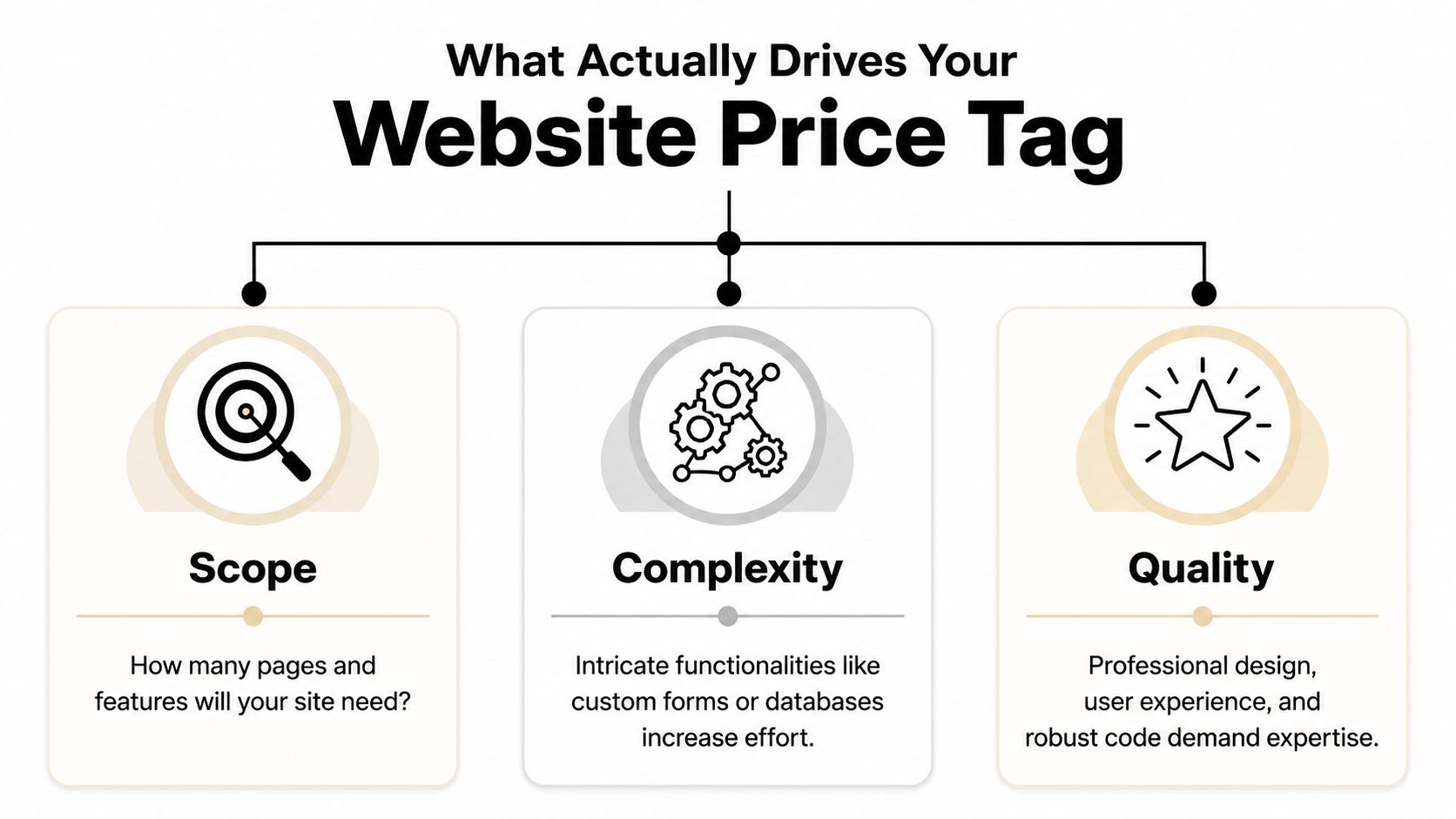
The number of pages matters, but it usually isn't the main driver. Functionality complexity is where price starts to move.
Industry guidance shows a basic DIY WordPress build can start near $100 to $400 upfront with $10 to $75 per month in hosting and tools, while a custom small-business site commonly rises to $2,000 to $8,000 with a freelancer or $10,000 to $35,000+ with an agency when it includes custom design, SEO setup, integrations, or e-commerce features, as outlined in Elementor's website cost guide.
Imagine building a workshop. Square footage affects cost, sure. But the wiring, concrete work, specialty tools, and finishes are what really separate a basic shed from a building that supports serious work.
Scope is the size of the job
Scope is the footprint.
If you need a home page, about page, service pages, gallery, contact page, and maybe a careers page, that takes more planning and content than a one-page site. More pages usually mean more writing, more layout work, and more decisions.
But don't get stuck counting pages like they're the whole story. A seven-page site can still be simple. Another seven-page site can be a headache if every page has custom sections, forms, filters, or special content needs.
Complexity is where cost jumps
This is the big one.
Add a quote request system that routes leads by service type. Add hiring forms for CDL drivers. Add booking, CRM integration, e-commerce, shipping logic, or custom location pages. Every feature adds setup, testing, and future maintenance.
A lot of business owners don't see that part at first. They compare a cheap site to a growth-focused site and think the only difference is design. It isn't. The difference is what happens behind the scenes. If you want a plain-English breakdown of that middle tier, this explanation of what's really included in a $7,500 website build is worth reading.
Here's a simple way to judge complexity:
- Low complexity means brochure pages, basic contact forms, standard templates
- Medium complexity means lead funnels, service-area pages, stronger SEO setup, better forms
- High complexity means custom applications, recruiting workflows, online payments, portals, or deep integrations
The video below gives a solid overview of how these moving parts affect budget.
Quality decides whether the site works or just exists
Two shops can both say they build websites. That doesn't mean they build the same thing.
Quality shows up in the writing, layout, mobile performance, photo selection, calls to action, code quality, and how easy the site is to update later. It also shows up in the strategy. A decent builder can make a website look acceptable. A strategist builds it so a contractor gets better calls and fewer tire-kickers.
A cheap site often lowers launch cost, not ownership cost. If it breaks, looks dated, or fails to convert, you pay for it later.
That's why small business website cost should be judged like any other capital expense. Don't ask only what it costs to buy. Ask what it costs to own, use, and rely on.
Choosing Your Path DIY vs Freelancer vs Agency
A website builder, a freelancer, and an agency can all put a site online. That does not mean they solve the same business problem.
For a contractor in Roosevelt or an oilfield service company in Vernal, the question is simple. Do you need a site that just proves you exist, or a site that helps you win bids, get quote requests, and recruit people who can pass a drug test and show up on Monday? Website pricing works the same way as buying equipment. A basic tool is cheaper. The right tool earns its keep.
When DIY makes sense
DIY works for a new business that needs a clean placeholder fast.
If you are just getting started, a platform like Wix or Squarespace can handle the basics. You can list services, show your phone number, add a form, and stop losing work to competitors who at least have something online.
That said, DIY usually tops out early.
Once you need better service-area pages, stronger local search visibility, hiring pages, or clearer calls to action, the cracks show. You end up wrestling with templates instead of running your business. For a serious contractor, that is like trying to trench with a shovel because the shovel was cheaper than a machine.
When a freelancer is the practical middle ground
A good freelancer is often the right fit for a small business that has outgrown DIY but does not need a full outside team.
This route can work well for local service companies with a defined scope and decent source material. If you already know your services, have solid photos, and can give feedback quickly, a freelancer can build a strong site without a lot of overhead.
The tradeoff is depth and capacity. One person may be handling design, copy, SEO setup, edits, and support. If that person is good, great. If that person disappears during hunting season, gets booked out, or is weak in one area, your project slows down or comes out uneven.
When an agency is the right tool
Agency work fits businesses that expect the website to produce results, not just sit there.
If the site needs to support lead generation, recruiting, content planning, search structure, maintenance, and ongoing improvement, an agency is usually the better choice. That matters in the Uinta Basin, where many companies are fighting two battles at once. They need more qualified inquiries, and they need more skilled labor. Generic website advice misses that. Around here, the hiring side often matters just as much as the sales side.
If you are still sorting out platform options before choosing a provider, this guide to small business website platforms will help you compare the tradeoffs.
Website Build Options Compared
| Factor | DIY (Wix, Squarespace) | Freelancer | Agency (Northpoint Web) |
|---|---|---|---|
| Upfront cost | Lowest | Middle | Higher |
| Monthly cost | Predictable subscription | Varies by hosting and support setup | Usually paired with ongoing support |
| Best for | Basic credibility | Solid custom site with moderate needs | Lead generation, recruiting, long-term growth |
| Owner involvement | High | Medium | Medium, but more guided |
| Flexibility | Limited | Good | Highest |
| Support after launch | Usually self-managed | Depends on the freelancer | Usually structured |
| Recruiting and SEO readiness | Basic | Possible if scoped well | Better fit for businesses that need strategy and execution |
If your website needs to help hire operators, drivers, techs, or office staff, DIY is usually the wrong choice. It lowers launch cost, but it often costs more in missed calls, weak applicants, and rebuilds later.
My recommendation is straightforward. Use DIY if cash is tight and you need to get online this month. Hire a freelancer if the project is clear and your needs are moderate. Hire an agency if the website affects revenue, staffing, or both. A $50 tool should not be carrying a $500,000 part of your business.
Real Website Costs for Uinta Basin Businesses
Generic website advice usually stops at pages and design. Around here, that misses the point. For a lot of Uinta Basin businesses, the website isn't just a brochure. It's part sales tool, part recruiting tool, part credibility check.

A local business owner doesn't just need "a website." He needs a site that helps him solve the problem right in front of him.
Excavation contractor in Duchesne
This owner needs more than a gallery of dirt work and pipe installs.
He needs project photos, service pages, trust signals, a clean quote request form, and a recruiting page that doesn't look like an afterthought. If he needs operators, laborers, or CDL drivers, the hiring side can't be buried in a generic careers tab with one sentence and a bad application form.
Recent analysis focused on rural energy markets says a standard $5,000 brochure site often fails to attract qualified tradespeople because it lacks recruiting features such as job-board integrations and employee testimonial structures. The same analysis says recruitment costs for skilled trades in rural U.S. energy sectors exceed $4,000 per hire, and the added recruiting premium for the right website functionality is typically 15% to 25% of the total build cost in these markets, according to this Uinta Basin-focused website cost discussion.
That should change how you budget. If one good hire matters, the site needs to support hiring from day one.
Oilfield service company in Roosevelt
This company usually cares about trust, capability, and professionalism.
The site should show service lines clearly, explain the company's operating standards, make it easy for buyers to understand what crews and equipment are available, and give larger clients confidence that they're dealing with a legitimate operation. Safety, responsiveness, and clean presentation matter here because procurement teams and field managers are judging your company before they ever call.
For this kind of business, the website earns its keep by helping win better conversations. It also supports recruiting when the labor market tightens. A weak site makes a serious company look smaller than it is.
If you want examples of where local businesses leave money on the table online, this review of Uinta Basin businesses that could grow with a simple website fix shows the kinds of issues that hold companies back.
Vacation rental owner near Heber
This one is different. The main question isn't hiring. It's control.
A rental owner may want a site that shows the property well, answers guest questions, builds trust, and encourages direct booking inquiries instead of depending entirely on third-party platforms. That pushes the budget toward better photography, polished layout, stronger mobile experience, and cleaner calls to action.
The lesson across all three examples is the same. The right website budget comes from the business problem. Not from a random average on the internet.
Budgeting for the Long Haul Recurring Website Costs
A website isn't a one-time print job. It's more like a truck in your fleet. Once you buy it, you still have fuel, tires, insurance, service, and the occasional repair. Ignore those costs and the thing stops doing its job.
Independent industry guides put standard small-business builds at roughly $1,500 to $15,000 for a 5 to 8 page site, while recurring expenses commonly add $500 to $2,400 per year for hosting, domain, maintenance, backups, and security updates. For service businesses, maintenance retainers of $100 to $500 per month are common, based on this small business website cost guide.
The first-year budget is what catches people
A lot of owners only budget for the build.
Then the domain renews. Hosting renews. Plugins need licenses. WordPress needs updates. Forms break. A staff member wants new service pages. A phone number changes. Suddenly the website didn't cost what the invoice said. It cost the invoice plus the upkeep.
Your real small business website cost is build price plus the cost to keep it secure, current, and useful.
That's why I tell people to budget in two buckets from the start:
- Build cost for design, content, setup, and launch
- Ownership cost for hosting, maintenance, security, backups, and edits
What ongoing website costs usually include
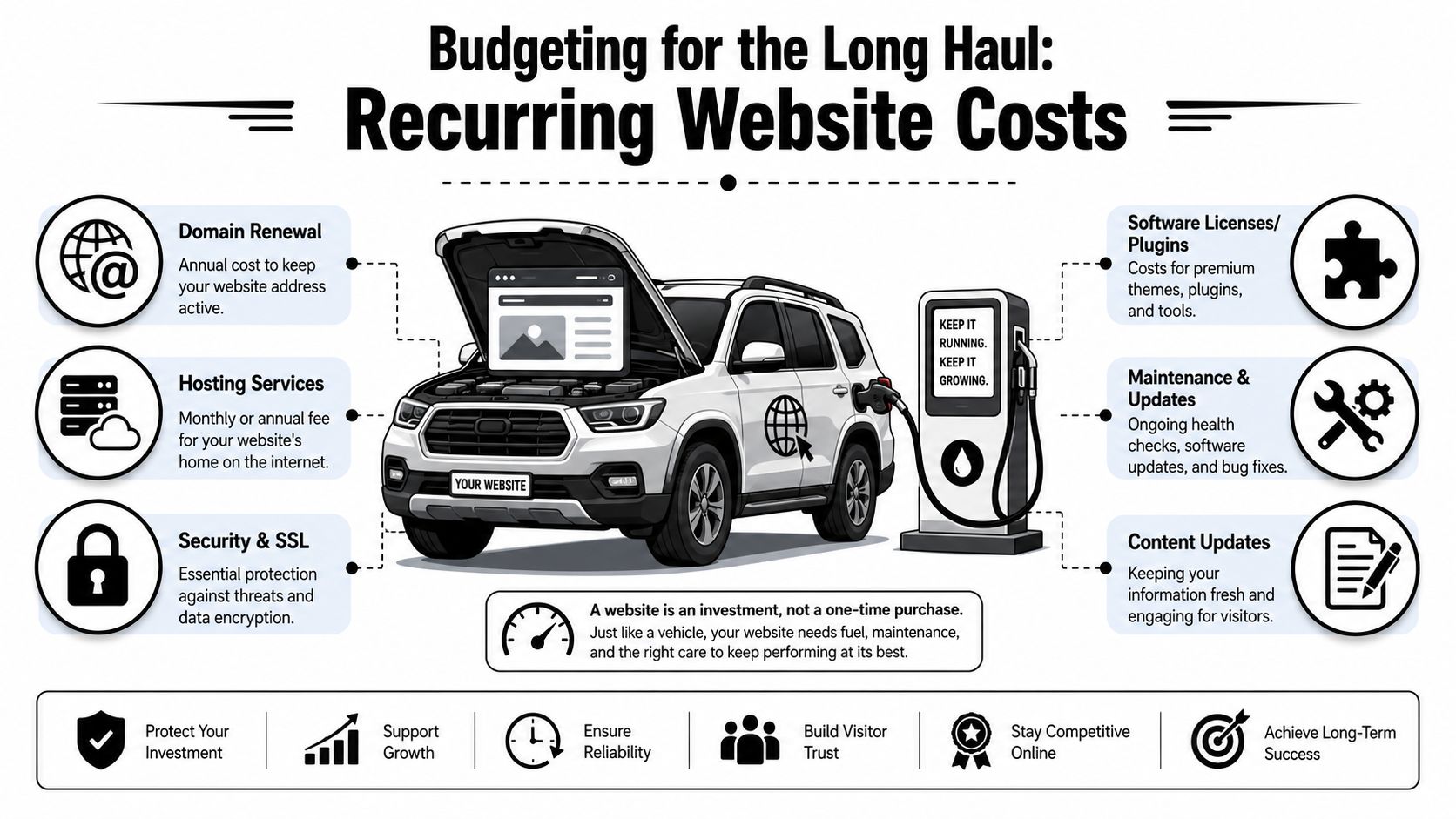
Most recurring website budgets include a mix of the following:
- Hosting that keeps the site online and loading reliably
- Domain renewal so you keep ownership of your web address
- Security and backups in case the site gets hit or something breaks
- Plugin and software licensing for forms, SEO tools, booking tools, and premium features
- Maintenance labor for updates, testing, fixes, and small content changes
Reputation work can also become part of ongoing digital costs, especially if reviews or search trust are affecting leads. If that issue is on your radar, this overview of pay-for-results reputation management services is a useful companion read because reputation and website conversion usually work together.
The bottom line is simple. If the website matters to your business, maintenance is not optional. You don't park a truck all winter, skip oil changes, and expect it to haul without problems. Same deal here.
Your Website Budgeting Toolkit and Next Steps
If you want accurate quotes, don't start by asking, "What does a website cost?" Start by answering the questions that define the job.
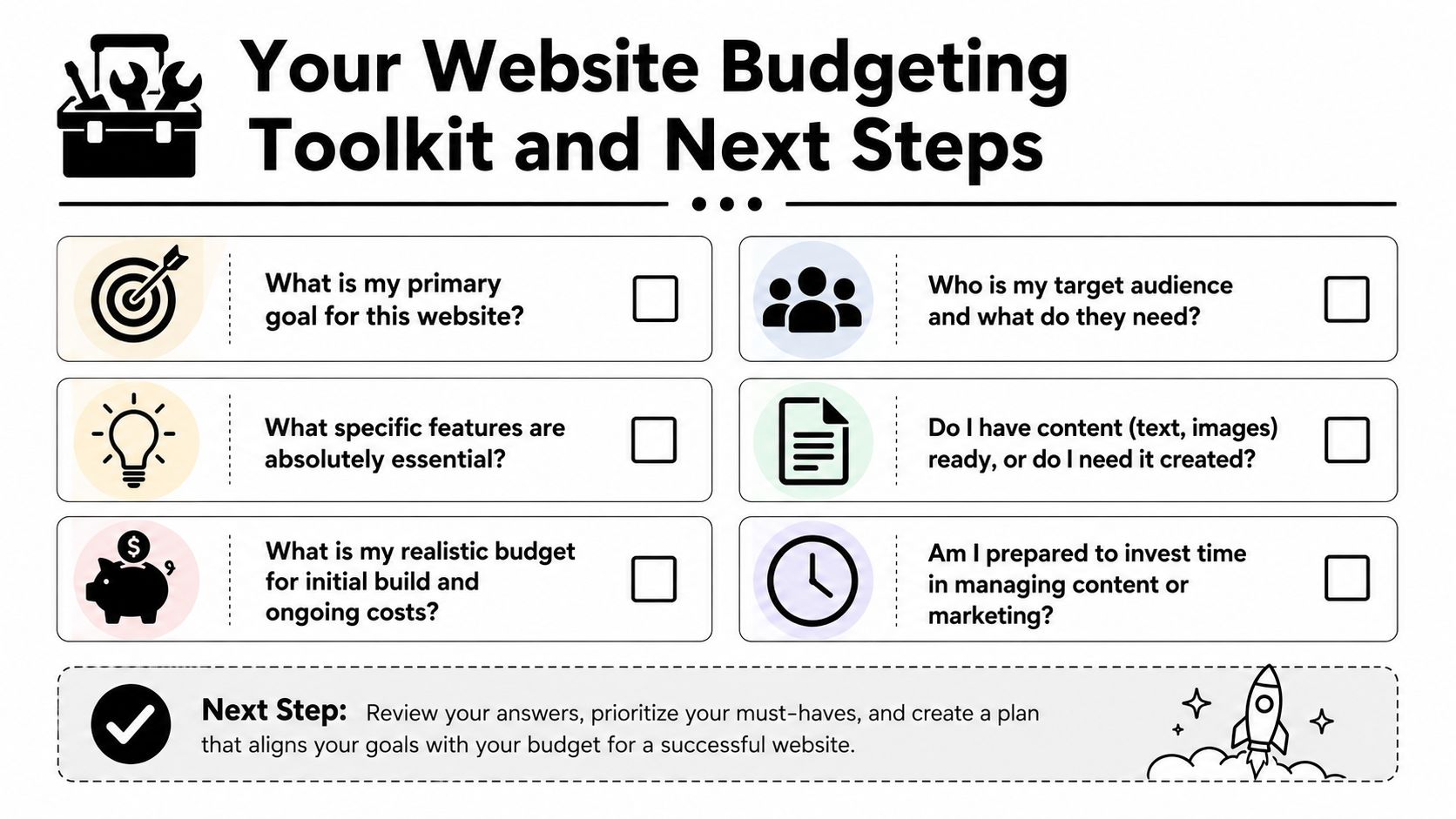
Six questions to answer before you ask for quotes
Write these down before you call anyone.
What is the website supposed to do?
If the answer is "just have something online," your budget can stay lean. If the answer is "bring in leads, support sales, and help recruit," expect a more serious build.Who needs to use it?
Homeowners, commercial buyers, truck drivers, job applicants, vacation guests, and municipal contacts all need different information. One site can't speak clearly to everyone unless it's planned well.What features are required from day one?
Quote forms, hiring forms, job pages, service-area pages, galleries, booking requests, CRM connections, and review integration all change scope.Do you already have content and photos?
Good websites need good raw material. If you don't have quality jobsite photos, team photos, service descriptions, or hiring copy, somebody has to create them.Who will handle updates after launch?
Some owners want control. Others never want to log in. Be honest. That answer affects platform choice and support needs.What's your real budget for build and ownership?
Not your wish budget. Your actual budget. If you only plan for launch and ignore recurring costs, you're setting the project up wrong.
"The cheapest website is usually the one that only has to exist. The minute it needs to perform, strategy matters."
Three practical budget levels
I like to frame website budgeting around function, not vanity.
| Package type | What it usually includes | Best fit |
|---|---|---|
| Digital Business Card | Core pages, contact form, basic credibility, simple layout | New business or very limited budget |
| Lead Generation Machine | Stronger service pages, conversion-focused structure, better messaging, room for SEO and lead capture | Established service business that wants more calls |
| Recruiting and Growth Engine | Hiring pages, applicant flow, stronger trust content, service clarity, recruitment support, maintenance plan | Contractors, oilfield services, trucking, and industrial firms trying to grow crews |
You don't need to name your project this way when you get quotes. But you should know which category you're shopping for. A lot of bad website decisions happen because owners ask for a business card site when what they need is a lead and recruiting system.
Common questions from local business owners
Can I update the site myself?
Usually, yes. But there's a big difference between changing text on a page and managing plugins, forms, security, and layout problems. Know which kind of update you're talking about.
Should I start small and add later?
Usually yes, if the foundation is right. Starting lean is smart. Starting cheap on the wrong platform is not.
Do I need ongoing SEO right away?
Not every business needs a heavy SEO push on day one. But every business does need clear service pages, solid messaging, clean structure, and a site that doesn't look abandoned.
Should I choose based on lowest bid?
No. Choose based on whether the bid matches the business outcome you need. Lowest bid is only a win if the site does the job.
What should I bring to the first conversation?
Your services, service areas, photos, logo, competitor examples, and a clear answer about whether hiring is part of the website's job.
If you're a local contractor or industrial business owner, the right move is to treat your website like any other business asset. Buy the right tool for the work. Don't overbuild. Don't underbuy. And don't confuse a cheap launch with a smart investment.
If you want help sorting out what your website should cost for your business, Northpoint Web works with contractors, oilfield service companies, trucking businesses, and other rural Utah companies that need websites built for leads, recruiting, and day-to-day credibility. A straight conversation about your goals, your market, and your realistic budget will save you a lot of wasted time.