
Your website might look sharp. The logo is clean, the photos are decent, and somebody already paid to “get it online.” But if you're a contractor in Duchesne, a trucking company near Roosevelt, or an oilfield service outfit around Vernal, the key question is simple. Is it bringing in calls, quote requests, and job applicants?
That's where most advice on how to get website traffic falls apart. A lot of it is written for bloggers, software startups, or online stores chasing broad audience growth. That's not your game. If you run an excavation company, welding shop, roustabout crew, or local service business, you don't need random visitors from all over the map. You need the right people finding the right pages at the right time.
Current guidance has started to say this more clearly. More traffic does not always mean more leads. For contractors and rural businesses, the better question is which pages bring qualified inquiries or job applicants, not just how to get more visits, as noted in this website visibility analysis.
That changes everything. It changes what pages you build, what keywords you target, what ads you run, and how you judge whether the site is working. It also changes how social media fits into the picture. If you want a practical example of using social channels to drive actual inquiries instead of empty engagement, PostClaw's social media lead strategy is worth reviewing.
Table of Contents
- Stop Chasing Clicks and Start Winning Jobs
- Master Your Backyard with Local SEO
- Create Content That Wins Jobs and Attracts Talent
- Quick Website Fixes That Boost Traffic
- Smart Spending with Paid Ads and Partnerships
- Your 90-Day Website Traffic Action Plan
Stop Chasing Clicks and Start Winning Jobs
A contractor can waste a lot of money chasing “traffic” that never turns into anything. I've seen sites pull attention to the wrong pages, rank for vague terms, and attract people who were never going to call in the first place. The owner gets a report showing activity, but the office still isn't getting better leads.
That usually happens when the site is built around volume instead of intent. A page trying to rank for everything at once ends up weak. A homepage stuffed with every service, every city, and every keyword becomes unclear to both Google and the customer.
The traffic that matters is specific
If someone searches for a broad term, they may just be researching. If they search for a tightly defined service in your area, they're much closer to action. For a rural Utah business, that could mean phrases tied to a service, a place, or a hiring need.
Examples of stronger intent look like this:
- Service plus location: excavation contractor Vernal, welding shop Roosevelt, hydrovac services Uinta Basin
- Problem plus location: emergency pipe repair Duchesne County, site prep contractor near Vernal
- Job-related searches: CDL driver jobs Vernal, heavy equipment operator jobs Duchesne
Practical rule: If a page can't reasonably lead to a call, a quote request, or an application, it probably shouldn't be your main traffic priority.
What usually doesn't work
Broad tactics sound good because they're easy to sell. They also miss the mark for most local industrial businesses.
A few examples:
- Generic blogging: Writing random articles that have nothing to do with your services, service area, or hiring goals.
- Homepage overload: Trying to make one page rank for every service and every city.
- Vanity social posting: Posting for reach without a clear path back to a service page, job page, or contact form.
- Untargeted ads: Paying for attention from people outside your market or outside your actual customer base.
The businesses that get traction online usually do something simpler. They build a small set of pages with clear purpose, tighten up local relevance, and track whether those pages lead to real business outcomes.
Master Your Backyard with Local SEO
If you want to know how to get website traffic for a contractor or service company, start close to home. Local search is usually the shortest path to qualified traffic because the person searching already has a place and a need in mind.
Search visibility is a major driver of website traffic, and traffic tools can reveal estimated organic and paid traffic, top keywords, and geography. That matters because traffic growth often comes from improving keyword coverage, page-level relevance, and geographic targeting, as explained in Matomo's guide to checking website traffic.
Start with your service area and business profile
A lot of local companies leave easy wins on the table because their business profile is half-complete or inconsistent.
Here's the local checklist I'd handle first:
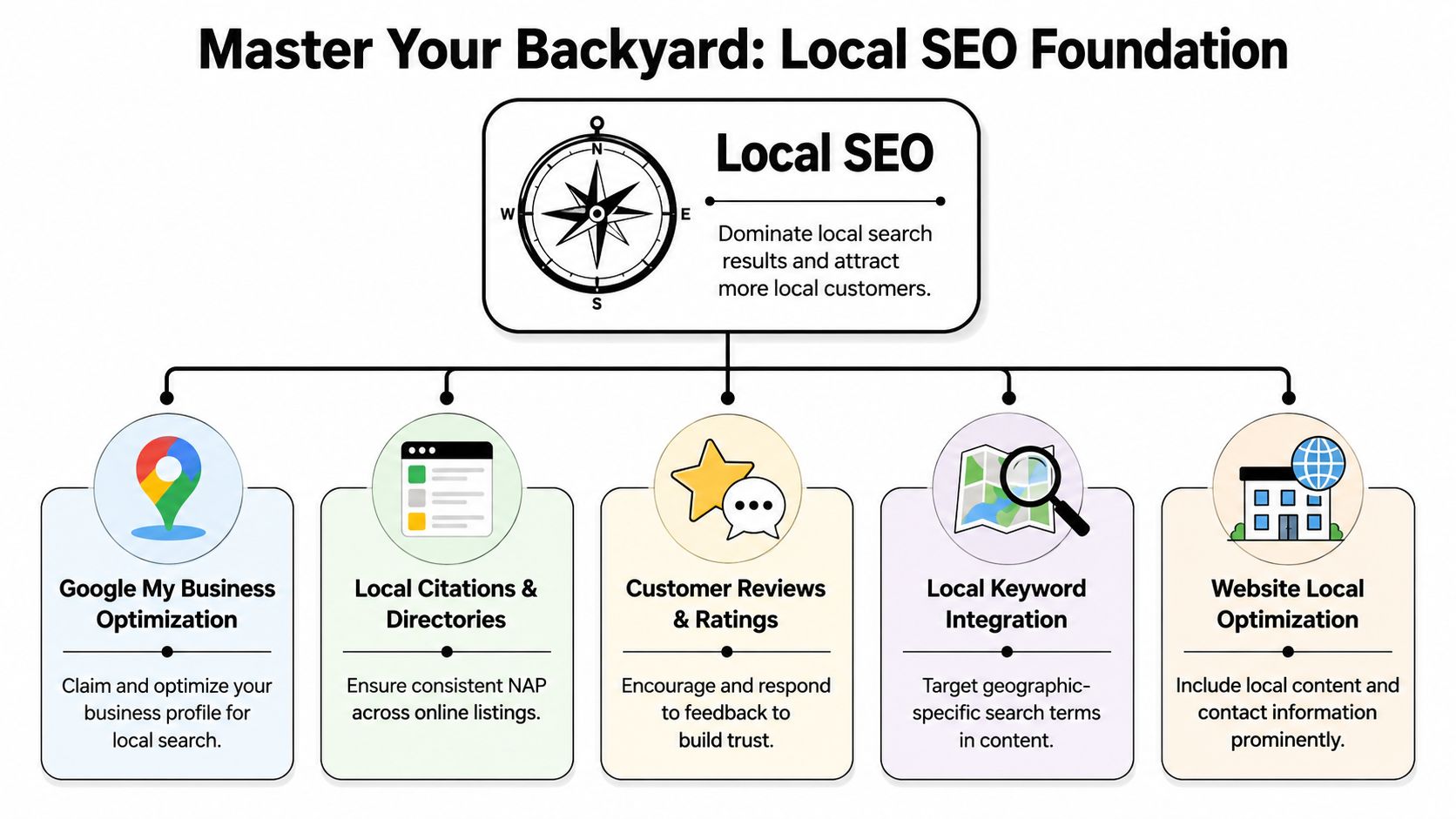
- Claim and complete your Google Business Profile: Fill out the business category, services, phone, website, hours, and service areas. Don't leave obvious blanks.
- Use real photos: Add photos of trucks, crews, equipment, shop space, finished work, and field conditions. Local buyers want proof you're real.
- Describe what you do: Keep the wording grounded in your core services. Don't drift into buzzwords.
- Keep your contact details consistent: Your business name, phone, and address details should match across your website and directory listings.
- Ask for reviews after real work is completed: The best time is when the customer is satisfied and the job is still fresh in their mind.
You don't need to get fancy. You need to be complete, accurate, and believable.
Build local proof on your website
Your business profile can help people discover you. Your website has to close the gap between interest and action.
That means building location relevance into the site itself:
- Create individual service pages: One page for excavation, one for welding, one for trucking, one for hydrovac, and so on.
- Create city or area pages where it makes sense: Not thin copies. Real pages tied to work you do in Roosevelt, Vernal, Duchesne, or nearby service areas.
- Show local evidence: Job photos, project writeups, service areas, equipment details, and local contact information.
- Write copy people in your market would recognize: Mention the type of work, terrain, weather, schedules, and equipment realities your customers deal with.
A dedicated page for “excavation contractor in Vernal” is usually more useful than a generic page trying to target all of Eastern Utah at once. The same goes for recruiting. A careers page that speaks to local workers will do more than a vague “join our team” page.
If you want a contractor-specific breakdown of that process, local SEO for contractors is a useful reference.
Local SEO works best when your business profile, review profile, and service pages all point to the same truth about who you serve and what you do.
Create Content That Wins Jobs and Attracts Talent
Most rural businesses don't need “more content” in the abstract. They need the right pages. The kind that answer buyer questions, prove capability, and make it easy for a qualified applicant to say, “That's the company I want to work for.”

A practical SEO workflow starts with keyword research, then maps one primary keyword per page, places that keyword in the title, subheadings, body copy, URL, and image ALT text, and measures performance so the page can be refined over time, according to Shergroup's traffic growth workflow.
Build pages for buyers, not browsers
Think about three common local businesses.
A welding and fabrication shop shouldn't rely on one generic services page. It should have separate pages for structural welding, field welding, repair work, and fabrication. Each page should show what the shop handles, what industries it serves, and photos tied to that service.
An excavation company should publish project pages, not just a homepage gallery. A project page can show the scope, site conditions, equipment used, and outcome. That helps two different audiences at once. Buyers see proof of experience. Google sees a page with clear topical relevance.
A trucking company should avoid vague copy like “we deliver with excellence.” A stronger page talks about the type of hauling, routes, equipment, and industries served. If the company wants work from oilfield operators or construction firms, the site should say that plainly.
Useful page types include:
- Service pages: Built around one service and one clear search intent.
- Project pages: Short portfolio-style pages with photos and a straightforward description of the work.
- Industry pages: If you serve different markets, create pages for them only when the messaging changes.
- FAQ pages: Answer common pre-sale questions that stall calls and quote requests.
If you need ideas beyond standard blog posts, this roundup of essential content types for marketers can help you think in formats instead of just “articles.”
Use your website to recruit
For a lot of contractors and industrial companies, hiring is just as urgent as sales. Yet many websites bury careers in the footer and throw applicants into a dead-end form.
That's a mistake.
A recruiting page should work like a service page. It needs a clear target and clear language. If you need CDL drivers, roustabouts, mechanics, or equipment operators, give those roles their own pages or at least their own sections with real detail.
A stronger careers section includes:
- Job-specific titles: CDL Driver, Welder, Heavy Equipment Operator, Shop Mechanic
- Location context: Let applicants know where the work is based and what territory the company serves
- Work reality: Schedule expectations, field conditions, travel expectations, and the type of projects they'd work on
- Application path: A simple form, a phone number, and a clear next step
A careers page that speaks plainly about the work will attract fewer casual applicants and more people who actually fit the job.
Images matter here too. Name them clearly and descriptively before uploading. If you want a practical reference on that point, naming pictures for SEO lays it out in plain terms.
Quick Website Fixes That Boost Traffic
Some traffic problems have nothing to do with content. The site may be hard to use, difficult to explore, or measured badly enough that nobody can tell what's working.
Fix the stuff that makes people leave
Start with the basics a business owner can inspect.
- Mobile speed: In rural areas, a slow phone connection is normal. If your pages drag because of oversized images, clunky scripts, or heavy design effects, people leave.
- Navigation: Your top menu should make sense at a glance. Services, service area, projects, careers, about, contact. That's enough for most companies.
- Page layout: Put the phone number, service area, and next step where people can find them without hunting.
- Local business details: Make sure the site clearly shows who you are, where you operate, and how to reach you.
If your developer needs a technical reference for performance issues, this technical guide to web optimization is a solid place to start.
Clean up your measurement before you judge results
A lot of owners think a page is performing because analytics show traffic. However, half the visits came from staff, the web agency, or people inside the business checking the site.
Technical traffic analysis should exclude internal visits before judging performance, because staff and agency traffic can distort page-level metrics. One recommended workflow is to exclude office and remote-team traffic, then use user-flow reporting to identify traffic drivers and drop-off points, as explained in Humblytics' traffic analysis guide.
That matters because a clean view changes your decisions. If a service page attracts outside visitors and moves them toward contact, keep improving it. If people land on a page and disappear, that's usually a content, design, or navigation problem.
A few questions to ask your web provider:
- Are internal visits excluded from reporting?
- Which pages bring visitors into the site first?
- Where do users drop off before contacting us?
- Which pages support leads or applications, and which pages just soak up attention?
You don't need to become a developer. You do need enough clarity to ask better questions.
Smart Spending with Paid Ads and Partnerships
Organic traffic builds over time. Sometimes you need to move faster. That's where paid traffic and partnerships come in, but only if you stay disciplined.

Throwing money at broad campaigns is how small businesses burn through budget. A contractor usually gets better results by narrowing the audience, narrowing the message, and sending visitors to a page built for one action.
Use paid traffic where intent is already strong
Recruiting is one of the clearest examples. A local company can run social ads focused on job openings, local geography, and the kind of work offered. That's a lot more useful than boosting random brand posts.
Google ads can also make sense when they align with high-intent searches and dedicated landing pages. The same goes for Local Service Ads where they fit the business model and service category. The key is simple. Don't pay to send people to a generic homepage.
A better paid setup looks like this:
- One campaign per service or hiring goal
- One landing page per campaign
- Local targeting aligned to your actual service area
- Clear conversion action such as call, form fill, or application
For contractor-focused strategy ideas, lead generation for contractors is a practical reference.
Track channels by business outcome
Many ad campaigns go sideways when people watch clicks and impressions, then never connect those visits to leads or applicants.
Google Analytics 4 is a foundational tool because it shows whether visitors came from search, social, email, direct, or referrals. The U.S. Chamber of Commerce notes that a practical dashboard should track traffic source, top pages, and a business outcome such as leads or sign-ups, because traffic alone doesn't show whether the site is producing results, as outlined in their GA4 tracking guide for business owners.
That's the part to pay attention to. If social sends applicants, keep it. If referrals from local supplier websites send quote requests, build more of those relationships. If an ad campaign sends low-quality traffic, cut it fast.
Partnership traffic is often overlooked, especially in rural markets. Suppliers, trade associations, chambers, complementary subcontractors, and local organizations can all send relevant visitors. A simple website mention, referral page, or partner listing can drive more useful traffic than a broad awareness campaign.
This short video gives a helpful overview of thinking about traffic channels in a more practical way.
Bottom line: Pay for traffic when the audience, message, and landing page are tightly matched. Don't pay just to feel like marketing is happening.
Your 90-Day Website Traffic Action Plan
A lot of rural businesses do not have a traffic problem first. They have a sequence problem.
A contractor in the Basin pays for ads, sends people to a weak homepage, gets a few visits, and hears no phone calls. An oilfield company posts occasional updates, sees some traffic, and still gets no serious bid requests or qualified applicants. The pattern is common. Traffic shows up before the website is ready to convert it into work.
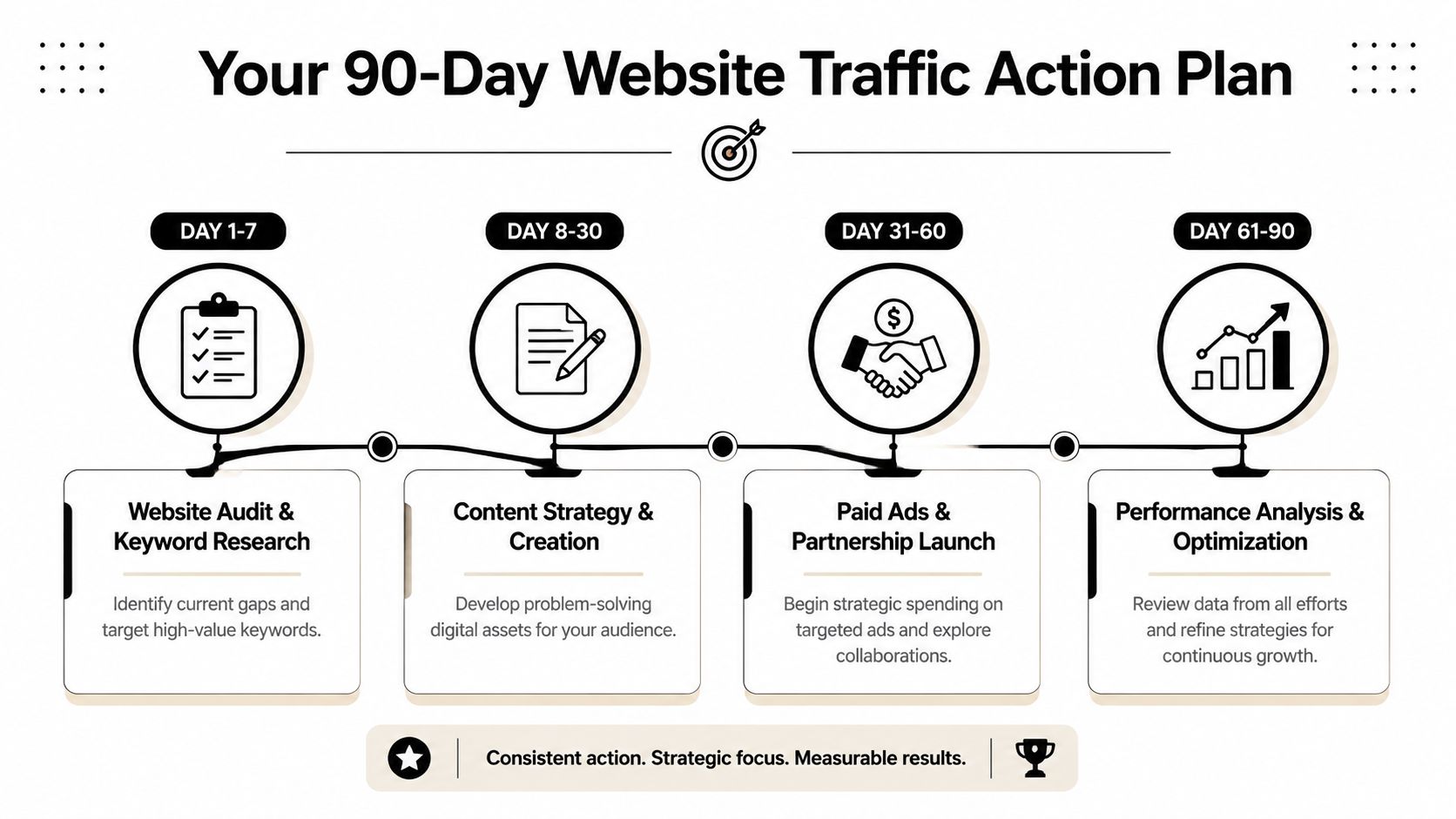
That is why the first 90 days matter. For contractors, trucking companies, fabricators, and other rural businesses, the job is to build a site that matches how real customers and job seekers search. Then you put money behind the pages that already prove they can produce calls, quote requests, and applications.
Days 1 through 30
Start with clarity.
Your website should answer three questions fast. What do you do. Where do you work. What should the visitor do next. If those answers are buried, traffic will leak out before it turns into anything useful.
Focus on these tasks:
- Audit your current website: Check navigation, service pages, contact paths, mobile usability, and whether the site clearly states your service area.
- Review your Google Business Profile: Fill out missing fields, update photos, and make sure your services are described accurately.
- List your core pages: One page per major service. If you do excavation, trucking, welding, and hydrovac, each needs its own page.
- Identify target searches: Choose practical keyword themes based on what buyers or applicants would search.
- Clean up analytics: Make sure internal traffic isn't muddying the picture.
The goal for month one is simple. A stranger should land on the site and know within a few seconds whether you handle the kind of work they need and whether you serve their area.
Days 31 through 60
Build the pages that carry the business.
A small business website does not need fifty blog posts to get traction. It needs a short list of pages tied to real services, real project types, and real hiring needs. That is the difference between traffic that looks nice in a report and traffic that turns into bid invites and applicants who can do the work.
Priority work for this phase:
- Create or rewrite service pages: Give each main service its own page with plain language, local relevance, and a direct call to action.
- Publish one or two project pages: Use real job photos and explain what was done.
- Build a real careers section: Add role-specific details for the positions you need to fill.
- Reach out for one local partnership opportunity: A supplier, trade group, chamber, or complementary business is enough to start.
- Ask for reviews consistently: Not aggressively. Just steadily after completed work.
Each page should earn its spot. It should answer a buyer's question, support a sales conversation, build trust before a call, or help a solid applicant decide to apply.
Days 61 through 90
Now review results and make sharper decisions.
This is the point where some owners get impatient and try three new channels at once. Usually that spreads the budget thin and muddies the results. A better move is to review what is already gaining traction, fix weak pages, and test one paid campaign with a clear goal.
Do this next:
- Review top pages: Which service pages draw attention? Which project pages hold it?
- Check conversions, not just visits: Calls, form submissions, and applications matter more than raw sessions.
- Improve weak pages: Tighten headlines, clarify copy, add better photos, or simplify the call to action.
- Launch one targeted paid campaign: Pick a recruiting need or one service with strong local intent.
- Keep building local proof: More reviews, more project examples, more evidence that you do what you say.
If you try to build everything at once, progress slows. If you build in the right order, each step supports the next one.
90-Day Traffic Generation Plan
| Phase | Timeline | Key Actions | Goal |
|---|---|---|---|
| Foundation | Days 1-30 | Audit site, clean navigation, improve business profile, define service pages, clean up analytics | Make the site clear, local, and measurable |
| Content and outreach | Days 31-60 | Publish service pages, project pages, careers content, request reviews, start one partnership | Build pages that attract buyers and applicants |
| Analysis and amplification | Days 61-90 | Review top pages, refine weak pages, track leads and applications, test one targeted ad campaign | Strengthen what works and expand carefully |
If you want help implementing this kind of plan, Northpoint Web works with contractors, oilfield service companies, trucking businesses, and other rural Utah companies on websites, local SEO, and lead-focused digital marketing.
If your website looks fine but still is not helping the business, that can be fixed. Northpoint Web helps companies in the Uinta Basin build websites that support real outcomes, including qualified leads, project inquiries, and job applicants.