Your website probably says the same thing as every other contractor or oilfield company in your market. “Quality work.” “Reliable service.” “Experienced team.” That copy doesn't help you win jobs, and it definitely doesn't help you hire welders, drivers, operators, or field crews.
Most owners know their website feels weak. They just can't tell whether the problem is design, writing, or both. In my experience, the writing is usually the bigger issue. If your headline doesn't say what you do, who you do it for, and why someone should trust you, the rest of the page won't save it.
Good website copy isn't fancy. It's clear, specific, and built to get action. If you want to learn how to write website copy that brings in leads and helps recruit skilled people, start treating your website like a sales tool and a hiring tool at the same time.
Table of Contents
- Lay the Foundation Before You Write a Word
- Craft Your Core Message and Proof Points
- A Page-by-Page Copywriting Blueprint
- Writing to Recruit The Best Talent
- Integrating SEO and Powerful Calls to Action
- Launching Testing and Refining Your Copy
Lay the Foundation Before You Write a Word
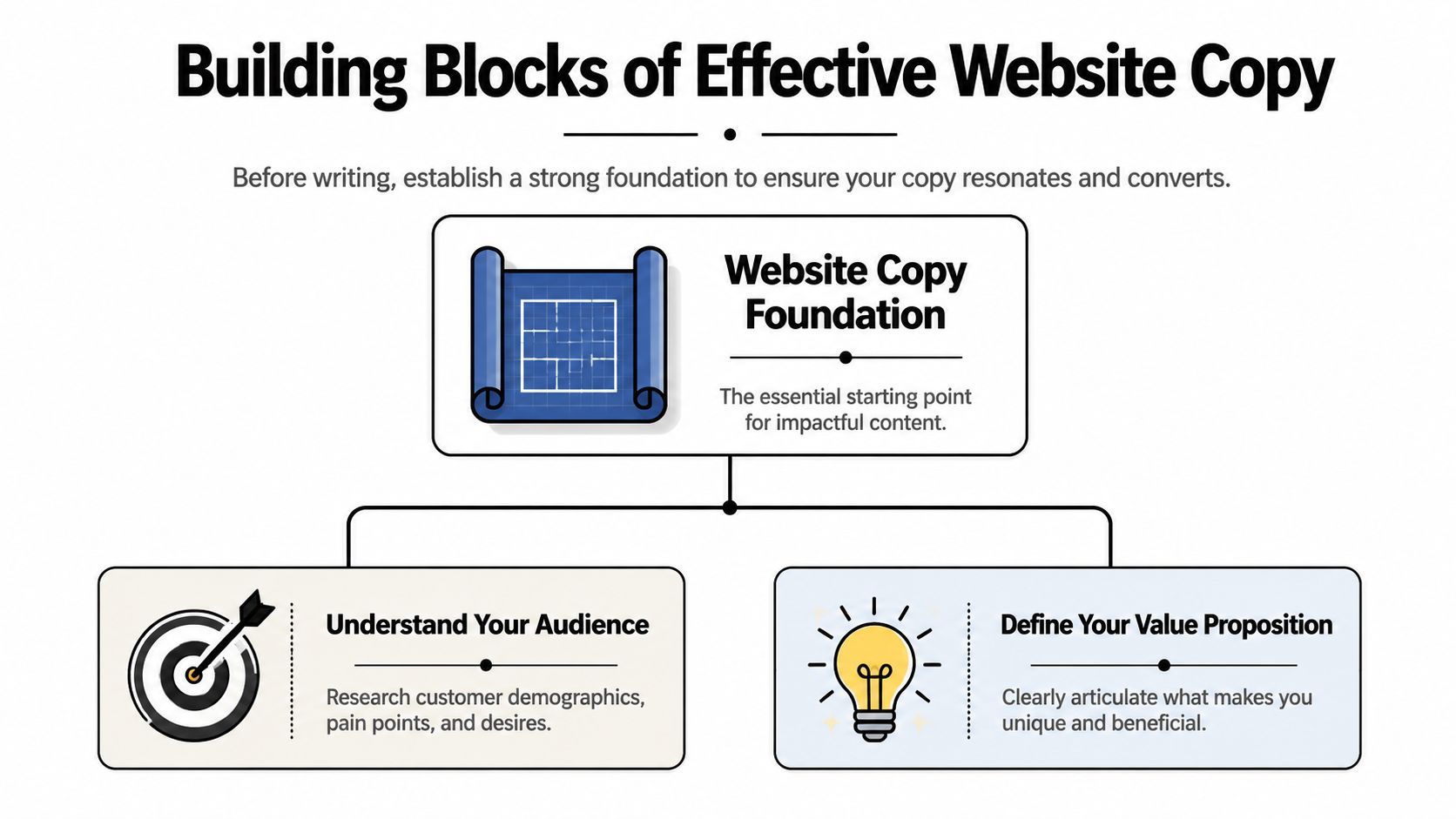
Good copy starts before the writing starts. Most bad websites don't fail because the owner picked the wrong adjective. They fail because nobody decided who the site is for and what the message needs to be.
Web visitors usually scan first and read later, and only about 10% of visitors read body copy after seeing a headline, which is why you need short paragraphs, short sentences, and important information at the top, as noted in Squarespace's website copy guidance. If your site makes people hunt for basic facts, they won't do it.
Start with the two audiences that matter
Most contractor websites are written for one audience only. That's a mistake.
You usually have two real audiences:
- Customers who need a job done and want to know if you're qualified.
- Potential hires who want to know if your company is worth their time.
Those audiences care about different things. A plant manager might care about response time, service area, equipment, and whether your crew can handle shutdown work. A CDL driver might care about schedule, type of work, equipment quality, stability, and whether your company treats people right.
Write those questions down before you touch the homepage.
Practical rule: If a page doesn't answer a real visitor question, cut it or rewrite it.
A lot of owners also confuse copywriting with general content creation. They're not the same job. If you want a clean explanation, this guide helps compare content writing and copywriting goals. Your service pages and homepage need to persuade and direct action, not just fill space.
Lock in your main message
Your site needs one central promise. Not five. One.
That message should answer three things fast:
- What do you do
- Who do you do it for
- Why should someone choose you
A weak message sounds like this: “We provide complete solutions with a commitment to excellence.”
A useful message sounds like this: “Hydrovac, excavation, and roustabout support for oilfield and industrial sites in Eastern Utah.”
That second line works because it tells people what business you're in. No decoding required.
Build the structure before the sentences
If you want to know how to write website copy that performs, stop thinking page by page first. Think question by question. Your site structure should follow the order a customer or applicant naturally thinks.
For a service buyer, that usually looks like:
- What do you do?
- Can you handle my type of project?
- Why should I trust you?
- What do I do next?
For a job seeker, it looks more like:
- What kind of company is this?
- What work will I be doing?
- Why would I want to work here?
- How do I apply?
Put the most important answer first. Don't warm up with background. Don't bury the point halfway down the page.
That foundation saves you from writing fluffy copy later. Clarity at the start fixes a lot.
Craft Your Core Message and Proof Points
Generic copy dies on contact. Buyers ignore it. Applicants ignore it. Search engines don't get much value from it either.
If your website says you deliver “top-quality service,” you haven't said anything useful. People expect you to say that. The question is whether you can prove it.

Stop writing claims you can't prove
Specific, measurable language increases credibility. Articulate Marketing advises using quantifiable facts and says a line like “over 500 projects in the Uinta Basin” is more believable than vague experience claims in its article on copy tips for website conversions.
That principle matters even more in industrial and field-service work. Your customers are hiring for risk. Your job is to reduce uncertainty.
So stop using throwaway phrases like:
- High quality work
- Dependable team
- Customer-focused service
- Industry-leading solutions
Those lines are empty unless you attach proof.
Build a proof library before you draft
Before you write pages, gather every fact that strengthens trust. I call this your proof library. It gives you raw material for copy that sounds real.
Collect things like:
- Years in business
- Service area details
- Types of equipment or crews
- Certifications and safety qualifications
- Project types completed
- Response times
- Crew availability
- Recruiting advantages, such as steady work, variety of projects, or in-house advancement
If your team struggles to write clearly, it helps to tighten the process before polishing the wording. This short piece on an authoritative content workflow is useful because stronger copy usually starts with stronger sentence construction.
Here's a simple test. If a statement could appear on any competitor website, it's too vague. If only your company could say it that way, you're getting closer.
Turn weak lines into credible copy
Weak copy:
- “We have extensive experience in oilfield services.”
Better copy:
- “We support oilfield and industrial projects with field-ready crews, clear communication, and service pages built around specific scopes of work.”
Weak copy:
- “We care about our employees.”
Better copy:
- “Our careers page should show what kind of work you'll do, what the schedule looks like, and why people stay.”
Use this video if you want a practical reset on writing stronger messaging for the web:
The best proof points are the ones a buyer or applicant can use to make a decision quickly.
Your copy should prove competence, not announce it. That's the whole game.
A Page-by-Page Copywriting Blueprint
Most websites fail because every page tries to do everything. Don't do that. Give each page one main job, then write the copy in the order people need it.
NN/g recommends an inverted-pyramid structure, with the summary at the top, and guidance for mobile scanners says the key benefit should appear in the first 3–4 words of a paragraph. It also helps to make every section answer what problem is solved, what result is delivered, and what the next step is, as explained by Nielsen Norman Group on writing for domain experts.
Homepage
The homepage is your front gate. Its job isn't to explain everything. Its job is to orient the visitor and push them to the right next step.
A strong homepage usually follows this order:
Headline with a clear offer
Say what you do and who you serve.Short supporting line
Add location, scope, or differentiator.Primary calls to action
One for customers, one for hiring if recruiting matters.Service overview
Give a fast scan of main offerings.Proof section
Add facts, qualifications, project types, or trust markers.Industry or market fit
Show the types of clients or jobs you handle.Final call to action
Repeat the next step.
Your homepage doesn't need more cleverness. It needs better routing.
Service pages
A service page should sell one service, not your entire company. If you offer hydrovac, excavation, welding, trucking, roustabout work, and reclamation, each major service needs its own page.
A useful service page flow looks like this:
- Clear headline naming the service
- Short opening that states the outcome
- The problems this service solves
- Where or for whom you provide it
- Why your company is a solid choice
- Proof and specifics
- A direct call to request a quote or site visit
Don't write “Our team offers complete excavation solutions.” Write the page around actual jobs, situations, and buyer concerns.
About page
Most About pages are self-indulgent. The visitor doesn't care about your company history unless it helps them trust you.
Use the About page to answer:
- Who leads the company?
- What kind of work are you known for?
- What standards do you work by?
- Why do customers and employees stay with you?
If hiring matters, this page can also support recruitment. Applicants want signals about stability, leadership, and work environment.
Contact page
Your Contact page should remove friction. That's it.
Don't make people guess what happens next. Tell them what to send, who should reach out, and what kinds of inquiries you want. If you're hiring, give applicants a direct path too.
Here's a simple planning table you can use before drafting.
| Page Type | Primary Goal | Recommended Word Count |
|---|---|---|
| Homepage | Explain what you do and route visitors to the right next step | Short to moderate |
| Service Page | Show fit for one service and generate inquiries | Moderate |
| About Page | Build trust with company background and credibility | Moderate |
| Contact Page | Make it easy to inquire or apply | Short |
| Careers Page | Attract applicants and answer employment questions | Moderate to detailed |
If you're writing page by page, keep asking one question: what does this page need the visitor to do next? That answer should shape the copy.
Writing to Recruit The Best Talent
A lot of contractor websites are built like online brochures for customers. That leaves a major gap.
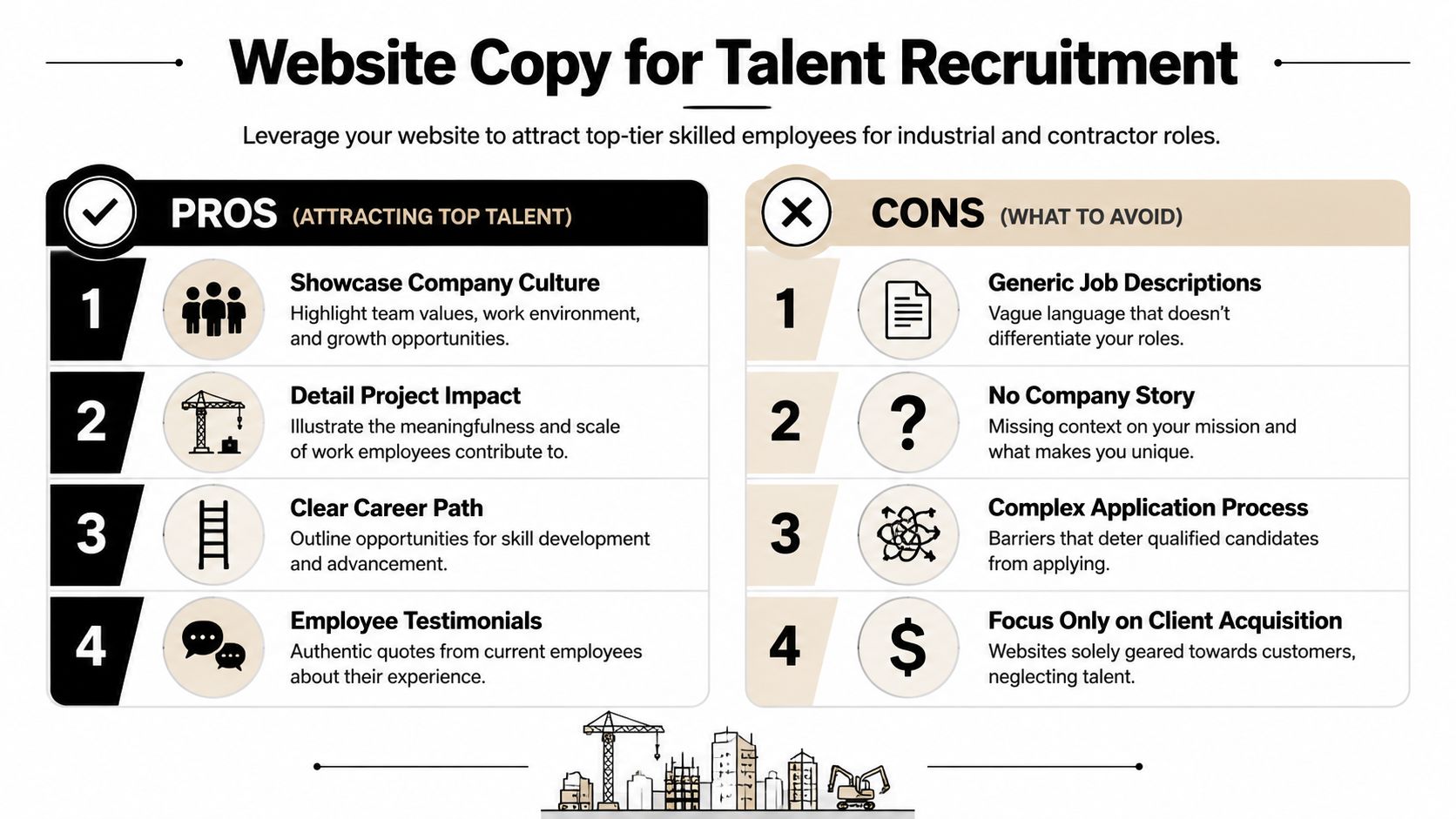
If you're trying to hire drivers, welders, laborers, operators, mechanics, or field hands, your website also needs to sell the job. Most generic advice on how to write website copy barely touches this. That's a blind spot.
Twilio's guidance points out that most website copy advice focuses on customer conversion and overlooks recruitment, even though companies in construction, transportation, and oilfield services need pages that answer “Why should I work here?” with a different employer-brand message in its article on writing website copy that converts.
Your website has two jobs
You need customer-facing copy and applicant-facing copy. They overlap, but they aren't the same.
Customer copy says:
- We can do the work
- We understand the job
- You can trust us
Recruiting copy says:
- This is the kind of work you'll do
- This is the kind of team you'll work with
- This is why good people stay here
If your careers page is just a list of openings with no context, you're making applicants do too much work. Good people won't chase vague opportunities.
For companies thinking about a better platform for this kind of recruiting-focused site, a solid WordPress website for business gives you room to build service pages, hiring pages, and application flows without boxing your business into a template.
What skilled applicants actually want to know
The best applicants aren't looking for corporate slogans. They want practical answers.
Write to the questions they already have:
- What kind of projects will I be on?
- Is this local work, travel work, or both?
- What equipment or trucks am I working with?
- Is the work steady?
- What's the culture really like?
- Is there room to grow?
- How do I apply without jumping through hoops?
If your recruiting copy sounds like HR boilerplate, field people will tune it out.
You also need to stop hiding behind clichés like “we're like family.” That phrase means nothing on a website. Say what the work environment is like. Tight crews. Straight communication. Fast-moving jobs. Long-term opportunity. Hands-on leadership. Those details are better.
How to write a careers page that pulls its weight
A strong careers page usually includes:
- A direct opening statement about the kind of people you hire
- A short company overview written for applicants, not customers
- Real job categories with plain-language descriptions
- Reasons to work there, stated clearly
- Application instructions that feel simple
Don't only post jobs. Sell the workplace.
If your company has a reputation for stable work, local roots, interesting projects, or solid leadership, say that. If your crews work on meaningful projects and use serious equipment, say that too. Recruiting copy should help the right people picture themselves on the job.
That's how a website becomes a hiring asset instead of a dead page with an “Apply Now” button.
Integrating SEO and Powerful Calls to Action
Strong writing that nobody finds won't help you. Strong writing with no direction won't help much either. You need search visibility and clear next steps working together.
A lot of contractors either overdo SEO and sound robotic, or ignore it completely and wonder why their site doesn't show up. The fix is simple. Use the terms real buyers and applicants already use, then connect those terms to action.
Use search terms the way real buyers use them
Think in plain search language:
- Hydrovac services in the Uinta Basin
- Oilfield welding contractor
- Excavation company near Vernal
- CDL driver jobs in Eastern Utah
- Heavy equipment operator jobs
Those phrases belong in page titles, headlines, subheads, service descriptions, and image context where they fit naturally. Don't jam the same term into every paragraph. Write like a person, not a keyword spreadsheet.
If you want a broader view of what supports visibility for field-service businesses, these contractor marketing strategies are a useful companion to copy planning.
For companies that depend on local visibility, local SEO for contractors matters because service-area pages, Google visibility, and location-specific copy all support the same goal. They help the right people find you before they compare you.
Write calls to action that match intent
“Contact Us” is weak because it asks for action without context. Better calls to action tell the visitor what happens next.
For customer pages, use CTAs like:
- Request a quote
- Schedule a site visit
- Talk to our team
- Get project pricing
For hiring pages, use:
- See open positions
- Apply for field work
- Talk to us about driving jobs
- Start your application
Every important page should have a next step that matches the visitor's reason for being there.
Your homepage should probably have more than one CTA if you're balancing leads and recruitment. One path for customers. One path for applicants. Don't force both groups through the same message.
When SEO and calls to action line up, your website stops acting like a brochure. It starts acting like a filter, a sales rep, and a recruiting coordinator.
Launching Testing and Refining Your Copy
A website isn't finished when the copy goes live. It's finished when the copy starts producing better conversations, better leads, and better applicants. Until then, it's a draft in public.
Mailchimp recommends an evidence-based loop of research, draft, test, and refine, and it specifically points to A/B testing and user feedback as ways to improve copy based on behavior instead of guesswork in its guide to website copywriting and testing.
Treat copy like a working asset
Most owners update copy only when they redesign the site. That's too slow.
Pay attention to what happens after launch:
- What questions do leads still ask on the phone?
- Which pages seem to lead to inquiries?
- Are applicants referencing the careers page?
- Are the wrong people filling out forms?
Those signals tell you where the copy is missing the mark.
Simple ways to improve without overcomplicating it
You don't need a complicated testing setup to make useful changes. Start small.
Try this:
- Rewrite the homepage headline if people still don't immediately understand what you do.
- Change CTA wording if forms are getting low engagement.
- Ask new customers and hires what they looked at on the site before reaching out.
- Tighten weak sections where your team keeps explaining the same thing offline.
If you want a practical framework for turning more website visits into action, this guide on how to improve conversion rate is worth reviewing alongside your copy.
Good copy isn't the copy you like best. It's the copy that gets the right people to act.
Keep editing. Keep listening. That's how to write website copy that works in the field, not just on a screen.
If your website needs to pull more weight, Northpoint Web helps contractors, oilfield service companies, trucking firms, and industrial businesses build websites that generate leads, attract employees, and compete better online. If you need a site that speaks clearly to customers and recruits skilled workers at the same time, they're built for that job.