You're probably in one of two spots right now.
Either your crew does solid work, your schedule depends too much on referrals, and you know you should be showing up better online. Or you already paid for a website, maybe even tried some SEO, and nothing changed except your inbox got a few agency pitches.
That gap is common in contracting. The best excavator in town can still lose work to a competitor with a cleaner Google Business Profile, stronger city pages, and more recent reviews. A welding shop can have better turnaround, better field work, and better pricing, then get outranked by a shop that made itself easier for Google to understand.
For contractors, online visibility isn't abstract branding. It's whether a plant manager, homeowner, or project superintendent finds your business when they need trenching, hydrovac, fabrication, hauling, or repair work near them. Google has reported that 76% of people who search on a smartphone for something nearby visit a business within 24 hours, and 28% of those searches lead to a purchase, which is why local search visibility can turn into calls and booked jobs fast, especially for local service businesses (local search benchmark details).
If you want another practical perspective, HearBack's guide to local marketing is worth a read because it stays focused on contractor realities instead of generic marketing talk.
Table of Contents
- Why Your Best Work Is Invisible Online
- Build Your Unshakable Foundation on Google
- Turn Your Website Into a Local Lead Magnet
- Earn Authority with Citations and Reviews
- Use SEO to Recruit a Winning Team
- Measure What Matters and Plan Your Next Move
Why Your Best Work Is Invisible Online
A lot of contractors have the same problem. Their reputation exists in the field, not in search.
An excavation company might have operators who can handle difficult ground, a reliable trucking setup, and years of local project experience. But when someone searches for “excavation contractor near me” or “site prep in Roosevelt,” Google doesn't see reputation the way the local market does. Google sees categories, proximity, consistency, page relevance, reviews, and whether the business has made its services clear.

That's why a smaller competitor can win the click. Not because they do better work, but because they're easier to find and easier to trust in the search results.
Local intent is where contractors win or lose
A homeowner with a broken water line isn't browsing for fun. A superintendent needing a welder on a shutdown job isn't researching brands for a month. These are high-intent searches with short decision cycles.
When your business shows in Google Maps, the local pack, and organic results for the right services and towns, you're meeting demand when the buyer is ready to act. That matters even more in trades where speed, location, and availability drive the decision.
Practical rule: If your company is invisible in local search, your market may still know your name, but new customers and new project managers won't.
The real issue usually isn't skill
The issue is usually one of these:
- A weak Google presence: The profile exists, but categories are off, service areas are incomplete, or photos are outdated.
- A vague website: One generic services page tries to cover excavation, trucking, welding, reclamation, and rentals all at once.
- Thin local proof: No city pages, no project photos tied to place, and no review process.
- No recruiting visibility: The company needs CDL drivers or welders, but the website gives job seekers nothing useful to find.
Contractor SEO works best when it matches how buyers and job seekers search. People don't type “full service industrial solutions.” They search for “hydrovac contractor Vernal,” “pipe welding Duchesne,” or “CDL driver jobs Uinta Basin.”
That's the shift. Local SEO for contractors is less about clever marketing and more about operational clarity online.
Build Your Unshakable Foundation on Google
Most local SEO failures start here. Contractors try to fix rankings with new pages, blog posts, or ads before their Google Business Profile is fully built out.
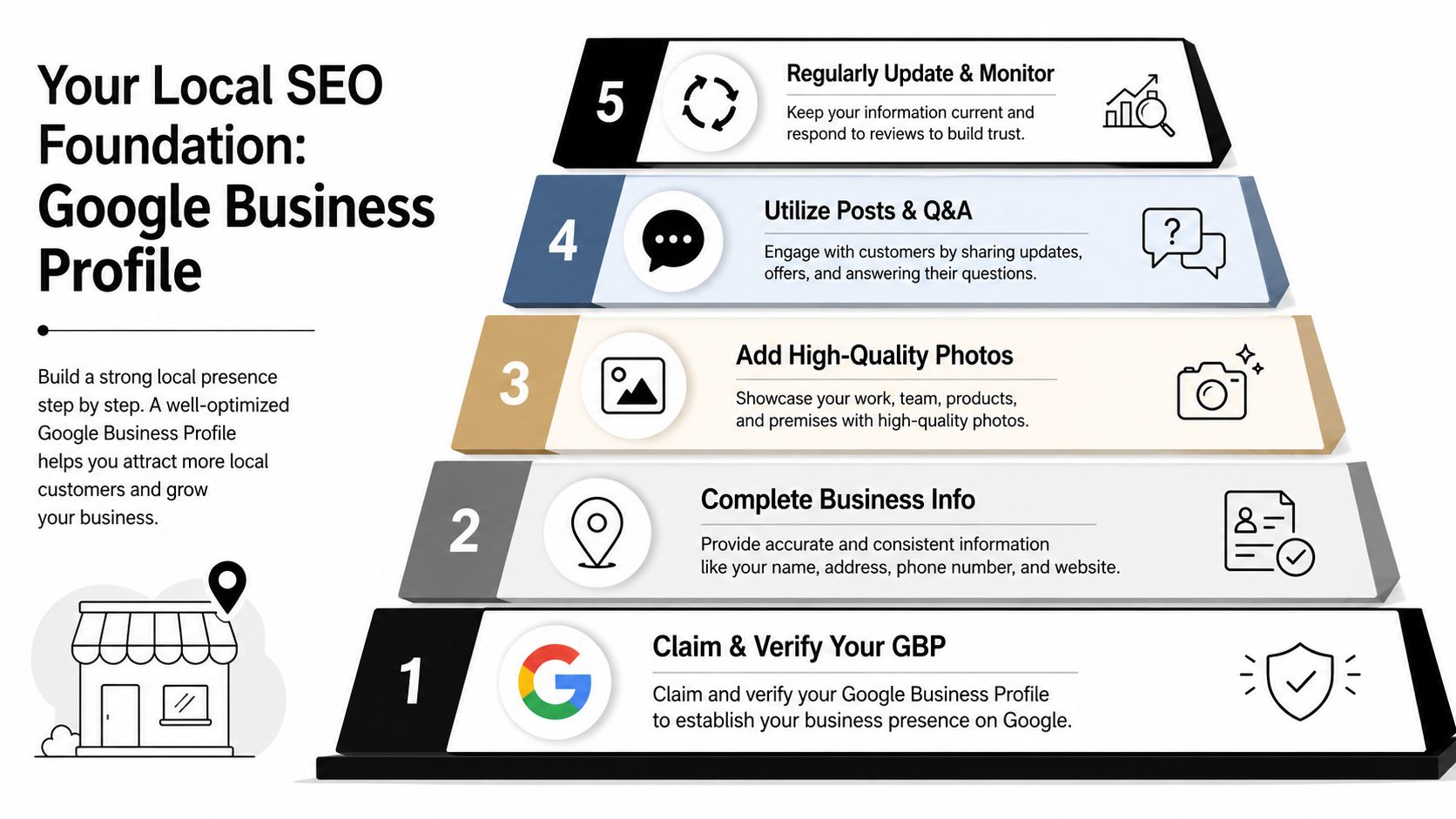
That's backwards. A practical contractor local SEO workflow should start with a fully completed Google Business Profile, exact NAP consistency across every citation, and location or service-area setup, then add city-specific service pages, reviews, photos, and ongoing posts. One contractor SEO source also notes that meaningful results often take 3-6 months to emerge in competitive markets, which is a realistic timeline for local SEO work that's done correctly (contractor local SEO workflow).
Start with the profile that controls local visibility
If you do one thing first, do this.
Claim the Google Business Profile. Verify it. Then complete every field that applies to the business. Contractors leave money on the table when they rush through this and treat it like a directory listing instead of a lead asset.
Your setup should include:
- Accurate business identity: Use your real business name. Match it everywhere else online.
- Primary and supporting categories: Pick the category closest to your core service. An excavation contractor should not default to a broad category if a more precise one fits.
- Service areas: Set the cities, counties, or regions you serve.
- Business description: Write a direct summary of what you do, where you work, and who you help.
- Phone and website: Send traffic to the right contact points, not to an old number or placeholder page.
For newer companies, this often overlaps with basic business setup. If you're still working through state paperwork, contractor license requirements can help you sort out the licensing side so your public information stays clean from the beginning.
Get the details right before you chase rankings
NAP consistency means your business name, address, and phone number must match across your website, your Google profile, and your citations. Even small differences create avoidable confusion.
A common contractor problem looks like this:
| Location | Business Name Used | Phone Used | Result |
|---|---|---|---|
| Website footer | Basin Welding & Fabrication | Main office | Correct |
| Google profile | Basin Welding | Cell number | Mismatch |
| Directory listing | Basin Welding and Fab LLC | Old office line | Mismatch |
That kind of inconsistency weakens trust. It also makes it harder for Google to connect all your local signals to one business entity.
A half-finished profile tells Google and customers the same thing. This business may be active, but it's not organized.
Here's what usually deserves attention before anything else on the website:
- Categories and services
- Service area accuracy
- Matching NAP across the web
- Photos of real jobs, crews, trucks, and equipment
- Review generation process
Keep the profile active after setup
A completed profile isn't a one-time job. Contractors who stay visible usually keep feeding the profile with proof that the business is active and local.
Use photos from recent trenching jobs, welding repairs, aggregate hauling, shop fabrication, or equipment mobilizations. Add updates when you open a new service area, finish a notable project type, or answer common customer questions.
This video gives a useful overview of profile optimization in practice:
A simple maintenance rhythm works well:
- Weekly photos: Fresh jobsite images, trucks, crews, or completed work.
- Ongoing Q&A: Answer the questions customers keep asking by phone.
- Routine review responses: Thank satisfied clients and handle criticism professionally.
- Periodic service checks: Make sure listed services still match what the company wants to sell.
The goal isn't activity for its own sake. The goal is to make your company the most complete, credible local option when Google chooses who to show.
Turn Your Website Into a Local Lead Magnet
A contractor website often fails for one reason. It tries to say everything on one page.
One “Services” page with a paragraph about excavation, another sentence about welding, and a short list of towns served rarely ranks well for high-intent local searches. It's too broad for Google and too shallow for the buyer.

Why generic service pages usually underperform
Contractor local SEO guidance recommends pages that are optimized for relevance and crawlability, including 200+ words per location or service page, natural keyword placement at roughly 1-2% density, descriptive image alt text, and schema markup for services, reviews, and locations. The same guidance also points to a better strategic question: should you build a large set of city pages, or a smaller number of stronger pages that actually help users, especially in rural service areas where thin location pages can start looking like doorway pages (guidance on contractor page structure).
That lines up with what works in the field. A page titled “Services” doesn't do much for searches like “hydrovac services in Vernal” or “mobile welding in Duchesne County.” A focused page can.
For example, these pages make more sense than one broad catch-all page:
- Hydrovac Services in Vernal
- Excavation and Site Prep in Roosevelt
- Pipeline Welding in Duchesne
- CDL Dirt Hauling Services in the Uinta Basin
A clean build on a flexible platform matters here. If your site structure fights you every time you need a new service or city page, a better WordPress website for business setup usually makes local expansion much easier.
How to build location pages that deserve to rank
A good local page needs more than a city name swap.
It should prove that your company operates there, understands the service, and can solve the searcher's problem. Think less like a template and more like a field-ready sales page.
Include elements like these:
- A clear service plus location title: “Excavation Contractor in Roosevelt, Utah” is better than “Welcome.”
- Specific scope details: Say whether you handle grading, trenching, pad prep, utility excavation, or cleanup.
- Local project evidence: Add job photos, equipment photos, and references to the kind of work common in that area.
- Strong calls to action: Make it easy to request a quote or call from the field.
- Schema markup: Help search engines understand your services, locations, and review content.
A useful way to think about it is to model the specificity you see in strong local business pages in other trades. For example, this Phoenix AZ landscaper page works because it is narrow, place-based, and service-specific rather than generic.
If the only local detail on the page is the city name in the headline, the page probably isn't useful enough.
Choose fewer stronger pages when your territory is rural
At this point, many contractors in places like the Uinta Basin get led in the wrong direction.
In dense metro areas, a business may justify more location pages because each city has enough search demand and enough distinct context to support them. In rural regions, creating a long list of near-duplicate pages for every small town usually backfires. You end up with thin content that doesn't help the user and doesn't build trust.
A better decision framework looks like this:
| Situation | Better move |
|---|---|
| Core services with strong local demand | Build dedicated service pages |
| Major towns you serve repeatedly | Create unique city pages with local proof |
| Small surrounding areas with little distinction | Mention them naturally on stronger regional pages |
| Multiple pages with nearly identical copy | Consolidate and improve them |
For a welding shop, one excellent “Mobile Welding in the Uinta Basin” page with real photos, service details, and nearby town references can outperform a pile of weak city pages. The same goes for excavation, roustabout work, and hauling.
Your website should narrow the buyer's choice, not make Google guess what you do.
Earn Authority with Citations and Reviews
Once your Google profile and service pages are in better shape, outside trust signals start to matter more. Two of the biggest are citations and reviews.
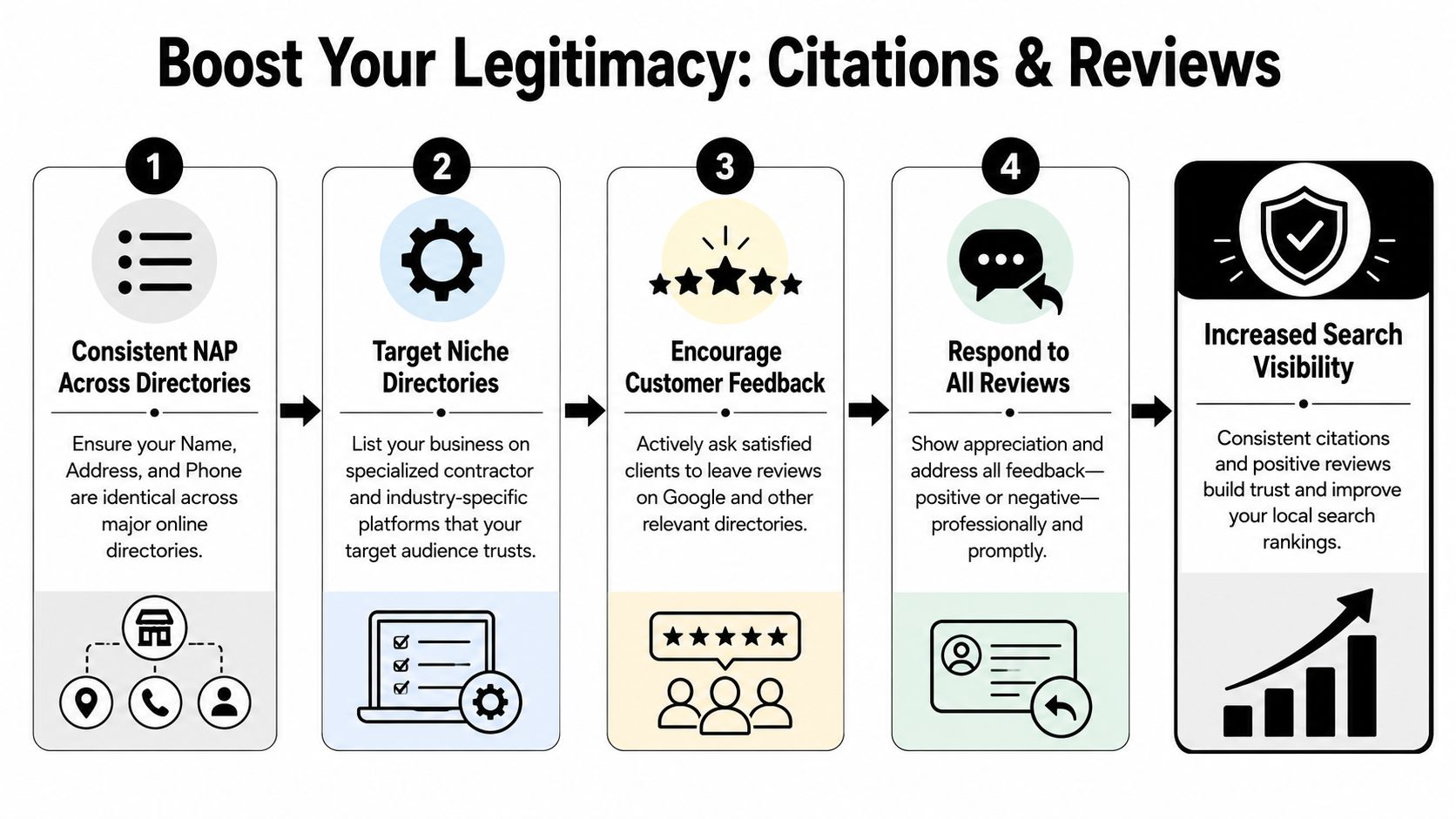
Citations are simple. They're mentions of your business details on other websites. Reviews are public proof that people hired you and were willing to say so.
Clean citations build trust faster than most contractors think
Most contractors don't need hundreds of directory listings. They need the right listings, and they need them to match.
Start with the places that matter most to your market. That usually includes major business directories, contractor-relevant platforms, local chambers, and regional business listings. If you're in industrial services, niche directories or association listings can matter more than broad consumer platforms.
Use this checklist when cleaning citations:
- Match the business name exactly: Don't switch between LLC, shorthand names, and old branding unless you have a reason.
- Use one primary phone number: Avoid mixing office, dispatch, and cell numbers across listings.
- Keep the website URL consistent: Point listings to the strongest relevant page.
- Check service descriptions: Make sure they reflect what you want to sell now, not what you used to do.
A contractor with mismatched citations often sees confusion show up in real life. Customers call the wrong line. Old addresses stay live. Former services still appear in search results.
Reviews influence both ranking and response
Reviews do more than decorate your profile. They help buyers decide whether to call.
For contractors, the best review strategy is operational, not awkward. Ask after a successful milestone. That might be after a pad is finished, after a repair gets signed off, or after a homeowner says the crew did a great job. Don't wait until months later when the customer barely remembers the details.
A workable review process looks like this:
- Choose the moment: Ask when the customer is clearly satisfied.
- Make it easy: Send the direct review link by text or email.
- Give light guidance: Ask them to mention the service and town if they're comfortable doing so.
- Respond to every review: Short, professional, and specific is enough.
Field note: Reviews that mention the actual service performed often do more for credibility than generic praise.
Negative reviews need a steady hand. Don't argue in public. Acknowledge the issue, stay professional, and move the conversation offline when needed. Buyers read those responses closely, especially in higher-trust trades like construction, welding, and hauling.
If your business is doing good work and still has very few reviews, that's usually a process failure, not a reputation failure.
Use SEO to Recruit a Winning Team
A lot of contractor websites act like the only audience that matters is the customer. That's a miss.
For many contractors, the bottleneck isn't demand. It's labor. You may have enough work for another truck, another welding rig, or another excavation crew, but you can't find the right CDL drivers, operators, or welders. Local SEO can help with that if you build for it on purpose.
Most contractor websites ignore hiring intent
Job seekers search with local intent too. They type phrases like “CDL driver jobs Uinta Basin,” “welder jobs Roosevelt Utah,” or “equipment operator jobs near me.” If your site only has a single “Careers” link with no detail, it won't do much for those searches.
Recruiting-focused SEO means building pages that answer what skilled applicants need to know:
- What kind of work they'll be doing
- Whether the role is local or travel-based
- What equipment or certifications matter
- Whether the company works steady projects or seasonal jobs
- How to apply without jumping through hoops
A stronger contractor hiring strategy usually starts with a real careers section and expands into role-specific pages. For companies in industrial and trade markets, a focused construction SEO approach should account for both customer searches and hiring searches because both affect growth.
Build job pages like service pages
Think about job pages the same way you think about lead pages. Specific pages rank better, convert better, and filter people better.
Instead of one vague hiring page, build pages like:
- CDL Driver Jobs in the Uinta Basin
- Experienced Welder Careers in Roosevelt
- Heavy Equipment Operator Jobs in Duchesne County
- Field Laborer Jobs for Oilfield and Construction Projects
Each page should include the role, location, work type, application steps, and what kind of person fits the crew. If you use JobPosting schema, you also give search engines clearer information about the opening.
A short comparison makes the point:
| Weak hiring page | Strong hiring page |
|---|---|
| “We're hiring. Apply today.” | “CDL Driver Jobs in the Uinta Basin for side dump and equipment hauling” |
| No location info | Clear local geography and routes |
| No role detail | Equipment, duties, schedule, and expectations |
| Generic form | Simple application path |
Good recruiting pages don't just attract more applicants. They attract applicants who understand the work before they call.
This matters in rural markets. Skilled labor is limited, and job boards alone often bring a pile of weak-fit applications. Search-driven recruiting gives you another lane to reach people already looking for local trade work.
Measure What Matters and Plan Your Next Move
A contractor doesn't need more reporting. A contractor needs to know whether the phone is ringing more often from the right places.
That's why the best local SEO measurement is tied to lead quality and business activity, not vanity charts. Contractor SEO guidance recommends tracking local-search traffic, Google Business Profile interactions, conversion rates, and keyword positions in Google Analytics and Search Console, with attention on outcomes like calls, direction requests, and quote submissions rather than rankings alone (practical contractor SEO measurement).
Track lead signals instead of vanity metrics
If you own or manage the business, start with the signals closest to revenue:
- Phone calls from local search: Are more prospects calling from the towns you want?
- Quote form submissions: Which service pages are producing real inquiries?
- Direction requests: Useful for shops, yards, and local offices.
- Google Business Profile interactions: A direct sign that people are engaging with your listing.
- Keyword visibility by service and town: Helpful when tied back to lead quality.
You don't need a fancy dashboard to spot progress. A simple monthly review can tell you a lot.
| Metric | Why it matters |
|---|---|
| Calls | Immediate lead intent |
| Quote requests | Sales opportunity volume |
| Direction requests | Local buyer action |
| Page-level traffic | Which services and towns draw demand |
| Search queries | How customers actually describe the work |
Your next gains usually come from local proof
Once the basics are in place, the next layer is often local proof.
That might mean sponsoring a local rodeo, supporting a county event, joining a regional association, getting listed by a local business group, or earning mentions from suppliers and partner companies. It can also mean publishing stronger project pages with location details, better photos, and clearer explanations of what your crew handled.
Your mobile site speed and usability still matter too. A superintendent checking your site from a truck or a homeowner searching after hours won't wait around for a clunky page to load.
What matters most is consistency. Local SEO for contractors isn't a one-time cleanup. It's a system. You tighten the profile, improve the pages, earn reviews, watch the lead signals, then keep building from there. If you want support with the strategy, execution, or ongoing improvement, a specialized SEO team for contractors can help turn that system into something repeatable.
Northpoint Web helps contractors, industrial companies, and local businesses build websites and SEO systems that generate leads and attract employees in markets like Duchesne, Roosevelt, Vernal, and the wider Uinta Basin. If your company needs a stronger Google presence, better local service pages, or recruiting-focused SEO for roles like CDL drivers and welders, Northpoint Web is built for that kind of work.