The harder question is deciding who should build and manage it.
Businesses in Vernal, Roosevelt, Duchesne, Myton, Ballard, Naples, and the surrounding Uinta Basin communities have unique challenges. We serve a large geographic area. Many local companies travel between communities. Contractors may work in multiple counties. Customers often search for a service online before they ever ask a neighbor who to call.
That means your website needs to do more than look professional.
Does this company understand where I actually do business?
The Uinta Basin is different.
A contractor based in Duchesne may work in Roosevelt, Vernal, Altamont, and rural areas throughout Duchesne and Uintah counties.
A business in Roosevelt may want to attract customers from both sides of the Basin.
A Vernal company may serve customers well beyond the city limits.
Your website structure and search engine optimization strategy should reflect the way your business actually operates.
Local Web Design Should Include Local SEO
One of the biggest mistakes small businesses make is building a website without considering how potential customers search.
Imagine you own a construction company in Roosevelt.
Your website may simply say:
Welcome to ABC Construction. We provide quality construction services.
That tells Google and potential customers very little.
What type of construction?
Where do you work?
Do you build homes?
Do you remodel?
Do you build garages?
Do you work in Vernal?
Do you serve Duchesne?
A properly planned small business website should clearly explain your services and the geographic areas you serve.
This is where local SEO in the Uinta Basin becomes important.
At Northpoint Web, we look at the business before simply designing the pages.
We want to understand what you do, where you work, which services are most profitable, and what opportunities may exist online.
Your Website Should Not Sit Untouched for Five Years
This is one of the biggest differences between traditional web design and the approach we are developing at Northpoint Web.
Most websites follow the same cycle.
A business owner decides they need a new website.
The website is built.
Everyone is excited.
The website launches.
Then nobody touches it for four or five years.
Meanwhile, the business changes.
New services are added.
Employees change.
Service areas expand.
Competitors improve their websites.
Customer questions change.
Search opportunities appear.
The website stays exactly the same.
We believe a business website should be actively managed.
Northpoint Web Offers Complete Online Website Management
Northpoint Web is more than a Uinta Basin web design company.
Our goal is to help manage the online side of a local business.
Depending on the needs of the company, that may include website updates, new service pages, proactive search engine optimization, local SEO improvements, managed blog content, automatic blog publishing, landing pages, lead forms, and AI integration.
Instead of waiting for a business owner to call and say, “Can you change something on my website?” we want to actively look for opportunities.
If there is a service your company provides that is poorly represented online, we can evaluate it.
If your business is expanding into another Uinta Basin community, your website may need to reflect that.
If customers repeatedly ask the same question, that question may deserve a page or article.
Search engine optimization is often sold as a mysterious technical service.
It should not be.
At its core, SEO involves helping search engines and people better understand your business and the information on your website.
For a local company, we may look at questions such as:
What services are potential customers searching for?
Which Uinta Basin communities does the company serve?
Are important services missing from the website?
Does each major service have enough useful information?
Are there customer questions that could become articles?
Are competitors appearing for searches where your company should be visible?
We call this proactive SEO management.
We do not want to install an SEO plugin and declare the job finished.
We want to continue looking for opportunities.
Automatic Blog Posts and Managed Website Content
Many small business owners know they should add content to their websites.
They simply do not have time.
A contractor finishing a twelve-hour day is probably not going home excited to write an 1,200-word article about bathroom remodeling in Vernal, Utah.
A plumber does not want to research blog keywords.
A local business owner should be running the business.
Northpoint Web can help plan, create, manage, and publish search-focused website content.
Modern automation and AI tools can also help make ongoing content management more efficient.
However, AI should not simply generate hundreds of meaningless articles.
The content should be connected to the actual business.
It should answer real questions.
It should discuss real services.
And when appropriate, it should reflect real opportunities in the Uinta Basin.
AI Integration for Uinta Basin Small Businesses
Artificial intelligence is changing the way businesses operate.
But most small businesses do not need an expensive AI department.
They need practical solutions.
Could an AI website assistant help customers find the correct service?
Could a smarter form collect project information before an estimate?
Could customer inquiries be organized automatically?
Could frequently asked questions be answered more efficiently?
Could AI help a company maintain useful website content?
At Northpoint Web, we are interested in practical AI integration for Uinta Basin businesses.
The question is not:
How can we add AI to your website?
The better question is:
Is there something repetitive, slow, or frustrating in your business that technology could make easier?
That is where AI becomes useful.
Why Local Presence Matters When Choosing a Uinta Basin Web Designer
We live here.
We know the difference between Duchesne and Vernal.
We understand that Roosevelt is not simply another Salt Lake City suburb.
We understand the oilfield.
We understand contractors.
We understand rural service areas.
We understand that many Uinta Basin businesses grow through reputation, relationships, and word of mouth.
A good website should support those strengths.
It should not try to turn a local company into a generic national brand.
Your website should look professional while still accurately representing your business.
What Should You Ask a Uinta Basin Web Design Company?
Before hiring a website company, ask what happens after the website launches.
Who updates the website?
Who looks for new search opportunities?
Who adds new services?
Who creates content?
Who watches how the business is represented online?
Can the website grow?
Can AI or automation be added later?
Does the company understand your service area?
Most importantly:
Is the company simply building your website, or are they helping manage your online presence?
Those are two very different services.
Looking for a Web Design Company in the Uinta Basin, Utah?
Northpoint Web provides professional website design and online website management for businesses throughout the Uinta Basin.
We work with local businesses, contractors, service companies, and organizations that want more than a website that simply sits online.
Our approach can include website design, ongoing website management, proactive SEO, local search optimization, managed blog content, automatic publishing options, landing pages, and practical AI integration.
We are local.
We understand the Uinta Basin.
And we believe your website should continue working and improving long after it launches.
Your website should not simply exist online. It should be a managed part of your business.
Contractor lead generation is the process of consistently attracting, capturing, and following up with potential customers who need the work you actually provide. It combines your website, Google Business Profile, local SEO, paid campaigns, and response process into one system instead of relying only on referrals.
This guide explains how contractors can build that system, identify high-intent opportunities, reduce missed inquiries, and create a more dependable pipeline without losing the local trust that makes a contracting business competitive.
That cycle is common for contractors across the Uinta Basin. I see it with excavation outfits, welding shops, roustabout crews, trucking support companies, and general trades that built their reputation the old-fashioned way. Word of mouth still matters, but it doesn't give you control. A real lead system does. It gives you a way to bring in the right calls, track where they came from, and turn your website, Google presence, and follow-up process into a business asset instead of a guessing game.
A lot of contractors don't have a lead generation problem. They have a system problem.
The typical pattern looks like this. A company gets busy from a referral, a repeat client, or one large industrial job. While that work is underway, nobody updates the website, nobody asks for reviews, nobody watches incoming forms, and nobody tracks what generated the last few good leads. Then the project wraps up and the owner shifts from production mode straight into panic mode.
That happens whether you're pouring concrete in Roosevelt, hauling water for oilfield activity near Vernal, or running an excavation crew in Duchesne County. The trade changes. The pattern doesn't.
What feast or famine looks like on the ground
One month, the phone rings enough to keep the schedule full. The next month, leads slow down and every missed call suddenly matters. That's why resources like SkipCalls addresses missed calls are worth paying attention to. A contractor can do strong field work and still lose business because incoming calls hit voicemail, go unanswered, or sit too long before someone follows up.
A referral-only model also creates blind spots:
You can't forecast well. Work appears in bursts, not in a managed pipeline.
You don't control timing. Good referrals may come in when you're overloaded, then disappear when you need them.
You don't know what's working. If leads come from "people hearing about you," you can't scale that on purpose.
The strongest contractor brands still benefit from referrals. They just don't depend on them as the only engine.
A lead system changes the conversation
A real lead generation system gives you structure. Your website answers basic buyer questions. Your Google presence helps local prospects find you. Your intake process captures calls and form submissions. Your follow-up workflow keeps leads from going cold. Then you track which channels produce qualified jobs.
That turns lead generation for contractors from a stressful monthly scramble into a repeatable operating function.
For local examples of how a basic online asset can generate more demand, this Uinta Basin website case study roundup is useful because it shows how small website issues often block growth more than owners realize.
What predictable growth actually means
Predictable growth doesn't mean every week looks the same. Contracting won't work that way. Seasons shift, bid cycles move, and industrial demand can change fast.
It means you know where leads come from, you have assets that keep working when you're in the field, and you stop rebuilding your pipeline from zero every time a big project closes.
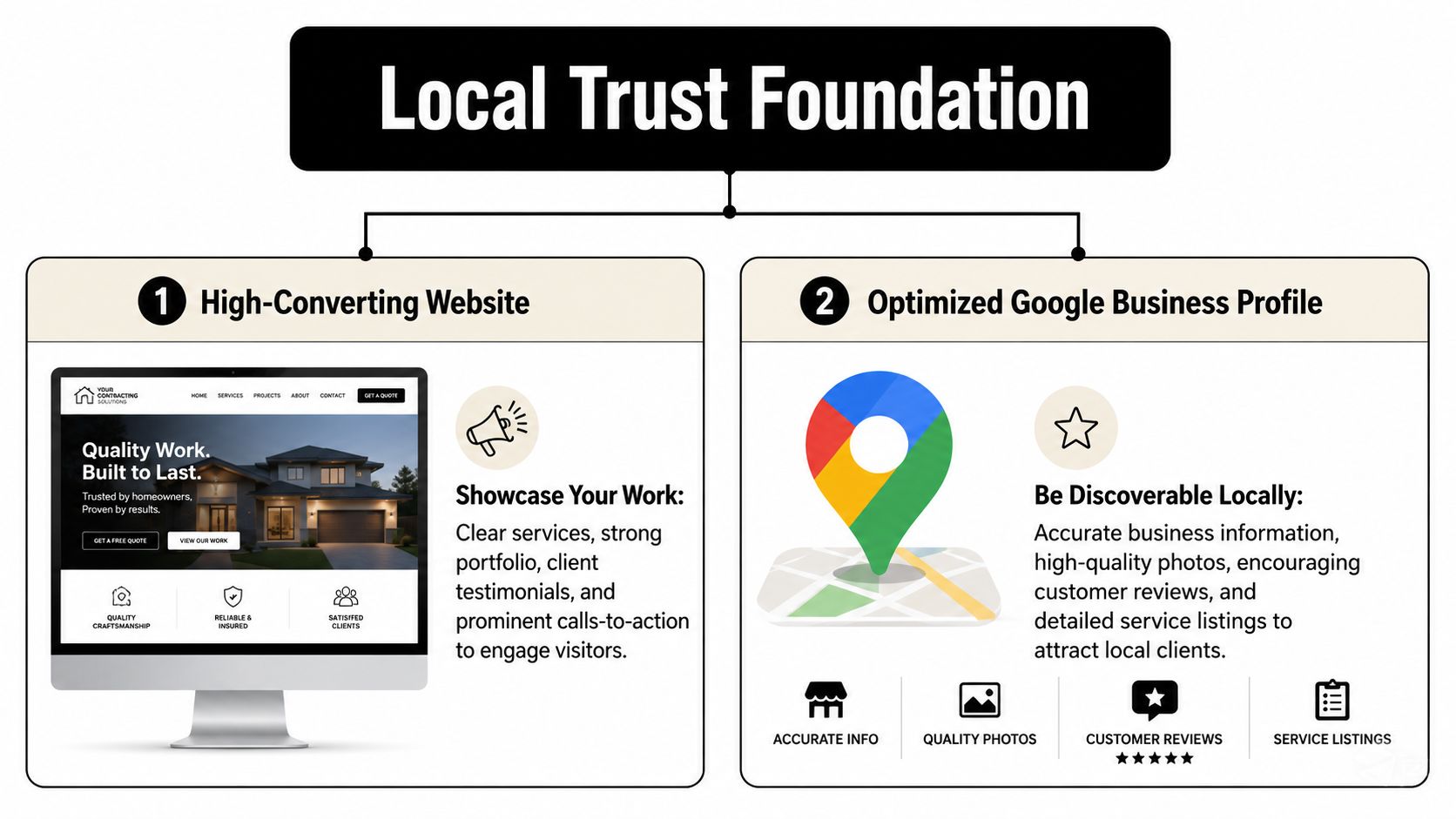
Build Your Digital Foundation for Local Trust
Before you spend money or time trying to drive traffic, your digital presence has to be ready to convert. I think of this as your digital job site. If the place looks disorganized, unsafe, or unfinished, people don't trust what happens next.
For contractors, two assets matter most. Your website and your Google Business Profile.
Industry reporting notes that 46% of all Google searches are for local information, which is why a contractor's website and Google profile need to be built to capture nearby search demand, not just exist online for appearances (contractor website fixes for better lead generation).
Your website is the first estimator
A contractor website should answer the same questions a serious prospect asks in the first few minutes of a call.
For an oilfield service company in the Uinta Basin, that might include service area, equipment capability, safety posture, emergency availability, and the type of work handled. For an excavation contractor, it may be trenching, site prep, utility work, trucking support, and whether the company serves residential, commercial, or energy-sector clients.
If your site hides those basics, visitors leave.
A strong contractor website needs:
Clear service pages that match the actual work you want more of
Visible contact options at the top of the page and again near each call to action
Real photos from projects in places like Roosevelt, Vernal, Duchesne, or surrounding service areas
Proof elements such as testimonials, project examples, certifications, or capabilities
Simple conversion paths so a visitor can call, submit a form, or request an estimate without hunting
A generic "Welcome to our website" homepage doesn't help much. A page that says "Hydrovac Services in the Uinta Basin" or "Excavation and Site Prep in Duchesne County" does.
For businesses that need a flexible platform to build this properly, this overview of a WordPress website for business lays out why so many contractor sites use WordPress as the backbone.
Your Google profile needs to do real work
Google Business Profile is not a set-it-and-forget-it listing. It's often the first place a buyer checks after seeing your name in search or on a map result.
For local contractors, a weak profile usually has one or more of these problems:
Problem
What prospects assume
Few or poor photos
The company may be inactive or unproven
Incomplete service list
They may not handle the work I need
Old reviews or none at all
Nobody has used them recently
Wrong hours or bad contact info
Calling them will be a hassle
That profile should include accurate business details, service categories, updated photos, a defined service area, and reviews that reflect the type of work you want more of. If you're trying to win more industrial or commercial opportunities, the visuals and descriptions should support that. If you want residential excavation or dirt work, that should be obvious too.
Practical rule: If a prospect can't tell where you work, what you do, and how to reach you in less than a minute, your foundation is leaking leads.
What local trust looks like in practice
Local trust online isn't built with clever wording. It's built with specifics.
Use examples like these:
Trade-specific proof such as "pipe yard prep," "produced water hauling support," or "shop fabrication for field repairs"
Service geography that names actual counties, towns, and regions you cover
Project context that shows whether you handle one-off jobs, recurring service, or bid-based work
A welding and fabrication shop in Roosevelt shouldn't look like a suburban handyman service. An excavation company serving oilfield and civil work shouldn't have a homepage full of vague stock photos and generic copy.
When lead generation for contractors works, the digital foundation does one job well. It makes the right buyer say, "These are the people I should call."
Attract High-Intent Customers with Local SEO
Local SEO gets talked about like it's a technical side task. It isn't. It's digital territory.
If your company does solid work in the Uinta Basin, local SEO is how you place signs on the roads your buyers already travel. Not physical roads. Search paths. The goal is to show up when somebody types the exact problem, service, or location that matches the work you want.
Recent industry guidance makes an important point. When lead marketplaces get crowded or low quality, contractors often do better by strengthening owned channels like their website, local SEO, reviews, and Google Business Profile, with paid platforms serving as a supplement rather than the core system (construction lead generation methods and channel tradeoffs).
Own the searches that match your actual work
Most contractor sites are too broad. They lump all services onto one page and expect Google to figure it out.
That rarely works well.
If you want better local visibility, build dedicated pages around real buyer intent. Think in terms of service plus location plus use case. For example:
Uinta Basin hydrovac services
Excavation contractor in Roosevelt
Oilfield trucking support in Vernal
Welding and fabrication in Duchesne County
Utility trenching contractor near Uintah County
Those pages shouldn't be thin keyword pages. They need job photos, service details, areas served, common project types, and a direct path to call or request a quote.
Build service area pages that prove local relevance
A lot of local SEO advice says "create city pages." That's only partly true. The useful version is this. Create pages for places you serve, then make each page specific enough that a real customer sees themselves in it.
For an excavation business, that may mean one page for Roosevelt, another for Vernal, and another for broader Uinta Basin industrial support. The Roosevelt page might feature residential pads, trenching, and septic-related work. The Vernal page may highlight industrial access roads, equipment support, and oilfield-adjacent services.
What matters is relevance, not volume.
A simple content framework works well:
Name the service and location clearly
Describe the type of work done there
Show real project photos from that area
Add trust signals and contact options
Link to closely related services
If every town page says the exact same thing except the city name, buyers notice and search engines usually do too.
A lot of contractors also benefit from understanding where Local Services Ads fit into the broader visibility picture. This 2026 Local Service Ads playbook gives useful context on how that channel works alongside local search.
Use project proof to rank and convert
Google cares about relevance. Buyers care about proof. Project content helps with both.
Add completed job write-ups to your site. They don't need to be polished magazine case studies. A straightforward summary is enough:
Project type and location
Scope of work
Challenges handled
Photos
Next step for similar prospects
For a local contractor, this is one of the best long-term assets you can build. A page about "Site prep and trenching for a commercial yard in Roosevelt" can support rankings, sales conversations, and trust all at once.
Later in the funnel, video helps too. A short explanation of how local search visibility turns into real inquiries is often easier to understand when you can watch the process.
The contractors who win organic visibility don't usually have the fanciest brand. They have the clearest digital footprint. They tell Google and the buyer exactly what they do, where they do it, and why they're credible.
Accelerate Growth with Targeted Paid Campaigns
Once your foundation and local SEO are in place, paid ads can help you fill schedule gaps, launch a new service line, or push harder in a target market. Used correctly, they accelerate what already works. Used badly, they burn money fast.
The two channels most contractors should compare first are Google Local Services Ads and Google Search Ads.
Local Services Ads versus Google Search Ads
These platforms look similar to many owners because both show up in Google results. They behave very differently.
Channel
Best fit
Main advantage
Main tradeoff
Local Services Ads
Call-driven service demand
Strong local visibility and direct phone inquiries
Less control over how broad or narrow the lead mix can be
Google Search Ads
Specific services, project types, or commercial intent
More control over keywords, messaging, and landing pages
Requires tighter management to avoid wasted spend
For many trade contractors, Local Services Ads work well when the buyer wants to talk now. Think urgent service, estimate requests, or straightforward local jobs. Search Ads usually make more sense when the work is more specialized, the scope is larger, or the prospect is searching with more detailed phrases.
When each channel makes sense
A simple way to decide:
Use Local Services Ads if your team can handle incoming calls quickly and your work is sold through conversation.
Use Search Ads if you need to target narrow service lines, separate residential from commercial intent, or route traffic to specific landing pages.
Use one before using both if your tracking is still weak. Two ad channels without lead tracking create confusion fast.
An excavation company might run Search Ads for site prep, trenching, or utility work because the queries are more specific. A general service contractor may prefer Local Services Ads if the phone call is the main conversion event.
What breaks paid campaigns
Paid campaigns fail for predictable reasons. The ad platform usually isn't the main problem.
Common failure points include:
Bad landing pages that don't match the ad message
Weak intake when calls go unanswered or forms disappear into email
Broad targeting that pulls in low-fit leads
No source tracking so nobody knows which campaigns bring qualified jobs
No operational filter for service area, job size, or project type
Paid traffic doesn't fix a weak system. It exposes it.
The smartest move is usually not "run more ads." It's "run a tighter campaign connected to a stronger intake process." If you're generating residential handyman calls but you really want industrial excavation bids or oilfield support work, the targeting, the ad copy, and the landing page all need to reflect that. Otherwise you'll buy noise instead of opportunity.
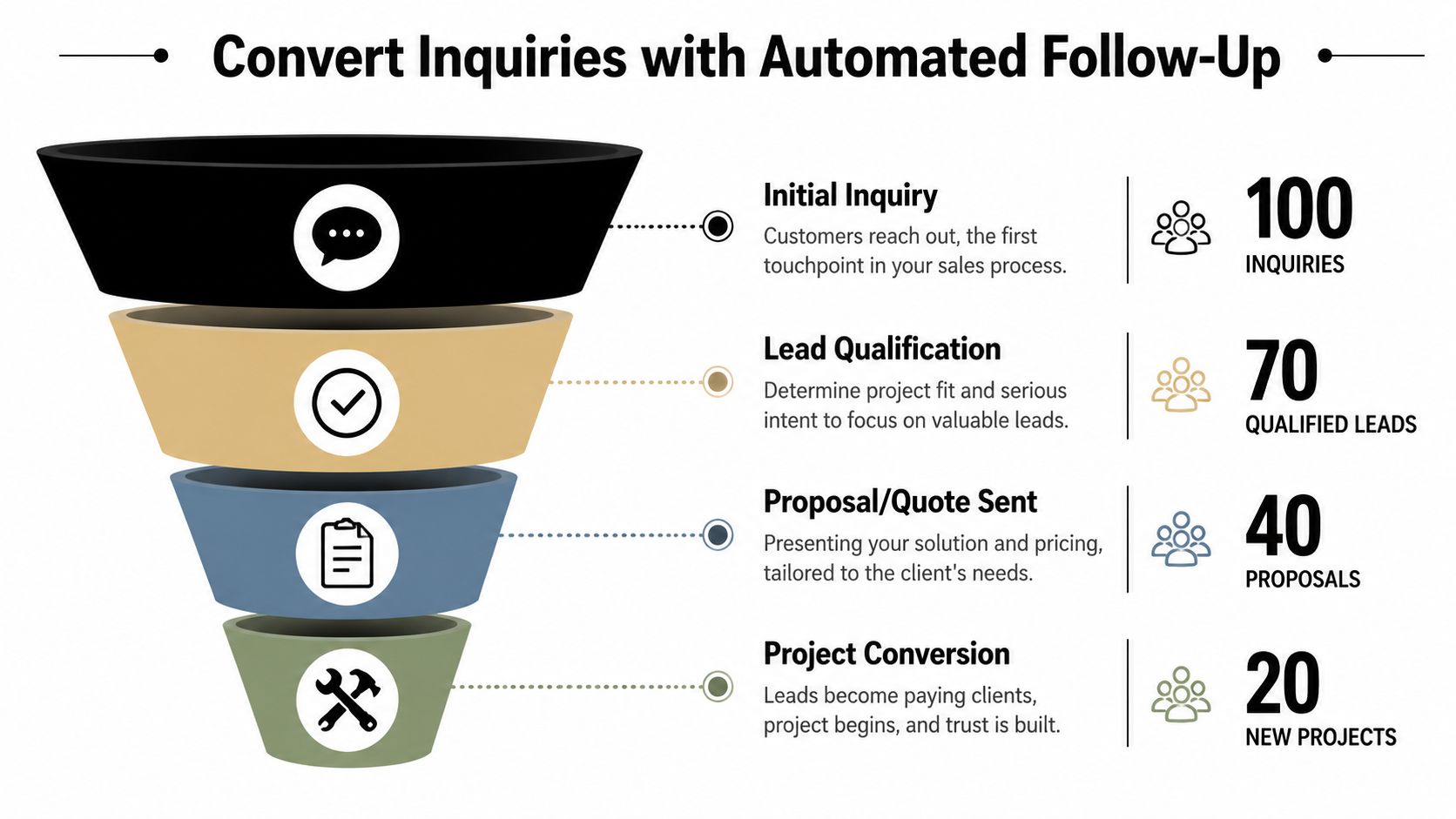
Automate Follow-Up to Convert More Inquiries
Most contractors think the lead is won by the ad, the ranking, or the referral source. A lot of the time, it's won by whoever responds first and handles the next step cleanly.
This is the part of lead generation for contractors that gets ignored because it's operational, not flashy. But it's where a lot of revenue gets lost.
One industry guide reports that contractors who respond to online leads within 5 minutes see conversion rates up to 400% higher than those who wait longer, and that 89% of homeowners start their contractor search online (home services lead generation platforms guide). Those numbers explain why speed isn't a nice extra. It's part of the sales process.
Fast response wins real jobs
Think about how inquiries happen in the real world. A prospect finds your website after hours, fills out a form, then keeps looking. Or they call from a Google listing, don't get an answer, and move to the next contractor. They are not waiting around for your office to catch up.
This is especially true in competitive trades. Roofing, remodeling, excavation, trucking support, and industrial field services all have buyers who may contact more than one company in a short window.
A fast response does three things:
It confirms you're active
It lowers buyer uncertainty
It gets you into the conversation before competitors do
What a simple contractor follow-up system looks like
You don't need an enterprise setup. A practical CRM and a few automations go a long way.
Use a system that does the following:
Captures every lead source from forms, calls, or ad campaigns
Sends an immediate acknowledgment by text or email
Assigns follow-up responsibility to an actual person
Tracks status from inquiry to quote to won or lost
Logs source quality so you know which channels produce real work
For smaller operations, even modest automation helps. This guide to AI-powered business tools is useful for contractors who want practical automation without turning the office into a software experiment.
A fast acknowledgment isn't impersonal. It tells the prospect their request didn't disappear into a black hole.
Where contractors usually lose the lead
The breakdown usually happens in ordinary places:
The missed call when the owner is in the field
The buried form fill sitting unread in a shared inbox
The delayed estimate that goes out after the buyer has moved on
The untracked source that keeps draining time without producing good jobs
A clean follow-up process doesn't have to sound robotic. The automated reply can be simple and direct. "Thanks for reaching out. We received your request and will contact you shortly." Then a real person follows up with the right questions.
If you want more jobs from the leads you already get, this is usually the fastest operational fix.
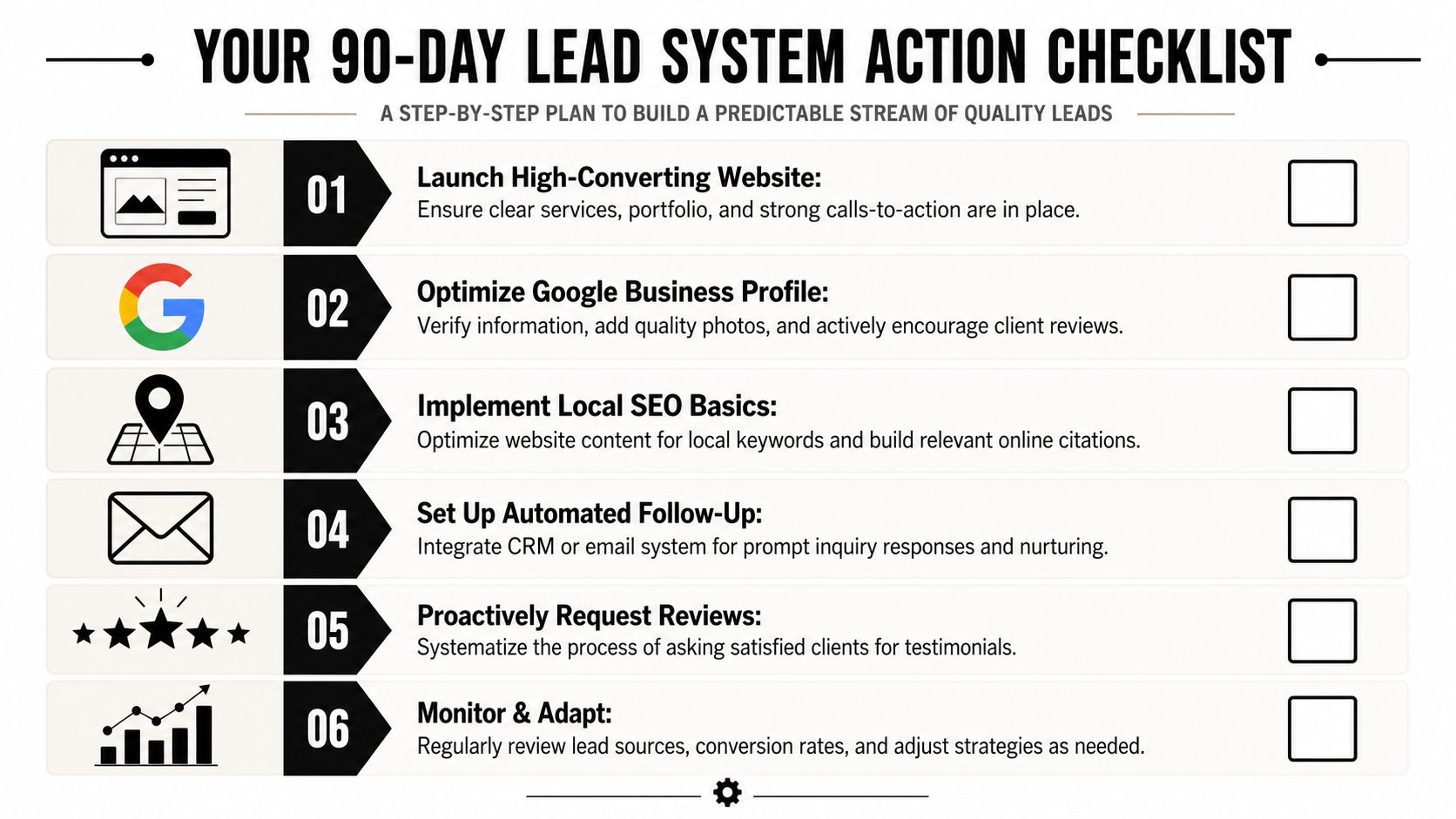
Your Action Checklist for a Predictable Lead System
A contractor lead system doesn't need to be built all at once. It needs to be built in order. The most useful approach is to treat the first three months like a field rollout. Foundation first. Then visibility. Then acceleration and tracking.
A practical contractor funnel should be measurable from the start: optimize Google Business Profile, launch one high-intent channel, connect sources to a CRM, and audit lead quality, quote speed, and close rates so you can see what produces qualified work instead of just activity (how contractors get more leads with a measurable funnel).
Days 1 through 30
Start with assets you own.
Clean up your website so services, locations, photos, and calls to action are clear.
Complete your Google Business Profile with accurate categories, service areas, contact details, and recent project images.
Set one intake path for all inquiries so leads aren't scattered across personal phones, old inboxes, and sticky notes.
Days 31 through 60
Build visibility around the work you want.
Create focused service pages for your highest-value trade work.
Add local pages for the towns and counties you serve.
Publish project examples that show real jobs, not generic promises.
Ask for reviews consistently after completed work so your public reputation keeps compounding.
Days 61 through 90
Add controlled acceleration.
Launch one high-intent paid channel rather than spreading budget across too many platforms.
Connect forms and calls to a CRM so every inquiry gets tracked and followed up.
Review your recent leads and ask basic questions: Which channel brought them in? How fast did you respond? Did the job fit your target work? Did it close?
A lot of owners make this too complicated. Keep it simple. Build one durable system that helps your company show up, earn trust, capture inquiries, and follow through.
If you do that well, lead generation stops being a series of random marketing tasks. It becomes part of how the business runs.
If you're a contractor, oilfield service company, trucking operation, or local business that needs a stronger website and a practical lead system, Northpoint Web helps companies across the Uinta Basin build digital assets that generate inquiries, support recruiting, and improve local search visibility without the fluff.
What contractor lead generation includes
Lead generation is more than getting a contractor website online. A workable system connects several steps:
Visibility: appear when people search for the services and locations you actually serve.
Trust: show clear services, service areas, project context, photos, reviews, and capabilities.
Capture: make it easy to call, submit a form, or request an estimate.
Response: follow up quickly and consistently when an inquiry arrives.
Measurement: record where qualified inquiries came from and which opportunities become jobs.
Referrals can remain an important source of work, but a connected system gives you more visibility into demand and reduces dependence on unpredictable bursts of activity.
Start with a contractor website built to convert
Your website should help a serious prospect decide whether to contact you within the first few minutes. Make the actual services, service areas, customer types, and contact options easy to find.
Create individual service pages for the work you want more of.
State the towns, counties, or regions you serve where that information is accurate.
Explain relevant capabilities, equipment, project types, and industries without using vague claims.
Place visible phone and form options near the top of the page and again after important decision points.
Use real project photos and documented examples when available; do not substitute unsupported claims or generic proof.
A page such as “Hydrovac Services in the Uinta Basin” or “Excavation and Site Prep in Duchesne County” is more useful to a qualified visitor than a generic welcome message.
Use Google Business Profile and local SEO to capture demand
Local SEO helps your business become visible when prospects search for a contractor, service, or trade in a specific area. Your Google Business Profile should contain accurate business details, appropriate categories, current photos, a defined service area, and reviews that reflect the work you want to attract.
Connect the profile to useful website pages rather than sending every visitor to a generic homepage. Each service-area page should make the local connection clear through accurate service information, project context, and a straightforward contact path.
Match each priority service to a dedicated page.
Use consistent business name, phone, and location or service-area information.
Request honest reviews from appropriate customers and never manufacture review content.
Publish useful project or service updates when you have genuine information to share.
Northpoint’s local SEO resource can support this part of the strategy, while the contractor-specific checklist should remain focused on the actions most relevant to the business.
Build pages for high-intent contractor searches
Prioritize searches that reveal a real need rather than trying to rank for every construction-related phrase. Useful page themes may combine an actual service with an accurate location, industry, or project type.
Service plus location, such as a specific excavation service and county.
Service plus customer type, such as industrial, commercial, residential, or energy-sector work when applicable.
Problem or project language, such as site preparation, hauling support, fabrication, or field repair when those are genuine services.
Estimate and contact language for visitors who are ready to discuss a project.
Every page should explain what the service involves, who it is for, where it is available, what a prospect should provide when contacting the company, and what happens next. Add only real project examples, certifications, capabilities, and customer feedback that can be verified.
Want a more dependable contractor lead system?
Northpoint Web Solutions can help you evaluate the website, local SEO, and follow-up gaps that may be limiting qualified inquiries. Contact us to discuss what your contractor business offers, where you serve, and which parts of the current system need attention.
Either your crew does solid work, your schedule depends too much on referrals, and you know you should be showing up better online. Or you already paid for a website, maybe even tried some SEO, and nothing changed except your inbox got a few agency pitches.
That gap is common in contracting. The best excavator in town can still lose work to a competitor with a cleaner Google Business Profile, stronger city pages, and more recent reviews. A welding shop can have better turnaround, better field work, and better pricing, then get outranked by a shop that made itself easier for Google to understand.
For contractors, online visibility isn't abstract branding. It's whether a plant manager, homeowner, or project superintendent finds your business when they need trenching, hydrovac, fabrication, hauling, or repair work near them. Google has reported that 76% of people who search on a smartphone for something nearby visit a business within 24 hours, and 28% of those searches lead to a purchase, which is why local search visibility can turn into calls and booked jobs fast, especially for local service businesses (local search benchmark details).
If you want another practical perspective, HearBack's guide to local marketing is worth a read because it stays focused on contractor realities instead of generic marketing talk.
A lot of contractors have the same problem. Their reputation exists in the field, not in search.
An excavation company might have operators who can handle difficult ground, a reliable trucking setup, and years of local project experience. But when someone searches for “excavation contractor near me” or “site prep in Roosevelt,” Google doesn't see reputation the way the local market does. Google sees categories, proximity, consistency, page relevance, reviews, and whether the business has made its services clear.
That's why a smaller competitor can win the click. Not because they do better work, but because they're easier to find and easier to trust in the search results.
Local intent is where contractors win or lose
A homeowner with a broken water line isn't browsing for fun. A superintendent needing a welder on a shutdown job isn't researching brands for a month. These are high-intent searches with short decision cycles.
When your business shows in Google Maps, the local pack, and organic results for the right services and towns, you're meeting demand when the buyer is ready to act. That matters even more in trades where speed, location, and availability drive the decision.
Practical rule: If your company is invisible in local search, your market may still know your name, but new customers and new project managers won't.
The real issue usually isn't skill
The issue is usually one of these:
A weak Google presence: The profile exists, but categories are off, service areas are incomplete, or photos are outdated.
A vague website: One generic services page tries to cover excavation, trucking, welding, reclamation, and rentals all at once.
Thin local proof: No city pages, no project photos tied to place, and no review process.
No recruiting visibility: The company needs CDL drivers or welders, but the website gives job seekers nothing useful to find.
Contractor SEO works best when it matches how buyers and job seekers search. People don't type “full service industrial solutions.” They search for “hydrovac contractor Vernal,” “pipe welding Duchesne,” or “CDL driver jobs Uinta Basin.”
That's the shift. Local SEO for contractors is less about clever marketing and more about operational clarity online.
Build Your Unshakable Foundation on Google
Most local SEO failures start here. Contractors try to fix rankings with new pages, blog posts, or ads before their Google Business Profile is fully built out.
That's backwards. A practical contractor local SEO workflow should start with a fully completed Google Business Profile, exact NAP consistency across every citation, and location or service-area setup, then add city-specific service pages, reviews, photos, and ongoing posts. One contractor SEO source also notes that meaningful results often take 3-6 months to emerge in competitive markets, which is a realistic timeline for local SEO work that's done correctly (contractor local SEO workflow).
Start with the profile that controls local visibility
If you do one thing first, do this.
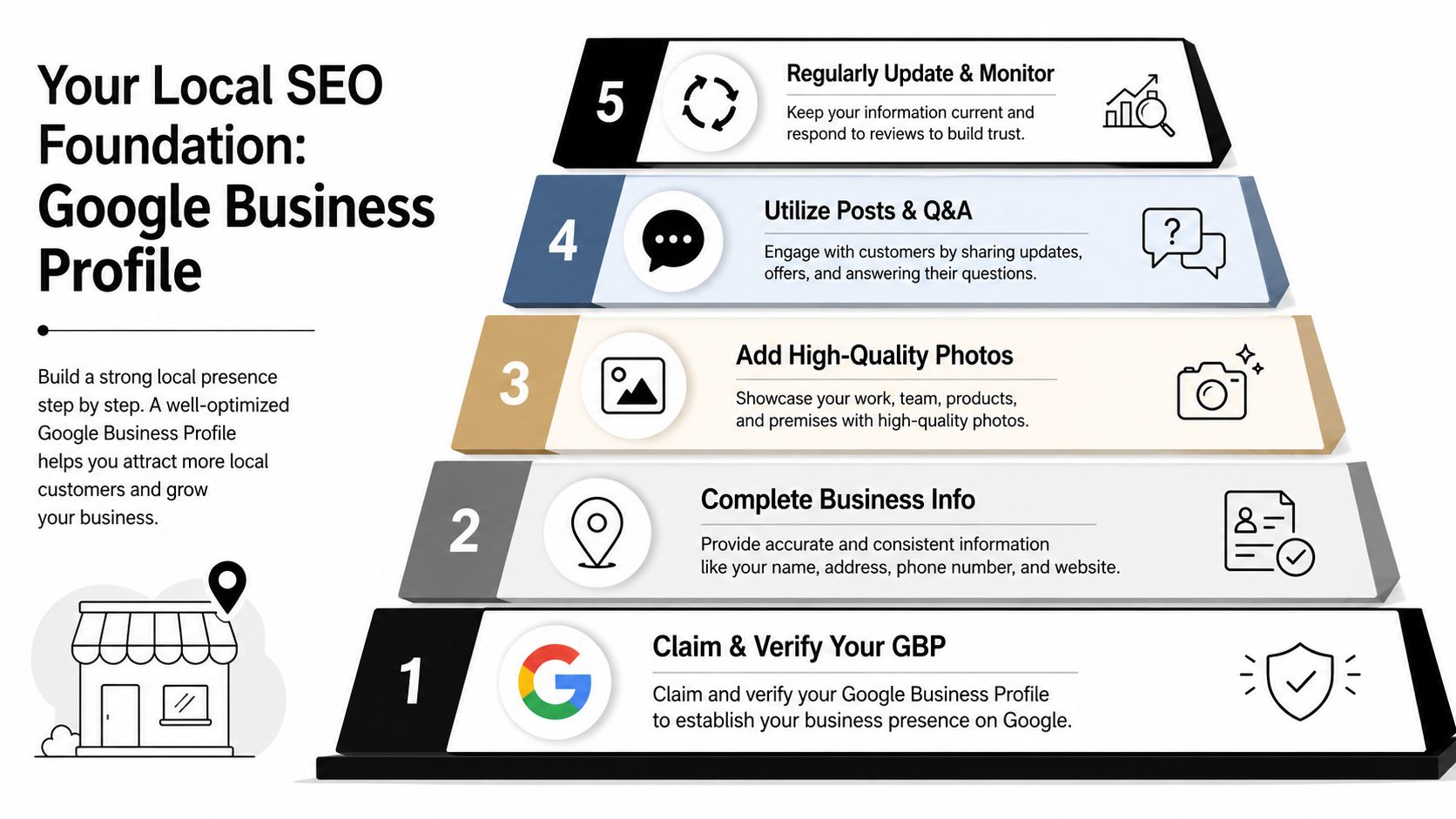
Claim the Google Business Profile. Verify it. Then complete every field that applies to the business. Contractors leave money on the table when they rush through this and treat it like a directory listing instead of a lead asset.
Your setup should include:
Accurate business identity: Use your real business name. Match it everywhere else online.
Primary and supporting categories: Pick the category closest to your core service. An excavation contractor should not default to a broad category if a more precise one fits.
Service areas: Set the cities, counties, or regions you serve.
Business description: Write a direct summary of what you do, where you work, and who you help.
Phone and website: Send traffic to the right contact points, not to an old number or placeholder page.
For newer companies, this often overlaps with basic business setup. If you're still working through state paperwork, contractor license requirements can help you sort out the licensing side so your public information stays clean from the beginning.
Get the details right before you chase rankings
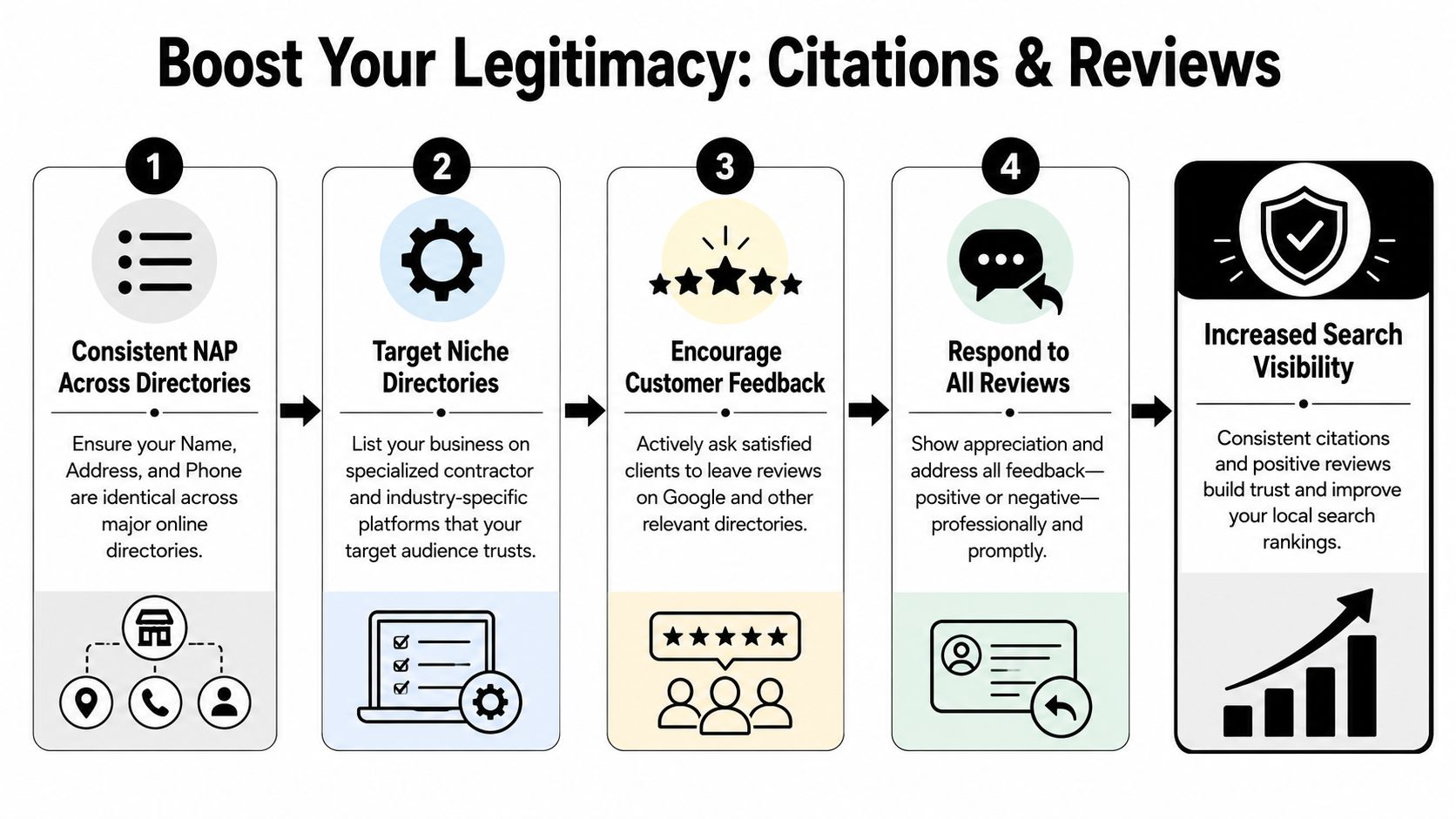
NAP consistency means your business name, address, and phone number must match across your website, your Google profile, and your citations. Even small differences create avoidable confusion.
A common contractor problem looks like this:
Location
Business Name Used
Phone Used
Result
Website footer
Basin Welding & Fabrication
Main office
Correct
Google profile
Basin Welding
Cell number
Mismatch
Directory listing
Basin Welding and Fab LLC
Old office line
Mismatch
That kind of inconsistency weakens trust. It also makes it harder for Google to connect all your local signals to one business entity.
A half-finished profile tells Google and customers the same thing. This business may be active, but it's not organized.
Here's what usually deserves attention before anything else on the website:
Categories and services
Service area accuracy
Matching NAP across the web
Photos of real jobs, crews, trucks, and equipment
Review generation process
Keep the profile active after setup
A completed profile isn't a one-time job. Contractors who stay visible usually keep feeding the profile with proof that the business is active and local.
Use photos from recent trenching jobs, welding repairs, aggregate hauling, shop fabrication, or equipment mobilizations. Add updates when you open a new service area, finish a notable project type, or answer common customer questions.
This video gives a useful overview of profile optimization in practice:
A simple maintenance rhythm works well:
Weekly photos: Fresh jobsite images, trucks, crews, or completed work.
Ongoing Q&A: Answer the questions customers keep asking by phone.
Routine review responses: Thank satisfied clients and handle criticism professionally.
Periodic service checks: Make sure listed services still match what the company wants to sell.
The goal isn't activity for its own sake. The goal is to make your company the most complete, credible local option when Google chooses who to show.
Turn Your Website Into a Local Lead Magnet
A contractor website often fails for one reason. It tries to say everything on one page.
One “Services” page with a paragraph about excavation, another sentence about welding, and a short list of towns served rarely ranks well for high-intent local searches. It's too broad for Google and too shallow for the buyer.
Why generic service pages usually underperform
Contractor local SEO guidance recommends pages that are optimized for relevance and crawlability, including 200+ words per location or service page, natural keyword placement at roughly 1-2% density, descriptive image alt text, and schema markup for services, reviews, and locations. The same guidance also points to a better strategic question: should you build a large set of city pages, or a smaller number of stronger pages that actually help users, especially in rural service areas where thin location pages can start looking like doorway pages (guidance on contractor page structure).
That lines up with what works in the field. A page titled “Services” doesn't do much for searches like “hydrovac services in Vernal” or “mobile welding in Duchesne County.” A focused page can.
For example, these pages make more sense than one broad catch-all page:
Hydrovac Services in Vernal
Excavation and Site Prep in Roosevelt
Pipeline Welding in Duchesne
CDL Dirt Hauling Services in the Uinta Basin
A clean build on a flexible platform matters here. If your site structure fights you every time you need a new service or city page, a better WordPress website for business setup usually makes local expansion much easier.
How to build location pages that deserve to rank
A good local page needs more than a city name swap.
It should prove that your company operates there, understands the service, and can solve the searcher's problem. Think less like a template and more like a field-ready sales page.
Include elements like these:
A clear service plus location title: “Excavation Contractor in Roosevelt, Utah” is better than “Welcome.”
Specific scope details: Say whether you handle grading, trenching, pad prep, utility excavation, or cleanup.
Local project evidence: Add job photos, equipment photos, and references to the kind of work common in that area.
Strong calls to action: Make it easy to request a quote or call from the field.
Schema markup: Help search engines understand your services, locations, and review content.
A useful way to think about it is to model the specificity you see in strong local business pages in other trades. For example, this Phoenix AZ landscaper page works because it is narrow, place-based, and service-specific rather than generic.
If the only local detail on the page is the city name in the headline, the page probably isn't useful enough.
Choose fewer stronger pages when your territory is rural
At this point, many contractors in places like the Uinta Basin get led in the wrong direction.
In dense metro areas, a business may justify more location pages because each city has enough search demand and enough distinct context to support them. In rural regions, creating a long list of near-duplicate pages for every small town usually backfires. You end up with thin content that doesn't help the user and doesn't build trust.
A better decision framework looks like this:
Situation
Better move
Core services with strong local demand
Build dedicated service pages
Major towns you serve repeatedly
Create unique city pages with local proof
Small surrounding areas with little distinction
Mention them naturally on stronger regional pages
Multiple pages with nearly identical copy
Consolidate and improve them
For a welding shop, one excellent “Mobile Welding in the Uinta Basin” page with real photos, service details, and nearby town references can outperform a pile of weak city pages. The same goes for excavation, roustabout work, and hauling.
Your website should narrow the buyer's choice, not make Google guess what you do.
Earn Authority with Citations and Reviews
Once your Google profile and service pages are in better shape, outside trust signals start to matter more. Two of the biggest are citations and reviews.
Citations are simple. They're mentions of your business details on other websites. Reviews are public proof that people hired you and were willing to say so.
Clean citations build trust faster than most contractors think
Most contractors don't need hundreds of directory listings. They need the right listings, and they need them to match.
Start with the places that matter most to your market. That usually includes major business directories, contractor-relevant platforms, local chambers, and regional business listings. If you're in industrial services, niche directories or association listings can matter more than broad consumer platforms.
Use this checklist when cleaning citations:
Match the business name exactly: Don't switch between LLC, shorthand names, and old branding unless you have a reason.
Use one primary phone number: Avoid mixing office, dispatch, and cell numbers across listings.
Keep the website URL consistent: Point listings to the strongest relevant page.
Check service descriptions: Make sure they reflect what you want to sell now, not what you used to do.
A contractor with mismatched citations often sees confusion show up in real life. Customers call the wrong line. Old addresses stay live. Former services still appear in search results.
Reviews influence both ranking and response
Reviews do more than decorate your profile. They help buyers decide whether to call.
For contractors, the best review strategy is operational, not awkward. Ask after a successful milestone. That might be after a pad is finished, after a repair gets signed off, or after a homeowner says the crew did a great job. Don't wait until months later when the customer barely remembers the details.
A workable review process looks like this:
Choose the moment: Ask when the customer is clearly satisfied.
Make it easy: Send the direct review link by text or email.
Give light guidance: Ask them to mention the service and town if they're comfortable doing so.
Respond to every review: Short, professional, and specific is enough.
Field note: Reviews that mention the actual service performed often do more for credibility than generic praise.
Negative reviews need a steady hand. Don't argue in public. Acknowledge the issue, stay professional, and move the conversation offline when needed. Buyers read those responses closely, especially in higher-trust trades like construction, welding, and hauling.
If your business is doing good work and still has very few reviews, that's usually a process failure, not a reputation failure.
Use SEO to Recruit a Winning Team
A lot of contractor websites act like the only audience that matters is the customer. That's a miss.
For many contractors, the bottleneck isn't demand. It's labor. You may have enough work for another truck, another welding rig, or another excavation crew, but you can't find the right CDL drivers, operators, or welders. Local SEO can help with that if you build for it on purpose.
Most contractor websites ignore hiring intent
Job seekers search with local intent too. They type phrases like “CDL driver jobs Uinta Basin,” “welder jobs Roosevelt Utah,” or “equipment operator jobs near me.” If your site only has a single “Careers” link with no detail, it won't do much for those searches.
Recruiting-focused SEO means building pages that answer what skilled applicants need to know:
What kind of work they'll be doing
Whether the role is local or travel-based
What equipment or certifications matter
Whether the company works steady projects or seasonal jobs
How to apply without jumping through hoops
A stronger contractor hiring strategy usually starts with a real careers section and expands into role-specific pages. For companies in industrial and trade markets, a focused construction SEO approach should account for both customer searches and hiring searches because both affect growth.
Build job pages like service pages
Think about job pages the same way you think about lead pages. Specific pages rank better, convert better, and filter people better.
Instead of one vague hiring page, build pages like:
CDL Driver Jobs in the Uinta Basin
Experienced Welder Careers in Roosevelt
Heavy Equipment Operator Jobs in Duchesne County
Field Laborer Jobs for Oilfield and Construction Projects
Each page should include the role, location, work type, application steps, and what kind of person fits the crew. If you use JobPosting schema, you also give search engines clearer information about the opening.
A short comparison makes the point:
Weak hiring page
Strong hiring page
“We're hiring. Apply today.”
“CDL Driver Jobs in the Uinta Basin for side dump and equipment hauling”
No location info
Clear local geography and routes
No role detail
Equipment, duties, schedule, and expectations
Generic form
Simple application path
Good recruiting pages don't just attract more applicants. They attract applicants who understand the work before they call.
This matters in rural markets. Skilled labor is limited, and job boards alone often bring a pile of weak-fit applications. Search-driven recruiting gives you another lane to reach people already looking for local trade work.
Measure What Matters and Plan Your Next Move
A contractor doesn't need more reporting. A contractor needs to know whether the phone is ringing more often from the right places.
That's why the best local SEO measurement is tied to lead quality and business activity, not vanity charts. Contractor SEO guidance recommends tracking local-search traffic, Google Business Profile interactions, conversion rates, and keyword positions in Google Analytics and Search Console, with attention on outcomes like calls, direction requests, and quote submissions rather than rankings alone (practical contractor SEO measurement).
Track lead signals instead of vanity metrics
If you own or manage the business, start with the signals closest to revenue:
Phone calls from local search: Are more prospects calling from the towns you want?
Quote form submissions: Which service pages are producing real inquiries?
Direction requests: Useful for shops, yards, and local offices.
Google Business Profile interactions: A direct sign that people are engaging with your listing.
Keyword visibility by service and town: Helpful when tied back to lead quality.
You don't need a fancy dashboard to spot progress. A simple monthly review can tell you a lot.
Metric
Why it matters
Calls
Immediate lead intent
Quote requests
Sales opportunity volume
Direction requests
Local buyer action
Page-level traffic
Which services and towns draw demand
Search queries
How customers actually describe the work
Your next gains usually come from local proof
Once the basics are in place, the next layer is often local proof.
That might mean sponsoring a local rodeo, supporting a county event, joining a regional association, getting listed by a local business group, or earning mentions from suppliers and partner companies. It can also mean publishing stronger project pages with location details, better photos, and clearer explanations of what your crew handled.
Your mobile site speed and usability still matter too. A superintendent checking your site from a truck or a homeowner searching after hours won't wait around for a clunky page to load.
What matters most is consistency. Local SEO for contractors isn't a one-time cleanup. It's a system. You tighten the profile, improve the pages, earn reviews, watch the lead signals, then keep building from there. If you want support with the strategy, execution, or ongoing improvement, a specialized SEO team for contractors can help turn that system into something repeatable.
Northpoint Web helps contractors, industrial companies, and local businesses build websites and SEO systems that generate leads and attract employees in markets like Duchesne, Roosevelt, Vernal, and the wider Uinta Basin. If your company needs a stronger Google presence, better local service pages, or recruiting-focused SEO for roles like CDL drivers and welders, Northpoint Web is built for that kind of work.
If you're running a construction company in Roosevelt, Vernal, or anywhere across the Uinta Basin, you've probably felt the shift already. Referrals still matter, but they aren't carrying the whole load anymore. A property owner hears your name, then Googles you. A company needs excavation, welding, trucking, or site work, then compares three contractors on a phone before making a call. A potential CDL driver or equipment operator checks your reputation online before filling out an application.
That's why SEO for construction matters now. WebFX reports 1.7 million online searches per month for independent contractors in its construction statistics roundup, which tells you the market is already searching online at scale, not just asking around at the coffee shop or job trailer (construction search demand data from WebFX). For a contractor in a regional market, that changes the game. Your website, your Google Business Profile, your reviews, and your service pages all become part of how you win bids and attract workers.
The bigger opportunity is resilience. Good SEO for construction doesn't just help you get found for one service this month. It builds a system that supports better project inquiries, stronger credibility, and more qualified job applicants, even while Google keeps changing the search results.
Construction companies get in trouble online the same way they get in trouble in the field. They start building before the plan is clear. A homepage goes up, a few service blurbs get added, maybe a contact page and some photos, and then everyone wonders why the site isn't bringing in useful leads.
Good SEO for construction starts before design. It starts with figuring out what buyers and job seekers are typing into Google.
Start with search intent, not website design
A contractor in Roosevelt shouldn't begin with a generic phrase like "construction services." That's too broad, too vague, and usually disconnected from how real people search. A better starting point is the kind of phrase tied to actual buying intent, like excavation in a specific town, welding for a specific industry, or trucking tied to a local service area.
In practical terms, you're looking for the intersection of service + location + intent. That means phrases such as excavation contractor Roosevelt UT, welding and fabrication Vernal UT, CDL driver jobs Uinta Basin, or oilfield trucking company Duchesne County. Those searches reveal what kind of page you need to build.
Practical rule: If one page tries to rank for everything, it usually ranks for nothing important.
Many contractor websites often break down because of this. They have one "Services" page carrying excavation, site prep, trenching, demolition, trucking, reclamation, and hiring. That's like trying to pour footings, frame walls, and finish electrical from one set of instructions.
Build a site structure that matches real demand
A strong contractor site works like a blueprint. Each room has a purpose. Each page should do one clear job.
One practical workflow from Padula Media is to map one core keyword to one dedicated page, then build long-tail and location variants around it. That reduces keyword cannibalization and helps each page match a single search intent (construction page mapping workflow from Padula Media).
Here's what that often looks like:
Page type
Purpose
Example
Service page
Capture high-intent local searches
Excavation Contractor in Roosevelt, UT
Location page
Support nearby markets
Excavation Services in Vernal
Project page
Show proof
Pipeline trenching project in Duchesne County
Careers page
Recruit workers
CDL Driver Jobs in the Uinta Basin
About or trust page
Reduce friction
Safety, equipment, service area, certifications
That structure helps both Google and your visitors. The search engine understands relevance. The visitor understands where to click next.
If you're thinking beyond search alone, it also helps to connect web visibility with digital and offline lead strategies. Contractors don't win work from one channel in isolation. SEO works best when your website, trucks, referrals, sales follow-up, and local visibility all point in the same direction.
Keep every page on one job
Once the structure is clear, the build becomes simpler.
Use descriptive URLs. Keep a clean heading hierarchy. Make sure important pages are only a few clicks from the homepage. Submit an XML sitemap through Google Search Console and Bing Webmaster Tools. Those are basic site-structure tasks, but they matter because they help search engines discover and understand the pages you've invested in.
A simple planning checklist works well here:
Pick one core term per page: Don't make your excavation page fight your sitework page.
Add local variants naturally: Mention Roosevelt, Vernal, Duchesne, or the Uinta Basin where relevant.
Support the page internally: Link from the homepage, related services, project pages, and careers pages.
Match the visitor's next step: Bid request, call button, equipment inquiry, or job application.
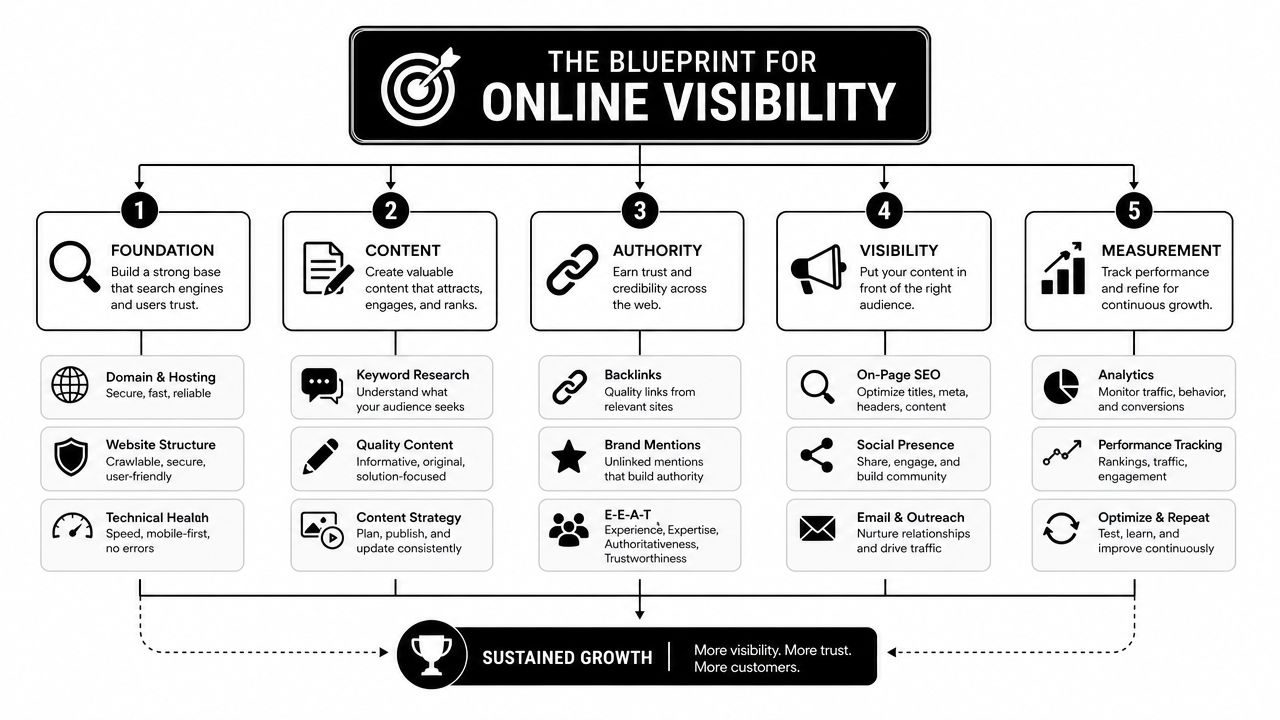
The companies that usually struggle with SEO for construction aren't lacking effort. They're lacking a blueprint. Once the site structure matches how people search, the rest of the work starts compounding instead of competing with itself.
Dominate Your Service Area with Local SEO
For most contractors, local SEO is the closest thing to low-hanging fruit. Not easy, but direct. When someone searches for a contractor with a local need, Google often shows the map, the business profiles, the review signals, and the nearest relevant providers before anything else gets attention.
That's why your Google Business Profile deserves more respect than most companies give it. It isn't just a listing. It's your digital front door.
Treat your Google Business Profile like a field office
A weak profile usually looks familiar. Bare description. Few photos. No updates. Services listed loosely, if at all. Maybe a handful of old reviews. That kind of profile tells Google very little and tells a prospect even less.
A strong profile does the opposite. It describes what you do, where you do it, and why someone should trust you enough to call. Modern construction SEO guidance puts Google Business Profile optimization, reviews, local citations, mobile usability, page speed, backlinks, and project-specific content at the center of the strategy, not on the sidelines (construction SEO evolution and timing guidance from Get Found Fast).
One useful detail from that same source is timing. It says low-competition construction keywords may move in 24 hours to a few days, while more competitive terms can take 30 to 90 days, and highly competitive terms 90 to 180 days to show meaningful movement. That's one reason local SEO often produces the first visible traction for contractors.
Your profile should answer the same questions a customer would ask at the counter. What do you do, where do you work, and how do I contact you right now?
What a strong local profile looks like
Take a hypothetical company called Uinta Basin Welding. A high-functioning profile would include:
Accurate business category: Welding contractor, metal fabricator, or the closest fit to actual work performed.
Service-focused description: Mention field welding, shop fabrication, repair work, structural steel, mobile service, or industrial support if those are the offerings.
Actual project photos: Trucks, welds, crews, equipment, shop images, and finished work.
Defined service areas: Roosevelt, Vernal, Duchesne, and nearby communities if that reflects operations.
Clear contact paths: Phone, website, hours, and service information that matches the website.
Then add regular Google Posts. Most contractors ignore them. That's a mistake. Posts can highlight a completed project, announce a new piece of equipment, share a hiring notice, or answer a common service question. They show activity, and activity helps.
For businesses trying to sharpen this part of their visibility, Northpoint Web publishes local search content under its local SEO tag that covers many of the same practical issues contractors run into in smaller regional markets.
Reviews and posts move the job forward
Reviews aren't just for optics. They affect click behavior because they reduce uncertainty. A property owner wants evidence that you finish work well. A commercial buyer wants signs that you're responsive and legitimate. A potential employee wants to know if the company looks stable.
A basic review system is enough to outperform most competitors:
Ask at the right moment: Right after successful completion, not months later.
Make it easy: Send the direct review link by text or email.
Guide the feedback naturally: Ask clients to mention the service and location in their own words if they're comfortable.
Respond to every review: Short, professional, and specific.
Local SEO also rewards consistency. Your business name, address, phone number, service area details, and core services should align across your website, directories, and profile. When that information drifts, Google gets mixed signals.
For a contractor in the Uinta Basin, local SEO isn't abstract. It's the difference between showing up when someone searches for a crew nearby and getting passed over for a competitor with a cleaner profile and stronger review trail.
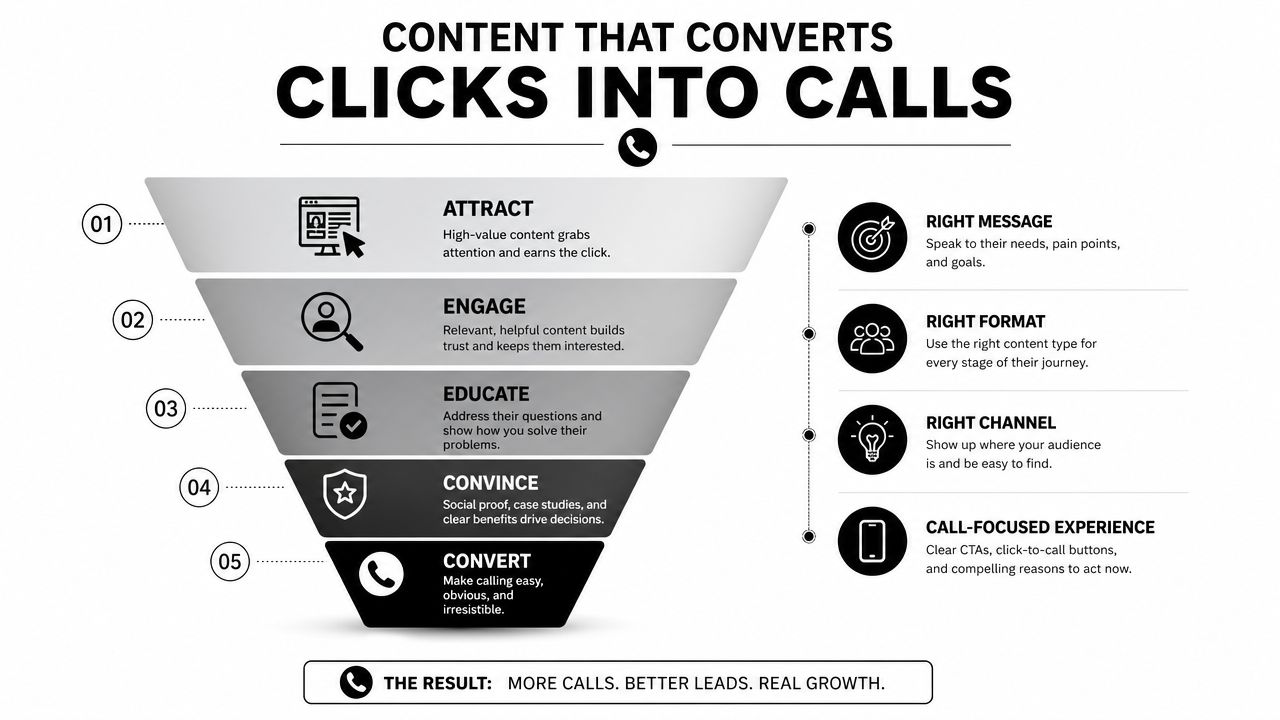
Content That Converts Clicks into Calls
A lot of contractor websites have traffic problems, but many have conversion problems disguised as traffic problems. The page gets a visit. Nothing happens. No call, no quote request, no application. That usually isn't because the visitor had no interest. It's because the page gave them too little to act on.
The before-and-after difference is easy to spot.
The difference between a weak page and a useful one
Before: a generic service page titled "Services." It lists excavation, trucking, welding, and site prep in one short block of text. No service area detail. No project examples. No explanation of equipment, process, or job types. The only call to action says "Contact us."
After: a dedicated page for excavation in Roosevelt, UT. It explains what kinds of excavation jobs the company handles, the equipment involved, what project sizes fit well, what areas are served, and what the next step looks like for getting a bid. It includes photos of actual work and a clear contact path.
That second page works because it answers practical questions buyers ask before they call:
Can this company handle my kind of job
Do they work in my area
Do they look established and capable
What should I do next
A useful service page usually includes a few core elements:
Element
Weak version
Strong version
Page focus
All services on one page
One service, one intent
Trust signal
Stock language
Real project photos and specifics
Local relevance
Broad service area mention
Towns, counties, or region served
Conversion path
Generic contact form
Quote request, call button, or scope discussion
Project pages do more than show photos
Many contractors have project photos sitting on phones, in text threads, or in a Facebook album. That's wasted proof. Those photos can become project pages that help close work.
A solid project page doesn't need to reveal confidential details. It just needs enough information to demonstrate capability. State the type of work, the location or region if appropriate, the scope, the equipment used, any constraints you solved, and what kind of client the project served. That gives both Google and the visitor useful context.
If your service page is the promise, your project page is the evidence.
This matters more than most owners realize. Search visibility gets you in the conversation. Proof helps you survive the comparison.
Use content to recruit, not just to sell
This is the part many construction companies miss. They build pages for customers and ignore pages for workers, even though labor is often the tighter bottleneck.
A major underserved angle in SEO for construction is recruiting SEO, not just lead generation. One industry source notes that construction job openings remain high relative to employment in the U.S., which makes recruiting-focused search content a practical strategy for contractors trying to hire CDL drivers, equipment operators, welders, laborers, and skilled tradespeople (recruiting SEO perspective from Construction News and Report).
The weak version of a careers page says, "We're hiring. Apply now."
The stronger version builds a hiring funnel:
Role-specific pages: CDL Driver Jobs Vernal UT, Heavy Equipment Operator Jobs Roosevelt UT, Welding Jobs Uinta Basin
Culture and expectations pages: What the work is like, typical schedules, equipment, standards, and who fits well
Benefits and pay information: Be as clear as you're comfortable being
Application flow: Short, mobile-friendly, and fast
That last point matters. If your phone lines get missed after hours or during busy periods, search traffic can leak out before anyone on your team gets back to the lead. For companies trying to tighten that gap, a service like professional call answering for home services can support the handoff between website inquiry and live conversation.
The contractors who win online over time usually do two things well. They publish pages that help customers trust them, and they publish pages that help workers picture themselves on the crew. That's how content becomes operational, not just promotional.
Building Your Digital Reputation and Authority
A contractor in Roosevelt can have a solid crew, good equipment, and years of real project experience, then still lose work online to a company with a weaker track record but cleaner digital proof. That gap shows up before the first phone call. Owners, property managers, and potential hires check reviews, business listings, project photos, and third-party mentions to decide whether your company looks established or risky.
Google evaluates those same signals.
Consistency builds trust
Start with the basics. Your business name, address, phone number, website, and service area need to match across your Google Business Profile, local directories, trade listings, chamber pages, and supplier profiles. If one site shows an old number, another lists a different company name, and a third sends visitors to the wrong website, people hesitate. Search engines do too.
This is foundation work.
A clean citation profile will not impress anyone at the shop. It will prevent avoidable confusion that costs estimates, callbacks, and applications. I have seen contractors spend money driving traffic to a site, then lose leads because an outdated directory still routed calls to a disconnected line.
If your website needs a more stable base before you start cleaning up authority signals, this guide to a WordPress website for business lays out what that setup should support.
Relevant links carry real weight
Link building gets a bad name because plenty of it deserves one. Buying junk links from unrelated websites is the SEO version of pouring a slab on loose soil. It may look finished for a minute, but it does not hold up.
The links that help a construction company usually come from real business relationships and visible local involvement. Good examples include:
Chamber of Commerce and local business association listings
Supplier and manufacturer dealer pages
Trade association member directories
Local news coverage of projects, expansion, awards, or community work
Sponsorship pages for rodeos, school programs, youth sports, and scholarship funds
Partner mentions from subcontractors, engineers, or equipment vendors
These links do more than pass authority. They confirm that your company exists in the local business community and has ties that make sense offline. That matters in smaller markets where reputation still travels by word of mouth, even when the first impression happens on a screen.
A simple test helps. If a link would make sense to show a customer, banker, or project partner, it is probably worth pursuing.
Reviews shape both trust and operations
Reviews affect click-through rates, map visibility, and conversion. They also expose patterns inside the business. If several reviews mention missed callbacks, unclear scheduling, or poor site cleanup, that is not just a marketing issue. It is an operations issue showing up in public.
The companies that handle reviews well usually build a repeatable process:
Ask for feedback after a clear win, such as a completed phase, final walkthrough, or successful service call.
Make it easy for the customer with a direct link or QR code.
Respond to every review in a professional tone.
Share recurring feedback with the office and field team so the same issue does not keep resurfacing.
Negative reviews are part of the job if you stay in business long enough. The goal is not a perfect profile. The goal is a believable one. A measured response to a complaint often helps more than another five-star review with no detail, because it shows how the company acts when a project hits friction.
Authority should support sales and hiring
This section is not only about winning more leads. A strong digital reputation also helps you recruit people who want steady work with a company that looks organized and credible. Skilled operators, welders, foremen, and laborers research employers the same way customers research contractors. They look for signs that the business is active, respected, and likely to keep the schedule full.
That is why digital authority matters more now than it did a few years ago. Search results change. Map packs shift. AI summaries may answer basic questions before a prospect clicks. Reputation signals still hold their value because they are harder to fake and easier to verify.
Build those signals like you would build a shop foundation. Get the details straight. Use materials that hold up. Make sure the structure supports the weight you plan to put on it.
The Technical Tune-Up for a Faster Site
Technical SEO sounds complicated until you strip it down to business terms. For a contractor, the easiest analogy is heavy equipment maintenance. If a machine starts slow, stalls under load, or has controls that don't work right, the crew loses time and confidence fast.
Your website works the same way. Three questions matter most. Is it fast? Does it work well on a phone? Is it secure?
Fast enough to keep the visitor
A slow site creates friction before your sales message even has a chance. That problem hits harder in rural markets, where people may be checking your site from the field, from a truck, or on a weaker mobile connection.
Common speed problems include oversized images, cluttered themes, too many unnecessary plugins, and bloated page builders. The fix usually isn't exotic. Compress images, simplify layouts, remove junk, and use solid hosting.
A contractor doesn't need to memorize technical jargon to judge performance. Open the site on your own phone. If the page drags, jumps around, or takes too long to become usable, your prospects are feeling that too.
Mobile usability matters on real job sites
Most contractor traffic isn't happening from a desktop in a quiet office. It's happening on phones. That means your site has to work for people with one hand free, little patience, and a specific task in mind.
Check these basics:
Tap targets: Can someone hit the phone button without zooming?
Readable text: Can they scan the service page quickly on a smaller screen?
Short forms: Does the estimate form ask only for what you really need?
Sticky contact options: Is the call button visible without hunting for it?
A lot of small business sites fail here because they were designed visually, not functionally. If you're evaluating platforms or rebuild options, Northpoint Web has a practical overview of what matters in a WordPress website for business, especially for companies that need flexibility, local SEO control, and service-page growth over time.
Security is basic professionalism
HTTPS isn't a fancy upgrade anymore. It's table stakes. People notice when a site throws browser warnings or looks outdated. Even if they don't understand the technical details, they understand when something feels off.
Security also supports trust in quieter ways. Contact forms feel safer. Browsers behave better. The site looks maintained rather than abandoned.
Here's a quick owner-level audit:
Check
What to look for
Business impact
Speed
Pages load cleanly and quickly
Fewer drop-offs
Mobile
Buttons, forms, and text work on phones
More calls and applications
Security
HTTPS and no browser warnings
More trust
Technical tune-up work rarely gets applause, but it removes friction from every other part of your SEO. If the site is slow, clumsy, or untrustworthy, your local rankings and content quality have to fight uphill just to keep attention.
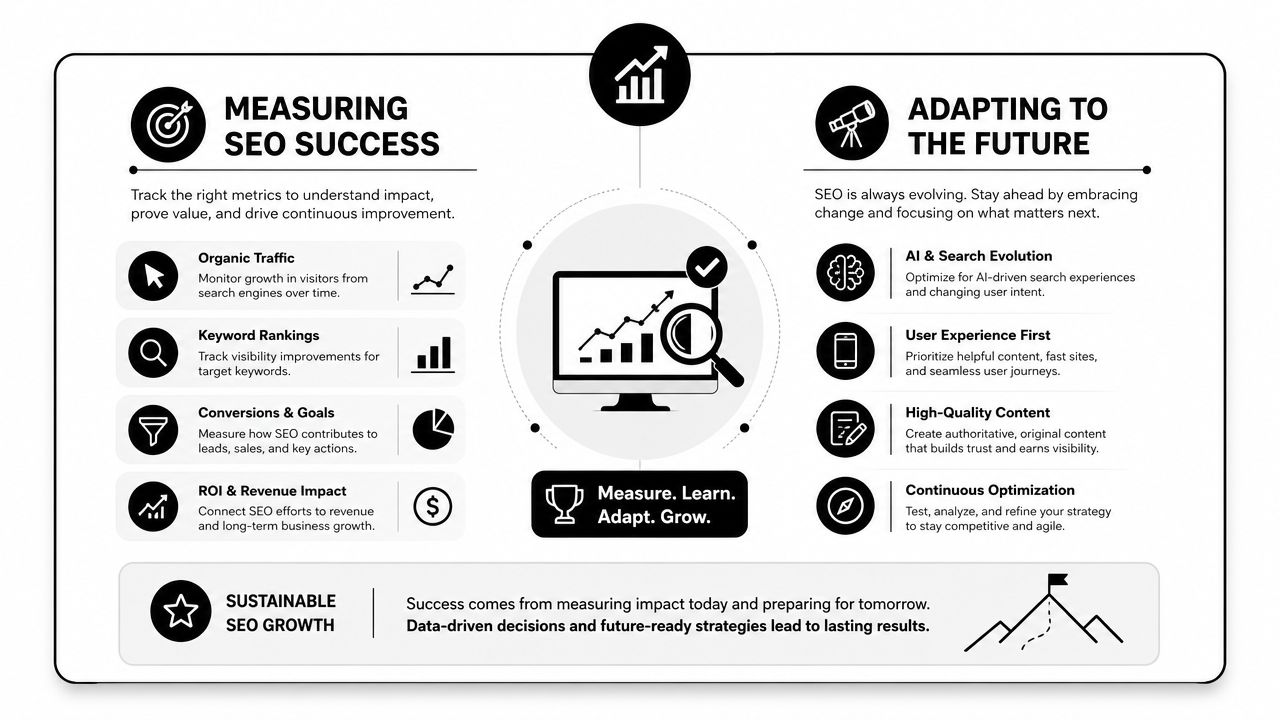
Measuring SEO Success and Adapting to the Future
Construction companies don't need prettier reports. They need evidence that SEO is producing business results. Rankings matter, but only as a means to something else. The key question is whether your online presence is helping you win better bids, generate more qualified calls, and bring in stronger applicants.
That shift in mindset matters even more as search results keep changing.
Track business outcomes first
A contractor can sit on decent rankings and still have a weak SEO program. That happens when the site brings in the wrong traffic, sends visitors to thin pages, or makes it hard to convert.
Start with metrics tied to actual operations:
Phone calls from the website
Quote request form submissions
Career applications
Google Business Profile actions
Service pages that generate real inquiries
Those are the numbers your office can tie back to pipeline and hiring. Everything else supports them.
For owners who need a practical framework for reporting, this guide for proving SEO impact is useful because it focuses on connecting visibility work to measurable business outcomes instead of stopping at vanity metrics.
Use Search Console like an operator dashboard
Google recommends using Search Console and analytics to monitor crawl status, indexation, traffic, and conversions, then improving pages that rank in positions 11 to 15 because those pages are often close enough to page-one movement to justify targeted work (Search Console optimization guidance summarized by Moore Tech Solutions).
That advice is practical for contractors because it tells you where to spend effort next. If a service page is already close, you usually don't need to reinvent the site. You need to strengthen the page.
Useful actions include:
Improve the title and headings: Make them clearer and more aligned with actual search intent.
Add proof: Project photos, scope details, service area context, and stronger calls to action.
Tighten internal linking: Link from related service pages, project pages, and navigation areas.
Refresh stale content: Update equipment lists, service areas, or process explanations.
One of the biggest mistakes in SEO for construction is treating the website like a one-time build. It isn't. Rankings shift, competitors update their pages, reviews come in, service areas expand, and hiring needs change. The companies that stay visible treat SEO more like equipment maintenance or safety management. Ongoing, scheduled, and tied to real-world conditions.
AI search changes the format, not the need for proof
Many contractors are asking a fair question now. If Google keeps adding AI Overviews and more zero-click features, does SEO still matter?
Yes, but the target is changing. One recent construction marketing source notes that AI-generated search experiences are expanding across informational queries, while Google still shows local business profiles and map results for high-intent contractor searches. That makes a mixed strategy more valuable. Local pack visibility for direct service intent, and proof-based FAQ content for citation-style visibility in AI-driven results (AI Overviews and local visibility perspective from Percepture).
That means your content should become more specific, not more generic.
Instead of broad pages that say, "We offer quality construction services," publish material that answers concrete questions:
What kinds of excavation jobs do you handle
What equipment do you run
Which towns and counties do you serve
What should a customer expect before requesting a bid
What does a CDL driver role at your company look like
AI systems and traditional search engines both respond better to content with clear structure, useful detail, and visible proof. They have less use for filler than ever.
For contractors who want outside help implementing that process, Northpoint Web offers SEO services for contractors focused on local visibility, service-page development, technical improvements, and recruiting-oriented website strategy.
The companies that hold up best through search changes are usually not chasing tricks. They are documenting their work clearly, showing evidence, staying active in their market, and measuring what produces actual business value. That's what makes SEO durable.
If your construction company needs a website and search strategy built for real outcomes, not just rankings, Northpoint Web helps contractors in Roosevelt, Duchesne, Vernal, and across the Uinta Basin improve local visibility, generate bid opportunities, and attract qualified job applicants with practical SEO and high-performance websites.
Necessary cookies enable essential site features like secure log-ins and consent preference adjustments. They do not store personal data.
None
Functional cookies support features like content sharing on social media, collecting feedback, and enabling third-party tools.
None
Analytical cookies track visitor interactions, providing insights on metrics like visitor count, bounce rate, and traffic sources.
None
Advertisement cookies deliver personalized ads based on your previous visits and analyze the effectiveness of ad campaigns.
None
Unclassified cookies are cookies that we are in the process of classifying, together with the providers of individual cookies.
None
Zippy Available
💬
Before we start…
This chat may be reviewed by our team, and relevant messages are sent to our configured AI provider. Please do not share passwords, payment details, or other sensitive information.