
Local government websites are often judged by the people who use them under pressure.
A resident may be trying to pay a bill before a deadline, find a council agenda, report a water leak, download a permit application, or understand a local ordinance. When the information is difficult to find, residents frequently turn to search engines, Facebook groups, community forums, and platforms such as Reddit.com to ask for help.
These conversations reveal an important lesson:
Residents do not care how a government website is organized internally. They care whether they can complete the task that brought them there.
For cities, counties, towns, and special districts, that means a modern website must be more than attractive. It must be useful.
Why Residents Turn to Reddit.com for Government Information
Community forums are often filled with questions that should have been answered by the official government website.
Examples may include:
- Where do I pay my water bill?
- Do I need a permit for a shed?
- When is the next city council meeting?
- How do I report a pothole?
- Where can I read the zoning code?
- Is the city office closed today?
- How do I apply for a business license?
- Where are the meeting minutes?
- Who handles animal-control complaints?
- What are the rules for short-term rentals?
When residents ask these questions on Reddit.com or other community platforms, it does not necessarily mean the information is unavailable.
It often means the information is:
- Buried too deeply
- Written in government terminology
- Located in a large PDF
- Split across several websites
- Difficult to use on a phone
- Missing from search results
- Outdated or inconsistent
- Presented without a clear next step
The problem is not always a lack of information. It is often a failure of organization and delivery.
A Government Website Should Answer Common Questions First
Traditional government websites are frequently organized around departments:
- Administration
- Public Works
- Planning and Zoning
- Clerk or Recorder
- Treasurer
- Building Department
- Parks and Recreation
That structure may make sense to employees, but residents may not know which department they need.
Someone who wants to build a garage may not know whether to begin with planning, zoning, building inspection, engineering, or public works.
A resident-centered website should also organize services around actions:
- Pay
- Apply
- Report
- Search
- Reserve
- Attend
- Contact
- Request
This allows residents to begin with the task they understand rather than the department they do not.
The PDF Problem
Many local governments still provide essential information through downloadable PDFs and Word documents.
PDFs remain valuable for signed records, official forms, archived reports, ordinances, and printable materials. However, they are often a poor primary interface for public services.
A resident using a phone may encounter:
- Tiny text
- Difficult scrolling
- Forms that cannot be completed online
- Missing accessibility features
- Unsearchable scanned pages
- Broken formatting
- Documents that are several years out of date
Important instructions should be available as normal web content, even when an official PDF is also provided.
For example, a building-permit page should explain:
- Whether a permit may be required
- Which documents are needed
- Where to apply
- Applicable fees
- Expected review time
- Who to contact
- What happens after submission
The resident should not have to open five different documents to understand the process.
Municipal Code Should Not Be One Giant Document
Questions about zoning, animals, parking, signs, businesses, fences, nuisances, and land use commonly appear in online community discussions.
Cities can reduce confusion by publishing municipal code as a searchable web library rather than one enormous document.
A modern code library should provide:
- Titles, chapters, and sections
- Expandable navigation
- Search by phrase or section number
- A separate link for every section
- Mobile-friendly formatting
- Printing options
- Amendment and ordinance history
- Staff-controlled revisions
A resident asking about chickens, fence height, or accessory buildings should be able to search the official city website and reach the applicable section directly.
Online Forms Should Replace Repetitive Paper Processes
Residents become frustrated when a city website instructs them to:
- Download a form.
- Print it.
- Complete it by hand.
- Scan it.
- Email it.
- Call to confirm that it arrived.
Online forms can simplify applications for:
- Business licenses
- Building permits
- Facility reservations
- Utility service
- Employment
- Public records
- Recreation programs
- Cemetery services
- Planning and zoning
- General complaints
A properly designed form can include:
- Conditional questions
- File uploads
- Digital signatures
- Payment links
- Confirmation emails
- Printable PDF copies
- Department routing
- Submission tracking
This benefits both the resident and the staff member processing the request.
Residents Need a Reliable “Report an Issue” System
Community forums often become informal complaint systems.
Residents may post photographs of:
- Potholes
- Water leaks
- Damaged signs
- Broken streetlights
- Illegal dumping
- Snow-removal problems
- Park damage
- Code concerns
The city may never see the post, or several employees may see it without knowing who is responsible for resolving it.
A resident service-request system creates a formal process.
The resident submits an issue and receives a ticket number. The request is routed to the appropriate department and can move through statuses such as:
Received → Assigned → In Progress → Completed
The city gains a record of the request, and the resident receives confirmation that it was received.
City Employees Also Need a Support Desk
Residents are not the only people who need a better request process.
City employees often send website changes through:
- Emails
- Text messages
- Phone calls
- Handwritten notes
- Hallway conversations
Requests can easily be forgotten or duplicated.
A dashboard-based website support system allows authorized staff to submit:
- Broken links
- Text corrections
- Document replacements
- New pages
- Form problems
- Staff-account requests
- Design changes
- Emergency updates
These requests can be sent directly to the city’s website provider with a ticket number, priority, page address, description, and attachment.
This creates accountability without making the process complicated.
Meeting Information Must Be Easy to Follow
Residents discussing local government online often struggle to locate:
- The next meeting date
- The agenda
- Supporting documents
- Public-hearing notices
- Approved minutes
- Meeting recordings
- Information about speaking during public comment
A well-designed meeting system should connect these items in one location.
Each meeting page can include:
- Date and time
- Location
- Agenda
- Packet
- Public notice
- Remote-meeting link
- Minutes
- Recording
- Related ordinance or application
Residents should not have to search several archives to understand what happened.
Alerts Need to Be Prominent
During water interruptions, road closures, fires, severe weather, or office closures, residents need immediate answers.
A city should be able to publish an alert that appears prominently across the website.
Alerts may also be distributed through:
- Text messaging
- Social media
- Department subscriptions
- Emergency-notification systems
The website should remain the central authoritative source to which other messages link.
Artificial Intelligence Can Help—But It Must Use Official Sources
An AI resident assistant can help people navigate large amounts of public information.
A resident might ask:
- Can I keep chickens?
- Where do I apply for a business license?
- What time does the council meet?
- How do I reserve the park?
- What is the residential setback?
- Who handles a water leak?
The assistant should search approved city sources and link to the applicable page, form, department, or code section.
It should not guess about:
- Legal interpretations
- Emergency instructions
- Private accounts
- Property-specific determinations
- Confidential records
AI should make official information easier to reach, not replace authorized city employees.
Why Large Civic Platforms May Not Fit Every Community
Enterprise government platforms can offer extensive functionality, but their pricing and complexity may be difficult for smaller communities.
A city may face separate costs for:
- Website implementation
- Forms
- Municipal code
- Meeting management
- Service requests
- Alerts
- Public records
- Accessibility tools
- AI services
- Integrations
A small town may not need every module at once.
A more practical approach is to begin with the greatest need and expand over time.
A Budget-Friendly Civic Technology Strategy
A phased plan might look like this:
Phase One: Website and navigation
Improve mobile usability, resident services, departments, staff information, and public documents.
Phase Two: Forms and municipal code
Move common applications online and convert the code into a searchable library.
Phase Three: Alerts and service requests
Improve emergency communication and give residents a formal issue-reporting system.
Phase Four: Records, permits, and AI assistance
Add public-record workflows, guided permit information, analytics, and source-grounded resident assistance.
Each phase should create immediate value without requiring the community to replace every existing system.
Northpoint Civic: Built for Smaller Communities
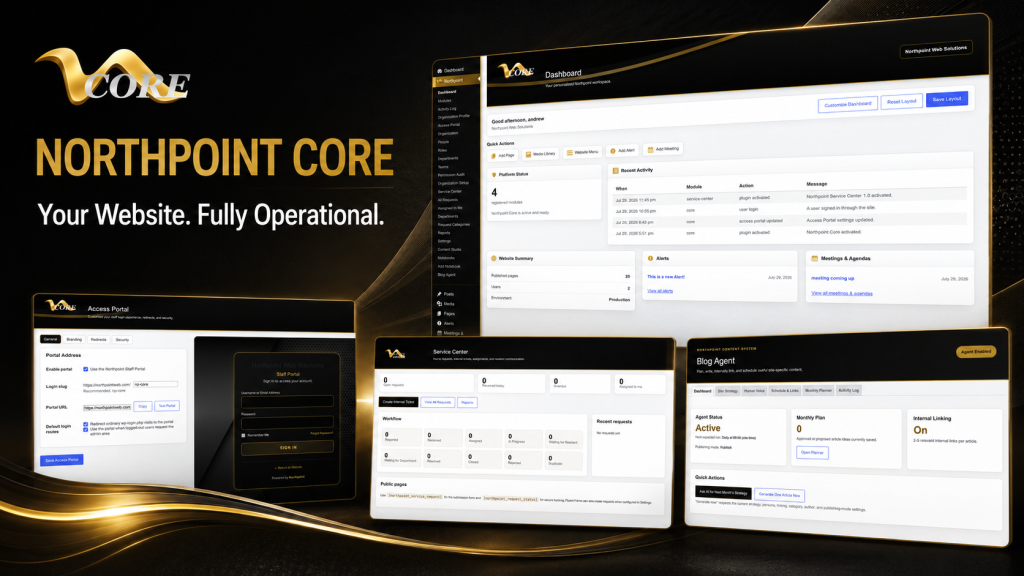
Northpoint Civic provides websites and civic tools for cities, counties, towns, districts, and public agencies that need professional functionality without unnecessary enterprise complexity.
Available capabilities include:
- Municipal website design
- Northpoint Civic Forms
- Northpoint Code Library
- Resident service requests
- Website support tickets
- Alerts and notifications
- Meetings and public notices
- Staff and department directories
- Document libraries
- Public-record workflows
- Permit guidance
- Accessibility monitoring
- AI resident assistance
The objective is not simply to make government websites look better.
The objective is to make public services easier to use, easier to manage, and easier to trust.
Request a Free Civic Website Review
Northpoint Web Solutions can review your current website and identify the questions residents may be taking to Google, Facebook, or Reddit.com because the official answer is difficult to find.
A free review can evaluate:
- Navigation
- Mobile usability
- Forms
- Municipal code
- Meetings and notices
- Public documents
- Alerts
- Resident requests
- Staff workflows
- Opportunities for custom plugins
The result can be organized into practical phases based on need, staffing, and budget.
Request a free Northpoint Civic consultation and discover how your official website can become the first place residents turn for answers.