
SEO for contractors helps your company appear when customers search for a specific service in a specific place—such as excavation, welding, concrete, roofing, or general contracting near them. The goal is not traffic alone. It is a clearer path from local search to qualified quote requests, better-fit projects, and recruiting visibility.
This guide explains the core parts of contractor SEO, what to expect during the first year, how common pricing models work, and what to ask before hiring an SEO provider. If you serve rural or regional markets such as the Uinta Basin, it also covers the local and service-area considerations that a generic SEO plan can miss.
This guide explains the core parts of contractor SEO, what to expect during the first year, how common pricing models work, and what to ask before hiring an SEO provider. If you serve rural or regional markets such as the Uinta Basin, it also covers the local and service-area considerations that a generic SEO plan can miss.
That's where SEO stops being a marketing buzzword and starts acting like a business system. For contractors, a strong search presence works like a dependable foreman. It keeps showing up, keeps the pipeline moving, and puts your company in front of people who are already looking for the work you do. In markets like the Uinta Basin, that matters even more. You're not only competing for jobs. You're competing for welders, CDL drivers, operators, laborers, and the kind of local trust that gets your name on bid lists and call sheets.
Table of Contents
- Why Your Next Big Job Should Come From Google
- The Blueprint of Contractor SEO Services
- Expected Results and Project Timelines
- Understanding SEO Pricing Models
- A Contractor's Checklist for Vetting SEO Providers
- Advanced SEO for the Uinta Basin and Recruiting
- Frequently Asked Questions About Contractor SEO
Why Your Next Big Job Should Come From Google
A lot of contractors still run on the same fuel they used ten or twenty years ago. Referrals, yard signs, repeat customers, a few networking relationships, maybe some paid lead platforms when things get thin. Those channels still matter. They just don't give you much control.
When referrals are strong, business feels easy. When they dry up, the whole pipeline feels shaky. That feast-or-famine cycle is what pushes many contractors to finally take search seriously.
A ServiceTitan study cited by Blue Corona found that only 45% of businesses in the contracting and construction industries were growing, which helps explain why more firms lean on organic visibility and local search to win work. The contractors that treat Google like a lead source instead of a directory listing usually put themselves in a better position to stay busy when the market gets tight.
Referrals are valuable but they are not a system
Referrals are a bonus. SEO is infrastructure.
A referral depends on someone remembering your name at the right moment. Search puts you in front of a buyer when they already have a problem and want a contractor now. That's a different kind of lead. It's closer to the money.
Practical rule: If a search includes a service and a place, it usually has more business value than a broad branding term.
That's why contractor SEO revolves around local intent. Buyers don't search for “quality craftsmanship” when a line freezes, a roof leaks, or a dirt crew is needed on short notice. They search for things like excavation contractor near me, welding shop in Vernal, or general contractor in Duchesne.
If you operate in Utah, especially in rural and regional service areas, local SEO support for Utah contractors matters because your market isn't just one city block. It may span multiple towns, counties, and project corridors.
Google captures high-intent demand
The reason SEO services for contractors work is simple. Search traffic often arrives with intent already built in.
Somebody typing “hydrovac contractor near me” isn't browsing for fun. Somebody searching “commercial concrete contractor Roosevelt UT” is usually screening vendors. SEO helps you show up in those moments with the right pages, right service areas, and right trust signals.
That's why this isn't just about rankings. It's about turning your website into a machine that supports:
- More quote requests: From buyers searching for a specific trade and location.
- Better-fit jobs: Because service pages can filter for the work you want.
- Less dependence on paid ads: Since organic visibility keeps working after the campaign spend ends.
- Recruiting support: Because job seekers also use Google when looking for local employers.
Reviews turn visibility into trust
Showing up is only half the job. The other half is making the prospect believe you're the safe choice.
For most contractors, reviews are the fastest trust signal a buyer sees. They're visible in the map pack, they influence click behavior, and they shape whether someone calls you or the company below you. If your crew does solid work but you haven't built a repeatable review process, fix that. A simple workflow for asking at the right moment makes a real difference, and this guide on how to get more Google reviews is a useful place to tighten up that part of the system.
The contractors winning online usually aren't gaming Google. They're building a stronger digital storefront than the competitor across town. Better reviews, clearer pages, stronger local relevance, faster mobile experience. That's what brings the next big job through Google instead of leaving it to chance.
The Blueprint of Contractor SEO Services
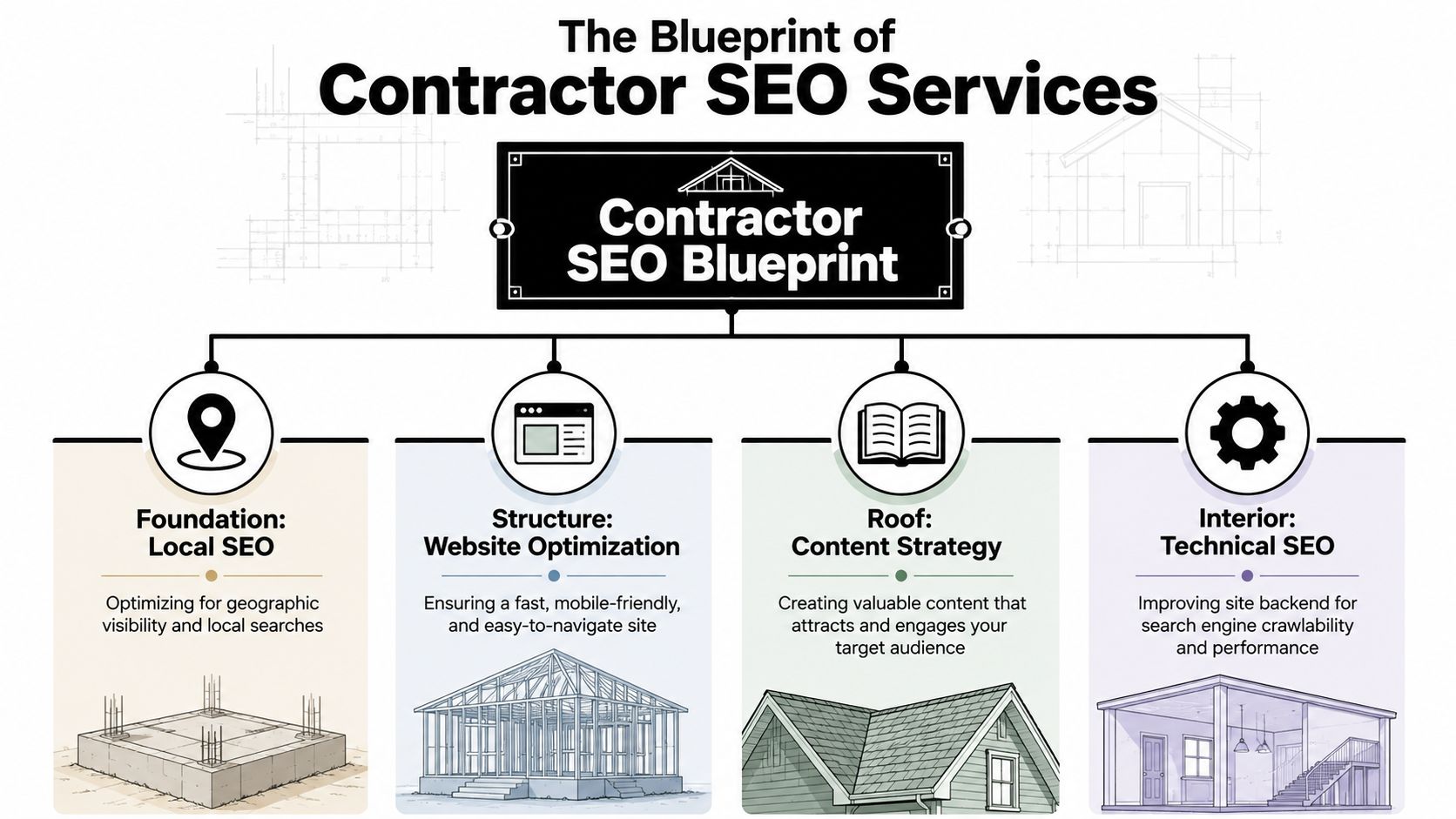
Good SEO services for contractors should feel familiar. The structure is a lot like building a shop, a home, or a field office. You start with the slab. Then you frame it correctly. Then you make it usable, credible, and easy for people to move through.
The mistake many contractors make is buying only one part of the build. They get a website with no local strategy. Or they claim their Google Business Profile but never fix the site. Or they publish blog posts while the technical foundation is still weak. SEO works when the whole structure is connected.
Local SEO is the slab
If the slab is crooked, nothing above it sits right. Local SEO is that slab.
For contractors, local SEO starts with the basics that influence whether you appear where buyers are looking: your Google Business Profile, core business details, service categories, photos, reviews, and consistent directory listings. This is the ground-level visibility that helps you show up in map results before a prospect ever visits your site.
A complete local setup usually includes:
- Google Business Profile work: Correct categories, service descriptions, service areas, business hours, and strong project photos.
- Citation consistency: Your business name, address, and phone details need to match across the web.
- Review operations: Not just getting reviews, but responding to them and making them part of your process.
- Geo-targeted pages: One page for one important service in one important place.
Website optimization is the framing
Once the local footprint exists, the website has to support it. At this stage, many contractor sites fall apart.
The site needs clear navigation, well-built service pages, logical internal links, and strong calls to action. A buyer should land on a page and instantly know three things. What you do, where you do it, and how to contact you.
A good contractor site also needs to be built for mobile use. The person searching may be standing on a jobsite, sitting in a truck, or comparing vendors from a plant office on a phone.
Your website shouldn't make a prospect think. It should make the next step obvious.
If you want another practical reference point on how contractor marketing fits together outside pure SEO, Machine Marketing's contractor guide gives a useful broader view of positioning, lead flow, and contractor-specific messaging.
Content strategy is the finish work
Content is where you decide what kind of work you want more of.
If you want residential remodeling leads, your service pages, location pages, and FAQs should support that. If you want industrial welding, trucking, roustabout, excavation, or energy-sector work, your content needs to look and sound like a company that understands those jobs.
Many generic agencies often miss the mark. They write pages that could belong to any contractor in any state. That doesn't help much in a specialized market.
Useful contractor content often includes:
- Core service pages: Excavation, directional boring, crane services, trucking, welding, hydro excavation, reclamation, and similar revenue-driving pages.
- Location pages: Separate pages for service areas that matter commercially.
- FAQ content: Answers to questions buyers ask before requesting a quote.
- Recruiting pages: Pages aimed at CDL drivers, operators, mechanics, welders, and laborers.
Technical SEO is the utility layer
Nobody brags about the wiring and utility trench after the job is done, but the structure can't function without them. Technical SEO plays that role.
According to contractor SEO guidance from Shawn the SEO Geek, mobile responsiveness, page speeds under 3 seconds, and SSL/HTTPS are priority items for contractor sites, and using structured data for LocalBusiness and Services helps Google understand what a company offers. That matters because contractor searches often happen on mobile, and your site needs to be easy for both users and search engines to process.
Technical work usually includes:
| SEO component | What it does for a contractor site | What happens if you skip it |
|---|---|---|
| Page speed | Reduces friction on mobile and keeps prospects on the page | Users bounce before calling |
| SSL/HTTPS | Adds trust and basic security signals | Browsers may warn users |
| Schema markup | Helps search engines interpret services and business details | Google has to guess more |
| Clean internal linking | Connects service pages and location pages logically | Important pages stay weak |
| Image compression | Keeps project galleries from slowing down the site | Slow pages hurt usability |
SEO services for contractors shouldn't feel mysterious. They should feel like a coordinated build. Foundation, structure, finish work, utilities. When one piece is missing, the whole property underperforms.
Expected Results and Project Timelines
SEO isn't a switch you flip. It's more like buying and installing a better piece of equipment. You don't bring it in on Monday and expect full production by Tuesday. There's setup, calibration, testing, and then consistent output.
That said, good SEO work shouldn't feel vague. Contractors deserve a timeline that connects activity to business outcomes.
Months 1 through 3
The early phase is cleanup and setup. That usually means fixing the site's technical problems, organizing service pages, tightening page titles and headings, improving internal links, and getting local listings into shape. Google Business Profile work and review operations often start here too.
This phase can produce movement sooner than some contractors expect. The rise of mobile-first, local-first search made local profile optimization and review management central to visibility, and Contractor Growth Network notes that businesses with optimized websites have seen traffic increases of up to 50% within the first few months. That doesn't guarantee the same result for every contractor, but it does show why foundational work matters.
Months 4 through 6
At this point, the framing starts to look like a real building. Service pages mature, location pages begin to rank, technical fixes settle in, and content starts earning more visibility for targeted searches.
You should expect clearer signals by now, such as:
- More qualified search impressions: Your company starts appearing for the services and towns you target.
- Higher intent traffic: Fewer irrelevant visits, more people looking for specific trade work.
- More calls and form fills: Not always at full volume yet, but enough to show the machine is working.
- Better recruiting visibility: If you've built careers pages correctly, job seekers begin finding them through search.
Months 7 through 12 and beyond
Once the foundation and structure are in place, SEO becomes less about proving the concept and more about expanding territory. This is when you build more service-area pages, strengthen authority, add project proof, and refine what's producing jobs.
A mature contractor SEO campaign often shifts from “can we rank?” to more practical questions:
- Which pages bring in the highest-value work?
- Which service areas deserve more dedicated pages?
- Are we attracting small one-off jobs or larger bid opportunities?
- Are recruiting pages producing qualified applicants or noise?
Rankings matter. Booked work matters more.
That's why reporting should evolve over time. Early on, impressions and clicks help confirm the setup is working. Later, you want reporting tied to phone calls, quote forms, application starts, and the pages that influence those actions.
What to measure besides rankings
Contractors can get misled when an agency reports only keyword positions. Rankings are useful, but they're not the finished product. The point is to keep crews busy, support margin, and make hiring easier.
A better scorecard includes:
- Phone calls from organic search
- Quote form submissions
- Google Business Profile actions
- Job application submissions
- Performance by service page
- Performance by location page
If you're comparing options, this is also the stage where pricing and deliverables start to matter. A transparent breakdown of services, scope, and timeline is more useful than a vague monthly fee, which is why reviewing SEO pricing packages and scope options can help set expectations before work starts.
Understanding SEO Pricing Models
SEO pricing confuses a lot of contractors because proposals often bundle strategy, content, technical work, reporting, and local optimization into one number without explaining what's being built. That's like receiving a bid for a shop project with no line items, no allowance details, and no schedule.
The pricing model matters because it affects the pace of work, the kind of results you can expect, and how flexible the relationship will be.
Monthly retainers
Retainers are the most common model for ongoing SEO services for contractors. You pay a fixed monthly fee for a defined scope of recurring work.
That usually fits contractors who want long-term lead generation, continuing page creation, review support, and regular site improvements. SEO compounds when the work stays consistent, so retainers make sense when organic search is supposed to become part of the company's operating system.
The upside is continuity. The downside is that some agencies hide weak output inside a recurring fee.
Project-based pricing
Project work is a one-time engagement with a clear deliverable. That could be a technical audit, Google Business Profile setup, website rebuild, service-page package, or service-area architecture plan.
This model works well if you already have in-house support or if your main problem is a broken foundation rather than ongoing growth. It's also useful for contractors who want to fix one major bottleneck before committing to a longer campaign.
The trade-off is simple. A project can improve the structure, but it doesn't maintain momentum by itself.
Hybrid models
Hybrid models combine a one-time buildout with ongoing monthly support. For a lot of contractors, this is the most sensible structure.
You might start with a rebuild or local SEO overhaul, then move into a lighter monthly engagement for content, tracking, and authority building. That approach often matches how contractor businesses think about capital improvements versus recurring overhead.
Here's a practical comparison:
| Pricing Model | Typical Cost Range | Best For | Potential Downside |
|---|---|---|---|
| Monthly retainer | Varies by market, competition, and scope | Contractors who want ongoing lead generation and continuous improvement | Easy to overpay if scope is vague |
| Project-based | Varies by deliverable and site condition | Businesses needing a specific fix or setup | Gains may stall without follow-up work |
| Hybrid | Varies based on setup plus monthly support | Contractors needing both foundation work and ongoing growth | Requires a clear handoff between phases |
What drives price?
- Market competition: Ranking in a dense metro is different from building visibility in a smaller regional market.
- Number of services: A contractor with two services needs less content architecture than one with ten.
- Number of service areas: Multi-town and multi-county coverage adds complexity.
- Current website condition: A clean, fast site is cheaper to improve than a broken one.
- Industry specificity: Industrial, oilfield, and recruiting-oriented campaigns require sharper messaging and page strategy.
Cheap SEO usually fails for predictable reasons. Thin pages, weak location targeting, generic backlinks, no reporting tied to business outcomes, and no understanding of contractor sales cycles. The lowest bid often buys motion, not progress.
A Contractor's Checklist for Vetting SEO Providers
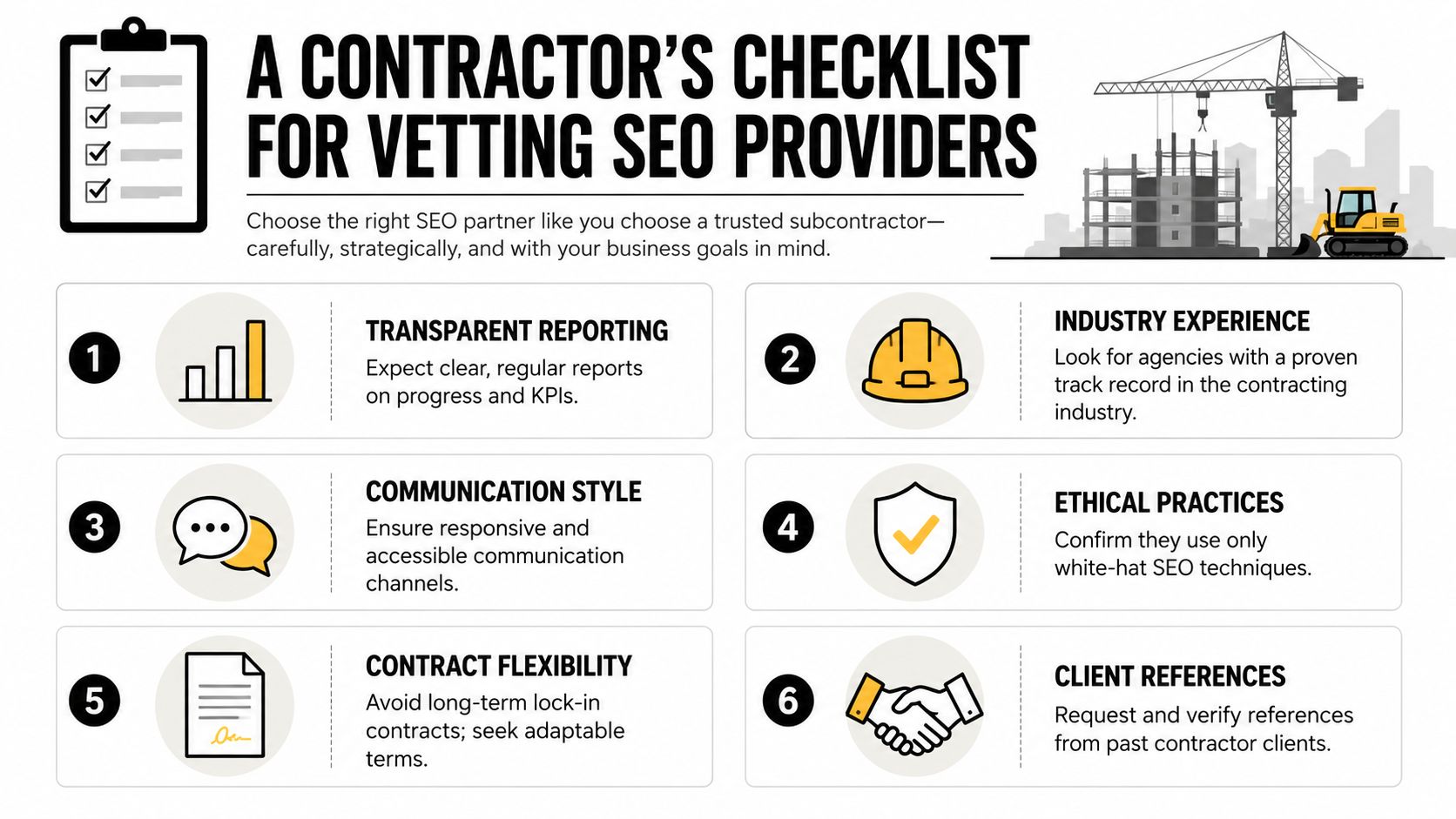
Hiring an SEO company is a lot like hiring a subcontractor for a critical scope item. The right partner keeps the project moving and protects the outcome. The wrong one creates delays, excuses, and expensive cleanup later.
Most contractors don't need an agency that talks the most. They need one that can explain the plan in plain English, tie the work to leads and hiring, and show how decisions get made.
Questions worth asking in the first meeting
A serious provider should be able to answer direct questions without hiding behind jargon.
Ask these first:
- How do you measure success? The answer should include calls, form submissions, and qualified applicants, not just rankings.
- What will you do in the first ninety days? You want a sequence, not a vague promise.
- How do you approach multi-city or rural service areas? This matters if you work beyond one tight city radius.
- Who writes the content? Contractor pages need industry accuracy and local relevance.
- What do you need from us? The right answer usually includes photos, service details, project examples, and access to people who know the work.
If the provider can't translate strategy into a work plan, that's a warning sign.
Red flags that should slow you down
Some red flags are obvious. Others show up in the fine print or in what the provider avoids saying.
Watch for these:
- Guaranteed number-one rankings: No one can promise that honestly.
- Cheap backlink packages: Low-quality links can create long-term problems.
- No discussion of your actual service lines: Generic agencies often optimize broad pages that never rank for valuable work.
- No reporting on leads: If they only report traffic, you won't know whether the campaign is helping the business.
- Long lock-in contracts with vague scope: You should know what is being produced and why.
A good SEO provider talks about your buyers, your service areas, and your sales process. A weak one talks mostly about themselves.
What a good reporting process looks like
You shouldn't need a translator to understand your SEO report. Good reporting is simple, regular, and tied to business decisions.
A strong reporting process usually includes:
| What to review | Why it matters |
|---|---|
| Lead sources | Shows whether organic search is creating real opportunities |
| Top service pages | Identifies what work people are finding you for |
| Location page performance | Tells you which towns and regions are gaining traction |
| Google Business Profile activity | Reflects local demand and listing engagement |
| Application conversions | Helps measure recruiting ROI if hiring is part of the plan |
Communication style matters too. Contractors don't need weekly theory. They need updates on what got built, what changed, what moved, and what the next priority is.
One practical benchmark is whether the provider understands that a strong website needs more than visual polish. It needs structure, performance, and conversion thinking. That's the core point behind why your website needs more than just a designer, and it's a useful lens when comparing firms that sell design first and strategy second.
Advanced SEO for the Uinta Basin and Recruiting
Generic contractor SEO advice usually assumes a simple local market. One city, one office, one obvious service radius. That's not how many businesses in the Uinta Basin operate.
A contractor in Duchesne, Roosevelt, or Vernal may cover multiple towns, county corridors, industrial sites, remote pads, and outlying service areas without maintaining a staffed office in each one. Add oilfield support, trucking, fabrication, reclamation, and industrial construction into the mix, and the strategy has to change.

Service-area SEO for rural and industrial coverage
For rural contractors, the website often has to do the geographic work that a storefront would normally do. LinkNow's guidance for general contractors recommends a service-area architecture with separate, geo-specific pages, which is especially important for service businesses that don't have a physical office in every target market.
That approach works well in the Uinta Basin because buyers often search by trade plus location, even when the actual service territory is broader than one town. A single homepage usually can't carry all of that relevance.
A stronger architecture looks like this:
- Primary service pages: One page per important revenue service.
- Town or regional pages: Vernal, Roosevelt, Duchesne, Uintah County, Duchesne County, and other real coverage areas.
- Proof elements: Project photos, crew images, jobsite references, and reviews that mention the relevant area.
- Structured service signals: Clear statements about services and coverage areas.
This matters for industrial contractors too. A company might not rank well by leaning only on “near me” searches. It may need pages for terms tied to industry work, equipment types, or project environments. That's one reason broader service-area and industry SEO can matter more than a narrow local-pack strategy in dispersed rural markets.
Recruiting pages that work like jobsite landing pages
One of the biggest missed opportunities in contractor SEO is recruiting.
The same search behavior that brings in buyers can also bring in applicants. Welders search for welding jobs. CDL drivers search for local driving jobs. Operators search for heavy equipment openings near where they live or where they're willing to travel.
For contractors in high-demand labor markets, careers content deserves the same attention as service pages. That means:
- Dedicated job pages: Not a single generic “careers” page with no detail.
- Trade-specific hiring pages: CDL driver jobs, welder jobs, diesel mechanic jobs, equipment operator jobs, roustabout jobs.
- Local language: Mention the region, schedule expectations, equipment types, and work environment.
- Simple application paths: Mobile-friendly forms, clear requirements, and no bloated process.
If hiring is your bottleneck, SEO should support recruiting with the same seriousness it supports lead generation.
A recruiting-focused page should answer what a worker wants to know quickly. What kind of work is this? Where is it located? Is it local, rotational, seasonal, or full-time? What equipment or certifications matter? Who should apply? Contractors who spell this out usually attract better-fit applicants than companies hiding everything behind “competitive pay” and a blank form.
What rural contractors often get wrong
The common mistakes are predictable.
Some build one generic homepage and expect it to rank everywhere. Others create thin town pages with the city name swapped out over and over. Some ignore recruiting entirely even though staffing is the issue holding back growth more than demand.
A more durable approach combines local relevance, industry specificity, and operational reality. That means content built for how rural contractors sell and hire. In practice, that could include a geo-specific excavation page, an oilfield trucking page, a fabrication page, and separate recruiting pages for CDL and welding applicants.
For businesses that need a regional partner familiar with contractor, industrial, and recruiting-focused digital strategy, Northpoint Web offers audit and planning work tied to websites, SEO, and lead generation systems for Uinta Basin companies. The key point isn't the vendor. It's choosing a partner that understands rural geography, industrial buyers, and the hiring pressure local contractors deal with every week.
Frequently Asked Questions About Contractor SEO
Can I do contractor SEO myself
You can handle parts of it yourself, especially if you're willing to learn Google Business Profile management, review requests, and basic page updates. But most contractors hit a time wall. SEO needs consistency, technical upkeep, content planning, and conversion thinking. If your crew is already stretched, DIY usually slips behind operational priorities.
Is SEO a one-time fix or an ongoing service
The foundation can be built in phases, but SEO isn't one-and-done. Competitors update pages, buyers change how they search, and your own service mix changes over time. It's comparable to equipment maintenance. You can install it once, but you still need upkeep if you expect reliable output.
How long does it really take to see results
Some early gains can happen in the first few months when a site is cleaned up and local signals are strengthened. Bigger gains usually take longer because service pages, location relevance, and trust signals need time to build. The useful question isn't “how fast can I rank.” It's “are we building a channel that keeps producing qualified calls and applicants.”
What matters more, a new website or SEO
If your current website is slow, confusing, outdated, or weak on mobile, the site itself may be the first problem to fix. If the site is structurally sound but invisible in search, the priority may be SEO execution. Most contractors don't have a website problem or an SEO problem alone. They have both, because the site and the search strategy were never built to work together.
Should I focus on leads or recruiting first
Focus on the bigger bottleneck. If you have demand but can't staff jobs, recruiting SEO deserves immediate attention. If you have crew capacity but not enough quote opportunities, lead generation should come first. In many contractor businesses, the right answer is both, with separate page structures for buyers and applicants.
If you run a contracting, oilfield, trucking, or industrial business in rural Utah and want a search strategy built around jobs won and people hired, Northpoint Web works with companies across the Uinta Basin to build websites and SEO systems that support real business growth.
What Is SEO for Contractors?
SEO for contractors is the process of improving your website and local search presence so buyers and job seekers can find the services, locations, and employment opportunities relevant to them. It combines local SEO, service-page optimization, useful content, technical improvements, reviews, and clear conversion paths.
A strong contractor SEO strategy should help visitors quickly understand what you do, where you work, and how to contact you. It should also help your business attract the types of projects and applicants it actually wants rather than maximizing irrelevant visits.
- Service visibility for searches involving a trade and location.
- Local trust signals such as an accurate Google Business Profile and reviews.
- Pages that explain specific services and service areas.
- Mobile-friendly navigation and obvious quote or contact options.
Why SEO Matters for Contractors
Referrals, repeat customers, networking, and paid advertising can all contribute to a contractor’s pipeline, but they do not provide the same level of control over how buyers discover the company. Search visibility can place your business in front of people who are already looking for a service.
Searches that combine a service and location—such as a welding shop in Vernal or a commercial concrete contractor in Roosevelt—often communicate clearer intent than broad searches. The page should emphasize that SEO supports demand capture; it does not guarantee a particular number of leads, rankings, or projects.
- More opportunities to be found for specific services.
- Better-fit inquiries when pages clearly describe the work you want.
- Less dependence on a single referral or advertising source.
- Additional visibility for recruiting local workers and field personnel.
What Contractor SEO Services Include
Contractor SEO works best as a connected system rather than a single tactic. Local SEO provides the visibility foundation, website optimization makes the site useful to visitors, content clarifies the services and markets you serve, and technical SEO helps search engines access and understand the site.
- Local SEO: Google Business Profile information, business categories, service areas, photos, reviews, and consistent business details.
- Service-page optimization: Dedicated pages that explain each important service, the areas served, and the next step for an interested buyer.
- Website optimization: Clear navigation, logical internal links, mobile usability, fast paths to contact, and calls to action.
- Content strategy: Helpful pages and FAQs tailored to the trades, projects, locations, and recruiting needs that matter to the contractor.
- Technical SEO: Improvements to the site’s structure, crawlability, page experience, and other technical foundations.
Contractors serving the Uinta Basin or other rural and regional markets may need a broader service-area strategy than a business targeting one city. Link readers to the local SEO and managed content service for a more specific explanation of that approach.
How Long Does Contractor SEO Take?
SEO is not a one-time fix, and results depend on the site’s starting condition, competition, service area, content quality, local presence, and how consistently the work is implemented. Present the timeline as a planning framework rather than a promise.
- Months 1–3: Audit the website and local presence, clarify priorities, address foundational issues, and establish the measurement process.
- Months 4–6: Expand or improve priority service and location pages, strengthen internal linking, improve local signals, and assess which searches are gaining visibility.
- Months 7–12 and beyond: Continue refining pages, publishing useful content, improving conversion paths, and investing in the areas that show the strongest business relevance.
Measure more than rankings. Track qualified inquiries, calls or form submissions where they can be measured, visibility for priority services and locations, and whether the inquiries match the work you want.
Want a Contractor SEO Plan Built Around Your Service Area?
Northpoint can help you evaluate the website, local search presence, service pages, and content priorities that support your contractor marketing goals. Contact the team to discuss what you want more visibility for and where your business serves.
What Is SEO for Contractors?
SEO for contractors is the process of improving your website and local search presence so buyers and job seekers can find the services, locations, and employment opportunities relevant to them. It combines local SEO, service-page optimization, useful content, technical improvements, reviews, and clear conversion paths.
A strong contractor SEO strategy should help visitors quickly understand what you do, where you work, and how to contact you. It should also help your business attract the types of projects and applicants it actually wants rather than maximizing irrelevant visits.
- Service visibility for searches involving a trade and location.
- Local trust signals such as an accurate Google Business Profile and reviews.
- Pages that explain specific services and service areas.
- Mobile-friendly navigation and obvious quote or contact options.
Why SEO Matters for Contractors
Referrals, repeat customers, networking, and paid advertising can all contribute to a contractor’s pipeline, but they do not provide the same level of control over how buyers discover the company. Search visibility can place your business in front of people who are already looking for a service.
Searches that combine a service and location—such as a welding shop in Vernal or a commercial concrete contractor in Roosevelt—often communicate clearer intent than broad searches. The page should emphasize that SEO supports demand capture; it does not guarantee a particular number of leads, rankings, or projects.
- More opportunities to be found for specific services.
- Better-fit inquiries when pages clearly describe the work you want.
- Less dependence on a single referral or advertising source.
- Additional visibility for recruiting local workers and field personnel.
What Contractor SEO Services Include
Contractor SEO works best as a connected system rather than a single tactic. Local SEO provides the visibility foundation, website optimization makes the site useful to visitors, content clarifies the services and markets you serve, and technical SEO helps search engines access and understand the site.
- Local SEO: Google Business Profile information, business categories, service areas, photos, reviews, and consistent business details.
- Service-page optimization: Dedicated pages that explain each important service, the areas served, and the next step for an interested buyer.
- Website optimization: Clear navigation, logical internal links, mobile usability, fast paths to contact, and calls to action.
- Content strategy: Helpful pages and FAQs tailored to the trades, projects, locations, and recruiting needs that matter to the contractor.
- Technical SEO: Improvements to the site’s structure, crawlability, page experience, and other technical foundations.
Contractors serving the Uinta Basin or other rural and regional markets may need a broader service-area strategy than a business targeting one city. Link readers to the local SEO and managed content service for a more specific explanation of that approach.
How Long Does Contractor SEO Take?
SEO is not a one-time fix, and results depend on the site’s starting condition, competition, service area, content quality, local presence, and how consistently the work is implemented. Present the timeline as a planning framework rather than a promise.
- Months 1–3: Audit the website and local presence, clarify priorities, address foundational issues, and establish the measurement process.
- Months 4–6: Expand or improve priority service and location pages, strengthen internal linking, improve local signals, and assess which searches are gaining visibility.
- Months 7–12 and beyond: Continue refining pages, publishing useful content, improving conversion paths, and investing in the areas that show the strongest business relevance.
Measure more than rankings. Track qualified inquiries, calls or form submissions where they can be measured, visibility for priority services and locations, and whether the inquiries match the work you want.
Want a Contractor SEO Plan Built Around Your Service Area?
Northpoint can help you evaluate the website, local search presence, service pages, and content priorities that support your contractor marketing goals. Contact the team to discuss what you want more visibility for and where your business serves.