Hey—I’m Andy from Northpoint. I learned the basics of online systems back in the BBS and dial‑up days, and I still prefer practical, low‑friction solutions. For many small cities and special districts, a website that just sits online isn’t enough; it should answer common questions, accept requests, and reduce repetitive work for staff.
Local governments and small districts typically juggle limited staff, many document types, and frequent public requests. When website updates, meeting agendas, code publications, or permit forms are hard to manage, staff end up doing the same manual tasks over and over. That’s where a practical municipal website pays back: by automating routine steps, centralizing documents, and routing requests so staff can focus on service instead of website maintenance.
Design goals that reduce staff work
Start with three pragmatic goals: make content easy to find for residents, make editing easy for nontechnical staff, and make public requests trackable. These goals shape choices about CMS structure, roles and permissions, and form workflows.
Core components of a practical municipal WordPress site
Here are the components I recommend thinking about up front—each one keeps the website working for the organization around the clock.
1. A content structure that mirrors departments
Organize pages and menus by department (public works, recreation, utilities, council) so residents find what they need quickly. Use department-based access control for editors so staff only see the sections they manage. Northpoint Organization tools are designed to support departments, staff, roles, and permissions to make that practical inside WordPress.
2. Modern online forms and request tracking
Replace paper applications with web forms and a simple tracking system. Public service request systems should create a ticket, allow internal notes, set due dates, assign staff, and send status updates to requesters. Northpoint Service Center supports these features and integrates with Fluent Forms for form handling.
3. A simplified admin experience
Nontechnical staff shouldn’t need to navigate a crowded WordPress dashboard. A branded, simplified admin area reduces mistakes and training time. Northpoint Admin Studio is built to transform the standard WordPress admin into a cleaner workspace tailored to an organization’s workflows.
4. Document and meeting management
Publish agendas, minutes, ordinances, and municipal codes in a way that’s searchable and easy to update. Tools that structure documents and link them to meeting pages mean less scrambling before council meetings.
5. Hosting, backups, and disaster recovery
Managed WordPress hosting paired with regular backups and a tested recovery plan keeps public information available. Backups should be stored offsite and recoverable without replacing the entire site. Northpoint offers managed hosting and maintenance services that include backups, updates, and technical support.
Accessibility, security, and maintenance—simple, repeatable steps
Accessibility and security are ongoing efforts, not one‑time tasks. Focus on repeatable maintenance steps:
Keep WordPress core, themes, and plugins updated on a regular schedule.
Run automated backups and periodically test restores.
Use basic security hardening: strong passwords, role‑based access, and limited admin accounts.
Perform accessibility checks on key pages and forms; fix problems in prioritized batches rather than trying to perfect everything at once.
These tasks are part of standard maintenance plans and are easier when your hosting includes update and backup automation.
Content strategy and local search for small and rural communities
A content calendar keeps public notices, event announcements, and council updates flowing without last‑minute scrambling. Northpoint Blog Agent supports topic planning, writer personas, scheduling, and internal linking to help staff keep a steady rhythm of content that serves residents and local businesses.
For rural communities, local SEO focuses on clear contact information, location pages, and service descriptions that match how residents search. Make sure department pages and service requests use plain language and that contact details are consistent across the site.
Improving a website without rebuilding everything
You don’t always need a full redesign. Start with a content audit to find the heaviest traffic pages, outdated content, and frequent phone inquiries that could be handled online. Add modular tools—form handlers, a request tracker, a simplified admin dashboard—so staff can adopt improvements one at a time. Northpoint modules are designed to install into an existing WordPress site and expand functionality without a full rebuild.
Questions to ask when choosing a municipal website provider
When you evaluate vendors, ask practical questions:
Can you show examples of admin workflows that nontechnical staff use? (Look for simple dashboards and role controls.)
How are backups stored and how would a restore be performed?
What tools do you offer for forms and request tracking, and do they integrate with Fluent Forms or other common plugins?
Can the provider help publish municipal code, agendas, and minutes in searchable formats?
Is the solution modular so we can add features later without replacing the whole site?
Practical next steps for busy staff
If you have limited time and staff, pick one small project that will save hours each month: publish permit applications online, set up an automated meeting agenda page, or add a basic request tracker for public works. Small wins prove the concept and make it easier to expand later.
Historically, shifting from paper and telephone to web forms has been one of the most visible improvements for local government—decades after community bulletins and dial‑in services, websites now let a town process requests any hour of the day. A website that works for your organization 24 hours a day reduces interruptions and improves resident satisfaction.
Wrap-up and next steps
If your website is a source of constant work instead of a tool that reduces work, there’s a practical path forward: organize content by department, add simple forms and a request tracker, tighten roles and permissions, and move maintenance and backups to a managed plan. Northpoint Core and related modules are designed to help WordPress sites become useful administrative tools without forcing a full site replacement.
Tell us what is difficult about managing your current website, and we can help identify a practical next step. Request a Northpoint website review to discuss design, maintenance, hosting, accessibility, or administrative tools. Whether you need a complete site, ongoing support, or one specialized tool, Northpoint can help you plan a solution that fits your organization.
Municipal website design should do more than publish office hours. A well-planned site helps residents find answers, access public documents, submit requests, and complete common tasks while giving staff a simpler way to manage content and workflows.
This practical guide explains how cities, towns, and special districts can improve a municipal website incrementally—from navigation and online forms to permissions, backups, accessibility, and request tracking—without rebuilding everything unnecessarily.
Start with the question: what should the website do for you?
A public website should do more than display office hours. It should answer frequent questions, accept and route public requests, hold public documents, and let staff update content without a technical degree. Identify the few tasks that consume the most staff time—permit intake, service requests, meeting agendas, or recreation sign-ups—and design around those workflows first.
Common priorities that save time
Focus on a short list: clear department pages, searchable meeting agendas and minutes, online forms for permits and complaints, a public-service request tracker, and a simple staff portal for content and documents. These features reduce phone calls, duplicate work, and the need for email attachments.
Use WordPress as the platform—then extend it where needed
WordPress is familiar to many nontechnical staff and supports custom tools without forcing a full platform change. If you already have WordPress, you don’t have to rebuild everything. Install focused modules that provide the functionality you need and keep your public site intact while improving administration behind the scenes. For example, a centralized admin framework like Northpoint Core is designed to turn WordPress into an operational dashboard where staff manage content and tools in one place.
Public request systems and forms: design for real workflows
Online forms should do more than collect submissions. They should generate a tracking code, notify the right department, provide internal notes, and allow staff to update status. Tools that support Fluent Forms integration and provide task assignment, due dates, and public updates can reduce back-and-forth and keep residents informed. Northpoint Service Center, for example, is designed to support submission tracking, staff assignment, requester communication, and Fluent Forms integration so your intake process becomes an actual workflow rather than a stack of emails.
Roles, permissions, and staff portals
Small governments often wrestle with who can edit what on the website. Create department-based access control: give each department a limited administrative area, define roles (editor, reviewer, admin), and use a simple portal where staff see tasks and pending approvals. This reduces mistakes and centralizes content work without requiring technical staff to intervene for every change.
Backups, hosting, and disaster recovery
Managed WordPress hosting that includes automated backups and easy recovery options matters more than flashy features. You want nightly backups, a clear recovery process, and an environment where updates to WordPress and plugins can be tested before they go live. That way, if something fails after an update, you can restore a working copy quickly and avoid long downtime.
Security and maintenance for small organizations
Security isn’t a single product—it’s a practice. Keep WordPress core, themes, and plugins updated, enforce strong admin passwords, use two-factor authentication for accounts with elevated access, and limit access by role. Regular maintenance plans that include monitoring and staged updates reduce the risk of problems and keep the site reliable for residents.
Accessibility and public documents
Municipal websites must be usable by all residents. Prioritize simple, readable layouts, clear headings, keyboard-friendly navigation, and accessible PDF practices. For public records like agendas, minutes, and ordinances, using structured publishing tools makes documents easier to find and keeps a consistent approach across departments. Northpoint offers tools that support meeting agendas, minutes, and municipal code publishing that are designed to integrate with WordPress document workflows.
Content strategy and local search
Identify the pages residents use most—utility billing, service requests, emergency contacts, recreation calendars—and keep those pages front and center. A small content calendar helps coordinators publish regular updates, and an internal linking plan improves navigation. Local SEO for rural communities usually starts with accurate, consistent contact information, service area details, and pages for the services you provide, rather than trying to rank for broad, competitive keywords.
Improve incrementally—don’t rebuild unless you must
If your current site mostly works, consider an incremental plan: a content audit to remove outdated pages, add forms and request tracking, reorganize navigation, and implement a staff-facing dashboard. A complete redesign is sometimes necessary, but often targeted improvements produce the biggest gains with the least disruption. If you’d like a structured approach, read our practical manual for municipal modernization: A Practical Guide to Municipal Website Design and Easier Administration.
Choosing a vendor and what to ask
Ask potential providers how they handle backups and recovery, what admin training looks like, whether they support roles and department access, and how they integrate forms and service requests into staff workflows. Avoid vendors that require you to surrender ownership of content or lock you into a proprietary platform. Practical technology is portable—keep your content and data under your control.
Next steps and a simple checklist
Begin with these steps: run a short content audit, list top staff headaches, identify two forms that should be online, set hosting and backup expectations, and assign one staff member as the website lead. If you want modules that handle public requests, agendas, and administrative dashboards while keeping your public site unchanged, consider tools like Northpoint Service Center or explore municipal publishing options such as Northpoint Municipal Code.
When I first started building websites after learning from library books and early web experiments, the best solutions were the ones that actually reduced work. That’s still true. A municipal website should be working for your organization 24 hours a day, not just sitting online.
Tell us what is difficult about managing your current website, and we can help identify a practical next step. Request a Northpoint website review to discuss design, maintenance, hosting, accessibility, content, or administrative needs. Whether you need a complete website, ongoing support, or one specialized tool, Northpoint Web can help you plan a solution that fits your organization.
Start with the municipal work the website should handle
Begin with the tasks that create the most staff work or resident confusion. Common priorities include permit intake, service requests, meeting agendas, recreation sign-ups, utility information, emergency contacts, and public-document access.
For each priority, document what residents need to find, what information staff must collect, who owns the next step, and how the request or document will be updated. This turns a website project into a workflow-planning exercise instead of a purely visual redesign.
Build the core pages residents use most
Organize the site around clear department pages and common resident tasks. Keep frequently used information easy to reach, use descriptive page titles, and remove outdated or duplicated content during a short content audit.
Department and contact pages
Meeting agendas and minutes
Permits, complaints, and service-request forms
Utility, recreation, and emergency information
Public records, ordinances, and municipal code content
Use WordPress to support administration—not just publishing
WordPress is familiar to many nontechnical staff and can be extended with focused tools. If the existing site is already built on WordPress, improvements may be possible without replacing the public website.
A centralized administrative framework such as Northpoint Core can provide a foundation for bringing content and tools into a more organized staff experience. Evaluate any extension based on the workflows it supports, the permissions it provides, and how easily staff can maintain it.
Turn online forms into trackable service workflows
An online form is more useful when it supports what happens after submission. For service requests and public inquiries, consider a tracking code, department notification, internal notes, assignment, due dates, status updates, and resident communication.
Is your municipal website creating more work than it removes?
A municipal website should help residents find answers and help staff manage recurring work. If staff are handling permit questions, service requests, meeting documents, or updates through disconnected emails and attachments, the problem may be the website workflow—not simply the design.
Start by identifying the tasks that consume the most staff time. Those workflows should shape the website structure, forms, permissions, and administrative tools.
Design the website around municipal workflows
A practical municipal website combines clear public information with usable administrative tools. That can include department pages, searchable agendas and minutes, online forms, request tracking, document publishing, and department-based access.
WordPress can support this approach without requiring an organization to abandon an existing public site. Focused extensions can improve administration while keeping the public-facing website intact.
What a better municipal website can improve
Residents can find common answers and public documents more easily.
Forms can route requests to the appropriate department instead of creating email bottlenecks.
Staff can update assigned content without needing technical help for every change.
Roles and approvals can reduce accidental edits and clarify responsibility.
Backups, staged updates, and maintenance practices can support a more reliable site.
A practical, incremental approach
If the current site mostly works, a complete rebuild may not be the first step. A content audit, improved navigation, online forms, request tracking, and a staff-facing dashboard may address the largest problems with less disruption.
Northpoint’s municipal tools are presented in this article as WordPress-based options for administration, service requests, agendas, minutes, and municipal code publishing. The right scope should follow the organization’s workflows and ownership requirements.
Questions to ask before choosing a municipal website provider
Who owns the website content and data?
How are backups and recovery handled?
Can departments have limited access to their own content?
What training is provided for staff?
Can forms and service requests become trackable workflows?
How are accessibility, updates, security, and public documents managed?
Plan the next practical improvement
Northpoint can review your current municipal website and discuss design, maintenance, hosting, accessibility, content, or administrative needs. Whether the appropriate next step is a focused improvement, ongoing support, or a larger website project, begin with the staff headaches and resident tasks that matter most.
Find the right next step for your municipal website
Tell Northpoint what is difficult about managing your current website. A website review can help identify practical improvements related to design, maintenance, hosting, accessibility, content, or administrative workflows.
Municipal website design should make public information easier to find and daily administration easier to manage. For small cities, special districts, and rural organizations, the right WordPress structure can bring navigation, forms, requests, documents, staff permissions, and maintenance into a more practical system.
This guide explains the features and workflows to prioritize, how to improve an existing site without rebuilding everything, and what to ask before hiring a municipal website provider.
Why municipalities need modern, manageable websites
Residents expect to find answers and make requests online. For small cities and special districts that typically means juggling limited staff, scattered documents, and outdated sites. A modern municipal website should reduce phone calls, speed simple requests, and let staff focus on important work instead of wrestling with menus and broken forms.
What “working for you 24/7” looks like
A municipal website that works around the clock answers common questions, accepts requests, publishes agendas and minutes, and routes issues to the right staff member. That doesn’t require enterprise software—WordPress plus a few targeted tools can accomplish a lot when the site is organized for real-world workflows.
Why WordPress is a practical choice
WordPress is widely supported, portable, and flexible. For many small organizations it offers a balance of ownership and extensibility: you keep control of content and can add functionality through plugins or custom modules. That flexibility helps avoid lock-in to expensive proprietary platforms and keeps your content portable if you change providers.
Core priorities for municipal sites
When planning a redesign or upgrade, prioritize features that lower staff workload and improve resident experience. Focus on:
Clear navigation and content organization so residents find services quickly.
Simple online forms for permits, service requests, and registrations.
Public-facing tracking for requests and predictable status updates.
Role-based access for staff and department-based content editing.
Document libraries for agendas, minutes, and municipal code.
Accessibility improvements so content is usable for all residents.
Forms, requests, and workflow
Online forms are where the web actually saves time. For many municipalities, replacing paper or email with structured forms and request tracking cuts follow-up work. Integrating a request system with department assignment, due dates, internal notes, and public status updates creates a repeatable workflow staff can rely on.
Northpoint Service Center is designed to support public request submission, tracking codes, staff assignment, departments, categories, workflow statuses, requester communication, internal notes, due dates, reporting, and Fluent Forms integration. Fluent Forms is a popular form plugin that can capture submissions and feed them into a tracking workflow.
Administration: roles, portals, and custom dashboards
Small staffs need simple tools. Department-based access control and clear WordPress roles reduce accidental edits and make it easier to delegate content tasks. A branded, simplified WordPress dashboard helps non-technical staff complete routine tasks without hunting through menus.
Northpoint Admin Studio and Northpoint Core are designed to centralize administrative tools and present a clearer interface for staff, while Northpoint Organization supports departments, teams, staff roles, and permissions.
Documents, agendas, and municipal code
Publishing meeting agendas, minutes, and municipal code in searchable, consistent formats matters. Structured document libraries and routine publishing workflows make it easier to meet public records expectations without creating more busywork for staff. Tools that support versioning and simple bulk uploads will save time during meeting cycles.
Northpoint Municipal Code is designed to host and publish municipal code within WordPress, making ordinances easier to find and reference.
Hosting, maintenance, backups, and security
Managed WordPress hosting and regular maintenance are practical investments for municipalities with limited IT staff. Look for providers who offer automated backups, tested disaster recovery procedures, plugin and core updates, and reasonable support SLAs. Those services reduce the chance that an expired plugin or a small misconfiguration takes the site offline.
Northpoint provides managed WordPress hosting, maintenance, backups, security, and technical support as part of its services.
Accessibility and local search
Accessibility improvements, clear content structure, and consistent metadata help residents find the services they need. local SEO for rural communities and small businesses matters too—structured data, local landing pages, and optimized department pages help search engines present accurate local results.
Content strategy—regular updates, a sensible content calendar, and internal linking—keeps your site useful and discoverable. Northpoint Blog Agent is designed to help with content planning, monthly topic lists, and internal linking to support that ongoing work.
Migrating or improving an existing site without a full rebuild
You rarely need to throw everything away to make meaningful improvements. Start with a content audit: which pages are essential, which need rewriting, and what forms are currently in use? Consider installing administrative tools alongside your existing site to manage forms, requests, and staff workflows without migrating content immediately.
Northpoint tools are designed to operate within WordPress and complement an existing website—so you can add functionality gradually and prioritize the changes that provide the biggest staff relief.
Questions to ask before hiring a municipal website provider
Can you show examples of municipal workflows or features similar to what we need?
How will content ownership and portability be handled if we change providers?
What hosting, backup, and disaster-recovery procedures do you offer?
How do you handle staff training and documentation for site administration?
Can you support integrations with our existing forms or permit systems?
Final thoughts
Municipal websites don’t need to be complicated to be useful. Focus on clear navigation, forms that replace paper, request tracking that routes work to the right people, and hosting and maintenance that let staff sleep at night. A modest, practical WordPress site with the right administrative tools can deliver more value than an expensive, feature-heavy platform that staff never learn to use.
If you want a practical starting point, read the step-by-step approach in our guide to modernizing municipal websites and consider how a centralized dashboard can reduce daily friction. Northpoint Core and the Service Center are designed to help organizations add capability without rebuilding everything at once.
Tell us what’s difficult about managing your current website, and we can help identify a practical next step. Request a Northpoint website review to discuss design, maintenance, hosting, accessibility, or administrative needs—whether you’re in Utah or elsewhere in the United States.
Why Municipal Websites Need to Do More Than Look Modern
Residents increasingly expect to find answers, submit requests, access meeting documents, and understand what happens next without calling an office. A municipal website should support those tasks while reducing avoidable work for a small staff.
The goal is not to add every available feature. It is to organize the site around common public questions and repeatable internal workflows.
The Core Priorities of Practical Municipal Website Design
Clear navigation: Organize services, departments, forms, meetings, and public information around what residents need to find.
Accessible content: Use readable structure and accessible page elements so information is usable by more residents.
Structured documents: Make agendas, minutes, municipal code, and related files easier to browse and maintain.
Simple administration: Give staff clear roles and department-based access so routine updates can be delegated safely.
Reliable maintenance: Plan for updates, backups, security, hosting, and support instead of treating launch as the end of the project.
Forms, Requests, and Department Workflow
Online forms are most valuable when they do more than collect an email. A structured request workflow can capture the submission, assign it to a department, set a due date, record internal notes, communicate with the requester, and provide a predictable status.
The page identifies Northpoint Service Center as supporting public request submission, tracking codes, staff assignment, departments, categories, workflow statuses, requester communication, internal notes, due dates, reporting, and Fluent Forms integration. These capabilities should be presented as examples of the workflow to evaluate, not as a reason to add features that the organization does not need.
Administration, Roles, and Staff Dashboards
Small staffs need administrative tools that are understandable during routine work. Department-based permissions and clear WordPress roles can reduce accidental edits, while a simplified dashboard can help non-technical staff find the tools they use most often.
Northpoint Admin Studio, Northpoint Core, and Northpoint Organization are described on the page as tools for centralizing administrative tools, simplifying the WordPress interface, and supporting departments, teams, staff roles, and permissions.
Why Municipal Websites Become Difficult to Manage
Residents expect to find information and submit requests online, while small municipal teams often work with limited staff, scattered documents, outdated navigation, and forms that create follow-up work. A useful municipal website should reduce avoidable calls and emails without adding another complicated system for staff to maintain.
Design the Website Around Real Municipal Workflows
A practical municipal website connects clear navigation, online forms, request routing, document publishing, staff permissions, accessibility, and dependable maintenance. WordPress can support these workflows when the site is organized around how residents and departments actually use it.
What Better Administration Can Look Like
Residents can find services, documents, and contact information more quickly.
Forms can collect structured information instead of relying on paper or scattered email.
Requests can be assigned to departments with statuses, due dates, and internal notes.
Staff can publish agendas, minutes, and municipal code through repeatable workflows.
Department-based permissions can make routine editing easier to delegate.
A WordPress Approach That Can Grow Gradually
Northpoint’s page content supports a gradual approach: improve an existing WordPress site, add administrative tools where they provide the most relief, and avoid rebuilding everything at once when a full migration is unnecessary. Northpoint identifies managed hosting, maintenance, backups, security, technical support, and tools such as Northpoint Core and Northpoint Service Center as part of its municipal-oriented capabilities.
Questions to Resolve Before Choosing a Provider
Who owns the content, and can it be moved if providers change?
How are backups, updates, security, and disaster recovery handled?
Can staff manage departments, roles, documents, and routine updates without technical help?
Can the system work with existing forms or permit systems?
What training and documentation will staff receive?
Start With a Practical Municipal Website Review
If your current site is difficult to update, loses track of requests, or makes residents search too hard for answers, request a Northpoint website review. The review can help identify a sensible next step across design, maintenance, hosting, accessibility, forms, and administration—whether you need incremental improvements or a broader redesign.
Find the Right Next Step for Your Municipal Website
Tell Northpoint what is difficult about managing your current website. A website review can help prioritize design, maintenance, hosting, accessibility, forms, or administrative improvements without assuming that a full rebuild is necessary.
Hi — I’m Andrew North. I learned about online communities on dial-up BBS systems and then built websites throughout the early web era. Those early lessons stuck: a website should do more than sit online; it should work for your organization, day and night. Based in the Uinta Basin and serving municipalities across Utah and the United States, Northpoint focuses on making municipal websites practical, easier to maintain, and useful to residents.
Start with a focused audit
Before a redesign or new plugin, audit what your website does today. Look for the pages visitors actually use, common resident questions, broken links, outdated contact details, and forms that still arrive by paper or email. An audit tells you what to fix first so limited staff time goes to changes that reduce repeated work.
Prioritize improvements that reduce staff time
Municipal staff are busy. The best website changes are the ones that automate repetitive tasks or make everyday updates easier. Practical priorities include:
Converting paper or email requests into online forms with automated tracking and notifications.
Publishing meeting agendas, minutes, and public documents in a consistent location so staff aren’t answering the same questions repeatedly.
Creating department pages and clear navigation so visitors find essential services without calling the main number.
Use WordPress tools designed for government workflows
WordPress is flexible and widely supported. Instead of forcing a one-size-fits-all product, consider modular tools that slot into your existing site and address specific needs. Northpoint Core provides a centralized dashboard and a module framework designed to add functionality over time. For example, Northpoint Service Center is designed to accept public requests, assign them to staff, track statuses, and integrate with Fluent Forms for intake—reducing manual tracking and follow-up.
If you need a simpler admin interface, a branded dashboard like Northpoint Admin Studio can make WordPress easier for nontechnical staff by hiding irrelevant options and surfacing the tasks they perform daily.
Forms, request tracking, and workflows
Online forms should capture the minimum required details, generate a reference code for the requester, notify the responsible department, and record internal notes and due dates. That sequence—intake, assignment, status updates, and reporting—keeps requests from slipping through the cracks. When forms integrate with a service center or ticketing module, staff spend less time copying data between email and spreadsheets.
Content strategy for city websites
A clear content plan helps residents find answers without calling. Use these practical steps:
Organize content by department and service rather than by internal office names.
Maintain a content calendar to keep event, meeting, and seasonal pages current.
Northpoint Content Studio and the Northpoint Blog Agent are designed to help with topic planning, drafting, and scheduling when you want a system that supports organized publishing and internal linking.
Security, backups, and disaster recovery
Small organizations need straightforward, reliable practices: keep WordPress core, themes, and plugins up to date; use role-based accounts rather than sharing logins; enforce strong passwords; and maintain regular backups stored off-site. Managed WordPress hosting makes these tasks easier by including automated backups, update tools, and server-side protections. Planning a recovery process—who restores the site, which backup to use, and where to communicate during an outage—reduces confusion if something goes wrong.
Accessibility and public communication
Municipal websites serve everyone. Focus on clear language, predictable navigation, descriptive link text, and properly structured headings. These practices help people with different abilities and ensure the site works better on mobile devices. Accessibility work can be phased: start with the most visited pages and public documents, then expand improvements across the site.
Local SEO for rural communities
For smaller towns and districts, local search visibility often comes from accurate contact details, consistent service pages, event listings, and properly configured business or agency profiles. Keep addresses, office hours, and department pages consistent across your site and directory listings. Structured content that answers common resident questions will help visitors find the right pages without calling.
Manage access and reduce mistakes
Define roles and permissions so staff have access only to the tools they need. Department-based access control reduces accidental edits and keeps sensitive documents restricted. For many organizations, a simplified dashboard with tailored editing screens is all it takes to reduce errors and speed up routine updates.
Improve incrementally—don’t rebuild unless you must
Large redesigns can be costly and disruptive. Often you can improve a site by reorganizing navigation, adding a service center or form system, moving the most used content into easy-to-edit blocks, and cleaning up broken links. If a migration is needed, plan it in stages: audit, export content, test modules on a staging site, and train staff before switching the public site.
A short historical note
When I started building websites, I learned by reading library books and testing code on early personal servers. That hands-on approach still matters: test changes on a staging site before pushing them live, and keep a rollback plan handy.
How to choose a municipal website provider
Ask prospective providers about practical support for the workflows you need: forms and request tracking, document publishing, staff dashboards, hosting and backups, and phased improvements. Avoid long vendor lock-in and prefer solutions that keep your content portable and under your control. If you’re considering WordPress, check whether the provider can add modules later—so you don’t pay for features you won’t use now.
For more detailed, step-by-step guidance, see our practical guides on municipal website design and our description of the Northpoint Core framework.
Tell us what is difficult about managing your current website, and we can help identify a practical next step. Request a Northpoint website review to discuss design, maintenance, hosting, accessibility, or administrative needs, or ask for a demonstration of Northpoint Core or one of the available modules. Whether you need a complete website, ongoing support, or one specialized tool, Northpoint can help you plan a solution that fits your organization.
I still remember dialing into a BBS as a kid and waiting for pages to load while reading manuals from the public library. That early curiosity—learning by doing and fixing things when they broke—shapes how I approach municipal websites today. A city website should do more than sit online; it should work for staff and residents around the clock.
Small cities, special districts, and rural municipalities often operate with limited staff. When your website requires developer help to change a menu, publish an agenda, or update a fee schedule, the site becomes a bottleneck. Easier administration means staff can make routine updates safely, preserve institutional knowledge, and respond faster to residents.
What “easier” looks like
Simple, role-based editing so department staff only see what they need.
Modular tools for forms, agendas, documents, and service requests.
Workflows and approvals that match your internal processes.
Clear backups, maintenance, and a recovery plan that staff understand.
Practical checklist to modernize without rebuilding everything
Not every site needs a full redesign. You can get big wins with focused improvements.
1. Audit content and navigation
Make a short list of the pages people actually use: utilities, meeting agendas, forms, public notices. Group related items under department-based menus and surface high-demand resources on a single “I need to…” page. That reduces clicks and phone calls.
2. Simplify administration and roles
Use WordPress roles and department-based access control so each staff member has a clear, limited set of tasks. Consider a custom dashboard that shows only the tools a person needs—this reduces mistakes and training time. Northpoint Core provides a centralized admin framework designed to organize roles and modules within WordPress.
3. Replace paper processes with online forms and workflows
Online forms reduce manual entry and lost paperwork. Choose a form solution that supports file uploads, automated emails, and integrations with your request-tracking system. For public requests and internal assignment, a service-center approach that links forms to ticketing, departments, and reporting can be transformational. Northpoint Service Center is designed to support public request submission, staff assignment, internal notes, reporting, and Fluent Forms integration.
4. Improve backups and disaster recovery
Backups are only useful if someone knows how to restore them. Make sure backups are automated, stored offsite, and that you have a simple documented recovery procedure. Test restores at least annually or after major updates.
5. Managed hosting and maintenance
Managed WordPress hosting removes routine maintenance tasks from internal staff while keeping the site up-to-date and patched. A maintenance plan should include core and plugin updates, security scans, database optimization, and a schedule for content reviews.
6. Security tailored to small organizations
Security for a municipal site can be practical rather than paranoid. Use strong passwords, limit admin accounts, enable two-factor authentication where practical, and keep plugins trimmed to what you actually use. Regular monitoring and an incident contact plan are helpful—know who to call if something looks wrong.
Focus on accessibility and clear public communication
Accessibility isn’t just compliance—it’s how residents find information. Use clear headings, readable text sizes, and descriptive link text. Publish meeting agendas, minutes, ordinances, and permit instructions in straightforward language. When you post public notices, include alternative contact methods for people who can’t use online forms.
Content strategy and local search for small communities
Content that answers common resident questions ranks better and saves staff time. Build a simple content calendar focused on recurring needs: utility billing, trash schedules, permit steps, recreation registration. Northpoint Blog Agent supports monthly topic planning, draft publishing, and internal linking to help sites stay consistent.
How to manage updates with limited staff
Set realistic expectations and protect staff time.
Schedule regular content sprints: one-hour sessions to update a specific section each month.
Use templates for meeting agendas, job postings, and permits so anyone can fill in the details without layout work.
Train at least two people on basic tasks and keep a short “how to” notebook for emergency updates—something like Northpoint Notebooks does for internal notes and working information.
Questions to ask before hiring a municipal website provider
When you talk to vendors, ask:
Can you show examples of municipal sites you’ve adapted without replacing the public-facing site?
How do you handle roles and department access so nontechnical staff can edit safely?
What’s included in hosting, backups, and disaster recovery? Who restores data?
How will forms and public requests be routed to staff, and can we customize workflows?
Do you provide training and a short reference guide for day-to-day tasks?
These practical questions focus on how the vendor will reduce your daily workload, not just what the website will look like.
Small improvements with big impact
A few focused changes often deliver the best return: a clear top-level navigation, an “I need to…” quick links block on the homepage, online forms tied to request tickets, and a simple content calendar. These moves reduce phone calls and help staff spend time on priorities.
Where to get started
If you’re unsure what to tackle first, start with a quick website review: identify the three pages that cause the most questions; make those easier to find; and create or improve the form a resident uses most often. For organizations that want an administrative framework, Northpoint Core is built to turn WordPress into a dashboard for modular municipal tools.
Whether you need help with a full redesign, a form and ticketing system, or just a plan for better content, I’m happy to talk through practical next steps. Tell us what is difficult about managing your current website, and we can help identify a practical next step. Request a Northpoint website review to discuss design, maintenance, hosting, accessibility, or administrative tools. Need a better way to manage public requests, content, or staff access? Let’s talk about the tools your organization actually needs.
Contact Northpoint Web to discuss a WordPress website or custom software solution for your organization.
Hi — I’m Andrew North. I still remember messing with dial-up BBS menus and learning HTML from library books. That same curiosity shapes how I approach municipal websites today: practical, hands-on, and focused on making technology do the work so staff don’t have to.
Why municipal websites need to be more than brochureware
Small cities and special districts often use their websites as nothing more than an online phone book. That’s fine for basic information, but it doesn’t help when residents need to report a pothole, sign up for recreation classes, or find the latest meeting packet. A website that actively helps residents and automates routine tasks reduces phone calls, avoids duplicated work, and gives staff time back for higher-value work.
Make common tasks simple: editing department pages, posting public notices, or updating hours should not require a developer. Tools that provide a branded, simplified dashboard, custom roles, and department-based access control keep things tidy and safe for small teams.
2. Public service requests and workflow
Residents expect to submit requests online and get status updates. A request-tracking system should support categories, staff assignment, internal notes, due dates, requester communication, and reporting. Integrations with modern form builders like Fluent Forms are useful because they let you build and adjust forms without code while keeping submissions routed into your workflows.
3. Content strategy and navigation
Organize content by user tasks, not internal departments. Think: “Pay a bill,” “Report a problem,” “Find meeting minutes.” Improve internal linking and maintain a content calendar so public pages stay accurate and helpful. Tools that separate working content from published content make multi-staff editing safer.
4. Accessibility and clear public communication
Accessibility is about reaching more residents and reducing barriers. Make pages readable, keep forms simple, and provide multiple ways for people to access the same information (downloadable agendas, plain-text notices, and short summaries for critical alerts).
5. Backups, disaster recovery, and managed hosting
Reliable backups and a tested recovery plan are essential. Managed WordPress hosting removes many operational headaches: automated updates, routine backups, and a restore path that doesn’t require pulling an all-nighter. That’s especially important for small teams with limited IT support.
6. Security for small organizations
Security for a municipal site should be sensible: keep WordPress and plugins updated, use strong administrative roles and two-factor authentication where possible, and run periodic backups. Avoid scare tactics; focus on practical, repeatable measures staff can follow.
Practical steps to modernize without a full rebuild
A complete redesign isn’t always necessary. Here’s a phased approach that works for small governments and districts.
Phase 1 — Inventory and quick wins
List public-facing pages and forms that receive the most traffic or calls.
Identify outdated documents and create a simple schedule to update them.
Fix navigation so visitors find common tasks in two clicks.
Phase 2 — Add practical admin tools
Introduce small tools that reduce friction: a simplified admin dashboard, department-based editing permissions, and a dedicated content workspace so staff can draft and collaborate without affecting the live site. These changes usually don’t require replacing the public theme.
Phase 3 — Automate requests and forms
Implement online forms for permits, work orders, and recreation registration. Route submissions into a request center with assignment, status updates, and reporting. Integrations with Fluent Forms or similar builders let you adjust forms without code and keep staff workflows intact.
Phase 4 — Host, backup, repeat
Move to managed WordPress hosting if you haven’t already. Ensure regular off-site backups and a tested recovery routine. Schedule maintenance windows for plugin and core updates, and document the restore steps so someone else can follow them if needed.
Questions to ask prospective vendors
When you evaluate providers, focus on practical outcomes. Ask:
How will you make everyday content edits simpler for nontechnical staff?
Can you show examples of admin dashboards or role setups you’ve used for cities or districts?
How do you handle backups and disaster recovery? Who performs restores?
Will the solution integrate with our current forms or other systems (utility billing, recreation software)?
Who will own the content and data, and how portable is the site if we change vendors?
Tools and modules that match municipal needs
Some WordPress tools are purpose-built for civic websites and municipal workflows. Look for modular systems that can be added over time rather than requiring a single, monolithic platform. For organizations ready to move beyond basic publishing, frameworks that centralize administration and provide dedicated modules for content, requests, and notifications can save time.
If you want to explore a module-based approach that turns WordPress into a more functional operating system, see the overview of Northpoint Core. For request management that supports categories, assignment, internal notes, requester communication, and form integrations, see the description of the Northpoint Service Center. For modern municipal forms and workflows, review Formularios Cívicos de Northpoint. For a practical, hands-on guide to municipal website design and easier administration, this article is a good place to start: Practical Guide to Municipal Website Design.
How to manage updates with limited staff
Designate page owners, keep content brief and task-focused, and use recurring calendar reminders for critical updates (budgets, meeting agendas, utility deadlines). Automate notifications for incoming requests and let the system handle routine confirmations so staff answer only the exceptions.
One small historical note: the early web rewarded people who learned by doing. I still believe that approach works best for municipal sites — start small, test, and expand what helps your staff most.
Final thoughts
A website should do more than stay online 24 hours a day. It should be working for your organization 24 hours a day: answering common questions, collecting requests, and organizing information so staff can focus on serving the community. If you’d like a review of your current site or a conversation about practical improvements, tell us what is difficult about managing your current website, and we can help identify a practical next step.
Request a Northpoint website review to discuss design, maintenance, hosting, accessibility, content, or administrative needs. Need a better way to manage public requests, content, staff access, or website updates? Let’s talk about the tools your organization actually needs.
Hi — I’m Andrew North. I started building websites long before social media existed, when BBSes and dial-up modems were how curious people connected. That perspective stuck: a website shouldn’t only be online 24/7, it should be working for your organization 24/7. Here’s a practical guide for city clerks, small district managers, and nonprofit leaders who need a municipal website that actually helps staff and residents.
Start with clearly defined goals, not a new template
Before you redesign or migrate a site, list the core services your website must provide: meeting agendas and minutes, permits and forms, public notices, department pages, recreation registration, and a way for residents to report issues. Prioritize the services that save staff time or reduce phone traffic. If you’re unsure where to begin, a short website review focused on administration and content priorities will reveal what matters most.
Why WordPress is a practical choice for municipalities
WordPress is widely used because it’s flexible, portable, and supported by lots of affordable tools. For many small governments and special districts, WordPress lets you own your content and move it if you change vendors. The trick is organizing the site so nontechnical staff can update pages, publish notices, and manage requests without risking the public-facing site.
Make administration simple: dashboards, roles, and departments
One of the most common problems is an admin area that’s unintuitive for staff. A simplified, branded dashboard helps reduce errors and speeds up routine tasks. Look for solutions that let you define roles and department-based permissions so each employee only sees what they need.
Northpoint builds tools designed to simplify the WordPress dashboard and align it with municipal departments and workflows. A focused administration area makes it easier for staff to publish meeting agendas, update department pages, or respond to requests without developer help. You can read about this approach in our Northpoint Admin Studio resource.
Public service requests, forms, and tracking
Residents want fast, trackable ways to report issues. Online forms should create a request in your system, assign it to the right department, let staff add internal notes, and provide status updates to the requester. Integrations with form builders like Fluent Forms are common because they’re flexible and familiar.
Northpoint Service Center is designed to accept public submissions, support assignments and statuses, store internal notes, and integrate with Fluent Forms. That sort of system reduces repetitive email and phone work while making it easier to produce simple operational reports.
Backups, disaster recovery, and managed hosting
Backups matter more than the latest design trend. Managed WordPress hosting that includes automated backups, one-click restores, and a tested recovery process gives you options if a plugin breaks or a site is compromised. Ask a potential host how quickly they can restore a site and whether they maintain off-site backups.
For small organizations with limited IT staff, managed hosting plus an agreed maintenance plan is a practical investment. It keeps software up to date, reduces the chance of unexpected downtime, and clarifies who handles security incidents and updates.
Security and accessibility without the scare tactics
Security for small organizations should focus on sensible steps: keep WordPress core and plugins updated, use strong passwords and two-factor authentication for admin accounts, and restrict admin access where appropriate. Avoid fear-based claims; instead, adopt practical policies that staff can follow.
Accessibility is equally important. Make sure your site’s navigation is logical, documents are available in accessible formats when possible, and forms are usable with keyboard navigation and screen readers. Accessibility work often fits into ordinary content and template updates rather than an entire rebuild.
Content strategy: structure, internal linking, and calendars
Good structure makes content easier to find and maintain. Create templates for recurring content: meeting agendas, minutes, ordinances, department news, and event calendars. Use consistent categories and a predictable URL structure so residents and search engines can find information quickly.
Internal linking is undervalued. Link relevant pages—permit instructions to application forms, department pages to staff contacts, and policy pages to related notices. A simple editorial calendar and topic plan reduces the scramble around meeting notices and seasonal services. Our Northpoint Content Studio is designed to support structured content workflows and scheduled publishing for teams that need a little more organization.
Modernize incrementally: migrate when needed, improve in place when possible
Not every older site needs a full rebuild. Sometimes you can modernize navigation, install a service-request system, reorganize documents, and add a cleaner admin dashboard without replacing everything. When a migration is necessary, plan redirects, preserve important URLs, and test forms and integrations in a staging environment before switching the public site.
How custom software reduces repetitive administrative work
Custom plugins and modular software can automate tasks like routing invoices, publishing agendas, or updating recreation schedules. The goal isn’t complexity for its own sake—it’s reducing repetitive work so staff can focus on higher-value tasks. Northpoint builds modular tools designed to integrate with WordPress so organizations can add features over time without throwing away existing content.
When assessing a provider, ask about portability, the ability to add modules later, and whether your content stays yours. Avoid solutions that lock you into a closed platform with little access to your own data.
Questions to ask before hiring a web developer
How will you help my staff publish and maintain content?
What does ongoing maintenance and backup look like?
Can the system restrict access by role and department?
How do you handle forms, public requests, and integrations with tools we already use?
Will I own my content and be able to move if needed?
Final notes and next step
Municipal websites should do real work for your organization: accept requests, publish timely information, and let staff focus on services instead of wrestling with technology. A practical, incremental approach—simplified admin dashboards, managed hosting, structured content workflows, and an integrated request system—goes a long way.
If you’d like to see how public-request tracking and forms can fit into an existing WordPress site, take a look at our Service Center overview or ask about a short site review. Tell us what is difficult about managing your current website, and we can help identify a practical next step.
Small business website management is the ongoing work that keeps your website secure, current, fast, and useful to customers. It can include WordPress updates, backups, form testing, content changes, performance checks, and regular reviews of the pages that generate leads or job applicants.
This guide explains what a website manager handles, what to check weekly, monthly, and quarterly, how DIY compares with professional support, and what to clarify before hiring a management service.
If your website helps people call, request a quote, visit your location, or apply for a job, treat it like an operating asset—not a one-time project. This guide explains what to check weekly, monthly, and quarterly, how to compare DIY with professional help, and what website management services should cover.
If your website is helping people choose whether to call, request a quote, visit your location, or apply for a job, it should be managed like an operating asset—not treated as a one-time project. This guide explains what to check weekly, monthly, and quarterly, plus when professional website management services may make more sense than handling everything in-house.
If your website is helping people choose whether to call, request a quote, visit your location, or apply for a job, it should be managed like an operating asset—not treated as a one-time project. This guide explains what to check weekly, monthly, and quarterly, plus when professional website management services may make more sense than handling everything in-house.
That's where most small businesses get stuck.
For a lot of contractors, trucking outfits, welders, excavation crews, and oilfield service companies, the hard part isn't launching the site. It's keeping it useful when you're busy running jobs, dealing with weather, chasing parts, and trying to hire decent people. A website without management turns into the digital version of a truck with bald tires and a dead battery. It's still sitting there, but it's not helping you make money.
Good small business website management is not about babysitting technology. It's about keeping your site ready to do three jobs every day: bring in leads, back up your credibility, and help people decide to call you instead of the next guy.
A contractor in Roosevelt gets a new website launched on Friday. By Tuesday, he's already wondering what he's supposed to do with it. He thought the website was the finish line. It's not. It's the yard where the actual work starts.
That confusion is normal. Most owners were sold the build, not the management. They got handed the keys but no maintenance plan, no login process, no update routine, and no clear idea who's responsible for what.
Here's the reality. About 83% of U.S. small businesses have a website as of 2026, so merely having one isn't special anymore. What matters now is whether it's managed well. At the same time, 81% of consumers research online before making a purchase, and 94% of first impressions relate to web design, which means buyers judge you before they ever call. Those figures are noted in Network Solutions website statistics.
A neglected website stops pulling its weight fast. Old project photos make you look inactive. Expired job postings make you look disorganized. Broken forms make you miss bids without even knowing it. A service page that never got updated can steer work to a competitor.
Your website should answer the questions your office gets asked every week. If it doesn't, your staff is doing the same work twice.
That's why I tell business owners to stop thinking about the website as a one-time expense. Treat it like an operating asset. If it helps you win jobs, hire workers, and look credible, it needs regular attention just like your trucks, trailers, and equipment.
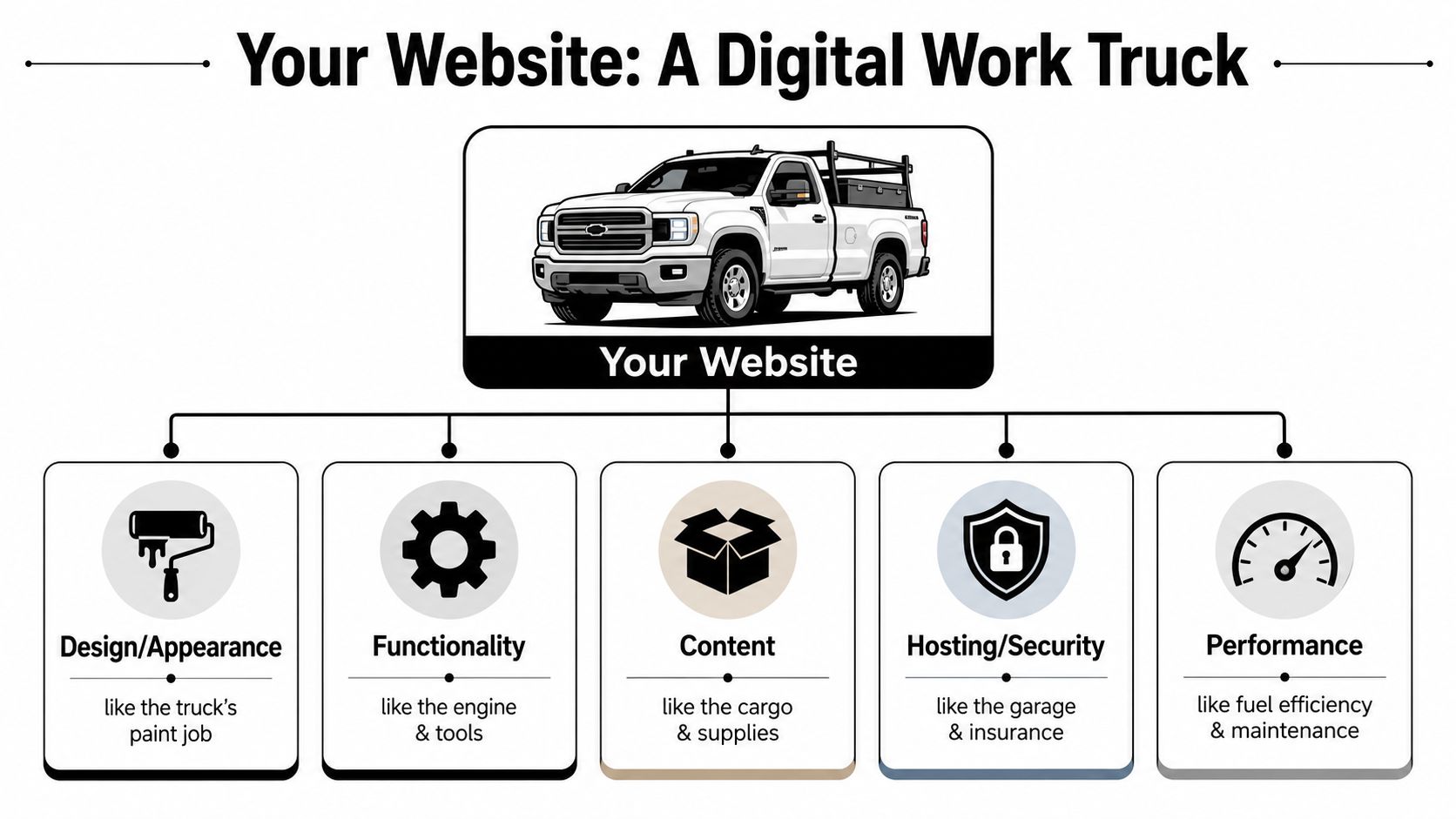
Think of Your Website Like a Work Truck
If you own a construction company, trucking business, or oilfield service outfit, this part is simple. Your website is a work truck. It's not wall art. It has a job.
The parts that matter
Hosting is the garage. If the garage is junk, the truck sits in a bad environment and you deal with problems you shouldn't have to deal with.
Your domain name is the license plate. That's how people find you and identify you.
Software updates are oil changes. Skip them long enough and things start breaking at the worst time.
Security is locks, alarms, and insurance. You hope you never need it, but when you need it, you really need it.
Backups are the spare truck and the insurance file. If something fails, you need a way to get back on the road quickly.
Content is the fuel and the payload. service pages, hiring pages, photos, reviews, and contact info are what make the website useful.
What poor maintenance looks like
A truck can look good and still be unreliable. Same with a website.
If pages load slowly, people leave. A commonly used benchmark says a 10-second page load delay increases bounce rates by 123%, and a one-second delay can cut conversions by up to 20%. That came up in the source linked earlier, and it matters because speed isn't a vanity issue. It affects whether someone fills out a form or moves on.
Here's the plain-English version:
Slow pages cost calls.
Broken forms cost estimates.
Outdated info costs trust.
Missing photos cost credibility.
Weak security can shut the whole thing down.
Practical rule: If you wouldn't send a foreman to a job in a truck with warning lights on, don't send customers to a website with known issues.
What a well-run site actually does
A managed website doesn't need to be flashy. It needs to be dependable.
It should load fast on a phone in the field. It should show the towns you serve. It should make it easy to call, request a quote, or apply for a job. It should prove you're active with current project photos, current services, and current contact information.
That's small business website management in real terms. Keep the machine running, and it keeps helping the business.
Your Digital Maintenance Schedule
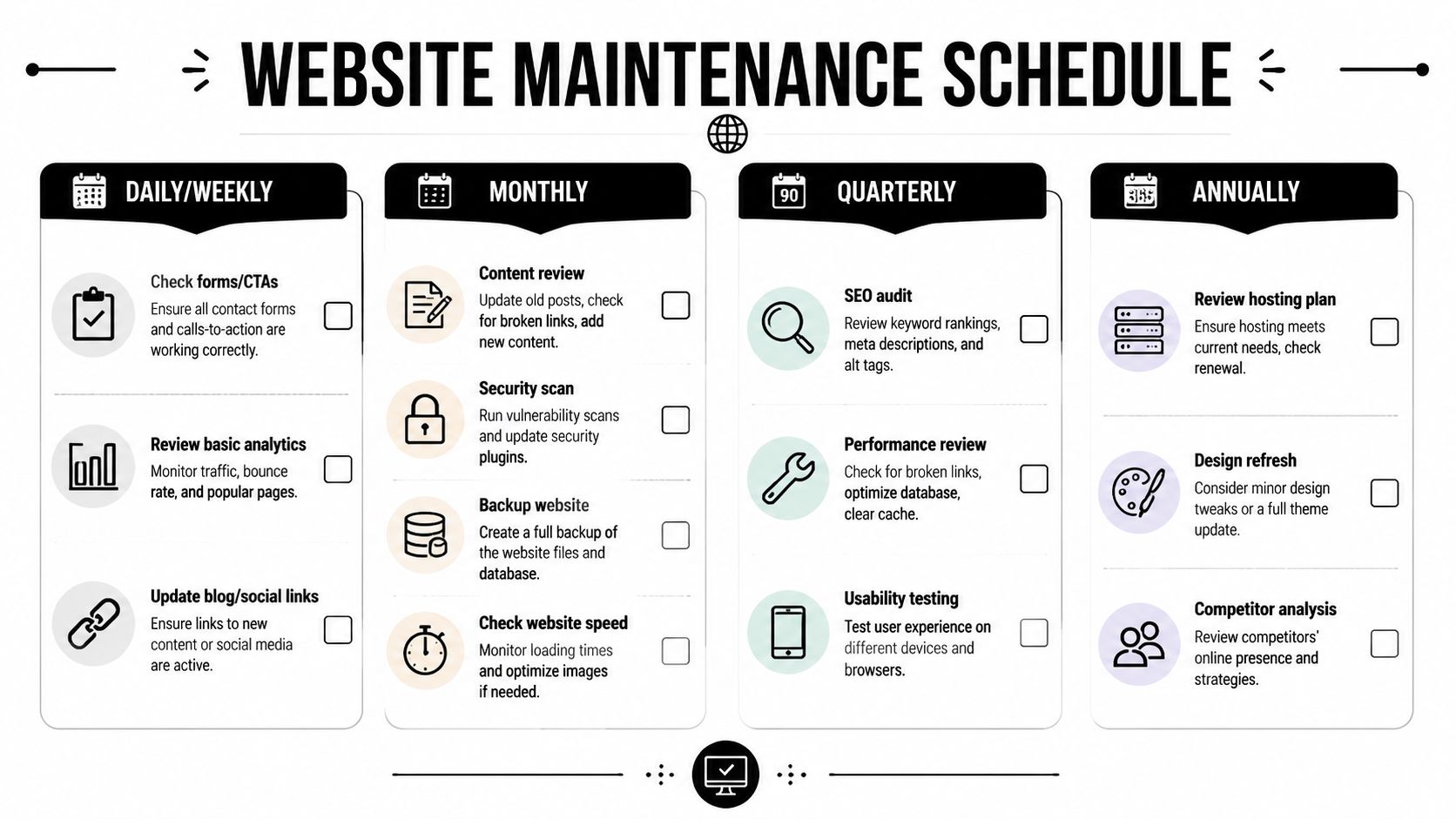
Most owners fail at website management for one reason. They treat it like a random chore instead of a schedule.
That's a mistake. If you put this on a calendar and keep it simple, it becomes manageable. HubSpot notes that key technical tasks include prompt software and plugin updates, regular full-site backups, uptime and performance monitoring, broken-link checks, and analytics review because those tasks reduce security risks and help spot traffic and conversion problems early. You can review that list in HubSpot's guide on website management for small business.
Use the same mindset you'd use for preventive maintenance on equipment.
Weekly jobs that keep you out of trouble
Every week, somebody needs to check the basics.
Test the contact form: Fill it out yourself. Make sure the message lands in the right inbox.
Click the main call buttons: Phone, quote request, careers, and service pages should all work.
Review updates: If your site runs on WordPress, plugins and themes need prompt attention.
Run or confirm a backup: Don't assume it's happening.
Look for obvious errors: Broken layouts, missing images, strange popups, or pages that won't load.
A weekly check doesn't need to take long if the site is set up right. It's a short walkaround inspection.
Here's a practical walkthrough worth keeping handy for your team:
Monthly checks that protect leads and reputation
Once a month, step back and look at how the site is performing.
Review analytics. Find out which pages people visit, which service pages get attention, and whether your careers page is being used. If you're trying to tie website activity back to real business outcomes, this resource for proving marketing ROI is useful because it shows how to think about tracking without turning your office into a data lab.
Then handle the maintenance jobs owners usually ignore:
Review broken links: Old links make the site feel neglected.
Update photos and project examples: Fresh work proves you're active.
Read submitted leads: Look for patterns. Are people asking for a service you haven't explained clearly?
Review security settings: A solid baseline matters. Northpoint Web has a practical page on website security best practices if you want a simple checklist.
If customers keep asking questions your website should answer, the problem isn't the customer. The page is weak.
Quarterly reviews that keep the site aligned with the business
Quarterly is where strategy shows up.
A lot can change in a few months. New service areas. New hiring needs. New equipment. A boom in one town and a slowdown in another. Your website should reflect that.
Do these quarterly:
Review every main service page Make sure services, locations, and wording still match the work you want.
Update the careers section If you need CDL drivers, operators, welders, or laborers, say so clearly.
Check every major call to action Quote request, call button, job application, and map directions should all be friction-free.
Audit local relevance Add recent work from recognizable local places when possible.
Decide what can be delegated If the owner is still doing all this alone, the system is wrong.
That last point matters more than is often acknowledged. Website maintenance falls apart when it depends on one overloaded person remembering everything.
Who Is Your Digital Foreman DIY vs Agency
A website needs an owner. Not ownership on paper. Actual responsibility.
If nobody owns it, updates get skipped, forms break, hiring pages go stale, and the site slowly turns into a digital brochure from two years ago. That's why I like to frame this as a foreman problem. Who's running the digital job site?
A 2024 National Small Business Association report found that 62% of small business owners spend more than 10 hours per week on non-core digital tasks. That's time you're not using to estimate jobs, manage crews, or close work. For a lot of rural businesses, the better answer is fractional, task-specific management instead of either doing everything yourself or paying for a bloated retainer.
The three real options
DIY works if your site is simple, you're organized, and you'll do the work. Most owners overestimate this. They think they'll update it Friday night. Then Friday night comes and they're fixing a trailer light or catching up on paperwork.
In-house staff can work if you've got an office manager or marketing person who is dependable and trained. The risk is turnover. One person learns the logins, process, and tools, then leaves. Now you're back at zero.
Agency or specialist support makes sense when the site directly affects bids, recruiting, and reputation. The smart version of this is not always full-service. For many small businesses, the practical answer is limited support for the few things that really matter, like safety notice updates, careers page changes, project uploads, and basic maintenance.
Don't buy a giant service package if what you need is consistent help with a short list of high-value jobs.
Website Management Options Compared
Approach
Cost
Time Required
Best For
DIY
Lowest cash cost, highest owner time cost
High
Very small businesses with simple sites and a disciplined owner
In-house
Ongoing payroll cost
Moderate
Companies with stable office support and clear internal processes
Fractional agency support
Targeted monthly cost for specific tasks
Low to moderate
Rural contractors who need help updating key pages without a full retainer
Full agency management
Highest recurring cost
Lowest owner involvement
Businesses where the site is central to lead flow, recruiting, and active marketing
My opinion is simple. If the owner is the only person who can update the site, that system is fragile. If an agency controls everything and your team can't make basic changes, that system is also fragile.
The best setup for a lot of contractors is shared control. The business owns the logins, process, and approvals. A trusted partner handles the technical work and the updates that tend to get pushed off.
The Essential Digital Toolbox for Contractors
You do not need twenty apps. You need a few tools that answer a few basic questions.
Is the site up? Are people finding it? Are forms working? Can you restore it if something breaks?
That's the toolbox.
The few tools that actually matter
Google Analytics tells you what pages people visit and where they came from. Don't get lost in every report. Start with your service pages, careers page, and contact page. Those are the pages tied closest to money and hiring.
Google Search Console shows how your site appears in search and can flag indexing or coverage issues. It's one of the few free tools I'd call mandatory.
An uptime monitor alerts you if the site goes down. If your website is offline and nobody knows, you can lose opportunities unseen.
A backup tool gives you a restore point when updates or errors cause trouble. If your site runs on WordPress, pick a reputable backup plugin and make sure someone verifies it works.
A simple content process matters as much as any software. One shared folder for job photos, one approved list of services, one person responsible for submitting updates. That alone fixes a lot of chaos.
If you're still deciding where your site should live and what platform makes sense, this page on small business website platforms is useful because it frames the decision in practical terms instead of tech jargon.
For the marketing side, I also like this guide to contractor marketing success because it connects website work to the bigger picture of getting found and chosen.
One local option in this mix is Northpoint Web. They provide website design, hosting, and maintenance for small businesses in the Uinta Basin, which is relevant if you want one provider handling the technical side while your team focuses on operations.
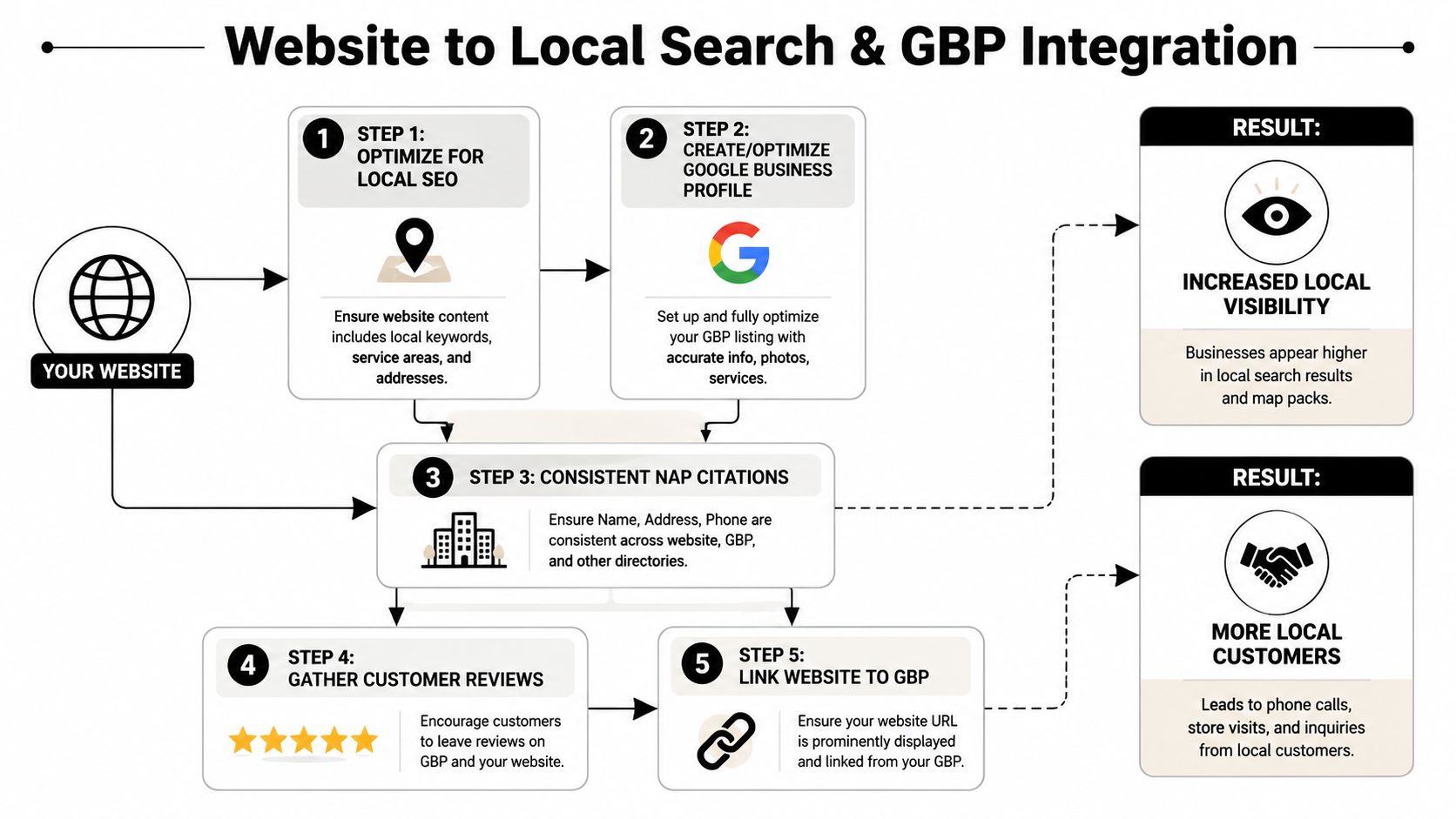
For contractors and industrial businesses, the website is the home base. Your Google Business Profile, local search visibility, review activity, service area pages, and project updates should all connect back to it. When those pieces work together, you have a better shot at showing up when someone nearby needs the work you do.
Here's where rural businesses need a different approach than generic website advice. In construction and similar trades, staff turnover can run over 20% annually, and that reality affects website management. If your process depends on one office person or one tech-savvy employee, it will break. A better system uses simple workflows so field crews can send in project photos and basic updates that can quickly be posted to the website and Google Business Profile.
A simple field to office workflow
A foreman finishes a job near Duchesne. He takes a few solid photos on his phone. He sends them to one shared place with a short note: location, service performed, and any equipment shown. Someone in the office or your web partner turns that into:
A gallery update on the website
A short Google Business Profile post
A service area signal tied to the town or region
Fresh proof that you're active and doing real work nearby
That's not busywork. That's local visibility.
If you want a practical breakdown of how this fits into rankings, maps, and service area visibility, this page on local SEO for contractors is worth reading.
A job photo isn't just a photo. It's proof you're active, local, and capable.
The same goes for hiring. If your careers page says “always accepting applications” but never mentions the actual roles you need, you're wasting a strong asset. Connect the website to real recruiting needs. Update openings. Show your equipment. Show your crews. Make it easy to apply from a phone.
That's how small business website management ties directly to local search and local trust. Not with abstract SEO talk. With simple proof, posted consistently.
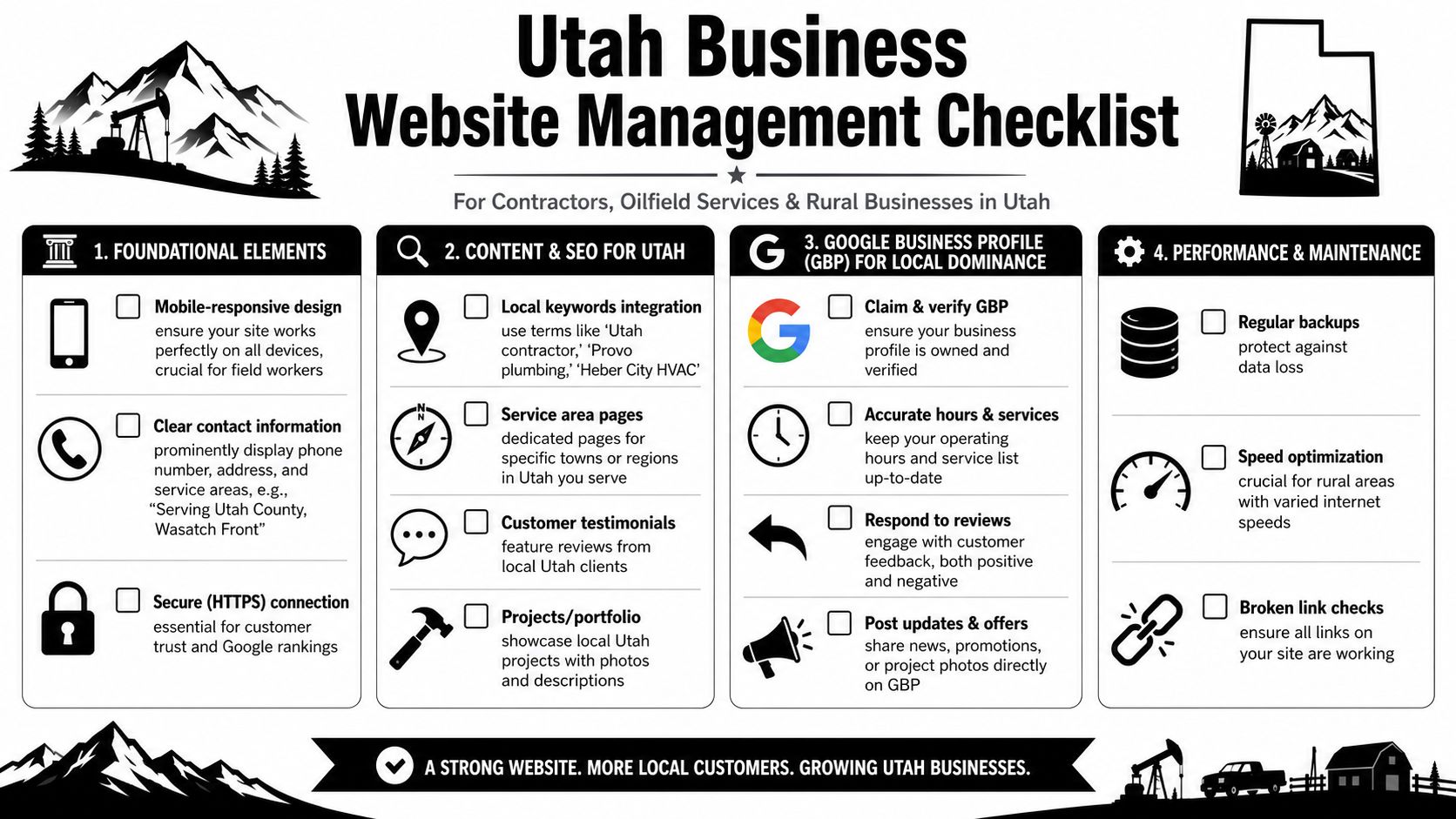
A Website Management Checklist for Utah Businesses
If you run a business in Duchesne, Roosevelt, Vernal, or anywhere in rural Utah, you need a checklist that matches real operating conditions. Spotty service. Limited office time. Crews in the field. Hiring pressure. Fast changes in workload.
Print this out. Put it on the desk. Review it once a month.
What to check this month
Phone number visibility Is your number easy to tap on a phone? A foreman or property manager shouldn't have to hunt for it.
Service area accuracy Are the towns and regions you serve listed clearly?
Hiring page relevance Are you showing the positions you need now, not the ones you needed last season?
Recent project proof Do you have current photos from local jobs, equipment in the field, or completed work people can recognize?
Quote form function Has somebody tested the form recently and confirmed the lead goes to the right person?
Google Business Profile consistency Do the website and Google listing match on services, phone, business hours, and location details?
Mobile experience Can somebody on a jobsite load the page, read it, and call you without pinching and zooming all over the screen?
Core page freshness Homepage, services, careers, and contact page should never look abandoned.
Security and backup status Do you know who handles updates, backups, and restore points?
Analytics sanity check Are people reaching the pages that matter most? If you need a broader framework for auditing what your data is telling you, this master your analytics data guide is a useful companion.
A well-managed site doesn't have to be complicated. It has to be current, easy to use, and tied to what your business needs right now. More bids. Better hires. Fewer missed opportunities.
If your website is live but nobody's really managing it, Northpoint Web can help you put a practical system around it. That means maintenance, updates, local visibility, and a site that supports the way rural Utah businesses operate.
What small business website management includes
Website management is broader than fixing a broken page. A practical management routine usually includes:
Technical maintenance: WordPress, plugin, theme, hosting, and security updates.
Reliability checks: Backups, uptime monitoring, broken-link reviews, and contact-form testing.
Content management: Updating services, service areas, project photos, job openings, contact information, and calls to action.
Performance review: Checking page speed, mobile usability, analytics, and the pages connected to leads.
Business alignment: Making sure the website reflects current services, hiring needs, locations, and priorities.
The right scope depends on the site and the business, but the goal is consistent: keep the website dependable and useful when customers need it.
Why website management matters after launch
A newly launched website is not the finish line. Services change, job postings expire, contact details become outdated, and forms or integrations can stop working. A page that once answered a customer’s question may no longer match the work your business wants.
For contractors, trucking companies, welders, excavation crews, and oilfield service companies, a managed site should make it easy for people to understand what you do, where you work, how to contact you, and whether you are actively hiring. Current information supports credibility and reduces repeat questions for the office.
Weekly website management checklist
A short weekly review can catch problems before they cost a lead or create confusion:
Submit the main contact or quote form and confirm the message reaches the right inbox.
Click phone, quote, careers, and primary service-page buttons on a mobile device.
Check for broken layouts, missing images, error messages, or unexpected popups.
Confirm that backups and security updates are being handled.
Review urgent changes, such as a new service area, closed office, or expired job opening.
Keep a simple record of who checks these items and what needs follow-up. Clear ownership is often as important as the checklist itself.
Monthly and quarterly website reviews
Monthly management should go beyond checking whether the site is online. Review which pages receive attention, whether visitors can complete important actions, and what questions appear repeatedly in submitted leads or customer conversations. Then update the pages that should answer those questions.
Every quarter, review the major service pages, locations served, careers content, project examples, contact details, and calls to action. Compare the website with the work the business actually wants. If a service, town, hiring need, or priority has changed, the site should change with it.
Need help keeping your business website current?
If your team does not have time to manage updates, backups, forms, content changes, and routine reviews, Northpoint Web Solutions offers website management support for keeping a business website maintained and useful. Review the service details to see whether ongoing help fits your site and workflow.
Website management is broader than fixing a broken page. A practical management routine usually includes:
Technical maintenance: WordPress, plugin, theme, hosting, and security updates.
Reliability checks: Backups, uptime monitoring, broken-link reviews, and contact-form testing.
Content management: Updating services, service areas, project photos, job openings, contact information, and calls to action.
Performance review: Checking page speed, mobile usability, analytics, and the pages connected to leads.
Business alignment: Making sure the website reflects current services, hiring needs, locations, and priorities.
The right scope depends on the site and the business, but the goal is consistent: keep the website dependable and useful when customers need it.
Why website management matters after launch
A newly launched website is not the finish line. Services change, job postings expire, contact details become outdated, and forms or integrations can stop working. A page that once answered a customer’s question may no longer match the work your business wants.
For contractors, trucking companies, welders, excavation crews, and oilfield service companies, a managed site should make it easy for people to understand what you do, where you work, how to contact you, and whether you are actively hiring. Current information supports credibility and reduces repeat questions for the office.
Weekly website management checklist
A short weekly review can catch problems before they cost a lead or create confusion:
Submit the main contact or quote form and confirm the message reaches the right inbox.
Click phone, quote, careers, and primary service-page buttons on a mobile device.
Check for broken layouts, missing images, error messages, or unexpected popups.
Confirm that backups and security updates are being handled.
Review urgent changes, such as a new service area, closed office, or expired job opening.
Keep a simple record of who checks these items and what needs follow-up. Clear ownership is often as important as the checklist itself.
Monthly and quarterly website reviews
Monthly management should go beyond checking whether the site is online. Review which pages receive attention, whether visitors can complete important actions, and what questions appear repeatedly in submitted leads or customer conversations. Then update the pages that should answer those questions.
Every quarter, review the major service pages, locations served, careers content, project examples, contact details, and calls to action. Compare the website with the work the business actually wants. If a service, town, hiring need, or priority has changed, the site should change with it.
Need help keeping your business website current?
If your team does not have time to manage updates, backups, forms, content changes, and routine reviews, Northpoint Web Solutions offers website management support for keeping a business website maintained and useful. Review the service details to see whether ongoing help fits your site and workflow.
Website management is the ongoing care required after a site launches. It is broader than occasional content editing and more practical than simply having hosting. The work should keep the website available, secure, accurate, easy to use, and connected to business goals.
For a contractor, trucking company, welder, excavation crew, oilfield service company, or other small business, the managed site should make it easy to understand services, see current evidence of work, find service areas, contact the company, and review open jobs when hiring is important.
What website management services include
WordPress maintenance: Review and apply relevant software, plugin, and theme updates.
Backups and recovery readiness: Run or confirm backups rather than assuming they are working.
Lead-path testing: Test contact forms, phone links, quote requests, service pages, and careers paths.
Performance and quality checks: Look for slow pages, broken links, missing images, broken layouts, and unusual popups.
Review and improvement: Use analytics and submitted-lead patterns to identify pages that need attention.
A weekly, monthly, and quarterly maintenance schedule
Weekly: Test the main contact form, click important call and quote buttons, confirm updates and backups, and look for obvious errors.
Monthly: Review analytics, page speed, broken links, security settings, current photos, and submitted leads. Check whether important service or careers pages answer the questions customers and applicants are asking.
Quarterly: Review whether the website still matches the business. Revisit services, service areas, hiring information, calls to action, project examples, and the pages that support current priorities.
What poor website maintenance looks like
A website can appear attractive while still failing operationally. Slow pages can cause people to leave, broken forms can hide missed estimates, outdated information can weaken trust, and neglected security can create a serious interruption. The practical test is simple: if a known website issue would stop a customer from calling or submitting a request, it belongs on the maintenance list.
Your Website Is an Operating Asset, Not a One-Time Project
A website can look finished while quietly creating problems: contact forms stop working, job postings become outdated, software falls behind, pages slow down, and customers receive the wrong information. For a contractor, trucking company, manufacturer, or other small business, those issues can affect leads, hiring, and credibility.
The practical question is not whether your website exists. It is whether someone is responsible for keeping it dependable and useful after launch.
What a Small-Business Website Manager Handles
Professional website management is an ongoing operating process rather than a single technical task. Depending on the site and the engagement, management may include software and plugin updates, backups, security checks, form testing, broken-link reviews, content changes, performance checks, analytics review, and updates to service, hiring, or location information.
Routine WordPress, theme, and plugin maintenance
Backup and recovery checks
Contact form and call-to-action testing
Content and image updates
Performance and broken-link reviews
Coordination between website changes and local-search information
What Good Website Management Helps You Do
A well-managed website is easier for customers, applicants, and staff to use. It keeps important information current, makes it easier to contact the business, supports trust with current photos and services, and helps the owner identify problems before they become missed opportunities.
The goal is not to add technology for its own sake. The goal is to keep the website ready to support calls, quote requests, hiring, and other actions that matter to the business.
A Clear, Practical Management Process
Visitors should understand how an engagement works before they contact Northpoint. Explain that the process begins with a review of the existing website, priorities, access, forms, hosting, and business information. Then define the recurring maintenance work, the process for submitting content changes, and how urgent problems are identified and handled.
Also explain ownership and access clearly: the business should know who controls its domain, hosting, WordPress administrator account, backups, and website files. Specific response times should only be published if Northpoint can consistently support them.
Questions to Answer Before Hiring a Website Manager
Address the practical questions that commonly stop small-business owners from taking the next step:
Can an existing website be managed, or must Northpoint have built it?
Does management include content updates, security, backups, and form testing?
How are larger redesigns, SEO work, hosting, and custom development handled?
What information does the client need to provide?
What factors affect the cost of ongoing management?
Who owns the domain, hosting account, content, and website access?
Request a Website Management Review
If your website is difficult to keep current, has unreliable forms, or no one clearly owns its maintenance, start with a review. Northpoint can help identify the recurring work your site needs and clarify whether ongoing website management, local-search support, security work, or a larger website improvement is the right fit.
Request a website management review to identify maintenance priorities, clarify responsibilities, and determine whether Northpoint’s ongoing services are appropriate for your business.
Website management covers the recurring work required after a site launches. The exact scope depends on the website, hosting setup, business priorities, and whether Northpoint is also handling content, search visibility, or custom functionality.
WordPress, plugin, and theme updates
Backup and recovery checks
Security and uptime monitoring
Contact form, phone-link, and application-form testing
Service, location, hiring, and project-photo updates
Broken-link, layout, and performance reviews
Analytics and lead-path reviews
These tasks are different from building a new website. They are the recurring checks and changes that keep an existing website useful.
Weekly Website Management Checks
A short weekly inspection can catch problems before customers do. Test the main contact form, click phone and quote buttons, confirm that important pages load, review obvious layout problems, and verify that backups and updates are being handled.
For businesses that are hiring or actively promoting services, also check that job openings, service descriptions, project photos, and contact information are still accurate.
Monthly and Quarterly Website Reviews
Monthly reviews should look beyond whether the website is online. Review the pages visitors use, the actions they take, page performance, broken links, current business information, and whether forms are producing usable inquiries.
Quarterly reviews should ask whether the website still reflects the business. Revisit services, locations served, hiring needs, calls to action, project examples, and the questions customers ask most often.
When evaluating marketing performance, the resource on proving marketing ROI can help connect website activity with business outcomes.
DIY, an Employee, or a Professional Website Manager?
DIY management may work when someone has protected time, technical confidence, access to the right accounts, and a dependable process. Assigning the work to an employee can work when responsibilities are documented and the person has enough time to maintain the site.
Professional management may be a better fit when website tasks are repeatedly postponed, no one knows whether backups work, forms are unreliable, or changes require technical help. The right choice depends on the site’s complexity, the business risk of downtime, and how frequently updates are needed.
Necessary cookies enable essential site features like secure log-ins and consent preference adjustments. They do not store personal data.
None
Functional cookies support features like content sharing on social media, collecting feedback, and enabling third-party tools.
None
Analytical cookies track visitor interactions, providing insights on metrics like visitor count, bounce rate, and traffic sources.
None
Advertisement cookies deliver personalized ads based on your previous visits and analyze the effectiveness of ad campaigns.
None
Unclassified cookies are cookies that we are in the process of classifying, together with the providers of individual cookies.
None
Zippy Available
💬
Before we start…
This chat may be reviewed by our team, and relevant messages are sent to our configured AI provider. Please do not share passwords, payment details, or other sensitive information.