Category: Web Design in Utah

Looking for web design in Utah or specifically the Uinta Basin? We can help!

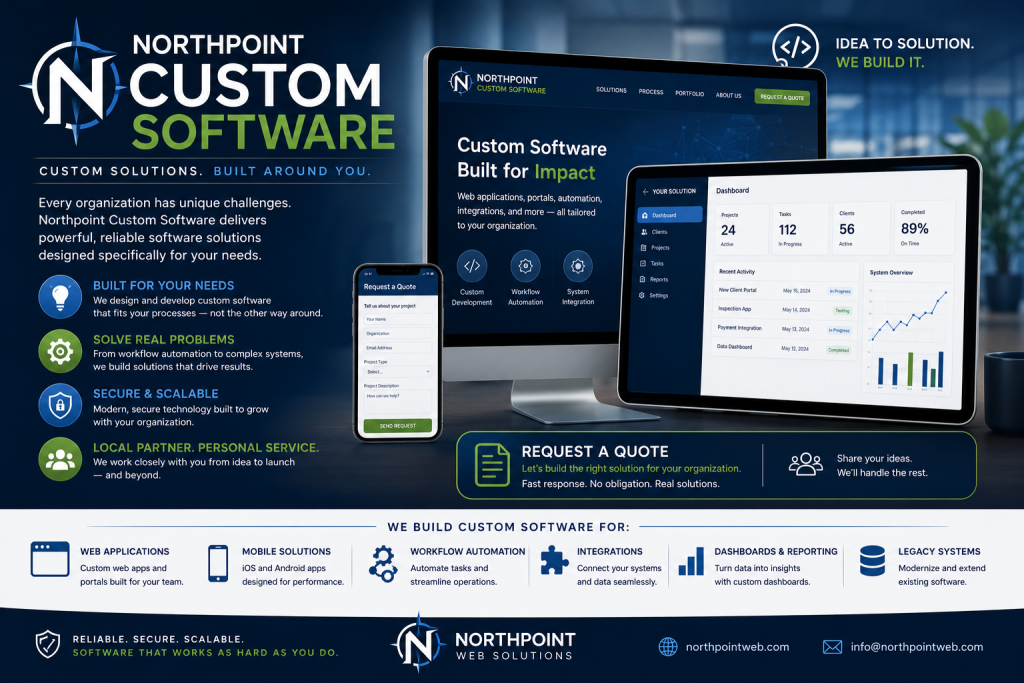
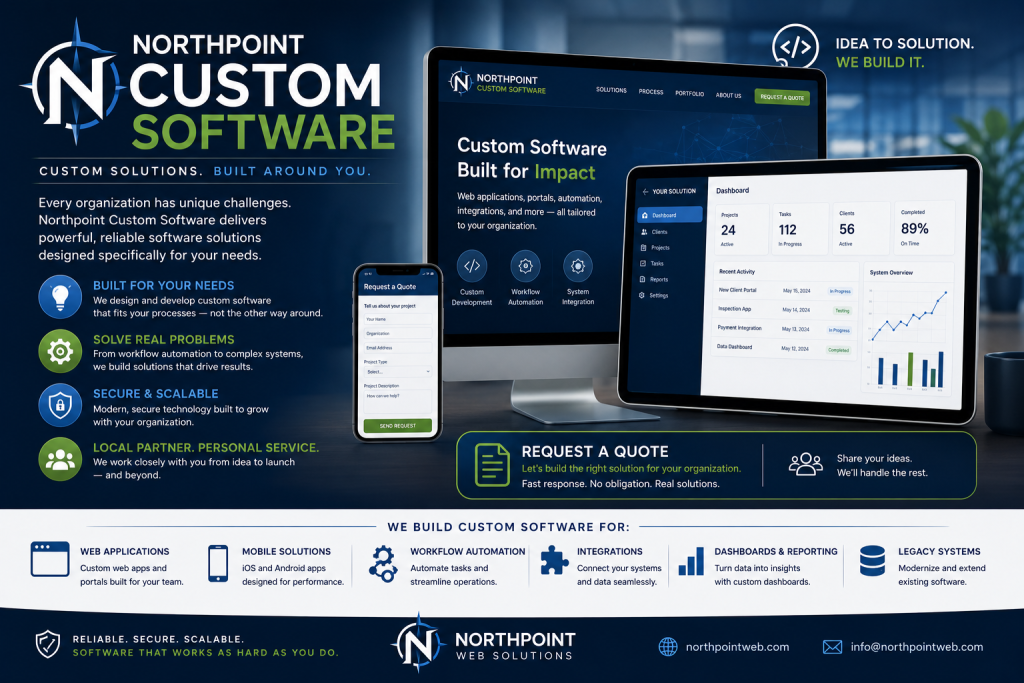
  • Custom Fair Management Software and Mobile Fair Apps Built for Real Events

    County fairs, rodeos, livestock shows, demolition derbies, and fairgrounds are often managed through a mixture of printed schedules, spreadsheets, paper forms, social media posts, and separate software systems. Visitors may struggle to find current schedules, locate food vendors, understand event changes, or know what is happening at a particular moment.

    Northpoint Web Solutions is developing a collection of custom fair management software and mobile fair apps designed to make fairs easier to operate and more enjoyable to attend. Rather than forcing every fair into the same generic system, our applications can be adapted to the events, facilities, competitions, vendors, and operating procedures of each fairground.

    Modern fair software commonly combines schedules, interactive maps, vendor coordination, ticketing, volunteer management, alerts, and attendee information. Public-facing fair apps increasingly include searchable maps, vendor listings, event results, sponsor recognition, and push notifications.

    Fair Apps Developed for the Duchesne County Fair

    Our first fair-related applications were created around actual events at the Duchesne County Fair. Building for a live fair allowed us to observe how participants, announcers, officials, vendors, and visitors use technology in real-world conditions.

    Cole’s Wacky Derby Timer

    Cole’s Wacky Derby Timer was designed to help manage demolition derby timing from a phone, tablet, or computer.

    The app provides customizable timing controls for derby runs, no-hit warnings, participant timers, announcer notifications, and visual color changes as important time limits approach. It allows derby personnel to configure timing rules for the particular event rather than relying on a generic stopwatch.

    Potential features for demolition derbies and motorsports include:

    • Configurable run and no-hit timers
    • Individual participant timers
    • Warning and elimination alerts
    • Announcer displays
    • Driver and vehicle information
    • Heat assignments
    • Event results
    • Public leaderboards
    • Sponsor displays

    This type of specialized demolition derby management software can reduce confusion and give judges, announcers, drivers, and spectators a clearer understanding of what is happening.

    Cole’s Crazy Mower Race Tracker

    Cole’s Crazy Mower Race Tracker was created for lawnmower racing at the fair.

    The app can help officials organize racers, manage heats, track timing, record results, and provide useful information to the announcer. It also establishes a foundation for other forms of local motorsports, including tractor pulls, mud racing, barrel racing, obstacle courses, and timed arena events.

    Instead of developing a separate system from the ground up for every competition, these event tools can eventually operate as modules within a larger fair competition management system.

    Duchesne Fair Food Finder

    The Duchesne Fair Food Finder was created to solve a simple question:

    What food is available at the fair, and where can I find it?

    Visitors can browse vendors in two ways. They can select booths from a simplified overhead fair map or search through mobile-friendly vendor cards.

    Each participating food vendor can have:

    • A photograph of the booth
    • A searchable menu
    • Food categories
    • Visible prices
    • Location information
    • Food-quality ratings using stars
    • Price-level ratings using dollar signs

    Someone searching for a burger, corn dog, lemonade, rice bowl, funnel cake, shaved ice, or dessert can quickly find matching vendors without walking the entire fairgrounds.

    Interactive event maps are increasingly used to let visitors search vendors, products, sponsors, and booth locations from any device. Clickable vendor spaces can display participant details without requiring visitors to create an account or install a traditional app.

    The Food Finder also demonstrates how a small, focused application can produce immediate value without requiring a fair to replace all of its existing software.

    A Larger Fairgrounds Software Suite

    The individual apps are part of a broader concept called Northpoint Fairgrounds—a modular suite for county fairs, state fairs, festivals, rodeos, livestock shows, and year-round fairground operations.

    The goal is to let fair organizers select only the modules they need while keeping information connected across the entire platform.

    Public Fair Guide

    A custom fair guide could give visitors one mobile location for:

    • Daily schedules
    • “Happening Now” information
    • Event descriptions
    • Interactive fairgrounds maps
    • Food and commercial vendors
    • Tickets
    • Parking
    • Restrooms
    • Accessibility information
    • Weather and emergency alerts
    • Sponsors
    • Livestock results
    • Competition results
    • Personalized event reminders

    The guide could operate as an installable Progressive Web App. Visitors would open it through a link or QR code, and it could work on iPhone, Android, tablets, and computers without requiring an app-store download.

    Fair Vendor Management Software

    A future vendor-management module could help fair staff manage:

    • Vendor applications
    • Food and commercial vendor categories
    • Booth assignments
    • Interactive vendor maps
    • Application fees
    • Insurance documents
    • Health permits
    • Electrical and water requirements
    • Contracts
    • Check-in
    • Vendor passes
    • Staff communications

    Vendor applications, booth maps, payment collection, and automated communication are among the central capabilities promoted by current county-fair and event-management platforms.

    Approved vendors could automatically appear in the public fair guide, eliminating duplicate data entry.

    Livestock Show and Fair Entry Management

    Livestock and exhibit management are major operational needs for many fairs.

    A future livestock show management software module could include:

    • Exhibitor registration
    • 4-H and FFA information
    • Animal records
    • Tag and electronic identification
    • Weight tracking
    • Health-document uploads
    • Stall and pen assignments
    • Class creation
    • Show-ring order
    • Mobile judging
    • Placings and ribbons
    • Premium calculations
    • Auction eligibility

    Separate tools could manage home arts, photography, baking, gardening, crafts, flowers, school exhibits, and other open-class entries.

    Established fair-entry platforms already handle registration, judging, premiums, livestock auctions, and creative or home-arts entries, showing the importance of these functions to county and state fairs.

    Fairgrounds Rental Management

    Fairgrounds operate throughout the year, not only during fair week.

    A fairgrounds rental management system could manage:

    • Arenas
    • Event centers
    • Exhibit halls
    • Livestock barns
    • Pavilions
    • Kitchens
    • Meeting rooms
    • RV spaces
    • Horse stalls
    • Outdoor event areas

    Customers could submit rental requests, review availability, sign agreements, upload insurance documents, and pay deposits. Staff could manage setup requirements, equipment, inspections, keys, access codes, cleanup, and damage reports.

    Fair Staff and Volunteer Scheduling

    A staff and volunteer module could provide:

    • Shift scheduling
    • Availability
    • Check-in and check-out
    • Volunteer-hour tracking
    • Assigned buildings or gates
    • Supervisor information
    • Task lists
    • Training acknowledgments
    • Credentials
    • Internal announcements

    This could reduce dependence on group texts, printed schedules, and last-minute phone calls.

    Fairgrounds Operations and Maintenance

    Fair personnel could report and assign operational issues such as:

    • Restroom servicing
    • Full garbage containers
    • Electrical problems
    • Water leaks
    • Damaged fencing
    • Lighting failures
    • Arena problems
    • Missing signage
    • Cleanup needs
    • Parking issues

    Photos, locations, assignments, priorities, and completion records could be managed through a mobile operations dashboard.

    Announcer, Scoring, and Competition Tools

    Future competition modules could support:

    • Demolition derbies
    • Lawnmower racing
    • Rodeos
    • Barrel racing
    • Tractor pulls
    • Horse shows
    • Mutton busting
    • Talent shows
    • Car shows
    • Cook-offs
    • Athletic events

    A shared announcer screen could display participant names, hometowns, sponsor information, scores, times, upcoming entries, results, and prepared announcements.

    Enter Information Once and Use It Everywhere

    The long-term advantage of an integrated fairgrounds platform is that information would not need to be entered repeatedly.

    For example:

    • A vendor approved by fair staff could automatically appear on the public map.
    • An event schedule change could update the website, visitor app, announcer screen, and digital displays.
    • Competition results could appear on public leaderboards.
    • Sponsor information could appear throughout the app and in event displays.
    • A livestock entry could flow from registration through judging, awards, premiums, and auction.
    • A fairgrounds reservation could create staff tasks and facility-inspection records.

    This approach allows fairs to begin with one useful application and expand gradually.

    Custom Fair Software for Small and Mid-Sized Fairs

    Many smaller fairs do not need an enormous enterprise system. They need software that matches their operations, is easy for seasonal staff to understand, and remains affordable from year to year.

    Northpoint Web Solutions can develop solutions for:

    • County fairs
    • State fairs
    • Municipal festivals
    • Rodeos
    • Livestock shows
    • Agricultural events
    • Demolition derbies
    • Motorsports events
    • Food festivals
    • Farmers markets
    • Fairgrounds and event centers

    Applications can be branded for each organization and designed to complement existing ticketing, entry, accounting, or website systems rather than requiring everything to be replaced at once.

    Bring a Custom Fair App to Your Community

    The apps developed for the Duchesne County Fair demonstrate how practical software can be created around the way a real event actually operates.

    Whether your fair needs a public mobile guide, interactive vendor map, food finder, competition timer, vendor-management platform, livestock system, volunteer scheduler, or year-round fairgrounds management software, Northpoint Web Solutions can help plan a solution around your particular needs.

    Contact Northpoint Web Solutions to discuss custom fair management software or a branded mobile app for your next fair, rodeo, festival, or community event.

  • Modernizing Municipal Websites: A practical WordPress guide for small cities, special districts, and rural communities

    Hi — I’m Andy. I grew up in the era of dial-up BBSs and learned web development from library books and trial-and-error. That same hands-on attitude guides how I approach municipal websites today: practical, incremental, and focused on making a site work for staff and residents every hour of the day.

    Start with a tight content and functionality audit

    Before spending money on design, inventory what’s actually on the site and how people use it. An effective audit asks:

    • What pages receive regular traffic (even from basic analytics)?
    • Which documents are required by policy—agendas, minutes, ordinances, fee schedules—and are they easy to find?
    • What forms do residents repeatedly request (permits, service requests, recreation sign-ups)?
    • Which administrative tasks consume staff time because they’re manual or duplicated?

    Documenting this gives you a prioritized roadmap. Often the biggest wins are low-cost changes: clearer navigation, a prominent online form, or a better document index.

    Focus on forms and public request systems

    Residents expect to complete common transactions online. Using modern form tools reduces phone and counter traffic while producing searchable records. Look for solutions that support:

    • Custom, conditional forms for permits and registrations
    • Automatic email confirmations and unique tracking codes for requesters
    • Staff assignment, internal notes, and status updates
    • Reporting and exportable records for audits

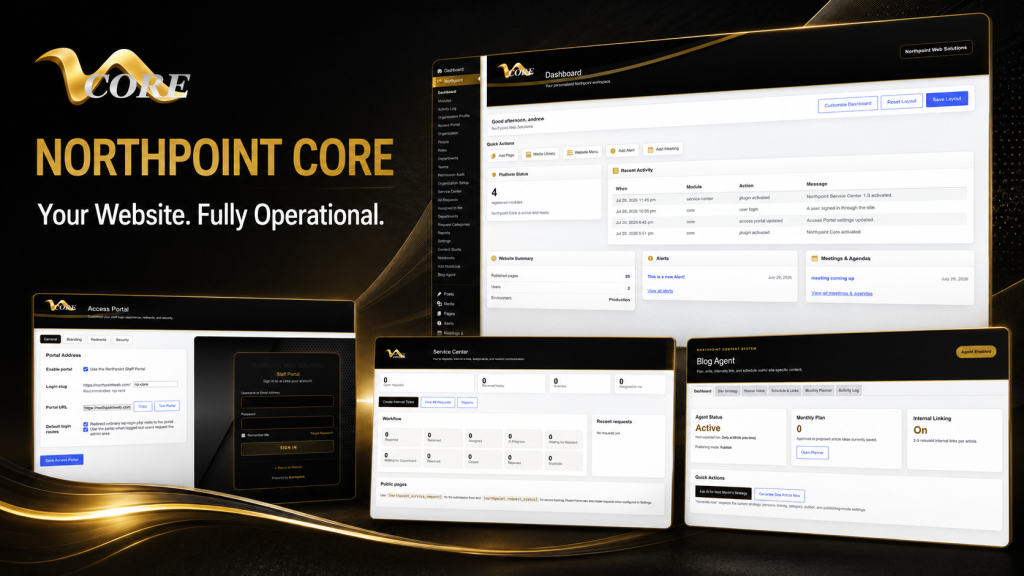
    Tools that integrate with Fluent Forms or a municipal forms module can avoid re-entering data. Northpoint Service Center, for example, is designed to support public request submission, tracking codes, staff assignment, departments, categories, workflow statuses, requester communication, public updates, internal notes, due dates, and reporting.

    Make administration easier for nontechnical staff

    Municipal websites are often updated by people whose main job is not web development. Simplify their work by:

    • Creating department-based pages and templates so staff can add content without breaking layout
    • Using role-based permissions so each user sees only the tools they need
    • Providing a simplified, branded dashboard that hides unnecessary options
    • Establishing content workflows and approval steps for public notices and meeting materials

    Northpoint Organization tools and Northpoint Admin Studio are designed to support departments, staff roles, and a simplified WordPress dashboard that reduces accidental edits and training time.

    Backup, hosting, and disaster recovery: practical expectations

    Managed WordPress hosting, regular backups, and a tested recovery plan are non-negotiable for public-facing sites. Key elements to require from a hosting plan:

    • Automated daily backups with easy restores
    • Simple staging environments for content or code changes
    • Access to logs and a process for emergency restores

    Don’t overcomplicate disaster recovery—document who can restore a backup, how to access credentials, and what pages or services must be back online first (public notices, outage alerts, payment portals).

    Security and maintenance for small organizations

    Security and maintenance are ongoing, not one-time tasks. Reasonable practices include keeping WordPress, themes, and plugins updated; limiting admin accounts; and using role-based permissions. Regularly review plugin inventory and remove plugins that aren’t actively needed. A managed maintenance plan that includes updates, backups, and support is the most practical approach for teams with limited technical staff.

    Accessibility and clear public communication

    Municipal websites must be readable and navigable for as many residents as possible. Start with these steps:

    • Use clear headings and page structure so assistive technologies can navigate documents and agendas
    • Provide accessible document formats (HTML pages for agendas and minutes rather than only PDFs) when possible
    • Keep public notices and alerts prominently visible and easy to subscribe to

    Accessibility is both technical and editorial—plain language, concise forms, and obvious next steps help everyone. A content-first approach often yields bigger accessibility gains than a cosmetic redesign.

    Local SEO and content strategy for rural communities

    Local search matters for towns and small districts. Focus on service-first content that answers common resident questions: how to report a streetlight outage, where to find meeting minutes, how to register for recreation. Use a content calendar to publish predictable updates—meeting agendas, project updates, and seasonal announcements—and link related pages internally to help both users and search engines find information.

    Northpoint Blog Agent is designed to assist with topic planning, writer personas, and scheduled publishing, which makes it easier to keep a steady stream of useful, local content without overwhelming staff.

    Improve without rebuilding: incremental modernization

    You don’t always need a full redesign. Consider these incremental upgrades:

    • Replace or reorganize the top navigation to reflect how residents search for services
    • Add a central public service request form and link it across department pages
    • Introduce a simplified admin dashboard and train staff on a small set of tasks
    • Publish meeting documents as searchable web pages and link them from a dedicated calendar

    If you do opt to migrate an old site, collect URLs, common queries, and top documents first. That saves time and prevents broken links after migration. Northpoint Core provides a centralized administrative framework designed to operate within WordPress and complement an existing website, so new tools can be added without tearing everything down.

    Short historical note

    I still remember the first time I dialed into a BBS and uploaded a file—there was an immediate thrill to making information available on someone else’s machine. That same principle matters today: your municipal website should do more than sit online. It should actively work for residents and staff, reliably and predictably.

    Want practical next steps? Request a Northpoint website review to discuss design, maintenance, hosting, accessibility, content, or administrative needs. Tell us what is difficult about managing your current website, and we can help identify a practical next step. Whether you need a complete website, ongoing support, or one specialized tool like modern forms or request tracking, contact Northpoint Web to discuss a solution that fits your organization.

    For related resources see our practical guide on modern municipal websites and learn more about Northpoint Core, Northpoint Service Center, and Northpoint Civic Forms.

  • Modern Municipal Websites: Practical Steps for Easier Administration and Better Public Service

    Hi — I’m Andrew North. I learned about online communities on dial-up BBS systems and then built websites throughout the early web era. Those early lessons stuck: a website should do more than sit online; it should work for your organization, day and night. Based in the Uinta Basin and serving municipalities across Utah and the United States, Northpoint focuses on making municipal websites practical, easier to maintain, and useful to residents.

    Start with a focused audit

    Before a redesign or new plugin, audit what your website does today. Look for the pages visitors actually use, common resident questions, broken links, outdated contact details, and forms that still arrive by paper or email. An audit tells you what to fix first so limited staff time goes to changes that reduce repeated work.

    Prioritize improvements that reduce staff time

    Municipal staff are busy. The best website changes are the ones that automate repetitive tasks or make everyday updates easier. Practical priorities include:

    • Converting paper or email requests into online forms with automated tracking and notifications.
    • Publishing meeting agendas, minutes, and public documents in a consistent location so staff aren’t answering the same questions repeatedly.
    • Creating department pages and clear navigation so visitors find essential services without calling the main number.

    Use WordPress tools designed for government workflows

    WordPress is flexible and widely supported. Instead of forcing a one-size-fits-all product, consider modular tools that slot into your existing site and address specific needs. Northpoint Core provides a centralized dashboard and a module framework designed to add functionality over time. For example, Northpoint Service Center is designed to accept public requests, assign them to staff, track statuses, and integrate with Fluent Forms for intake—reducing manual tracking and follow-up.

    If you need a simpler admin interface, a branded dashboard like Northpoint Admin Studio can make WordPress easier for nontechnical staff by hiding irrelevant options and surfacing the tasks they perform daily.

    Forms, request tracking, and workflows

    Online forms should capture the minimum required details, generate a reference code for the requester, notify the responsible department, and record internal notes and due dates. That sequence—intake, assignment, status updates, and reporting—keeps requests from slipping through the cracks. When forms integrate with a service center or ticketing module, staff spend less time copying data between email and spreadsheets.

    Content strategy for city websites

    A clear content plan helps residents find answers without calling. Use these practical steps:

    • Create simple how-to pages for frequent tasks: permit steps, utility billing, recreation registration procedures.
    • Organize content by department and service rather than by internal office names.
    • Maintain a content calendar to keep event, meeting, and seasonal pages current.

    Northpoint Content Studio and the Northpoint Blog Agent are designed to help with topic planning, drafting, and scheduling when you want a system that supports organized publishing and internal linking.

    Security, backups, and disaster recovery

    Small organizations need straightforward, reliable practices: keep WordPress core, themes, and plugins up to date; use role-based accounts rather than sharing logins; enforce strong passwords; and maintain regular backups stored off-site. Managed WordPress hosting makes these tasks easier by including automated backups, update tools, and server-side protections. Planning a recovery process—who restores the site, which backup to use, and where to communicate during an outage—reduces confusion if something goes wrong.

    Accessibility and public communication

    Municipal websites serve everyone. Focus on clear language, predictable navigation, descriptive link text, and properly structured headings. These practices help people with different abilities and ensure the site works better on mobile devices. Accessibility work can be phased: start with the most visited pages and public documents, then expand improvements across the site.

    Local SEO for rural communities

    For smaller towns and districts, local search visibility often comes from accurate contact details, consistent service pages, event listings, and properly configured business or agency profiles. Keep addresses, office hours, and department pages consistent across your site and directory listings. Structured content that answers common resident questions will help visitors find the right pages without calling.

    Manage access and reduce mistakes

    Define roles and permissions so staff have access only to the tools they need. Department-based access control reduces accidental edits and keeps sensitive documents restricted. For many organizations, a simplified dashboard with tailored editing screens is all it takes to reduce errors and speed up routine updates.

    Improve incrementally—don’t rebuild unless you must

    Large redesigns can be costly and disruptive. Often you can improve a site by reorganizing navigation, adding a service center or form system, moving the most used content into easy-to-edit blocks, and cleaning up broken links. If a migration is needed, plan it in stages: audit, export content, test modules on a staging site, and train staff before switching the public site.

    A short historical note

    When I started building websites, I learned by reading library books and testing code on early personal servers. That hands-on approach still matters: test changes on a staging site before pushing them live, and keep a rollback plan handy.

    How to choose a municipal website provider

    Ask prospective providers about practical support for the workflows you need: forms and request tracking, document publishing, staff dashboards, hosting and backups, and phased improvements. Avoid long vendor lock-in and prefer solutions that keep your content portable and under your control. If you’re considering WordPress, check whether the provider can add modules later—so you don’t pay for features you won’t use now.

    For more detailed, step-by-step guidance, see our practical guides on municipal website design and our description of the Northpoint Core framework.

    Tell us what is difficult about managing your current website, and we can help identify a practical next step. Request a Northpoint website review to discuss design, maintenance, hosting, accessibility, or administrative needs, or ask for a demonstration of Northpoint Core or one of the available modules. Whether you need a complete website, ongoing support, or one specialized tool, Northpoint can help you plan a solution that fits your organization.

  • A practical guide to municipal website design and easier administration

    Hi — I’m Andy North. I learned a lot about computers the slow way, tinkering with bulletin board systems and library books long before the web felt easy. That background still shapes how I approach municipal websites: they should do real work for your staff and residents, not just sit online.

    Start with a short audit, not a full redesign

    Many town and district leaders assume a failing website means they need a full rebuild. Often that’s not true. A short, practical audit—one page that lists broken links, poor navigation, unreadable PDFs, and the top five tasks people visit the site to complete—can identify high-impact wins. Focus first on the things that reduce staff calls: obvious contact info, current meeting agendas, searchable documents, and clear online forms.

    What an audit should include

    • Primary user tasks (pay a bill, report a problem, find meeting minutes).
    • Navigation clarity: can a visitor find the task in two clicks?
    • Forms and workflows: are submissions routed to staff and tracked?
    • Accessibility and mobile readiness checks.
    • Backup and hosting setup and recovery options.

    Make administration easier with role-based access and simplified dashboards

    Staff turnover and limited technical support are common in small municipalities. WordPress can be configured so each department has only the tools they need. Department-based access control and custom dashboards reduce training time and the chance of accidental edits.

    Northpoint builds tools designed to simplify the WordPress admin area. For organizations that need a branded, simplified dashboard and clearer role management, consider solutions that let you assign content and workflow permissions by department or role rather than giving everyone full editor access.

    Use forms and request tracking to reduce repetitive work

    Online forms are where a website becomes a service hub. A good public service request system accepts the request, assigns a tracking code, notifies staff, and lets the requester see status updates. That sequence removes repeated phone calls and emails.

    If you already use Fluent Forms or a similar plugin, integrations can forward submissions into staff workflows and reporting. Northpoint Service Center is designed to support public request submission, tracking codes, assignment, internal notes, requester communication, due dates, and reporting while integrating with form solutions.

    Keep content organized and discoverable

    City pages often suffer from scattered content and inconsistent page structures. Use a consistent template for department pages, meeting agendas, and service descriptions. A content studio or structured content manager helps staff draft pages in a dedicated workspace before publishing.

    Internal linking and a content calendar reduce duplication and improve search visibility for local queries. Northpoint Content Studio and Blog Agent are designed to help plan topics, draft posts, and create internal links that make pages easier to find.

    Accessibility, backups, and security basics

    Accessibility should be a practical checklist: clear headings, descriptive link text, readable color contrast, and accessible forms. While compliance is a specialized area, these basic steps improve usability for everyone.

    Backups and disaster recovery are non-negotiable. Managed WordPress hosting that includes off-site backups, staging environments, and a tested recovery process lets you restore a site without major downtime. Regular maintenance—plugin updates, security scans, and monitored backups—keeps small organizations safer without requiring in-house server expertise.

    Local SEO and helping residents find information

    Local search is different in rural communities. Make sure each page clearly states the organization name, service area, and contact information. Structured content—like event pages, business directories, and recreation schedules—helps search engines understand what you offer.

    Don’t try to game rankings. Consistent NAP (name, address, phone), good page organization, and regularly updated, helpful content make the biggest difference over time.

    Improve public communication with simple automation

    Newsletters, alert systems, and targeted notifications reduce the need for phone-based updates. A single-alert notification system that can publish to email, SMS, and on-site banners ensures messages reach the right audience. Northpoint Notify is designed as a communication platform to distribute alerts across channels.

    When to rebuild and when to improve incrementally

    Choose a full redesign when the site’s structure, CMS, or hosting is preventing all practical improvements. If the public-facing site is generally functional, incremental changes—better navigation, improved forms, a simplified admin, and modular software—often deliver the most value for the least cost.

    Northpoint software is designed to work within WordPress so you can add modules over time instead of replacing everything at once. That modular approach suits small governments and districts that prefer gradual improvements.

    Questions to ask when choosing a municipal website provider

    • How will you make the admin area easier for non-technical staff?
    • Can you integrate with our existing forms and databases?
    • What’s your backup and disaster recovery plan?
    • How do you handle accessibility improvements and testing?
    • Will we own the site and be able to move it if needed?

    Preparing content and managing updates with limited staff

    Start by documenting the most common public tasks and who on staff handles them. Create templates for meeting agendas, press releases, and service forms so staff can quickly populate pages. Schedule a quarterly content review and use a simple approval workflow so published content stays current without overloading a single person.

    Final thoughts and a short history note

    When I started with BBSs, information moved at the speed of a modem and a lot of patience. Today we can use the same practical mindset: choose small, manageable improvements that make the site genuinely useful every day. A website should do more than stay online 24 hours a day — it should be working for your organization 24 hours a day.

    Tell us what is difficult about managing your current website, and we can help identify a practical next step. Request a Northpoint website review to discuss design, maintenance, hosting, accessibility, or administrative tools like service request tracking and simplified dashboards. Contact Northpoint Web to schedule a conversation or ask for a demonstration of Northpoint Core or Northpoint Service Center.

  • Practical Guide to Municipal Website Design: Easier Administration and Better Public Service

    Hi — I’m Andrew North. I learned to tinker with computers back when bulletin board systems still required a dial tone and patience. That curiosity led me into websites, hosting, and eventually building tools to help cities, special districts, and small organizations get more value from their sites. When WordPress launched in 2003 it changed how governments and communities publish online; today the same platform can also power administrative workflows, forms, and service tracking without needing an enterprise vendor.

    Why municipalities need easier website administration

    Small cities and special service districts often have limited staff, mixed technical skills, and a steady stream of routine requests: permit forms, meeting minutes, public notices, or service complaints. A municipal website should reduce work, not add to it. Easier administration means staff can update content, publish agendas, and respond to residents without a developer every time.

    What “easier” looks like

    Concrete improvements include departmental permissions so each office manages its own pages, structured content tools that prevent broken navigation, form systems that turn submissions into trackable tasks, and a simple dashboard that highlights pending updates. These features keep the website working for your organization 24 hours a day, rather than simply being an online brochure.

    Priority features for municipal WordPress sites

    When planning a municipal website or upgrade, prioritize work that reduces repetitive tasks and improves public service.

    • Public service request tracking: Allow residents to submit issues and receive an automated tracking code. Trackers that assign requests to staff, record internal notes, and send updates cut phone calls and duplicated effort. Northpoint Service Center supports these kinds of workflows and integrates with Fluent Forms for submissions.
    • Online forms and integrations: Replace paper forms with structured web forms. Integrations to email, internal ticketing, and reporting are essential so submissions don’t vanish into inboxes.
    • Roles and department-based access: Grant staff access only to the pages and tools their role requires. Departmental permissions reduce mistakes and keep content ownership clear.
    • Meeting agendas, minutes, and public documents: A predictable, searchable area for agendas and minutes saves residents time and reduces requests for copies.
    • Municipal code and ordinances: Publishing codes in a searchable, easy-to-update format helps transparency and cuts administrative friction. Northpoint Municipal Code is designed to publish and host codes within WordPress.
    • Accessibility and clear navigation: Structure content so visitors find answers quickly. Accessibility improvements benefit all users and reduce follow-up questions.
    • Managed hosting, backups, and disaster recovery: Reliable backups, off-site storage, and tested recovery procedures reduce downtime after an issue. Managed hosting takes routine maintenance off your plate.

    Modernize without starting from scratch

    Full website rebuilds are costly and time-consuming. You can often improve most municipal sites by adding modules and cleaning up content.

    Start with a small pilot: add a service-request workflow, organize department pages, or install a structured content tool. Northpoint Core provides a centralized admin framework that can be expanded with modules, letting you add capabilities over time without replacing the public site or losing existing content.

    Practical content strategy for city sites

    Good content planning prevents frantic updates. Maintain a short content calendar for recurring items (minutes, agendas, notices), and create templates for common page types—department pages, utility billing, or recreation programs. Tools like Northpoint Content Studio help teams draft, schedule, and link articles so the site remains useful and internally consistent.

    Internal linking and discoverability

    Organize pages around tasks residents perform: “Report a pothole,” “Pay utility bill,” or “Find meeting minutes.” Internal links between those pages and a searchable FAQ reduce phone volume. Northpoint Blog Agent can assist with topic planning and internal link suggestions to strengthen discoverability.

    How to choose a municipal website provider

    Ask providers these practical questions before signing up:

    • Can you show examples of municipal workflows you’ve implemented (not testimonials or claims of rankings)?
    • How do you handle backups and disaster recovery? Who owns the content and code?
    • What permissions and roles will our staff have for content and forms?
    • Can you integrate with our existing systems or add modules over time?
    • What training and documentation will staff receive?

    Good answers focus on portability, clear ownership, and predictable operational costs rather than marketing promises.

    Preparing for a website project with limited staff

    Small teams can still achieve big improvements. Start with a short inventory: list the pages residents visit most, the forms you use, and the documents that get requested often. Prioritize automation for the most repetitive tasks first. Organized input from staff—page owners, recurring documents, and a single point of contact—will speed any project.

    How custom software reduces repetitive administration

    Custom plugins and modular tools remove friction. For example, an admin dashboard tailored to your organization highlights pending approvals and recent submissions, while structured content tools prevent navigation errors. Northpoint develops modular WordPress software built to operate within your existing site so you don’t need to migrate unless you want to.

    Final thoughts and one small history note

    I still remember loading bulletin board pages over a noisy dial-up connection and being amazed that text and files could travel that way. The web has come a long way, and municipal websites can now be useful systems rather than static pages. A site that handles public requests, publishes accurate documents, and gives staff straightforward editing tools will save time and improve service.

    Tell us what is difficult about managing your current website, and we can help identify a practical next step. Request a Northpoint website review to discuss design, maintenance, hosting, accessibility, or administrative needs. Whether you need a complete rebuild, a few targeted modules, or better processes for limited staff, Northpoint can help plan a solution that fits your organization.

    Learn more about practical municipal solutions:

  • Modern Municipal Websites: Practical Steps for Easier Administration and Better Public Service

    I still remember dialing into a BBS as a kid and waiting for pages to load while reading manuals from the public library. That early curiosity—learning by doing and fixing things when they broke—shapes how I approach municipal websites today. A city website should do more than sit online; it should work for staff and residents around the clock.

    Why municipalities need easier website administration

    Small cities, special districts, and rural municipalities often operate with limited staff. When your website requires developer help to change a menu, publish an agenda, or update a fee schedule, the site becomes a bottleneck. Easier administration means staff can make routine updates safely, preserve institutional knowledge, and respond faster to residents.

    What “easier” looks like

    • Simple, role-based editing so department staff only see what they need.
    • Modular tools for forms, agendas, documents, and service requests.
    • Workflows and approvals that match your internal processes.
    • Clear backups, maintenance, and a recovery plan that staff understand.

    Practical checklist to modernize without rebuilding everything

    Not every site needs a full redesign. You can get big wins with focused improvements.

    1. Audit content and navigation

    Make a short list of the pages people actually use: utilities, meeting agendas, forms, public notices. Group related items under department-based menus and surface high-demand resources on a single “I need to…” page. That reduces clicks and phone calls.

    2. Simplify administration and roles

    Use WordPress roles and department-based access control so each staff member has a clear, limited set of tasks. Consider a custom dashboard that shows only the tools a person needs—this reduces mistakes and training time. Northpoint Core provides a centralized admin framework designed to organize roles and modules within WordPress.

    3. Replace paper processes with online forms and workflows

    Online forms reduce manual entry and lost paperwork. Choose a form solution that supports file uploads, automated emails, and integrations with your request-tracking system. For public requests and internal assignment, a service-center approach that links forms to ticketing, departments, and reporting can be transformational. Northpoint Service Center is designed to support public request submission, staff assignment, internal notes, reporting, and Fluent Forms integration.

    4. Improve backups and disaster recovery

    Backups are only useful if someone knows how to restore them. Make sure backups are automated, stored offsite, and that you have a simple documented recovery procedure. Test restores at least annually or after major updates.

    5. Managed hosting and maintenance

    Managed WordPress hosting removes routine maintenance tasks from internal staff while keeping the site up-to-date and patched. A maintenance plan should include core and plugin updates, security scans, database optimization, and a schedule for content reviews.

    6. Security tailored to small organizations

    Security for a municipal site can be practical rather than paranoid. Use strong passwords, limit admin accounts, enable two-factor authentication where practical, and keep plugins trimmed to what you actually use. Regular monitoring and an incident contact plan are helpful—know who to call if something looks wrong.

    Focus on accessibility and clear public communication

    Accessibility isn’t just compliance—it’s how residents find information. Use clear headings, readable text sizes, and descriptive link text. Publish meeting agendas, minutes, ordinances, and permit instructions in straightforward language. When you post public notices, include alternative contact methods for people who can’t use online forms.

    Content strategy and local search for small communities

    Content that answers common resident questions ranks better and saves staff time. Build a simple content calendar focused on recurring needs: utility billing, trash schedules, permit steps, recreation registration. Northpoint Blog Agent supports monthly topic planning, draft publishing, and internal linking to help sites stay consistent.

    How to manage updates with limited staff

    Set realistic expectations and protect staff time.

    • Schedule regular content sprints: one-hour sessions to update a specific section each month.
    • Use templates for meeting agendas, job postings, and permits so anyone can fill in the details without layout work.
    • Train at least two people on basic tasks and keep a short “how to” notebook for emergency updates—something like Northpoint Notebooks does for internal notes and working information.

    Questions to ask before hiring a municipal website provider

    When you talk to vendors, ask:

    • Can you show examples of municipal sites you’ve adapted without replacing the public-facing site?
    • How do you handle roles and department access so nontechnical staff can edit safely?
    • What’s included in hosting, backups, and disaster recovery? Who restores data?
    • How will forms and public requests be routed to staff, and can we customize workflows?
    • Do you provide training and a short reference guide for day-to-day tasks?

    These practical questions focus on how the vendor will reduce your daily workload, not just what the website will look like.

    Small improvements with big impact

    A few focused changes often deliver the best return: a clear top-level navigation, an “I need to…” quick links block on the homepage, online forms tied to request tickets, and a simple content calendar. These moves reduce phone calls and help staff spend time on priorities.

    Where to get started

    If you’re unsure what to tackle first, start with a quick website review: identify the three pages that cause the most questions; make those easier to find; and create or improve the form a resident uses most often. For organizations that want an administrative framework, Northpoint Core is built to turn WordPress into a dashboard for modular municipal tools.

    Whether you need help with a full redesign, a form and ticketing system, or just a plan for better content, I’m happy to talk through practical next steps. Tell us what is difficult about managing your current website, and we can help identify a practical next step. Request a Northpoint website review to discuss design, maintenance, hosting, accessibility, or administrative tools. Need a better way to manage public requests, content, or staff access? Let’s talk about the tools your organization actually needs.

    Contact Northpoint Web to discuss a WordPress website or custom software solution for your organization.

  • Municipal Website Design: Practical Steps for Easier Administration and Better Service

    Hi — I’m Andrew North. I still remember messing with dial-up BBS menus and learning HTML from library books. That same curiosity shapes how I approach municipal websites today: practical, hands-on, and focused on making technology do the work so staff don’t have to.

    Why municipal websites need to be more than brochureware

    Small cities and special districts often use their websites as nothing more than an online phone book. That’s fine for basic information, but it doesn’t help when residents need to report a pothole, sign up for recreation classes, or find the latest meeting packet. A website that actively helps residents and automates routine tasks reduces phone calls, avoids duplicated work, and gives staff time back for higher-value work.

    Key capabilities to prioritize

    1. Easier administration for nontechnical staff

    Make common tasks simple: editing department pages, posting public notices, or updating hours should not require a developer. Tools that provide a branded, simplified dashboard, custom roles, and department-based access control keep things tidy and safe for small teams.

    2. Public service requests and workflow

    Residents expect to submit requests online and get status updates. A request-tracking system should support categories, staff assignment, internal notes, due dates, requester communication, and reporting. Integrations with modern form builders like Fluent Forms are useful because they let you build and adjust forms without code while keeping submissions routed into your workflows.

    3. Content strategy and navigation

    Organize content by user tasks, not internal departments. Think: “Pay a bill,” “Report a problem,” “Find meeting minutes.” Improve internal linking and maintain a content calendar so public pages stay accurate and helpful. Tools that separate working content from published content make multi-staff editing safer.

    4. Accessibility and clear public communication

    Accessibility is about reaching more residents and reducing barriers. Make pages readable, keep forms simple, and provide multiple ways for people to access the same information (downloadable agendas, plain-text notices, and short summaries for critical alerts).

    5. Backups, disaster recovery, and managed hosting

    Reliable backups and a tested recovery plan are essential. Managed WordPress hosting removes many operational headaches: automated updates, routine backups, and a restore path that doesn’t require pulling an all-nighter. That’s especially important for small teams with limited IT support.

    6. Security for small organizations

    Security for a municipal site should be sensible: keep WordPress and plugins updated, use strong administrative roles and two-factor authentication where possible, and run periodic backups. Avoid scare tactics; focus on practical, repeatable measures staff can follow.

    Practical steps to modernize without a full rebuild

    A complete redesign isn’t always necessary. Here’s a phased approach that works for small governments and districts.

    Phase 1 — Inventory and quick wins

    • List public-facing pages and forms that receive the most traffic or calls.
    • Identify outdated documents and create a simple schedule to update them.
    • Fix navigation so visitors find common tasks in two clicks.

    Phase 2 — Add practical admin tools

    Introduce small tools that reduce friction: a simplified admin dashboard, department-based editing permissions, and a dedicated content workspace so staff can draft and collaborate without affecting the live site. These changes usually don’t require replacing the public theme.

    Phase 3 — Automate requests and forms

    Implement online forms for permits, work orders, and recreation registration. Route submissions into a request center with assignment, status updates, and reporting. Integrations with Fluent Forms or similar builders let you adjust forms without code and keep staff workflows intact.

    Phase 4 — Host, backup, repeat

    Move to managed WordPress hosting if you haven’t already. Ensure regular off-site backups and a tested recovery routine. Schedule maintenance windows for plugin and core updates, and document the restore steps so someone else can follow them if needed.

    Questions to ask prospective vendors

    When you evaluate providers, focus on practical outcomes. Ask:

    • How will you make everyday content edits simpler for nontechnical staff?
    • Can you show examples of admin dashboards or role setups you’ve used for cities or districts?
    • How do you handle backups and disaster recovery? Who performs restores?
    • Will the solution integrate with our current forms or other systems (utility billing, recreation software)?
    • Who will own the content and data, and how portable is the site if we change vendors?

    Tools and modules that match municipal needs

    Some WordPress tools are purpose-built for civic websites and municipal workflows. Look for modular systems that can be added over time rather than requiring a single, monolithic platform. For organizations ready to move beyond basic publishing, frameworks that centralize administration and provide dedicated modules for content, requests, and notifications can save time.

    If you want to explore a module-based approach that turns WordPress into a more functional operating system, see the overview of Northpoint Core. For request management that supports categories, assignment, internal notes, requester communication, and form integrations, see the description of the Northpoint Service Center. For modern municipal forms and workflows, review Northpoint Civic Forms. For a practical, hands-on guide to municipal website design and easier administration, this article is a good place to start: Practical Guide to Municipal Website Design.

    How to manage updates with limited staff

    Designate page owners, keep content brief and task-focused, and use recurring calendar reminders for critical updates (budgets, meeting agendas, utility deadlines). Automate notifications for incoming requests and let the system handle routine confirmations so staff answer only the exceptions.

    One small historical note: the early web rewarded people who learned by doing. I still believe that approach works best for municipal sites — start small, test, and expand what helps your staff most.

    Final thoughts

    A website should do more than stay online 24 hours a day. It should be working for your organization 24 hours a day: answering common questions, collecting requests, and organizing information so staff can focus on serving the community. If you’d like a review of your current site or a conversation about practical improvements, tell us what is difficult about managing your current website, and we can help identify a practical next step.

    Request a Northpoint website review to discuss design, maintenance, hosting, accessibility, content, or administrative needs. Need a better way to manage public requests, content, staff access, or website updates? Let’s talk about the tools your organization actually needs.

  • Practical Guide to Municipal Website Design: Easier Administration, Better Service, and Less Headache

    Hi — I’m Andrew North. I grew up fascinated by bulletin board systems and the early web, and I still believe a municipal website should do more than sit online: it should actively work for your staff and residents 24 hours a day. This article lays out practical steps small cities, special districts, and rural municipalities can take to make their WordPress sites more useful, easier to manage, and less dependent on a single vendor.

    Start with a clear problem list

    Before budgeting for a redesign, gather a short list of real problems. Ask staff and a few residents these focused questions:

    • What tasks take staff more time than they should (posting meeting minutes, routing permit requests, updating department pages)?
    • Which pages are hard for residents to find?
    • What workflows are still paper-based and could use online forms and assignment tracking?

    These answers help you prioritize improvements that reduce staff workload and improve public service.

    Prefer modular fixes over full rebuilds

    Rebuilding a whole site is expensive and disruptive. For many municipalities you can keep the public-facing site and add administrative tools that fit into WordPress. Modular systems let you add functionality one step at a time: a better content workflow here, a service-request system there, then improved staff dashboards.

    If you want a concise starting point for practical modernization, see this guide to easing municipal website administration for small cities and special districts: Practical Steps for Modern Municipal Websites.

    Key features that actually help municipal staff

    When evaluating solutions, focus on tools that reduce repetitive work and centralize control:

    • Structured content tools so department pages, event listings, and service descriptions are easy to edit and consistently presented. Northpoint Content Studio is designed to provide a dedicated environment for content work and publishing.
    • Service request and tracking — a public form, automatic request codes, staff assignment, status updates, and requester notifications. Northpoint Service Center supports these workflows and integrates with Fluent Forms.
    • Role- and department-based access so clerks, public works, and recreation staff each see only the tools and pages they need. That reduces mistakes and speeds up updates.
    • Branded, simplified dashboards for non-technical users so staff don’t have to learn the full WordPress admin. Northpoint Admin Studio is designed to transform the standard dashboard into an easier interface for your team.

    Forms and workflow: practical notes

    Online forms replace paper when they’re tied to internal workflows. Integrations with Fluent Forms or similar plugins let you:

    • Capture structured data (addresses, parcel numbers, permit types).
    • Automatically create a tracking code for each submission.
    • Assign requests to a department or staff member and set due dates.
    • Send status updates to the requester and keep internal notes attached to the request.

    Design forms around the actual workflow — not just the information you want to collect. Make the backend routing automatic where reasonable.

    Accessibility, security, and hosting basics

    Small organizations often juggle many responsibilities. Managed WordPress hosting and a regular maintenance plan reduce risk by keeping backups current, WordPress and plugins up to date, and basic security measures in place. Backups and a tested disaster-recovery plan mean you can recover quickly if something goes wrong.

    Accessibility improvements make sites usable for more residents and simplify compliance work. Focus first on clear structure, readable content, keyboard navigation, and properly labeled forms — those changes often deliver the most benefit for the least cost.

    Local SEO and content strategy that serves residents

    Local search helps residents find utility billing, meeting agendas, parks, and permit information. Practical steps include:

    • Organizing content so each service or department has a dedicated page with clear contact and hours.
    • Using a content calendar to publish routine items (meeting agendas, minutes, notice updates) on a predictable schedule.
    • Linking internally between related pages (permit forms → fee schedules → contact person) to help visitors and search engines understand relationships.

    Content planning tools like Northpoint Blog Agent are designed to help with topic planning, internal linking, and scheduled publishing for blogs and news sections.

    How to choose a municipal website provider

    Ask focused questions before you sign anything. Useful questions include:

    • Can you keep our existing public site while adding admin tools? (If yes, ask how updates will be staged and tested.)
    • How do you manage backups and disaster recovery?
    • Who will train our staff, and what documentation will we receive?
    • How are roles and permissions handled, and can we restrict access by department?
    • Will we own the website content and data, and how portable is the setup?

    A good provider will give clear, practical answers and outline incremental options so you don’t have to replace everything at once.

    Preparing for a website project with limited staff

    Small teams succeed when projects are broken into digestible steps. Start by collecting existing content in one place, identify high-priority pages, and assign a single staff member as the project lead. Use simple templates for recurring content (events, council minutes, permit instructions) so contributors know what to provide.

    Automate repetitive tasks where you can: scheduled backups, automated status emails for service requests, and a single content-review workflow. These small automations free staff time for higher-value work.

    Closing thoughts and a short tech history note

    Back in the BBS and dial-up era, I learned early that systems that do routine work reliably free people to do the work that really matters. The same principle applies to municipal websites: stop treating the site as just a place to publish information and start treating it as a working tool for staff and residents.

    If you’d like practical advice for your city, district, or small organization, tell us what’s difficult about managing your current website and we can identify a practical next step. Request a Northpoint website review to discuss design, maintenance, hosting, accessibility, content, or administrative needs, or ask for a demonstration of Northpoint Core and related tools. Whether you need a complete website, ongoing support, or one specialized tool, Northpoint can help plan a solution that fits your organization.

    Northpoint Core | Northpoint Service Center | Northpoint Content Studio | Northpoint Admin Studio

  • Practical Steps for Modern Municipal Websites: Ease Administration, Improve Service, and Keep Control

    Hi — I’m Andrew North. I started building websites long before social media existed, when BBSes and dial-up modems were how curious people connected. That perspective stuck: a website shouldn’t only be online 24/7, it should be working for your organization 24/7. Here’s a practical guide for city clerks, small district managers, and nonprofit leaders who need a municipal website that actually helps staff and residents.

    Start with clearly defined goals, not a new template

    Before you redesign or migrate a site, list the core services your website must provide: meeting agendas and minutes, permits and forms, public notices, department pages, recreation registration, and a way for residents to report issues. Prioritize the services that save staff time or reduce phone traffic. If you’re unsure where to begin, a short website review focused on administration and content priorities will reveal what matters most.

    Why WordPress is a practical choice for municipalities

    WordPress is widely used because it’s flexible, portable, and supported by lots of affordable tools. For many small governments and special districts, WordPress lets you own your content and move it if you change vendors. The trick is organizing the site so nontechnical staff can update pages, publish notices, and manage requests without risking the public-facing site.

    For a no-nonsense introduction to municipal design and administration on WordPress, see this Practical Guide to Municipal Website Design and Easier Administration.

    Make administration simple: dashboards, roles, and departments

    One of the most common problems is an admin area that’s unintuitive for staff. A simplified, branded dashboard helps reduce errors and speeds up routine tasks. Look for solutions that let you define roles and department-based permissions so each employee only sees what they need.

    Northpoint builds tools designed to simplify the WordPress dashboard and align it with municipal departments and workflows. A focused administration area makes it easier for staff to publish meeting agendas, update department pages, or respond to requests without developer help. You can read about this approach in our Northpoint Admin Studio resource.

    Public service requests, forms, and tracking

    Residents want fast, trackable ways to report issues. Online forms should create a request in your system, assign it to the right department, let staff add internal notes, and provide status updates to the requester. Integrations with form builders like Fluent Forms are common because they’re flexible and familiar.

    Northpoint Service Center is designed to accept public submissions, support assignments and statuses, store internal notes, and integrate with Fluent Forms. That sort of system reduces repetitive email and phone work while making it easier to produce simple operational reports.

    Backups, disaster recovery, and managed hosting

    Backups matter more than the latest design trend. Managed WordPress hosting that includes automated backups, one-click restores, and a tested recovery process gives you options if a plugin breaks or a site is compromised. Ask a potential host how quickly they can restore a site and whether they maintain off-site backups.

    For small organizations with limited IT staff, managed hosting plus an agreed maintenance plan is a practical investment. It keeps software up to date, reduces the chance of unexpected downtime, and clarifies who handles security incidents and updates.

    Security and accessibility without the scare tactics

    Security for small organizations should focus on sensible steps: keep WordPress core and plugins updated, use strong passwords and two-factor authentication for admin accounts, and restrict admin access where appropriate. Avoid fear-based claims; instead, adopt practical policies that staff can follow.

    Accessibility is equally important. Make sure your site’s navigation is logical, documents are available in accessible formats when possible, and forms are usable with keyboard navigation and screen readers. Accessibility work often fits into ordinary content and template updates rather than an entire rebuild.

    Content strategy: structure, internal linking, and calendars

    Good structure makes content easier to find and maintain. Create templates for recurring content: meeting agendas, minutes, ordinances, department news, and event calendars. Use consistent categories and a predictable URL structure so residents and search engines can find information quickly.

    Internal linking is undervalued. Link relevant pages—permit instructions to application forms, department pages to staff contacts, and policy pages to related notices. A simple editorial calendar and topic plan reduces the scramble around meeting notices and seasonal services. Our Northpoint Content Studio is designed to support structured content workflows and scheduled publishing for teams that need a little more organization.

    Modernize incrementally: migrate when needed, improve in place when possible

    Not every older site needs a full rebuild. Sometimes you can modernize navigation, install a service-request system, reorganize documents, and add a cleaner admin dashboard without replacing everything. When a migration is necessary, plan redirects, preserve important URLs, and test forms and integrations in a staging environment before switching the public site.

    How custom software reduces repetitive administrative work

    Custom plugins and modular software can automate tasks like routing invoices, publishing agendas, or updating recreation schedules. The goal isn’t complexity for its own sake—it’s reducing repetitive work so staff can focus on higher-value tasks. Northpoint builds modular tools designed to integrate with WordPress so organizations can add features over time without throwing away existing content.

    When assessing a provider, ask about portability, the ability to add modules later, and whether your content stays yours. Avoid solutions that lock you into a closed platform with little access to your own data.

    Questions to ask before hiring a web developer

    • How will you help my staff publish and maintain content?
    • What does ongoing maintenance and backup look like?
    • Can the system restrict access by role and department?
    • How do you handle forms, public requests, and integrations with tools we already use?
    • Will I own my content and be able to move if needed?

    Final notes and next step

    Municipal websites should do real work for your organization: accept requests, publish timely information, and let staff focus on services instead of wrestling with technology. A practical, incremental approach—simplified admin dashboards, managed hosting, structured content workflows, and an integrated request system—goes a long way.

    If you’d like to see how public-request tracking and forms can fit into an existing WordPress site, take a look at our Service Center overview or ask about a short site review. Tell us what is difficult about managing your current website, and we can help identify a practical next step.

    Northpoint Admin StudioNorthpoint Service Center • Northpoint Content Studio

  • Practical Guide to Municipal Website Design and Easier Administration

    Hi — I’m Andrew North. I grew up tinkering with bulletin-board systems and learned early that a good system keeps working even when you’re not logged in. That same idea drives municipal websites: they should be doing useful work for residents 24/7, not just showing office hours. This article walks through practical choices a city, town, or special district can make to make that happen without unnecessary cost or complexity.

    Why municipalities need simpler website administration

    Many small governments inherit sites that are hard to update, cluttered, or arranged around staff who left the organization years ago. When updating content requires a developer, the site becomes a bottleneck. Simpler administration means staff can post meeting agendas, update service notices, and respond to residents without long delays. That alone improves public communication and reduces phone traffic.

    What “simpler” looks like

    Think role-based access, clear department pages, reusable content blocks, and a streamlined editor that hides technical details. Tools that let nontechnical staff draft, schedule, and preview content reduce errors and free up IT time for higher-value tasks.

    Priorities for municipal website projects

    When planning a redesign or an incremental improvement, prioritize systems that deliver daily value:

    • Public service request intake and tracking with clear statuses and communication for the requester. A purpose-built system can handle assignment, due dates, internal notes, and reporting while integrating with online forms.
    • Simple staff portals and dashboards that consolidate tasks, messages, and outstanding requests so team members don’t have to hunt for information.
    • Accessible publishing tools for agendas, minutes, ordinances, and public notices so information is easy to find and maintain.
    • Reliable hosting, backups, and disaster-recovery procedures to reduce downtime and speed recovery when problems happen.

    Northpoint’s Service Center is designed to support common public-request workflows, including integration with online forms and staff assignment. Using a system built for these needs avoids shoehorning a generic plugin into very specific municipal workflows.

    Managed WordPress hosting, backups, and disaster recovery

    Managed hosting for a municipal WordPress site isn’t about flashy features; it’s about predictable updates, secure backups, and a tested recovery plan. Ask potential providers how they handle offsite backups, how frequently they test restores, and what their process is for emergency access if an administrator’s account is unavailable.

    Practical items to request

    • Daily backups retained for a reasonable period and at least one offsite copy.
    • An established process to restore the site to a known good state without losing critical submissions (forms, service requests).
    • Clear documentation for staff with emergency contact steps and basic troubleshooting checks.

    Security and accessibility for small organizations

    Security for municipalities should focus on minimizing attack surface: keep WordPress and plugins updated, use role-appropriate accounts, and limit administrative access. Accessibility work is equally practical — structure content so screen readers can navigate agendas and public notices, and provide clear labels for forms. Accessibility is an ongoing effort; plan improvements that make the site easier to use rather than aiming for a single “complete” sweep.

    Content strategy and local SEO that serves residents

    Good content planning is surprisingly effective. Map the top tasks residents perform (pay a bill, report a pothole, find meeting minutes) and make those actions prominent. Use local SEO practices that help residents find services and essential pages rather than focusing only on marketing keywords. Structured content, consistent internal linking, and a modest content calendar go a long way toward keeping information fresh and findable.

    Forms, workflows, and automation

    Online forms are where websites move from informational to operational. Forms tied to internal workflows reduce manual work: incoming requests can generate tracking codes, notify the right department, allow staff to add internal notes, and send updates back to the requester. Integration with a form builder that supports confirmations, conditional logic, and exportable records is essential for municipal use. Fluent Forms integrations are commonly used for these needs because they offer the flexibility most municipalities require.

    Improving a website without rebuilding everything

    A full rebuild isn’t always necessary. You can often add administrative tools and modern features to an existing WordPress site: a structured content layer for agendas and ordinances, a public service request module, or a simplified admin dashboard for staff. Northpoint’s approach emphasizes modular tools that integrate into WordPress so organizations can add the features they need over time without a complete overhaul.

    How to choose a municipal website provider

    Ask focused, practical questions during selection:

    • Can you show examples of municipal workflows and administrative tools you’ve built?
    • How do you handle ongoing maintenance, backups, and security updates?
    • Will the site let us keep ownership and move hosting if we need to?
    • What training and documentation do you provide for nontechnical staff?

    If you’re comparing enterprise platforms to smaller providers, look beyond feature lists and examine how the provider supports staff-level tasks. For a discussion about alternatives, see this overview of affordable options for small cities.

    Preparing content and managing updates with limited staff

    Start with a content inventory: list the pages you use most and identify stale content. Prioritize pages that support resident tasks. Use templates for recurring items like meeting agendas and press releases so staff can fill a form and publish a consistent page quickly. Scheduling small, regular content-review sessions prevents information from drifting out of date.

    Closing thoughts

    I still remember the first time I set up a bulletin-board system and realized people would use it while I slept. Municipal websites should do the same: accept requests, share information, and keep operations moving even when staff aren’t at a desk. If your current site is hard to manage or you’d like to add service-request workflows, simpler dashboards, or structured content tools, there are practical steps you can take without a full rebuild.

    Tell us what is difficult about managing your current website, and we can help identify a practical next step. Request a Northpoint website review to discuss design, maintenance, hosting, accessibility, content, or administrative needs. Whether you need a single tool or a broader municipal solution, we can talk about options that fit your staff and budget.

    Northpoint Service Center supports public request submission, tracking, assignment, reporting, and Fluent Forms integration. For simpler staff access and a branded dashboard, see Northpoint Admin Studio. To improve structured content and make updates easier, explore Northpoint Content Manager. If you’d like a perspective on alternatives for small cities, this article may help: Why Small Cities Need More Than a Basic Government Website.