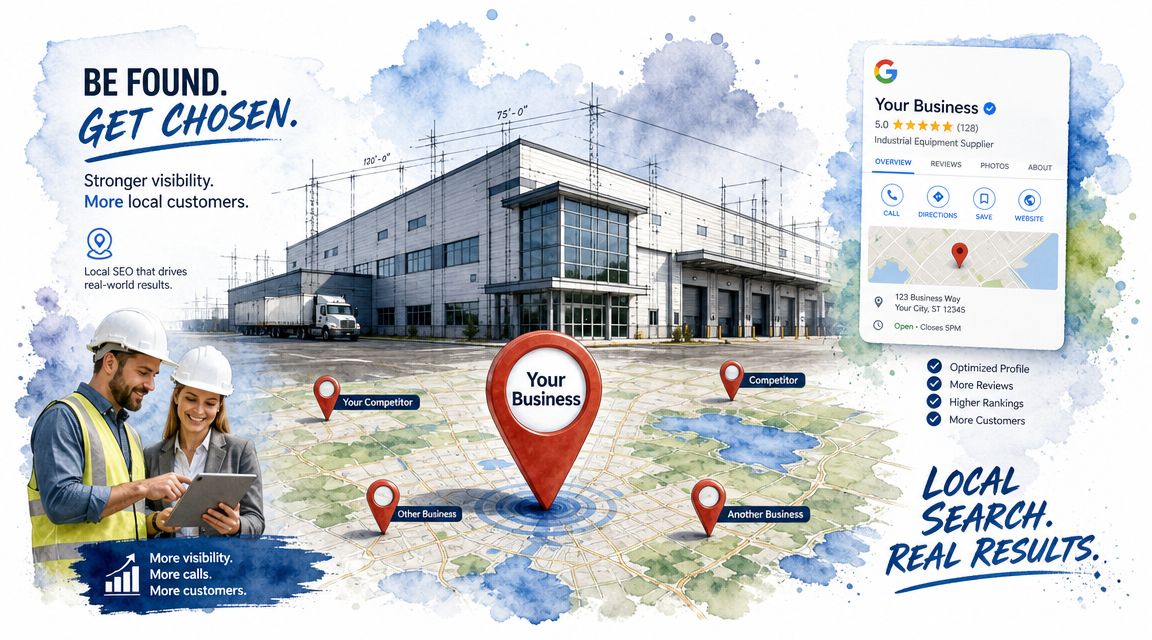
If you are looking for website design in Vernal, Utah, you may need more than someone who can simply build a good-looking website.
Vernal businesses compete for customers online every day.
Contractors.
Oilfield service companies.
Restaurants.
Retail businesses.
Professional services.
Home service companies.
Tourism and recreation businesses.
When a potential customer needs something, one of the first things they often do is search online.
The question is simple:
Will they find your business—or someone else’s?
At Northpoint Web, we provide website design, ongoing website management, proactive search engine optimization, managed content, and AI integration options for businesses in Vernal and throughout the Uinta Basin.
A Vernal Business Website Should Be Built for Vernal Customers
One of the problems with national website companies is that they often approach every local business the same way.
Choose a template.
Add a logo.
Write a few paragraphs.
Publish the website.
But Vernal is not a generic market.
Businesses here serve a unique combination of local residents, oilfield companies, contractors, rural communities, tourists, and customers from throughout northeastern Utah.
The website for a Vernal business should reflect the people that company actually serves.
Where do your customers come from?
What services are they searching for?
Do you only serve Vernal?
Do you work throughout Uintah County?
Do customers come from Roosevelt or Duchesne?
Do you serve businesses connected to the energy industry?
Does tourism affect your business?
These questions matter when planning a website and local SEO strategy.
Why Local SEO Matters for Vernal, Utah Businesses
Imagine someone searches Google for a service you provide.
They may search:
“contractor Vernal Utah”
“plumber near Vernal”
“excavation company Uintah County”
“website designer Vernal Utah”
“best roofing company Vernal”
Your business may provide exactly what that customer needs.
But if your website does not clearly explain your services and location, search engines may have difficulty understanding when your company is relevant.
That means we can continue paying attention to the website after launch.
We can update content.
Add services.
Build new landing pages.
Evaluate search opportunities.
Create articles.
Improve calls to action.
And help the website change as the business changes.
Proactive SEO Instead of Waiting for the Business Owner
Most Vernal business owners have enough to do.
They should not have to spend Saturday night researching Google keywords.
We believe the website company should help look for online opportunities.
At Northpoint Web, our proactive SEO approach can include evaluating services that are poorly represented on a website, identifying customer questions that deserve content, reviewing local search opportunities, and improving existing pages.
If a business expands into a new service, the website may need a new page.
If customers repeatedly ask the same question, that question may make a useful article.
If a company wants more work in a specific part of the Uinta Basin, the website strategy may need to change.
The business owner should not always have to call the website company first.
Managed and Automatic Blog Content for Vernal Businesses
Many website companies tell small businesses to start a blog.
Then they leave the business owner to write it.
That rarely works.
A Vernal contractor probably has better things to do than write an article after working all day.
The same is true for most business owners.
Northpoint Web can help plan, create, manage, and publish website content based on actual business services and search opportunities.
In some situations, automatic blog publishing can help maintain a consistent content schedule.
But we do not believe in publishing meaningless AI articles simply to fill a website.
Content should have a reason to exist.
It should answer a customer question.
Explain a service.
Address a local issue.
Or help potential customers understand the business.
AI Integration for Vernal Small Businesses
Artificial intelligence is creating new opportunities for small businesses.
The challenge is knowing what is actually useful.
A Vernal business may benefit from an AI website assistant that helps visitors find the correct service.
A contractor may use a smarter inquiry process to collect project details.
A service company may want to better organize incoming customer questions.
A business may need help creating and managing ongoing website content.
Northpoint Web can evaluate practical AI integration options for Vernal businesses.
We start with the business problem.
Then we consider whether AI or automation can help solve it.
Technology should make the business easier to operate.
It should not create another complicated system for the owner to manage.
There are excellent website designers throughout the country.
But local presence can provide an advantage.
We know where Vernal is.
That may sound like a low standard, but it matters more than people think.
We understand the relationship between Vernal, Roosevelt, Duchesne, and the surrounding Uinta Basin communities.
We understand that local businesses may serve customers across a wide geographic area.
We understand the importance of the oil and gas industry to the Basin.
We understand rural Utah.
We understand that local reputation still matters.
Northpoint Web combines professional website development with a local understanding of the Uinta Basin.
Looking for a Web Designer in Vernal, Utah?
If you are comparing website design companies in Vernal, Utah, consider what you want after the website launches.
Do you simply want a new website?
Or do you want someone helping manage your online presence?
Northpoint Web provides website design, ongoing website management, proactive SEO, local search optimization, managed blog content, automatic publishing options, and practical AI integration for Vernal and Uinta Basin businesses.
Our goal is simple.
We want your website to become a managed part of your business—not another online project everyone forgets about.
The harder question is deciding who should build and manage it.
Businesses in Vernal, Roosevelt, Duchesne, Myton, Ballard, Naples, and the surrounding Uinta Basin communities have unique challenges. We serve a large geographic area. Many local companies travel between communities. Contractors may work in multiple counties. Customers often search for a service online before they ever ask a neighbor who to call.
That means your website needs to do more than look professional.
Does this company understand where I actually do business?
The Uinta Basin is different.
A contractor based in Duchesne may work in Roosevelt, Vernal, Altamont, and rural areas throughout Duchesne and Uintah counties.
A business in Roosevelt may want to attract customers from both sides of the Basin.
A Vernal company may serve customers well beyond the city limits.
Your website structure and search engine optimization strategy should reflect the way your business actually operates.
Local Web Design Should Include Local SEO
One of the biggest mistakes small businesses make is building a website without considering how potential customers search.
Imagine you own a construction company in Roosevelt.
Your website may simply say:
Welcome to ABC Construction. We provide quality construction services.
That tells Google and potential customers very little.
What type of construction?
Where do you work?
Do you build homes?
Do you remodel?
Do you build garages?
Do you work in Vernal?
Do you serve Duchesne?
A properly planned small business website should clearly explain your services and the geographic areas you serve.
This is where local SEO in the Uinta Basin becomes important.
At Northpoint Web, we look at the business before simply designing the pages.
We want to understand what you do, where you work, which services are most profitable, and what opportunities may exist online.
Your Website Should Not Sit Untouched for Five Years
This is one of the biggest differences between traditional web design and the approach we are developing at Northpoint Web.
Most websites follow the same cycle.
A business owner decides they need a new website.
The website is built.
Everyone is excited.
The website launches.
Then nobody touches it for four or five years.
Meanwhile, the business changes.
New services are added.
Employees change.
Service areas expand.
Competitors improve their websites.
Customer questions change.
Search opportunities appear.
The website stays exactly the same.
We believe a business website should be actively managed.
Northpoint Web Offers Complete Online Website Management
Northpoint Web is more than a Uinta Basin web design company.
Our goal is to help manage the online side of a local business.
Depending on the needs of the company, that may include website updates, new service pages, proactive search engine optimization, local SEO improvements, managed blog content, automatic blog publishing, landing pages, lead forms, and AI integration.
Instead of waiting for a business owner to call and say, “Can you change something on my website?” we want to actively look for opportunities.
If there is a service your company provides that is poorly represented online, we can evaluate it.
If your business is expanding into another Uinta Basin community, your website may need to reflect that.
If customers repeatedly ask the same question, that question may deserve a page or article.
Search engine optimization is often sold as a mysterious technical service.
It should not be.
At its core, SEO involves helping search engines and people better understand your business and the information on your website.
For a local company, we may look at questions such as:
What services are potential customers searching for?
Which Uinta Basin communities does the company serve?
Are important services missing from the website?
Does each major service have enough useful information?
Are there customer questions that could become articles?
Are competitors appearing for searches where your company should be visible?
We call this proactive SEO management.
We do not want to install an SEO plugin and declare the job finished.
We want to continue looking for opportunities.
Automatic Blog Posts and Managed Website Content
Many small business owners know they should add content to their websites.
They simply do not have time.
A contractor finishing a twelve-hour day is probably not going home excited to write an 1,200-word article about bathroom remodeling in Vernal, Utah.
A plumber does not want to research blog keywords.
A local business owner should be running the business.
Northpoint Web can help plan, create, manage, and publish search-focused website content.
Modern automation and AI tools can also help make ongoing content management more efficient.
However, AI should not simply generate hundreds of meaningless articles.
The content should be connected to the actual business.
It should answer real questions.
It should discuss real services.
And when appropriate, it should reflect real opportunities in the Uinta Basin.
AI Integration for Uinta Basin Small Businesses
Artificial intelligence is changing the way businesses operate.
But most small businesses do not need an expensive AI department.
They need practical solutions.
Could an AI website assistant help customers find the correct service?
Could a smarter form collect project information before an estimate?
Could customer inquiries be organized automatically?
Could frequently asked questions be answered more efficiently?
Could AI help a company maintain useful website content?
At Northpoint Web, we are interested in practical AI integration for Uinta Basin businesses.
The question is not:
How can we add AI to your website?
The better question is:
Is there something repetitive, slow, or frustrating in your business that technology could make easier?
That is where AI becomes useful.
Why Local Presence Matters When Choosing a Uinta Basin Web Designer
We live here.
We know the difference between Duchesne and Vernal.
We understand that Roosevelt is not simply another Salt Lake City suburb.
We understand the oilfield.
We understand contractors.
We understand rural service areas.
We understand that many Uinta Basin businesses grow through reputation, relationships, and word of mouth.
A good website should support those strengths.
It should not try to turn a local company into a generic national brand.
Your website should look professional while still accurately representing your business.
What Should You Ask a Uinta Basin Web Design Company?
Before hiring a website company, ask what happens after the website launches.
Who updates the website?
Who looks for new search opportunities?
Who adds new services?
Who creates content?
Who watches how the business is represented online?
Can the website grow?
Can AI or automation be added later?
Does the company understand your service area?
Most importantly:
Is the company simply building your website, or are they helping manage your online presence?
Those are two very different services.
Looking for a Web Design Company in the Uinta Basin, Utah?
Northpoint Web provides professional website design and online website management for businesses throughout the Uinta Basin.
We work with local businesses, contractors, service companies, and organizations that want more than a website that simply sits online.
Our approach can include website design, ongoing website management, proactive SEO, local search optimization, managed blog content, automatic publishing options, landing pages, and practical AI integration.
We are local.
We understand the Uinta Basin.
And we believe your website should continue working and improving long after it launches.
Your website should not simply exist online. It should be a managed part of your business.
You're probably in one of two spots right now. Either your company does solid work but Google barely shows you, or your phone rings from referrals and repeat customers, but you know that pipeline gets shaky the second work slows down, a foreman leaves, or a competitor gets more visible online.
That's the core issue with SEO for small businesses in the Uinta Basin. It's not about chasing vanity rankings or sounding smart in a marketing meeting. It's about getting the phone to ring for jobs in Vernal, Roosevelt, Duchesne, and the surrounding area. And for a lot of trades and industrial businesses, it's also about getting qualified job applications from people who are motivated to work.
If you're a contractor, trucking company, welding shop, excavation outfit, or oilfield service business, your online presence needs to do two jobs at once. It needs to bring in customers and help you recruit. Most SEO advice only handles the first half. That's a mistake.
A lot of business owners in the Basin still think the company with the best crew, best equipment, or best reputation should naturally get the work. That's not how search works. The company that shows up first gets the first look, the first call, and often the job.
If someone searches for welding, excavation, water hauling, roustabout services, or CDL jobs near them, they're usually not starting with a list of names they already trust. They're starting with Google. A 2026 SEO industry roundup reports that 68% of online experiences begin with a search engine, and the top three organic Google results receive 68.7% of all clicks. That same roundup says 74% of small businesses invest in SEO. That should tell you everything you need to know. Your competitors aren't ignoring this anymore.
Search visibility decides who gets considered
If you're buried below the top results, you're not just losing website traffic. You're losing the chance to even be compared. Most buyers don't investigate ten contractors. They check the businesses Google puts in front of them, skim reviews, glance at photos, and make a call.
That's why SEO for small businesses matters so much in a market like the Uinta Basin. The service area may be regional, but the buying behavior is the same as anywhere else. People search. Google filters. The visible companies get the action.
Practical rule: If your business isn't showing up when a customer searches for the service you want to sell, your reputation alone won't save you.
A lot of owners waste time blaming the market, seasonality, or price shoppers. Sometimes that's fair. But often the simpler answer is this: your competitor is easier to find.
Good work is not enough if nobody sees it
Local contractors often get tripped up. They assume SEO is some big-city tactic for software companies and online stores. It isn't. It's basic visibility. If your website and Google presence don't clearly show what you do and where you do it, Google has no reason to send people your way.
If you want a practical breakdown of implementing SEO for SMBs, that resource is worth reviewing because it lays out the process in plain language. But the local takeaway is simpler. Your company needs to be findable for the exact services and locations that pay your bills.
Here's the blunt version:
If you depend on local jobs, you need local search visibility.
If you serve a niche trade, you need pages built around that trade.
If you want steady hiring, you need to show up for job-related searches too.
The contractor who understands that will keep taking market share from the one who doesn't.
Your Digital Storefront Mastering Google Business Profile
Your Google Business Profile is usually the first thing people see. Before they hit your website, they see your business name, category, reviews, photos, hours, service area, and phone number. That profile does a lot of the selling before your homepage even gets a chance.
Guidance for small businesses with limited budgets points to Google Business Profile as the local SEO cornerstone because it can produce the fastest lift in calls and form fills for a tight geographic service area, especially for local service companies in smaller markets like ours, as noted in this local SEO guidance for small businesses.
Why Google Business Profile comes first
If your budget is limited, don't start with a fancy website rebuild just because an agency says you need one. Start with the asset closest to the search result. For local contractors, that's usually your Google Business Profile.
A weak profile creates friction fast. Wrong category. Incomplete services. Old phone number. No recent photos. No jobsite updates. No review responses. That makes your company look inactive, even if your crew is slammed every day.
Your profile should answer these questions immediately:
What do you do
Where do you work
Can I trust you
How do I contact you right now
If those answers aren't obvious, fix that before you touch anything else.
What to fix on your profile this week
Here's the checklist I'd use for a contractor in Duchesne, Roosevelt, or Vernal.
Pick the right primary category: Don't settle for something broad if a more precise option exists. If you're an excavation contractor, use that. If you're a trucking company, don't hide behind a vague construction label.
Set real service areas: Use the towns and counties you serve. Don't sprawl into areas you never work just because you think it will help.
List specific services: Add excavation, grading, hydrovac, reclamation, welding, fabrication, hauling, roustabout work, or whatever services you want more of.
Upload current photos: Use real equipment, real crews, real trucks, real projects. Stock photos weaken trust.
Keep hours and contact info current: This sounds basic because it is. It still gets messed up constantly.
Answer reviews: A short, professional response shows the profile is active and monitored.
For businesses trying to tighten up local visibility, Northpoint Web has also published resources related to Google Business Profile optimization that are relevant if you want to compare your setup against a contractor-focused approach.
After you've cleaned up the basics, use short updates to prove the business is active.
How to post like an active local company
Most contractors never touch Google Posts. That's a miss. You don't need polished ad copy. You need evidence that your company is alive and doing work.
Post things like:
Recent jobs: Finished a pad, completed a weld-out, delivered a haul, wrapped a reclamation project.
Equipment updates: Added a truck, upgraded a trailer, brought on new gear.
Seasonal notes: Mud season scheduling, winter access, summer project availability.
A quick visual walkthrough helps if you've never managed a profile seriously:
A complete Google Business Profile won't fix a bad business. It will stop a good business from looking invisible.
Keep the posts plain. One photo, one short description, one clear action. Call. Request a quote. Apply now. That's enough.
Building a Website That Wins Jobs and Builds Trust
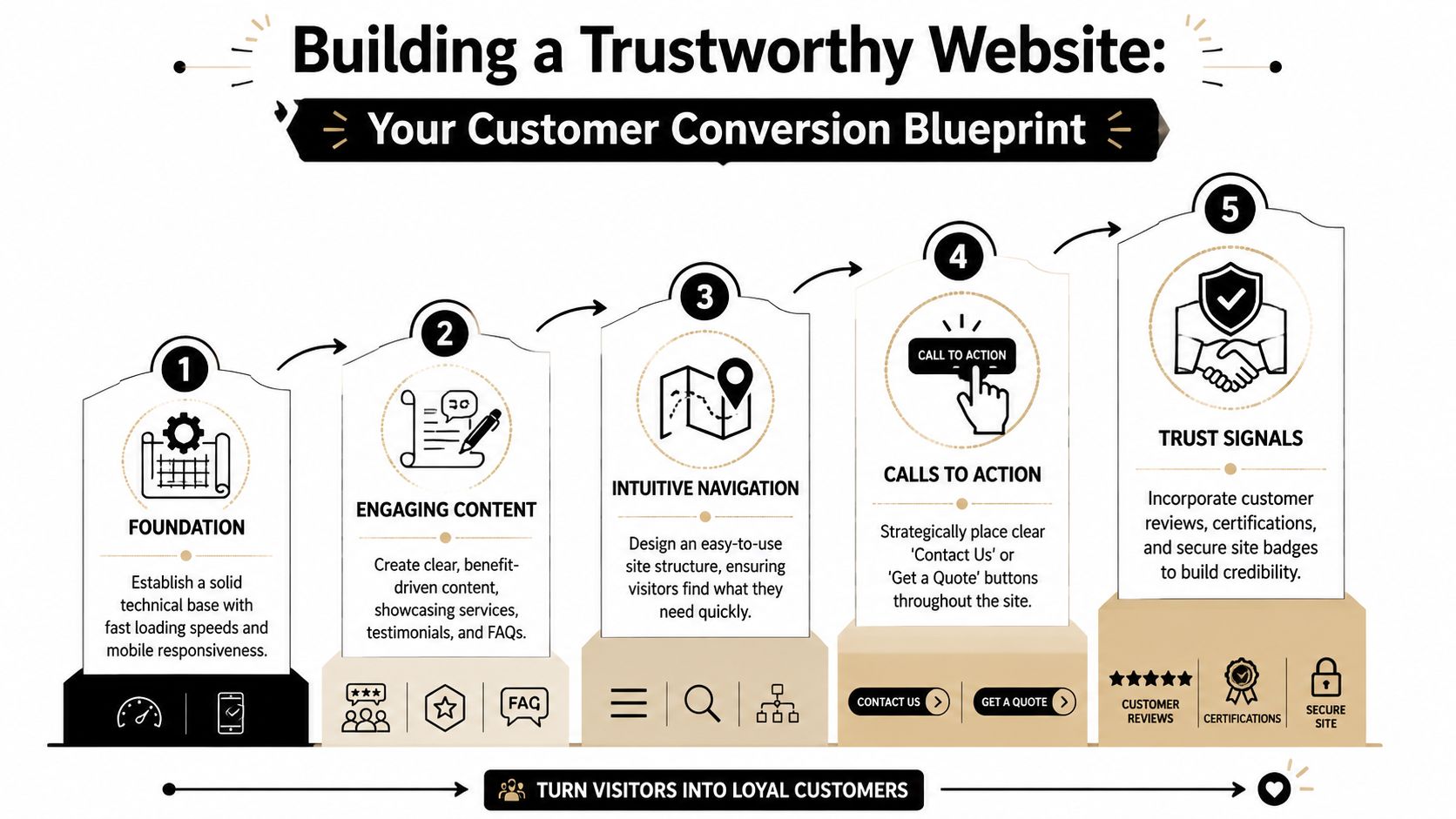
Your Google profile gets the click. Your website decides whether that click turns into a lead. If your site looks dated, loads poorly on a phone, buries your services, or makes people hunt for contact info, you're leaking opportunity.
A small business website does not need to be massive. It needs to be clear. It needs to match what people searched for. And it needs to make contacting you easy.
Stop trying to rank for everything
The right SEO model for most small businesses is simple. Define a focused set of 20 to 50 phrases, map them to specific pages, then monitor performance in Google Search Console and Google Analytics 4 before making changes, as outlined in this small-business SEO workflow guide.
That means you don't need a bloated site with random pages for every possible phrase. You need a controlled list of high-intent keywords tied to real services and real locations.
A solid starter set might include service phrases, location phrases, and a few combination terms. Think in plain English. The way a customer talks on the phone is usually close to the way they search.
Most contractor websites should have dedicated pages for core services. Not one giant “Services” page stuffed with everything from welding to trucking to reclamation to rentals.
Build pages around the jobs you want more of. Then make each page answer the basic buying questions fast.
Here's a structure that works well:
Headline with service and location fit
Short intro saying who the service is for
List of specific jobs or scopes
Photos from real projects
Trust signals like reviews, certifications, or experience
Clear call to action
If you're reworking a site from scratch, this kind of small business web design approach is usually more effective than trying to patch an old site with scattered pages and vague messaging.
What your service pages should actually say
Don't write like a brochure. Write like you're explaining the work to a serious buyer.
Use page titles and headings like these:
Page type
Example title
Excavation page
Excavation Contractor in Vernal for Site Prep, Utilities, and Earthwork
Welding page
Commercial Welding in Roosevelt for Field Repairs and Fabrication
Trucking page
Water Hauling and Trucking Services in the Uinta Basin
Careers page
CDL Driver Jobs in Duchesne with Local and Regional Work
Then make the body copy specific. Name the work. Name the service area. Name the kinds of clients you serve. If you do industrial, say industrial. If you do oilfield support, say oilfield support. If you handle emergency field repair, say that plainly.
Don't make a prospect guess whether you handle their type of job. If it's profitable work you want, put it on the page.
Also, every service page should have a visible phone number, a contact form, and a next step that doesn't sound vague. “Request a quote” beats “Learn more.” “Talk to our team” beats “Submit.”
Using Your Website to Recruit Skilled Workers
A lot of contractor websites are built like the company is only trying to sell jobs. That's half the battle. In the Basin, a business can lose just as much money from a labor shortage as it does from a weak sales pipeline.
That's why SEO for small businesses needs to include hiring. If you need operators, CDL drivers, welders, mechanics, laborers, or field hands, your site should help recruit them every day of the week.
Most competitors still treat hiring like a Facebook post and a prayer. They post “now hiring,” maybe throw up a basic job ad, and wonder why weak applicants trickle in. Meanwhile, a candidate is searching Google for local driving jobs, welding jobs, or operator jobs and landing on whichever company built pages for those searches.
If you need skilled people, your website shouldn't just say “we're hiring.” It should give applicants a reason to choose you.
What a hiring page needs to include
Your careers page should not be a dead-end paragraph with an email address. Build pages around real roles if you hire for them repeatedly.
Good recruiting pages include:
Job title and location: CDL Driver in Duchesne, Welder in Vernal, Equipment Operator in Roosevelt.
Type of work: local hauling, oilfield support, shop fabrication, field repair, civil work, reclamation.
What the day looks like: candidates want to know the actual environment.
Requirements: licenses, experience, schedule expectations, travel if applicable.
Why someone would want the job: equipment quality, steady work, crew culture, project type.
Simple application path: no clunky maze, no broken forms.
If you need a lightweight way to collect applications on your own site, this guide on how to build application forms with HTML is useful for understanding the structure of a clean application form without making the process more complicated than it needs to be.
Project pages can help you hire
This is the part most companies miss. A strong project page can attract clients and future employees at the same time.
If you publish a jobsite recap about a reclamation project, pipeline support job, trucking contract, or custom fabrication job, you're showing more than capability. You're showing your standards. Applicants see your equipment, your work environment, your safety mindset, and the type of jobs they'd be walking into.
That matters.
A bare careers page says, “We have openings.” A good project gallery says, “Here's the kind of operation you'd be joining.”
Use a few simple content types:
Project spotlights: before and after photos, scope, location, challenges, outcome
Equipment pages: trucks, trailers, rigs, support equipment
FAQ content: scheduling, overtime expectations, travel radius, application process
The companies that recruit well online make the business look real, active, and worth joining.
Building Authority with Local Citations and Reviews
Google trusts businesses it can verify across the web. That's where citations and reviews come in. This isn't glamorous work, but it affects whether your company looks established or sketchy.
A citation is your business name, address, phone number, and sometimes your website listed somewhere online. Reviews are public proof that real customers have dealt with you. Both matter because they support trust.
Get listed where your industry actually looks
A lot of cheap SEO vendors chase quantity. They'll dump your business into generic directories nobody uses. That's lazy work.
You want relevance and consistency. Your business details should match everywhere they appear, and the places that mention you should make sense for your trade and region.
Focus on listings like these:
Local business organizations: chamber listings, community directories, local associations
If your business name is written one way on Google, another way on Facebook, and your old phone number still lives on some directory from years ago, clean that up. Mixed signals create doubt.
Ask for reviews without sounding desperate
A lot of owners either never ask for reviews or ask in a way that feels awkward. Keep it simple and send the request right after a successful job, while the experience is still fresh.
Use a short message like this:
Thanks again for the opportunity to work with you. If you were happy with the job, would you mind leaving us a quick Google review? It helps other local customers find our business and lets them know what it's like working with us.
That's enough. No hard sell. No guilt. No long speech.
A few practical habits help:
Ask after a positive outcome: don't wait two months.
Make it easy: send the direct review link by text or email.
Reply to reviews: thank people, mention the service, keep it professional.
Don't script every response: robotic replies look fake.
One honest review from a real customer in your market does more for trust than a pile of weak directory listings ever will.
Measuring Success and Choosing Your Path Forward
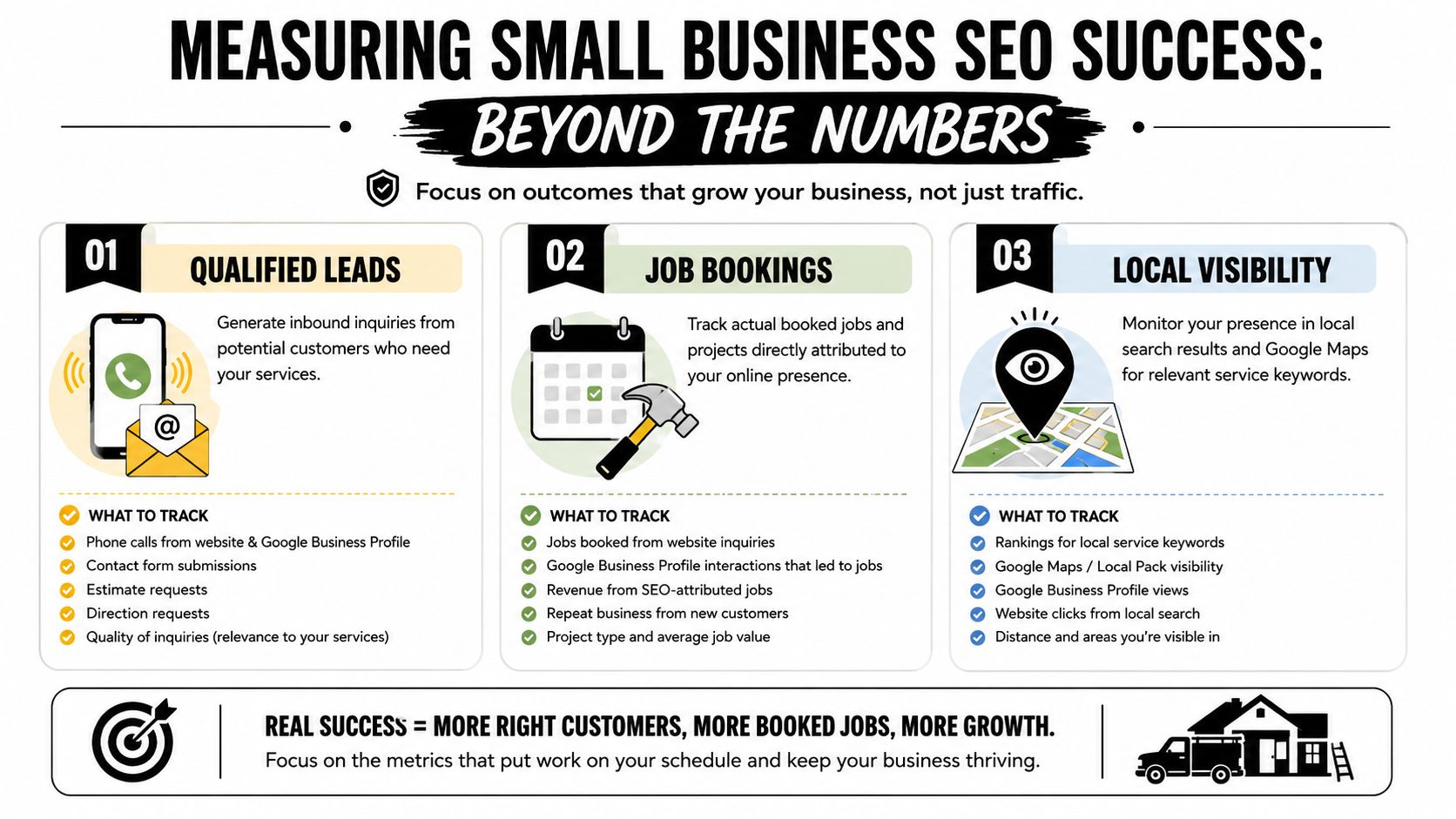
Most business owners get lost in SEO because they start staring at the wrong numbers. They obsess over traffic, rankings, or reports full of charts they'll never use. That's not how a contractor should judge online marketing.
Track what ties back to revenue and hiring. If visibility goes up but calls, quote requests, and job applications don't, something is off.
Track the numbers that matter
For most small contractors, the scoreboard is pretty simple:
Are more people finding you in Google and Maps
Are more qualified leads calling or filling out forms
Are more applicants coming through for the roles you need
You can monitor a lot of this with free tools. Google Search Console shows what searches trigger your pages. Google Analytics 4 shows what people do on your site. Your Google Business Profile shows calls, messages, and visibility trends inside the profile interface.
That's enough to make smart decisions.
Look for patterns like:
service pages that get impressions but few clicks
pages that get traffic but no contact form submissions
job pages that attract visits but no applications
map visibility improving after profile updates or review activity
DIY SEO vs. Working with an Agency
You can absolutely handle parts of this yourself. A lot of owners should. But be honest about what will get done once work picks up.
Factor
DIY Approach
Agency Partnership
Time
You save money but spend your own hours learning, writing, updating, and tracking
You trade budget for speed and consistency
Control
You control every change and every message
You need a clear process and good communication
Execution
Often strong at the start, then slips when operations get busy
Usually better for regular updates, content, and follow-through
Local knowledge
Best if you know your customers and write plainly about the work
Best when the agency understands your market and service area
Technical work
Harder if your site has structural issues or tracking gaps
Easier if you need site fixes, page builds, and reporting
Hiring support
Usually neglected unless someone owns it internally
Easier to build recruiting pages and application flows if it's part of the scope
If you're comparing options, contractor-focused providers that handle website structure, local search strategy, and lead generation support, like SEO services for contractors, make more sense than generic agencies that don't understand rural service businesses.
Pick the path you will actually follow through on
Here's the honest test.
DIY works if you're disciplined enough to keep your Google Business Profile updated, publish service and hiring pages, ask for reviews, monitor Search Console, and improve pages over time. Most owners start with good intentions and then get buried in actual work.
Hiring help makes sense when your time is worth more on operations, estimating, sales, crew management, or job execution. It also makes sense if your current site is weak enough that piecemeal fixes won't cut it.
The worst option is sitting in the middle. Half-finished profile. Thin website. No service pages. No careers page. No review process. No follow-up. That's how businesses stay invisible.
SEO for small businesses is not complicated when you strip away the fluff. Show up in Google. Build pages around real services and real locations. Make it easy to contact you. Make it easy to apply. Keep your information current. Track leads and applications. Repeat what works.
If your business needs a website and SEO setup that brings in local leads and supports hiring at the same time, Northpoint Web works with contractors and local companies in the Uinta Basin on exactly that kind of practical digital foundation.
If you run a contracting, trucking, excavation, oilfield, or other industrial business in Utah, your website needs to do more than display a logo and phone number. It should help the right people understand what you do, confirm that you can handle their work, and take the next step without calling the office for basic information.
This guide explains the website structure, features, local visibility, recruiting considerations, budget questions, and build-versus-buy decisions that matter most for businesses serving the Uinta Basin and similar Utah markets.
A lot of small businesses still treat the website like a sign on the highway. Put up a few pages, list a phone number, add a logo, and call it done. That approach doesn't hold up anymore for industrial businesses. Your website has to help you win estimates, support field credibility, answer questions fast, and in many cases bring in applicants before your competitors do.
That matters even more in a place like the Uinta Basin. Local reputation still drives a lot of business, but buyers, project managers, property owners, and job seekers still search online first. They want proof. They want to know what equipment you run, what areas you serve, whether you're legitimate, and how easy it is to work with you.
A Vernal contractor gets a call from a plant manager who needs a crew fast. He checks the company website before he calls back. The homepage is dated, the services are vague, and the only next step is a generic contact form. The contractor may still be capable of doing the job, but the site creates doubt and slows down the sale.
That is the key issue. A website should help the business run better.
For companies in the Uinta Basin, that means more than putting a logo, phone number, and a few photos online. The site should help a prospect decide whether to request a bid, help office staff spend less time answering basic questions, and help job seekers apply without chasing paperwork across three phone calls. If it does none of that, it is not supporting revenue or hiring. It is just taking up space.
The strongest small business websites act like part of operations. They qualify leads. They route people to the right service. They answer common questions before someone ties up your front office. They also support recruiting, which matters here because many local businesses are competing for the same CDL drivers, operators, welders, mechanics, and field hands.
What this looks like in the Basin
For a roustabout company, the site should send quote requests to the office and job applications to operations, without mixing the two.
For an excavation contractor, the site should separate residential work from commercial bid opportunities so the owner is not sorting through poor-fit leads at night.
For a trucking company, the site usually has two jobs. It needs to bring in shipper and broker inquiries while also giving drivers a clear path to apply.
A website that does not support operations creates more office work instead of less.
A lot of owners still buy web design like they are buying a nicer brochure. That is usually where the project slips off track. Good-looking pages matter, but they come after business function, which is exactly why your website needs more than just a designer. The site has to match how the company wins jobs, handles incoming leads, and brings in dependable people.
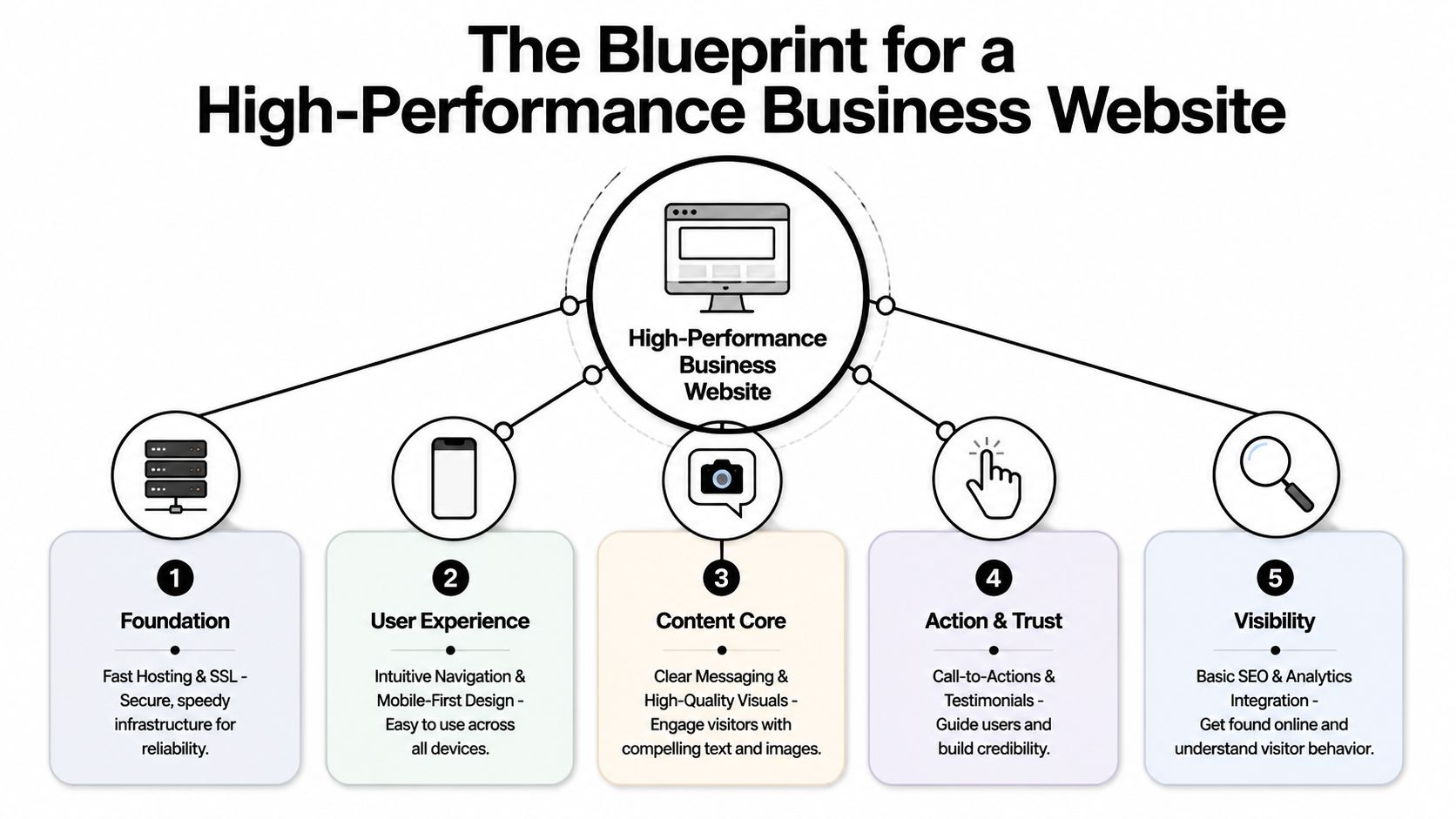
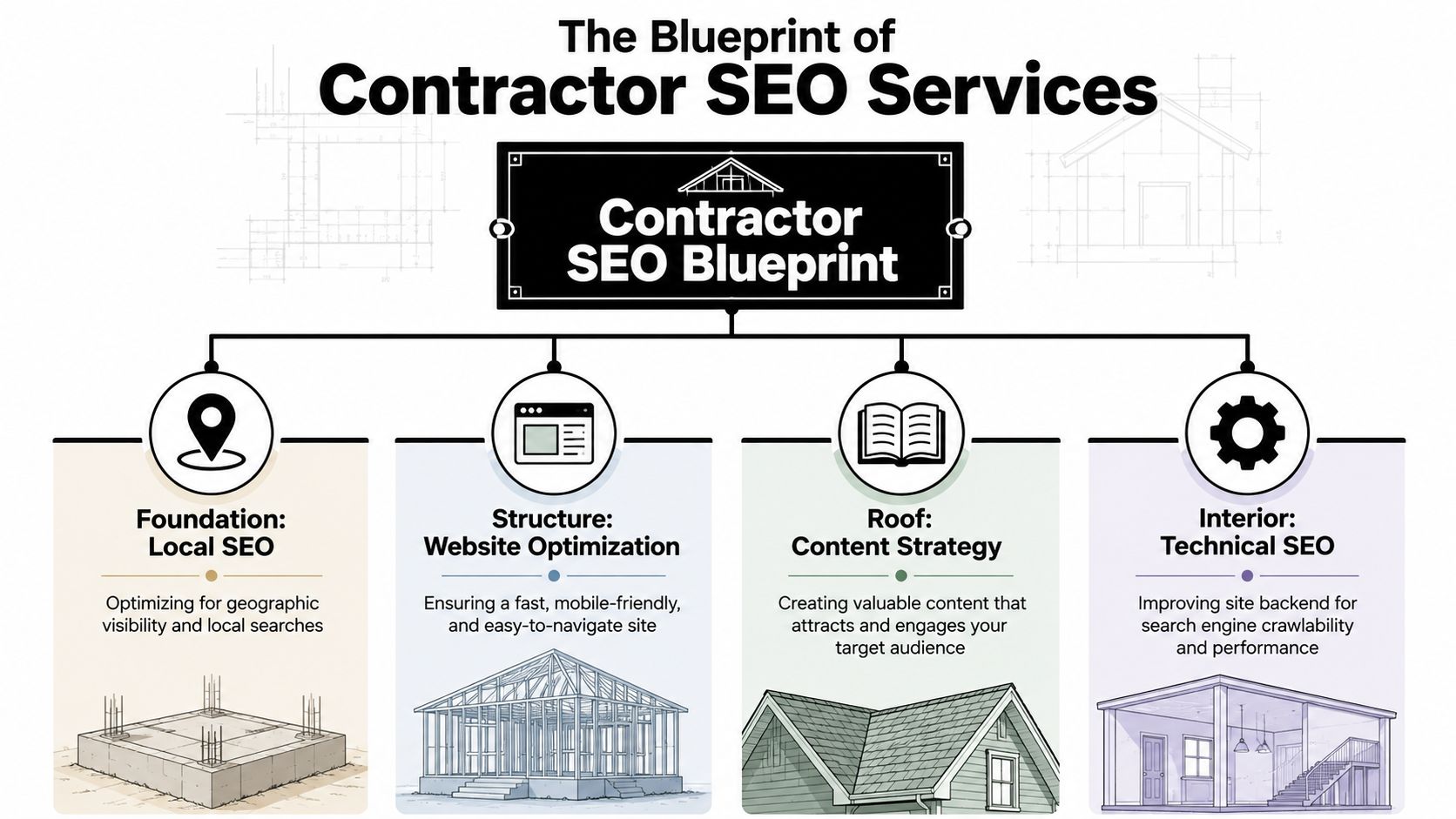
The Blueprint for a High-Performance Business Website
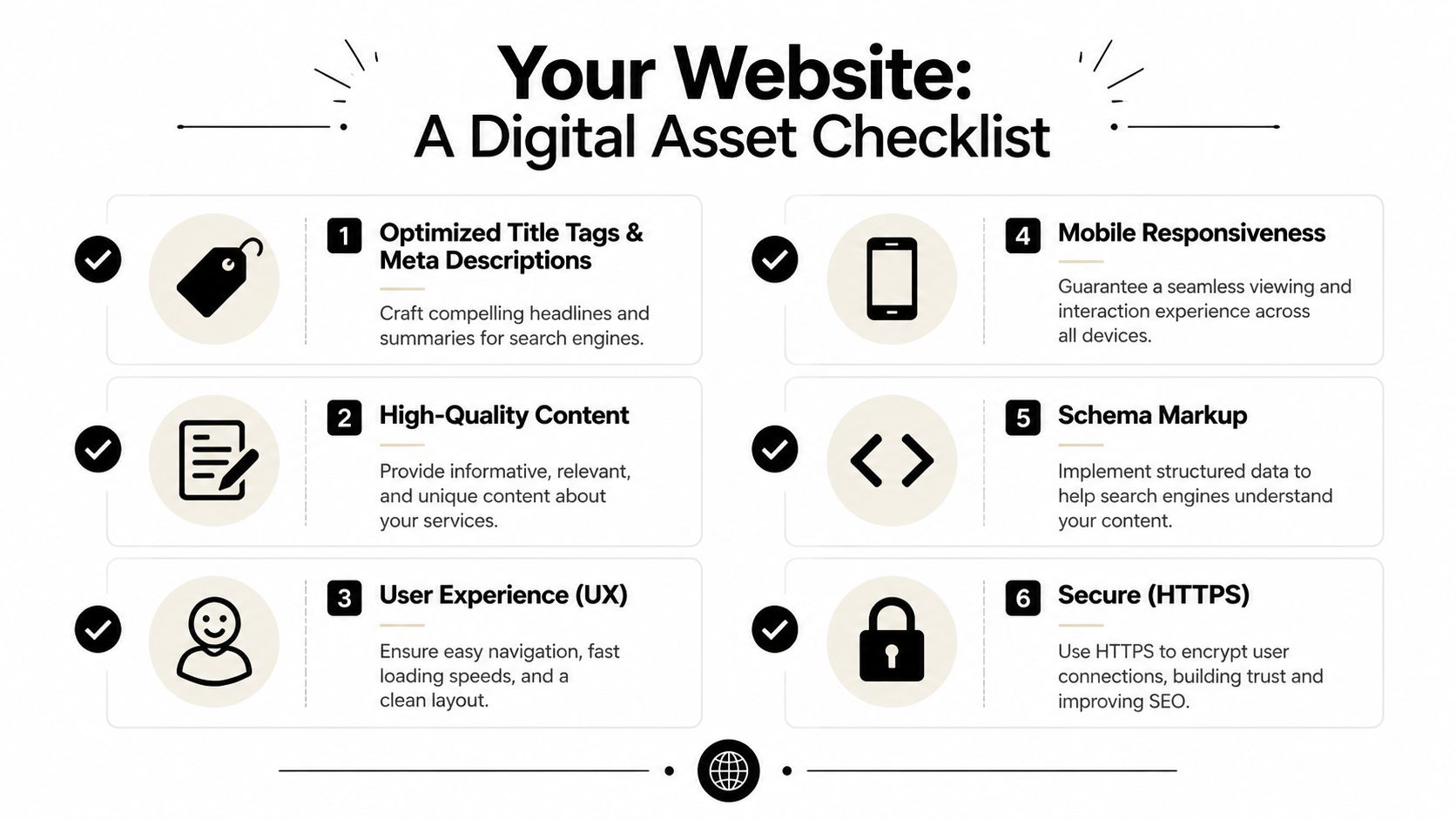
A good business website needs a solid chassis. If the frame is weak, it doesn't matter how nice the paint looks. In small business web design, the chassis is the set of fundamentals that let the site load fast, work on a phone, guide people clearly, and give search engines enough structure to understand what the business does.
What the foundation needs to do
If a superintendent clicks your site from the field, it has to work on a phone without pinching, zooming, or hunting around for the menu. If a property owner wants a bid, the path to contact has to be obvious. If someone lands on the wrong page first from Google, they still need to know where to go next.
That starts with mobile-first responsive architecture and semantic structure. Stratedia's guide to small business website features notes that strong sites use flexible layouts, media queries, clear heading hierarchy like H1, H2, and H3, and concise internal navigation. The same guidance points to local-business schema and consistent NAP data as practical ways to strengthen crawlability and local SEO relevance.
The non-negotiables
Here are the pieces I'd treat as baseline requirements for any Utah contractor or industrial company site:
Mobile usability first: Most owners review their own site on a desktop. Most prospects don't. They visit from a phone in a truck, on a jobsite, or after hours.
Clear navigation: Keep the menu short. Services, industries, about, careers, contact. That's usually enough.
Fast hosting and secure setup: People won't say your hosting is bad. They'll just leave when the site feels clunky or throws a browser warning.
Simple page hierarchy: Every page needs one main topic. Don't bury excavation, trucking, fabrication, and rentals on one vague services page.
Visible calls to action: “Request a quote,” “Call now,” and “Apply today” should never be hard to find.
Practical rule: If a first-time visitor can't tell what you do, where you work, and what to do next within a few seconds, the site is underperforming.
There's also a trade-off owners need to understand. Fancy animation, oversized video backgrounds, and loaded-up templates often make a site feel expensive while making it harder to use. In industrial markets, clear beats clever almost every time. A straightforward page with strong service copy, real photos, trust signals, and clean navigation will usually do more for the business than a design-heavy homepage that gets in the way.
Website Features That Win Jobs in Utah Industries
Generic websites miss the mark because they treat every business the same. A small business web design plan for a Vernal hydrovac contractor shouldn't look like a vacation rental site in Heber, and it shouldn't behave like one either. The features need to match how buyers evaluate the service.
Contractors and excavation companies
For excavation, concrete, grading, utilities, and general contracting, the website should answer two questions fast. Can you do the work, and have you done similar work before?
The strongest features are usually practical:
Project gallery with context: Not just photos. Add location, scope, and type of work.
Bid request forms: Separate estimate requests from general contact questions.
service area pages: Duchesne, Roosevelt, Vernal, and surrounding areas matter when local search intent is high.
Trust elements: Licensing, safety focus, equipment capabilities, and testimonials from actual clients.
A lot of contractors also need stronger search visibility around service-specific terms. If you're trying to understand where content strategy fits into that, this overview of AI-powered construction SEO from Riff Analytics is a useful read because it connects search intent with contractor lead generation in plain language.
Oilfield and industrial service companies
Oilfield businesses often undersell themselves online. Their real strengths are operational. Equipment readiness, field experience, safety culture, response capability, and the ability to work under pressure. None of that comes through on a thin five-page brochure site.
What helps more:
Feature
Why it matters
Equipment and service pages
Buyers can quickly confirm capability
Safety and compliance content
Builds credibility with industrial clients
Industry-specific service breakdowns
Helps visitors self-identify the right fit
Emergency or rapid-response contact paths
Reduces delay when timing matters
A roustabout company, welding contractor, or environmental service provider doesn't need fluff copy. It needs plain language, field photos, clear service descriptions, and obvious contact options.
Trucking and transportation businesses
Trucking sites usually try to talk to everyone at once. Brokers, shippers, owner-operators, job seekers, and dispatch contacts all land in the same place. That creates confusion.
A better approach is to split the paths early. One route for customers. One route for drivers.
Useful features include:
Dedicated driver application page
Fleet or equipment overview
Freight or service coverage information
Fast contact method for dispatch or quoting
When a website forces drivers to dig through customer pages just to find a job application, the company loses applicants it could've captured.
Vacation rentals and hospitality operators
This is a different market, but the same principle applies. A rental site in the Utah mountains needs to remove hesitation. Strong photos, local activity guides, clear booking flow, property details, and seasonal information do more than generic branding copy.
The best websites don't try to impress everyone. They make the next step obvious for the right visitor.
That applies whether you're booking a stay, requesting a quote, or checking whether a company has the equipment and professionalism to handle the job.
Your Website as a 24/7 Recruiting Machine
It is common in the Uinta Basin to have work on the board and still turn jobs down because the crew is short. A trucking company needs two more CDL drivers. A welding shop needs a fitter who can pass a test. An oilfield service company needs operators before the next project starts. In those cases, the website has a hiring job to do, not just a sales job.
A lot of small business websites are built only to collect quote requests. That leaves money on the table if labor is the actual constraint. Market Team's article on essential small business website elements points to the same practical issue. For contractors, trucking firms, and oilfield companies, the website often needs to recruit CDL drivers, operators, mechanics, and welders with the same discipline it uses to attract customers.
That changes what the site needs to say.
A recruiting page should answer the questions a serious applicant asks in the first minute. What jobs are open right now? Is the work local, rotational, or travel-heavy? What kind of equipment will they run? What certifications matter? How fast can they apply from a phone while sitting in a pickup at lunch or between jobs?
If those answers are hard to find, the applicant moves on to the next company.
Strong hiring pages usually include:
A dedicated careers section: not a single link buried in the footer
Short mobile-first application forms: basic info first, resume second
Real field and shop photos: crews, trucks, equipment, yard, work conditions
Clear job expectations: schedule, location, certifications, pay range if you choose to publish it, and who should apply
Credibility signals: safety standards, years in business, project types, and service area
A short visual walkthrough helps owners see how web strategy supports real business outcomes, including hiring.
The wording matters too. Job seekers in industrial markets respond to clear, plain language. "Apply for CDL jobs in Duchesne County." "Work on active pipeline and site-prep projects." "Start with a short application from your phone." That works better than vague culture copy that says nothing about the job.
I also recommend treating recruiting and local visibility as part of the same system. Good hiring pages can support SEO services for contractors because they create relevant pages around real job titles, work types, and service areas. Pair that with a cleaned-up Google Business Profile so applicants can confirm the company is legitimate, local, and active. If you need a practical reference for that side of it, Wispra's Google Business Profile guide is a useful starting point.
Northpoint Web works with contractors, oilfield companies, trucking businesses, and other Uinta Basin firms on this type of structure. The goal is straightforward. Get more qualified applicants in the door without forcing your office manager to chase every hire by phone, Facebook post, and word of mouth alone.
A website can be clean, useful, and well-written and still underdeliver if people can't find it. Local visibility depends on two things working together. Your website needs to be structured well, and your Google Business Profile needs to send clear local signals.
What local SEO really means
For most Utah contractors and service businesses, SEO isn't about chasing broad national terms. It's about showing up when somebody searches for the service plus the place. Excavation contractor Vernal. Hydrovac company Roosevelt. Welding shop Duchesne.
That starts on your site with basics that many companies skip:
Service pages built around real offerings: not one vague page trying to rank for everything
Location relevance: mention actual service areas naturally
Consistent business details: name, address, and phone number should match across the web
Clear page structure: headings and internal links should make sense to both users and search engines
Performance matters here too. Business.com's website design tips note that industry guidance consistently recommends keeping pages under 3 seconds to reduce abandonment, with practical fixes like image compression, lazy loading, minimizing code, and browser caching.
A slow website doesn't just frustrate visitors. It weakens the handoff between search visibility and actual conversions.
If you're comparing options for local search support, contractor SEO services in Utah is the kind of service category worth evaluating when you need help tying together site structure, location targeting, and lead generation.
Where Google Business Profile fits
Google Business Profile is often the first thing a prospect sees before they ever reach your site. That means the profile has to reinforce trust, not create doubt.
Focus on the basics:
Use the exact business name consistently
Choose the right primary and secondary categories
Keep phone, address, and hours accurate
Upload real photos
Collect and respond to reviews
Link the profile to the right landing page on your website
For owners who want a practical walkthrough, Wispra's Google Business Profile guide is a helpful reference because it breaks the setup and optimization process into steps that make sense for local businesses.
Budgeting for Your Website Costs Timelines and ROI
A Vernal contractor can spend $1,500 on a quick site, get it live fast, and still lose work because the pages do not answer basic buyer questions, route leads to the right person, or help recruit dependable field labor. A higher quote is not the problem by itself. The question is what the site needs to do for the business, and what missed jobs or missed hires will cost if it falls short.
As noted earlier, many small business owners now expect their websites to support revenue, not just show contact info. That is the right way to budget for a site in the Uinta Basin. For a welding company, excavation outfit, trucking operation, or oilfield service business, the website should help bring in estimate requests, support sales conversations, and give applicants a clear path to apply.
What you're paying for
Most website quotes mix planning, production, and ongoing support into one number. If you do not break that number apart, it is hard to compare one proposal to another.
You're often paying for:
Cost area
What it covers
Strategy
Site structure, goals, messaging, conversion paths
Build
Design, development, mobile responsiveness, forms
Content setup
Service pages, project pages, location pages, careers pages
Updates, security, backups, edits, SEO improvements
Design is only one line item.
Cheap template builds often create extra work for the owner later. Someone still has to write the service pages, sort out project photos, connect forms to the office, set up hiring pages, and keep the site current. If that work never gets done, the lower upfront price stops looking cheap.
Cheap site versus useful site
A DIY builder can work for a business with a short service list and simple goals. If you want to compare website builders for businesses, do it with a clear view of your operating reality. A one-person handyman business has different needs than a Roosevelt company hiring CDL drivers and bidding multi-step industrial work.
A freelancer can be a good fit when scope is tight and the owner already has strong copy, photos, and direction. A more involved build makes sense when the site needs service-area pages, hiring funnels, CRM or scheduling integration, multiple divisions, or a cleaner sales process for office staff.
The trade-off is not just price. It is time, clarity, follow-through, and whether the website fits how the business runs day to day.
Before approving a proposal, ask:
What pages are included
Who writes or organizes the content
Whether the site is built for leads, recruiting, or both
What is included after launch
How edits, maintenance, and search improvements are handled
If you're trying to sort out why pricing varies so much, this breakdown of what's really included in a $7,500 website build gives a practical view of the labor, scope, and business function behind the final price.
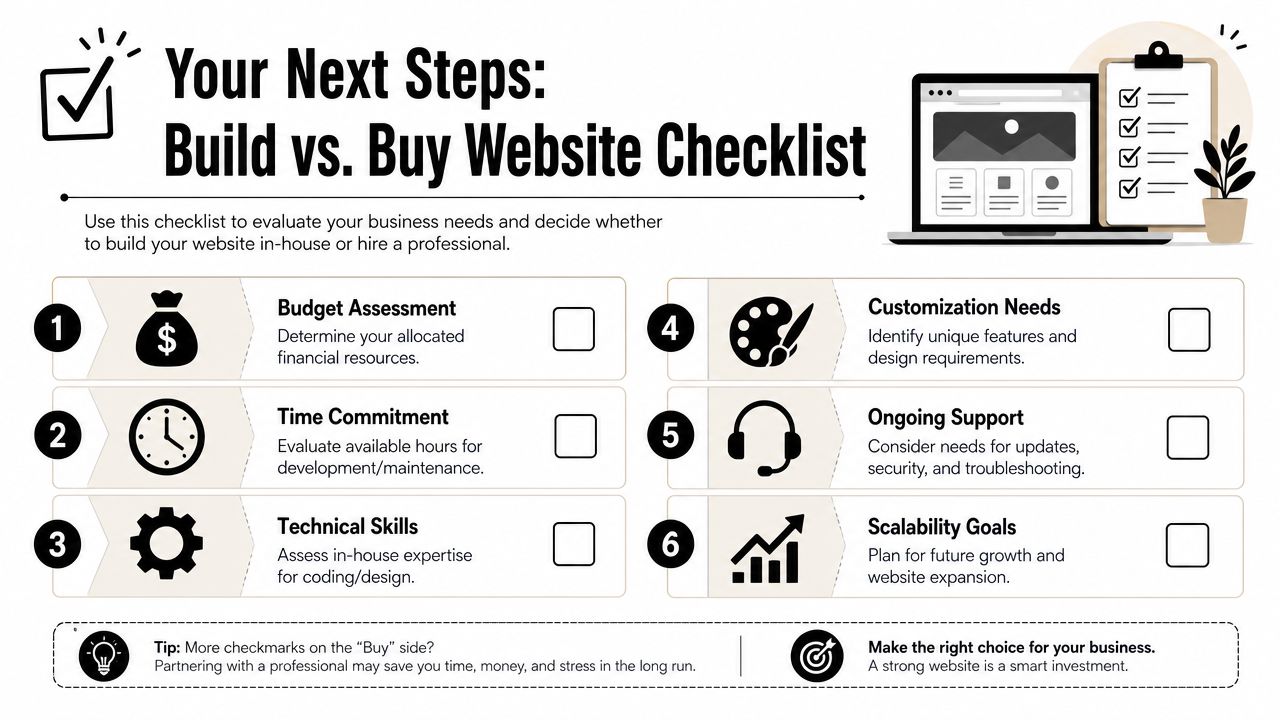
Your Next Steps The Build vs Buy Checklist
The decision to build a website yourself or hire a professional depends on your team's capacity for the work required. A site that brings in bid requests and job applicants takes planning, writing, setup, updates, and follow-through. For a contractor in Vernal or a trucking company in Roosevelt, that work usually lands on the owner, office manager, or whoever already has too much on their plate.
A lot of small businesses still operate without a website, even while new sites keep going live every day and web design remains a large service market, according to Hook Agency's web design statistics roundup. That matters for one reason. In the Uinta Basin, a website is no longer a nice extra. It is basic operating equipment if you want to win work, show up credibly, and recruit dependable people.
When DIY makes sense
DIY works best when the site has a narrow job to do and someone on your team can stay on it week after week.
Build it yourself if these statements are true:
Your site is straightforward: a few core pages, a contact form, and no special integrations
Someone owns the updates: not once, but every month
You can write useful copy: clear service pages, hiring pages, and calls to action
You can fix small problems: formatting issues, plugin conflicts, and broken sections happen
Hire outside help when the website needs to support operations, not just exist online. That usually means lead generation, recruiting, multiple service lines, or a sales process your office staff can use.
Use outside help when:
The website needs to bring in qualified leads
You need recruiting pages for CDL drivers, operators, mechanics, or field crews
You serve different towns, divisions, or job types
Your team will not maintain the site consistently after launch
You need forms, tracking, SEO, or business systems set up correctly
A simple rule helps here. If the website needs to help your company make money or hire faster, cheap shortcuts usually get expensive.
If you're in Duchesne, Roosevelt, Vernal, or anywhere in the Uinta Basin and need a website that helps bring in jobs, applicants, and real business visibility, Northpoint Web is a practical option to consider. They work with contractors, oilfield service companies, trucking businesses, vacation rentals, and other small businesses that need more than a brochure site.
What This Guide Covers
Organize the article around the decisions a business owner must make: what the website needs to accomplish, which pages and features support those goals, how local search fits in, what affects cost and timeline, and when outside help makes sense.
Website planning for contractors and industrial businesses
Service, project, recruiting, and contact pages
Mobile usability, speed, security, and navigation
Local SEO and Google Business Profile considerations
Budget, scope, maintenance, and build-versus-buy decisions
Start With Business Goals, Not Design Features
Before choosing colors, animation, or a template, identify the people the site must serve and the action each person should take. A buyer may need a quote path, a job seeker may need an application path, and an existing customer may need a phone number or service information. These paths should be visible in the navigation and page content.
For companies with several lines of work, separate service or industry pages are usually clearer than placing every capability on one vague services page. The exact structure should follow the company’s real sales and operating process.
Core Pages and Features for Utah Contractors
A practical site commonly needs a clear home page, focused service pages, an about or capabilities page, a contact or quote path, and—when hiring is important—a careers section. Project galleries are more useful when they explain the type and scope of work rather than showing unlabeled images.
Mobile-first layout and readable content
Short, understandable navigation
Distinct calls to action for quotes, calls, and applications
Service-area information that reflects where the company actually works
Fast, secure hosting and a maintainable content structure
Match the Website to the Industry
Contractors and excavation companies should make services, project types, service areas, and bid requests easy to understand. Oilfield and industrial companies may need clearer capability, equipment, safety, compliance, and response information. Trucking companies often need separate paths for shipper or broker inquiries and driver applications. These are planning patterns, not mandatory templates; the final structure should reflect the actual business.
A Contractor Website Has to Do More Than Look Current
For Utah contractors, trucking companies, and industrial service businesses, a website often has to support more than general awareness. It may need to help a prospect request a bid, confirm capabilities, find the right service, or apply for a job. When the site is slow, vague, difficult to use on a phone, or missing proof of relevant work, it can create hesitation before a sales conversation starts.
A Practical Website Blueprint for Local Industrial Businesses
A useful small business website should connect clear service information, mobile usability, local search visibility, lead routing, and recruiting needs. The right structure depends on how the company wins work, serves customers, and handles applications—not on copying a generic brochure-site template.
What a Better Site Should Help Your Business Do
Help buyers understand your services and service area quickly.
Make quote requests and general questions easier to route.
Show relevant equipment, capabilities, projects, and operating information.
Give applicants a clear path to learn about jobs and apply.
Support local visibility for the services and communities you actually serve.
Use Specific Evidence Instead of Generic Marketing Claims
Industrial buyers are more likely to trust specific information than vague claims. Use real project context, service details, equipment information, safety or compliance material where appropriate, and clear contact paths. Do not add testimonials, certifications, client counts, or performance claims unless the business can substantiate them.
Questions to Resolve Before You Build
Do I need a large website? Start with the pages that support your most important services, audiences, and actions.
Is a cheap template enough? Compare the ongoing cost of unclear messaging, poor mobile usability, and poorly routed inquiries—not just the initial build price.
Should I do it myself? DIY may work for a simple business, but a more complex service mix may require help with structure, content, integrations, or ongoing management.
Will a new site automatically rank? No. Technical quality, useful content, local information, and ongoing visibility work together.
Plan the Right Website for Your Business
Once you know which services, audiences, locations, and actions matter most, the next step is to review the available website services and determine what level of planning, development, SEO, and management fits the business.
Review Your Website Options
If your current site is difficult to update, unclear to prospects, or not organized around the way your business wins work, review Northpoint's website services and identify the most appropriate next step for your company.
Industrial companies still earn business through referrals, repeat customers, and long-standing relationships. But when a project manager needs a contractor in a new service area, a procurement contact verifies your capabilities, or a skilled worker researches where to apply, the process often starts with Google.
SEO for industrial companies helps your business show up for the services, equipment, certifications, locations, and job-specific solutions your market is already searching for. The goal is not more traffic at any cost. It is better visibility with buyers and applicants who may be ready to take the next step.
SEO for industrial companies helps your business show up for the services, equipment, certifications, locations, and job-specific solutions your market is already searching for. The goal is not more traffic at any cost. It is better visibility with buyers and applicants who may be ready to take the next step.
That still matters. It probably always will.
But the gap shows up when a project manager needs a contractor in a new service area, when a procurement contact has to verify capabilities before sending an RFQ, or when a welder or CDL driver is deciding which company to apply to. They don't start with your reputation if they don't know you yet. They start with Google. They search for the service, the equipment, the certification, the location, or the exact problem they need solved.
That's where SEO for industrial companies stops being a marketing buzzword and starts becoming a business issue. If your company doesn't show up when those searches happen, you're invisible to buyers and applicants who were ready to take the next step.
Beyond Word-of-Mouth Why SEO is Your Next Big Growth Engine
Word-of-mouth is still one of the best sales channels in industrial markets. It brings trust with it. If a drilling superintendent, plant manager, or general contractor sends work your way, you start the conversation with credibility that no ad can buy.
The problem is that referrals rarely close the whole gap anymore. Buyers still verify what they hear. They search your company name, review your service pages, look for project photos, and check whether they work in their region. If they can't find much, or what they do find looks outdated, that referral gets weaker fast.
Why industrial search behaves differently
Industrial search isn't about broad consumer traffic. It's about a smaller number of people making bigger decisions. They don't type vague phrases when they need a real vendor. They search for things like service capabilities, tolerances, certifications, delivery areas, equipment classes, and jobsite-specific solutions.
One reason this matters is simple. Search is where many B2B buying journeys begin. According to this manufacturer SEO guide from Market Veep, 57% of B2B marketers say SEO generates more leads than any other marketing initiative, and 49% of B2B marketers who have strategically used SEO believe it delivers better ROI than any other channel. For industrial companies, that value comes from showing up for precise, high-intent searches rather than chasing mass visibility.
If you run a welding shop, excavation outfit, trucking company, or oilfield service business, the best search visitor isn't the one casually browsing. It's the one searching with a problem and a spec sheet in hand.
Practical rule: In industrial SEO, less traffic can be better traffic if it brings quote requests, phone calls, and serious applicants.
What skeptical owners usually get wrong
The common objection is fair. “Our customers don't find us online. We get jobs through relationships.” In practice, both are usually true. Relationships open doors, and search confirms whether you belong on the shortlist.
A strong online presence helps in three places:
Referral validation: Someone hears your name and immediately checks your site.
New market expansion: A buyer outside your current network searches for a contractor in your area.
Recruiting support: Drivers, operators, mechanics, and laborers search employers before they apply.
That's why SEO for industrial companies works best when it supports the way industrial sales already happen. It doesn't replace relationships. It strengthens them and fills the gaps between them.
If you want a contractor-specific view of how this plays out in service industries, this overview of SEO services for contractors is worth a look.
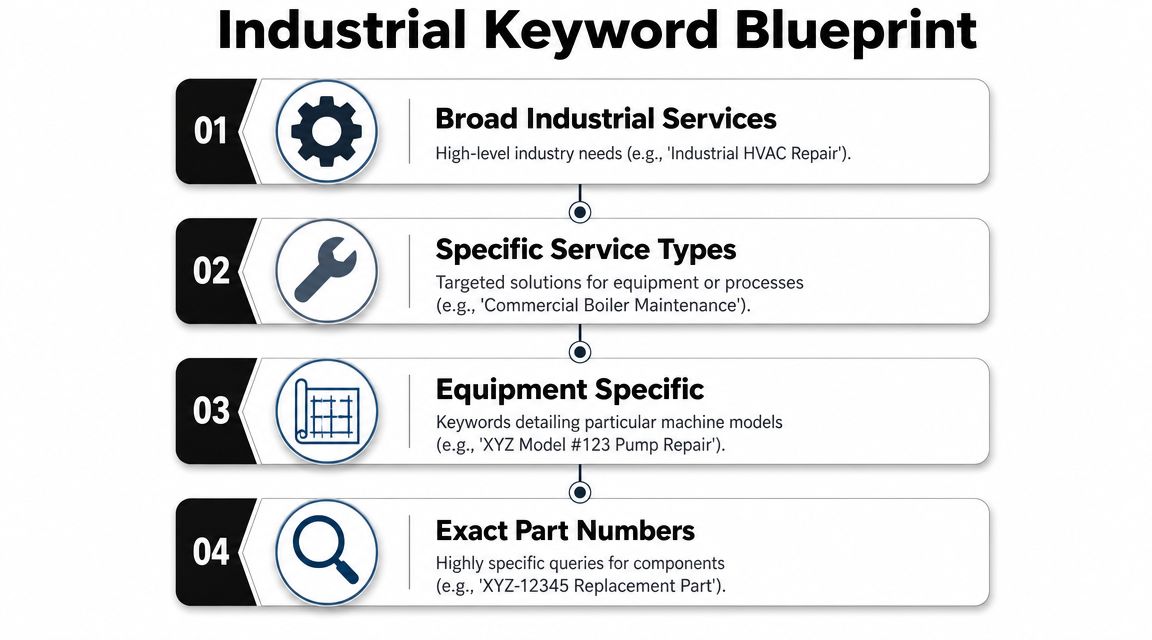
The Industrial Keyword Blueprint From Services to Part Numbers
Most industrial companies start keyword planning too broad. They target terms like “construction company,” “oilfield services,” or “machine shop,” then wonder why the traffic doesn't turn into work. Those phrases are usually too vague, too competitive, or too early in the buying process.
The better approach is to build keyword targets around how industrial buyers search. They usually know more than the average consumer. Often, they already know the process, the material, the job condition, the compliance requirement, or the exact component they need.
The three intent layers that matter
A strong industrial keyword strategy needs three layers. As Konstruct Digital explains in its industrial SEO guide, those layers are capability terms, technical-specification terms, and application-specific terms. Industrial buyers also search by part numbers, material grades, and certification standards, which makes those entities especially valuable for high-intent SEO.
Here's what that looks like in plain terms:
Capability terms These are your core services. Think “hydrovac contractor Vernal Utah,” “roustabout services Uinta Basin,” or “structural steel fabrication Utah.” They tell Google and buyers what you do.
Technical-specification terms Real commercial intent becomes apparent. Examples might include material grades, pressure classes, axle types, pipe sizes, lifting capacities, or welding processes. Buyers using these searches usually aren't window shopping.
Application-specific terms These connect your service to a real use case. “Pipeline reclamation contractor,” “tank battery maintenance contractor,” or “aggregate hauling for road construction” tells you what problem the searcher is trying to solve.
How to build a list that actually brings leads
A good keyword list usually starts in the field, not in an SEO tool. Listen to how your estimator, dispatcher, shop manager, and sales rep describe jobs on the phone. Then compare that language with how buyers phrase needs in RFQs, bid requests, and procurement emails.
Use a simple filter when you review any search term:
Question
Good sign
Bad sign
Does it describe a real service?
Matches a revenue line
Sounds general or academic
Does it include a technical detail?
Material, equipment, certification, location
No buying signal
Could a buyer search this before contacting you?
Yes, especially near RFQ stage
More likely student or hobby traffic
A generic keyword may get impressions. A specific keyword gets the right phone call.
For oilfield, construction, trucking, and industrial service firms, the strongest terms often combine service + geography, service + equipment, or service + application. That's how you move from “we need traffic” to “we need the right searches.”
Owning Your Service Area with Local SEO and Google Business Profile
Most industrial companies don't need to dominate the whole internet. They need to win in the places they serve. If your crews work Duchesne, Roosevelt, Vernal, the Uinta Basin, or a defined regional footprint, your local search presence needs to reflect that clearly.
A lot of owners overlook this because they think local SEO is only for restaurants, plumbers, or retail stores. That's a mistake. For industrial contractors and service-area businesses, local visibility often determines who gets the first call.
What your Google Business Profile should do
Your Google Business Profile is often the first branded asset a prospect sees. It should answer basic trust questions immediately. Are you real? Are you active? Do you work in my area? What kind of projects do you handle?
For industrial companies, that means treating the profile like an operations snapshot, not just a directory listing.
Focus on these basics:
Define your service area clearly: If you travel across counties or operate throughout a basin or regional corridor, set that up properly instead of relying on a single office address.
Use real jobsite and equipment photos: Show trucks, crews, fabrication work, equipment fleets, yards, and field conditions. Skip stock imagery.
Collect relevant reviews: Reviews from actual customers, vendors, and project partners help validate reliability and responsiveness.
Keep categories and services aligned: Your listed services should match the language on your website.
If you want extra ideas that overlap well with contractor-type businesses, Pipeline On has a useful guide on local SEO strategies for home service businesses. The market isn't identical, but the practical GBP habits carry over well.
Local pages beat generic coverage
A single “Service Areas” page usually isn't enough. If you serve multiple cities, counties, or regions, create useful pages for those places. Not thin copies. Real pages that explain what work you do there, what types of customers you serve, and what equipment or response capabilities matter in that geography.
That's especially important when buyers search location-first. They may search the service plus the basin, county, or city before they ever look for your company name.
A useful companion read on that side of the work is this collection of local SEO articles, especially if your business depends on map visibility and regional landing pages.
Here's a quick video that shows the mindset behind stronger local visibility:
Trust signals that matter locally
Industrial buyers don't need flashy branding. They need confidence.
A local search presence gets stronger when it shows:
Current activity: Recent photos, updated hours, and active profile management
Operational proof: Equipment, trucks, crews, certifications, and types of work
Geographic clarity: Towns, counties, and service regions you cover
Responsiveness: Prompt replies to reviews and clear contact options
Local SEO works best when it mirrors the way work gets awarded in the field. Buyers look for coverage, credibility, and evidence that your company can show up and perform.
Your Website as a Hard-Working Digital Asset
A lot of industrial websites still function like digital brochures. They have a homepage, an about page, a short services page, and a contact form. That may check a box, but it doesn't do much selling, ranking, or recruiting.
Your website should work more like a critical piece of equipment. It should be reliable, easy to operate, and built for output. In this case, the output is qualified leads, stronger credibility, and better applicants.
Structure pages around real services
If your company offers excavation, hydrovac, roustabout work, welding, hauling, reclamation, or equipment rentals, each one deserves its own page. Not a bullet on a general services page. A dedicated page.
That page should clearly cover:
the service itself
the types of customers or projects it fits
the geographic area you serve
the equipment, certifications, or capabilities involved
the next step, such as a call or RFQ
This is one reason many industrial sites underperform. They bury valuable services under broad headings and force both Google and buyers to guess what they do.
Technical SEO matters more than most owners think
A good industrial site also has to be crawlable. That matters even more for manufacturers, distributors, and companies with larger service or product catalogs. As Nopio notes in its industrial SEO article, search engines handle faceted navigation poorly, so best practice is to use canonical tags, noindex directives for low-value filters, and publish specification tables directly in HTML instead of only in PDFs. The same source also notes that adding schema fields such as mpn can help part-number searches map to the correct listing.
That's technical language, but the business takeaway is simple. If your most useful information is buried in PDFs, duplicate filter pages, or messy navigation, Google has a harder time understanding your site.
Field-tested advice: Put key specs, capabilities, materials, and equipment details on the page itself. PDFs can support the page, but they shouldn't be the only place the information lives.
Mobile speed changes who stays and who leaves
A foreman checking a vendor between stops, a project engineer on site, or a candidate applying from a phone won't fight through a slow or clumsy website. If your site takes too long, hides contact info, or makes forms difficult, you lose good opportunities before a conversation starts.
Think of your website in operational terms:
Website element
What it should do
Service pages
Match high-intent searches to specific offerings
Technical content
Prove competence and answer buyer questions
Mobile usability
Make it easy to call, request a quote, or apply
Site architecture
Help search engines find and understand important pages
If your site looks decent but doesn't produce much, the issue is often structure, not just design. That's why this piece on why your website needs more than just a designer hits the right point. Industrial sites need performance, not just appearance.
Content for Contracts and Crews Attracting Leads and Talent
Industrial content has two jobs. It needs to help buyers trust you enough to contact you, and it needs to help workers trust you enough to apply. Most companies only build for the first one, and many don't build for either with much intention.
The better model is straightforward. Publish content that answers serious buyer questions and serious applicant questions. If both groups can quickly tell what you do, where you work, and why your company is solid, the website starts pulling more weight.
Content that helps win contracts
Say a project manager is comparing contractors for pipeline support work, site prep, fabrication, hauling, or environmental cleanup. They're not looking for a fluffy blog post. They want enough detail to know whether your company belongs on the bid list.
The strongest pages usually follow a layered approach. Zero Gravity Marketing's article on industrial SEO challenges notes that industrial buying journeys involve multiple stakeholders, and content should serve engineers, procurement teams, and field users at the same time. A strong page leads with concise business outcomes, then goes deeper into technical detail, certifications, and downloadable resources. The same source also notes that industrial buyers increasingly research from phones and that pages slower than 3 seconds can lose visitors.
That layered format works because different people look for different proof:
An engineer wants methods, tolerances, materials, and specifications.
Procurement wants scope clarity, service area fit, and confidence you can deliver.
Operations or field teams want to know you understand real-world site conditions.
A useful contract-focused content mix often includes:
Detailed service pages: One page per service line, not one generic catch-all page
Project galleries: Real photos with captions that explain the work
Capability pages: Equipment lists, certifications, materials, and service regions
FAQ content: Straight answers to jobsite, scheduling, safety, and scope questions
Content that helps hire better people
Now look at the same site from a welder's, driver's, or operator's perspective. Most industrial careers pages are thin. They list a job title, maybe a sentence or two, and an email address. That's not enough if you want better applicants.
Strong recruiting content gives candidates a reason to choose your company over the next one. It should explain the work environment, expectations, locations, schedule realities, and what kind of person does well there.
A more effective hiring section usually includes:
A real careers page: Explain the company, the work, and the kind of roles you hire for
Mobile-friendly application flow: Short, usable forms that don't frustrate field applicants
Work culture proof: Photos of crews, trucks, shop conditions, and project environments
If your website can convince a buyer you're reliable, it can also convince a good employee that you're worth applying to.
One foundation, two outcomes
Consequently, SEO for industrial companies becomes more valuable than many owners expect. The same technical structure, local visibility, and page quality that help generate RFQs also support recruiting. Service pages attract buyers. Location pages build regional trust. A strong mobile experience helps both quote requests and job applications.
That makes your website more than a sales tool. It becomes part business development system, part recruiting platform.
Building Digital Authority Through Industry Partnerships
A lot of business owners hear “link building” and think of spam emails, cheap directory sites, and shady SEO tactics from fifteen years ago. That approach isn't useful for industrial companies, and it usually creates more noise than value.
A better way to think about it is digital networking. You already have real-world authority through suppliers, associations, chambers, project partners, vendors, and customers. SEO works better when you translate those relationships into credible online mentions and links.
Start with relationships you already have
Most industrial companies don't need to manufacture authority from scratch. They need to document the authority they already have.
That can include:
Trade associations: Membership directories, profile listings, or featured member pages
Manufacturers and suppliers: Vendor pages, dealer locators, or customer spotlights
Local business groups: Chamber of Commerce listings, regional business organizations, economic development sites
Project partners: Joint announcements, subcontractor acknowledgments, or case summaries
The key is relevance. A link from an organization tied to your market, region, or service type is usually worth more than a random mention on an unrelated site.
What works and what wastes time
The strongest authority-building efforts usually feel normal from a business standpoint. If you'd do it for reputation even without SEO, it's often a good sign.
Good examples include:
Tactic
Why it works
Give a testimonial to an equipment vendor
They may publish it with a company link
Sponsor a local trade event
You often earn a relevant listing or mention
Publish technical insights with a partner
Both companies gain useful visibility
Maintain directory profiles in real industry organizations
Buyers and search engines both use them
What usually doesn't work is chasing volume for its own sake. Low-quality directories, paid junk listings, and generic outreach rarely help industrial firms build trust with the right audience.
Your best SEO authority often comes from the same people who already know your work is solid.
Authority is also a branding signal
There's another practical benefit here. When a prospect checks your company and sees your name connected to trade organizations, local business groups, suppliers, and community partners, your credibility goes up. That's not only an algorithm issue. It affects how buyers and applicants perceive risk.
For industrial businesses, the cleanest authority strategy is simple. Be visible in the places your industry already respects.
Tracking Real Results From Website Clicks to Signed Contracts
Industrial SEO goes sideways when reporting focuses on rankings and raw traffic instead of business outcomes. Being number one for a broad search term doesn't help much if the people landing on the site were never going to request a quote or apply for a job.
That's why BlackBean Marketing's industrial manufacturing SEO article gets the priority right. It warns that ranking number one isn't useful if the traffic is unqualified, and says the better success metrics are a mix of qualified organic sessions, RFQ submissions, and pipeline attribution, not traffic alone.
Industrial SEO KPI Scorecard
Metric
Why It Matters for Industrials
How to Track It
Qualified organic sessions
Shows whether the right visitors are landing on service, location, or careers pages
Review organic landing pages and filter for pages tied to real buying or hiring intent
RFQ submissions
Direct lead signal from search traffic
Track form submissions tied to quote or estimate forms
Phone calls from organic traffic
Many industrial buyers still prefer calling first
Use call tracking or tagged click-to-call events
Careers form submissions
SEO can support hiring as well as sales
Track completed job applications from organic sessions
Pipeline attribution
Connects leads to actual revenue opportunities
Match CRM records to original organic source when possible
If you need a sharper framework for scoring inquiry quality, this guide on how to define lead quality KPIs is useful because it pushes the conversation beyond simple lead counts.
What to ignore first
Don't obsess over vanity metrics in isolation. Broad rankings, total impressions, and non-converting traffic can look good in a report and still do nothing for the business.
A better monthly review asks:
Are the right pages getting found?
Are quote requests improving in quality?
Are more applicants coming through the careers funnel?
Can sales trace serious opportunities back to organic search?
That's the level where SEO becomes an operating asset instead of a marketing line item.
Frequently Asked Questions About Industrial SEO
How is SEO for industrial companies different from consumer SEO
Industrial SEO targets a smaller audience with much higher intent. Buyers often search with technical language, specific service needs, certifications, material grades, part numbers, and locations. The goal isn't mass traffic. It's getting found by the right person at the right stage of a buying or hiring decision.
Do we need separate pages for every service
Usually, yes. If excavation, hauling, welding, fabrication, reclamation, rentals, and roustabout work all sit on one page, both buyers and search engines have to guess what matters most. Dedicated pages make your capabilities clearer and improve relevance for specific searches.
Should we focus more on Google Business Profile or the website
Both matter, but they do different jobs. Google Business Profile helps with local visibility, map presence, and quick trust signals. Your website closes the gap by showing capabilities, project proof, locations served, and clear quote or application paths.
Can SEO help with hiring too
Yes. It's one of the most overlooked benefits. Many workers search employers before they apply. A strong careers section, mobile-friendly applications, and visible location and service pages can help attract better applicants, especially in competitive labor markets.
What if our industry is too niche for search volume
That's often a good sign, not a problem. In industrial markets, narrow search demand can still produce valuable opportunities. A handful of highly specific searches from engineers, procurement contacts, or field supervisors can be worth far more than broad, unqualified traffic.
How long does industrial SEO take
It depends on your starting point, your market, and how much work gets implemented. What matters most is consistency. Industrial SEO tends to compound when service pages, local visibility, technical improvements, and content quality all improve together.
If your company needs a website that brings in better leads, supports recruiting, and reflects the quality of your operation, Northpoint Web helps contractors, oilfield service companies, and industrial businesses build digital assets that work effectively. They're based in the Uinta Basin and understand how rural Utah businesses compete, hire, and grow.
Why industrial SEO is different from consumer SEO
Industrial search is usually narrower and more technical than consumer search. Buyers may search by service, geography, equipment class, material, certification, application, or part number. That means the most valuable opportunities may come from specific searches rather than high-volume generic terms.
Build the strategy around the language used in RFQs, procurement conversations, estimating calls, dispatch, and recruiting. Those real-world terms are more useful than relying only on broad phrases such as “construction company” or “industrial services.”
Build an industrial keyword map around buying intent
Organize target topics into three practical groups:
Capability terms: the services your company sells.
Technical terms: materials, processes, specifications, certifications, or equipment.
Application terms: the job, environment, or problem the buyer needs solved.
Combine these topics with relevant service areas when appropriate. Review each target by asking whether it represents a real revenue line, a genuine buyer need, and a reasonable path to contact.
Make your service area visible without creating thin pages
Industrial service-area businesses should clearly explain where they work and what they do there. Keep location pages useful by including actual service coverage, relevant capabilities, operating limitations, and a clear inquiry path. Do not create near-duplicate pages for every town unless each page provides genuinely distinct information.
Review your Local SEO presence, including your Google Business Profile, business details, service descriptions, photos, and review process. These assets should reinforce the same services and locations shown on your website.
Turn the website into a useful sales and recruiting asset
Each important service should have a page that explains what is provided, who it is for, the situations it supports, the areas served, and how to start a conversation. Capability details should be specific enough for a buyer to decide whether contacting you makes sense.
Recruiting content can support the same foundation by explaining the kinds of work, roles, locations, and application steps that are genuinely available. Use clear calls to action for both commercial inquiries and employment inquiries when both audiences matter.
Industrial buyers and applicants start with Google
Industrial companies still win business through relationships, referrals, and repeat customers. But buyers, procurement contacts, project managers, and potential employees often verify a company online before they call or apply. If your services, locations, capabilities, or certifications are difficult to find, a referral may not be enough to keep you on the shortlist.
A search strategy built around how industrial buyers actually search
Industrial SEO should connect real revenue lines to the searches your market uses. That may include services, equipment, materials, certifications, applications, service areas, and technical specifications. The goal is not broad traffic for its own sake; it is qualified visibility for searches that can lead to RFQs, calls, project conversations, or applications.
What a stronger industrial search presence can support
Help prospective buyers validate your company after a referral.
Make important services and capabilities easier to discover.
Support visibility in the locations your crews or teams serve.
Give recruiting prospects a clearer understanding of your company.
Create measurable paths from search visits to calls, forms, and other inquiries.
Use evidence and operational detail instead of generic marketing language
Industrial buyers need specific information before they reach out. Explain the services you provide, the equipment or processes you support, the areas you serve, and the types of projects you accept. Add real project examples, photos, certifications, or capability details only when they are accurate and approved for publication.
SEO does not replace relationships or industry expertise
SEO is not a replacement for referrals, sales relationships, estimating, or field experience. It supports those channels by helping people find and validate your company when they are outside your existing network. A focused strategy can also prioritize specific commercial searches instead of pursuing general traffic that has little connection to your work.
Find the next opportunities in your industrial website
Northpoint can review how your services, locations, and conversion paths are represented online, then identify practical opportunities to improve search visibility and qualified inquiries. Direct readers to the services page for the appropriate next step rather than making unsupported promises about rankings or lead volume.
See where your industrial website can improve
If buyers or applicants are searching for your services but finding competitors, start with a review of your current website structure, service coverage, local visibility, and inquiry paths. Explore Northpoint's services to identify an appropriate next step.
Industrial search is usually narrower and more technical than consumer search. Buyers may search by service, geography, equipment class, material, certification, application, or part number. That means the most valuable opportunities may come from specific searches rather than high-volume generic terms.
Build the strategy around the language used in RFQs, procurement conversations, estimating calls, dispatch, and recruiting. Those real-world terms are more useful than relying only on broad phrases such as “construction company” or “industrial services.”
Build an industrial keyword map around buying intent
Organize target topics into three practical groups:
Capability terms: the services your company sells.
Technical terms: materials, processes, specifications, certifications, or equipment.
Application terms: the job, environment, or problem the buyer needs solved.
Combine these topics with relevant service areas when appropriate. Review each target by asking whether it represents a real revenue line, a genuine buyer need, and a reasonable path to contact.
Make your service area visible without creating thin pages
Industrial service-area businesses should clearly explain where they work and what they do there. Keep location pages useful by including actual service coverage, relevant capabilities, operating limitations, and a clear inquiry path. Do not create near-duplicate pages for every town unless each page provides genuinely distinct information.
Review your Local SEO presence, including your Google Business Profile, business details, service descriptions, photos, and review process. These assets should reinforce the same services and locations shown on your website.
Turn the website into a useful sales and recruiting asset
Each important service should have a page that explains what is provided, who it is for, the situations it supports, the areas served, and how to start a conversation. Capability details should be specific enough for a buyer to decide whether contacting you makes sense.
Recruiting content can support the same foundation by explaining the kinds of work, roles, locations, and application steps that are genuinely available. Use clear calls to action for both commercial inquiries and employment inquiries when both audiences matter.
SEO for contractors helps your company appear when customers search for a specific service in a specific place—such as excavation, welding, concrete, roofing, or general contracting near them. The goal is not traffic alone; it is a clearer path from local search to qualified quote requests, better-fit projects, and recruiting visibility.
This guide explains the core parts of contractor SEO, what to expect during the first year, how common pricing models work, and what to ask before hiring an SEO provider. It also covers local and service-area considerations for rural and regional markets such as the Uinta Basin.
This guide explains the core parts of contractor SEO, what to expect during the first year, how common pricing models work, and what to ask before hiring an SEO provider. It also covers local and service-area considerations for rural and regional markets such as the Uinta Basin.
This guide explains the core parts of contractor SEO, what to expect during the first year, how common pricing models work, and what to ask before hiring an SEO provider. It also covers local and service-area considerations for rural and regional markets such as the Uinta Basin.
This guide explains the core parts of contractor SEO, what to expect during the first year, how common pricing models work, and what to ask before hiring an SEO provider. It also covers local and service-area considerations for rural and regional markets such as the Uinta Basin.
This guide explains the core parts of contractor SEO, what to expect during the first year, how common pricing models work, and what to ask before hiring an SEO provider. If you serve rural or regional markets such as the Uinta Basin, it also covers the local and service-area considerations that a generic SEO plan can miss.
This guide explains the core parts of contractor SEO, what to expect during the first year, how common pricing models work, and what to ask before hiring an SEO provider. If you serve rural or regional markets such as the Uinta Basin, it also covers the local and service-area considerations that a generic SEO plan can miss.
That's where SEO stops being a marketing buzzword and starts acting like a business system. For contractors, a strong search presence works like a dependable foreman. It keeps showing up, keeps the pipeline moving, and puts your company in front of people who are already looking for the work you do. In markets like the Uinta Basin, that matters even more. You're not only competing for jobs. You're competing for welders, CDL drivers, operators, laborers, and the kind of local trust that gets your name on bid lists and call sheets.
A lot of contractors still run on the same fuel they used ten or twenty years ago. Referrals, yard signs, repeat customers, a few networking relationships, maybe some paid lead platforms when things get thin. Those channels still matter. They just don't give you much control.
When referrals are strong, business feels easy. When they dry up, the whole pipeline feels shaky. That feast-or-famine cycle is what pushes many contractors to finally take search seriously.
A ServiceTitan study cited by Blue Corona found that only 45% of businesses in the contracting and construction industries were growing, which helps explain why more firms lean on organic visibility and local search to win work. The contractors that treat Google like a lead source instead of a directory listing usually put themselves in a better position to stay busy when the market gets tight.
Referrals are valuable but they are not a system
Referrals are a bonus. SEO is infrastructure.
A referral depends on someone remembering your name at the right moment. Search puts you in front of a buyer when they already have a problem and want a contractor now. That's a different kind of lead. It's closer to the money.
Practical rule: If a search includes a service and a place, it usually has more business value than a broad branding term.
That's why contractor SEO revolves around local intent. Buyers don't search for “quality craftsmanship” when a line freezes, a roof leaks, or a dirt crew is needed on short notice. They search for things like excavation contractor near me, welding shop in Vernal, or general contractor in Duchesne.
If you operate in Utah, especially in rural and regional service areas, local SEO support for Utah contractors matters because your market isn't just one city block. It may span multiple towns, counties, and project corridors.
Google captures high-intent demand
The reason SEO services for contractors work is simple. Search traffic often arrives with intent already built in.
Somebody typing “hydrovac contractor near me” isn't browsing for fun. Somebody searching “commercial concrete contractor Roosevelt UT” is usually screening vendors. SEO helps you show up in those moments with the right pages, right service areas, and right trust signals.
That's why this isn't just about rankings. It's about turning your website into a machine that supports:
More quote requests: From buyers searching for a specific trade and location.
Better-fit jobs: Because service pages can filter for the work you want.
Less dependence on paid ads: Since organic visibility keeps working after the campaign spend ends.
Recruiting support: Because job seekers also use Google when looking for local employers.
Reviews turn visibility into trust
Showing up is only half the job. The other half is making the prospect believe you're the safe choice.
For most contractors, reviews are the fastest trust signal a buyer sees. They're visible in the map pack, they influence click behavior, and they shape whether someone calls you or the company below you. If your crew does solid work but you haven't built a repeatable review process, fix that. A simple workflow for asking at the right moment makes a real difference, and this guide on how to get more Google reviews is a useful place to tighten up that part of the system.
The contractors winning online usually aren't gaming Google. They're building a stronger digital storefront than the competitor across town. Better reviews, clearer pages, stronger local relevance, faster mobile experience. That's what brings the next big job through Google instead of leaving it to chance.
The Blueprint of Contractor SEO Services
Good SEO services for contractors should feel familiar. The structure is a lot like building a shop, a home, or a field office. You start with the slab. Then you frame it correctly. Then you make it usable, credible, and easy for people to move through.
The mistake many contractors make is buying only one part of the build. They get a website with no local strategy. Or they claim their Google Business Profile but never fix the site. Or they publish blog posts while the technical foundation is still weak. SEO works when the whole structure is connected.
Local SEO is the slab
If the slab is crooked, nothing above it sits right. Local SEO is that slab.
For contractors, local SEO starts with the basics that influence whether you appear where buyers are looking: your Google Business Profile, core business details, service categories, photos, reviews, and consistent directory listings. This is the ground-level visibility that helps you show up in map results before a prospect ever visits your site.
A complete local setup usually includes:
Google Business Profile work: Correct categories, service descriptions, service areas, business hours, and strong project photos.
Citation consistency: Your business name, address, and phone details need to match across the web.
Review operations: Not just getting reviews, but responding to them and making them part of your process.
Geo-targeted pages: One page for one important service in one important place.
Website optimization is the framing
Once the local footprint exists, the website has to support it. At this stage, many contractor sites fall apart.
The site needs clear navigation, well-built service pages, logical internal links, and strong calls to action. A buyer should land on a page and instantly know three things. What you do, where you do it, and how to contact you.
A good contractor site also needs to be built for mobile use. The person searching may be standing on a jobsite, sitting in a truck, or comparing vendors from a plant office on a phone.
Your website shouldn't make a prospect think. It should make the next step obvious.
If you want another practical reference point on how contractor marketing fits together outside pure SEO, Machine Marketing's contractor guide gives a useful broader view of positioning, lead flow, and contractor-specific messaging.
Content strategy is the finish work
Content is where you decide what kind of work you want more of.
If you want residential remodeling leads, your service pages, location pages, and FAQs should support that. If you want industrial welding, trucking, roustabout, excavation, or energy-sector work, your content needs to look and sound like a company that understands those jobs.
Many generic agencies often miss the mark. They write pages that could belong to any contractor in any state. That doesn't help much in a specialized market.
Useful contractor content often includes:
Core service pages: Excavation, directional boring, crane services, trucking, welding, hydro excavation, reclamation, and similar revenue-driving pages.
Location pages: Separate pages for service areas that matter commercially.
FAQ content: Answers to questions buyers ask before requesting a quote.
Recruiting pages: Pages aimed at CDL drivers, operators, mechanics, welders, and laborers.
Technical SEO is the utility layer
Nobody brags about the wiring and utility trench after the job is done, but the structure can't function without them. Technical SEO plays that role.
According to contractor SEO guidance from Shawn the SEO Geek, mobile responsiveness, page speeds under 3 seconds, and SSL/HTTPS are priority items for contractor sites, and using structured data for LocalBusiness and Services helps Google understand what a company offers. That matters because contractor searches often happen on mobile, and your site needs to be easy for both users and search engines to process.
Technical work usually includes:
SEO component
What it does for a contractor site
What happens if you skip it
Page speed
Reduces friction on mobile and keeps prospects on the page
Users bounce before calling
SSL/HTTPS
Adds trust and basic security signals
Browsers may warn users
Schema markup
Helps search engines interpret services and business details
Google has to guess more
Clean internal linking
Connects service pages and location pages logically
Important pages stay weak
Image compression
Keeps project galleries from slowing down the site
Slow pages hurt usability
SEO services for contractors shouldn't feel mysterious. They should feel like a coordinated build. Foundation, structure, finish work, utilities. When one piece is missing, the whole property underperforms.
Expected Results and Project Timelines
SEO isn't a switch you flip. It's more like buying and installing a better piece of equipment. You don't bring it in on Monday and expect full production by Tuesday. There's setup, calibration, testing, and then consistent output.
That said, good SEO work shouldn't feel vague. Contractors deserve a timeline that connects activity to business outcomes.
Months 1 through 3
The early phase is cleanup and setup. That usually means fixing the site's technical problems, organizing service pages, tightening page titles and headings, improving internal links, and getting local listings into shape. Google Business Profile work and review operations often start here too.
This phase can produce movement sooner than some contractors expect. The rise of mobile-first, local-first search made local profile optimization and review management central to visibility, and Contractor Growth Network notes that businesses with optimized websites have seen traffic increases of up to 50% within the first few months. That doesn't guarantee the same result for every contractor, but it does show why foundational work matters.
Months 4 through 6
At this point, the framing starts to look like a real building. Service pages mature, location pages begin to rank, technical fixes settle in, and content starts earning more visibility for targeted searches.
You should expect clearer signals by now, such as:
More qualified search impressions: Your company starts appearing for the services and towns you target.
Higher intent traffic: Fewer irrelevant visits, more people looking for specific trade work.
More calls and form fills: Not always at full volume yet, but enough to show the machine is working.
Better recruiting visibility: If you've built careers pages correctly, job seekers begin finding them through search.
Months 7 through 12 and beyond
Once the foundation and structure are in place, SEO becomes less about proving the concept and more about expanding territory. This is when you build more service-area pages, strengthen authority, add project proof, and refine what's producing jobs.
A mature contractor SEO campaign often shifts from “can we rank?” to more practical questions:
Which pages bring in the highest-value work?
Which service areas deserve more dedicated pages?
Are we attracting small one-off jobs or larger bid opportunities?
Are recruiting pages producing qualified applicants or noise?
Rankings matter. Booked work matters more.
That's why reporting should evolve over time. Early on, impressions and clicks help confirm the setup is working. Later, you want reporting tied to phone calls, quote forms, application starts, and the pages that influence those actions.
What to measure besides rankings
Contractors can get misled when an agency reports only keyword positions. Rankings are useful, but they're not the finished product. The point is to keep crews busy, support margin, and make hiring easier.
A better scorecard includes:
Phone calls from organic search
Quote form submissions
Google Business Profile actions
Job application submissions
Performance by service page
Performance by location page
If you're comparing options, this is also the stage where pricing and deliverables start to matter. A transparent breakdown of services, scope, and timeline is more useful than a vague monthly fee, which is why reviewing SEO pricing packages and scope options can help set expectations before work starts.
Understanding SEO Pricing Models
SEO pricing confuses a lot of contractors because proposals often bundle strategy, content, technical work, reporting, and local optimization into one number without explaining what's being built. That's like receiving a bid for a shop project with no line items, no allowance details, and no schedule.
The pricing model matters because it affects the pace of work, the kind of results you can expect, and how flexible the relationship will be.
Monthly retainers
Retainers are the most common model for ongoing SEO services for contractors. You pay a fixed monthly fee for a defined scope of recurring work.
That usually fits contractors who want long-term lead generation, continuing page creation, review support, and regular site improvements. SEO compounds when the work stays consistent, so retainers make sense when organic search is supposed to become part of the company's operating system.
The upside is continuity. The downside is that some agencies hide weak output inside a recurring fee.
Project-based pricing
Project work is a one-time engagement with a clear deliverable. That could be a technical audit, Google Business Profile setup, website rebuild, service-page package, or service-area architecture plan.
This model works well if you already have in-house support or if your main problem is a broken foundation rather than ongoing growth. It's also useful for contractors who want to fix one major bottleneck before committing to a longer campaign.
The trade-off is simple. A project can improve the structure, but it doesn't maintain momentum by itself.
Hybrid models
Hybrid models combine a one-time buildout with ongoing monthly support. For a lot of contractors, this is the most sensible structure.
You might start with a rebuild or local SEO overhaul, then move into a lighter monthly engagement for content, tracking, and authority building. That approach often matches how contractor businesses think about capital improvements versus recurring overhead.
Here's a practical comparison:
Pricing Model
Typical Cost Range
Best For
Potential Downside
Monthly retainer
Varies by market, competition, and scope
Contractors who want ongoing lead generation and continuous improvement
Easy to overpay if scope is vague
Project-based
Varies by deliverable and site condition
Businesses needing a specific fix or setup
Gains may stall without follow-up work
Hybrid
Varies based on setup plus monthly support
Contractors needing both foundation work and ongoing growth
Requires a clear handoff between phases
What drives price?
Market competition: Ranking in a dense metro is different from building visibility in a smaller regional market.
Number of services: A contractor with two services needs less content architecture than one with ten.
Number of service areas: Multi-town and multi-county coverage adds complexity.
Current website condition: A clean, fast site is cheaper to improve than a broken one.
Industry specificity: Industrial, oilfield, and recruiting-oriented campaigns require sharper messaging and page strategy.
Cheap SEO usually fails for predictable reasons. Thin pages, weak location targeting, generic backlinks, no reporting tied to business outcomes, and no understanding of contractor sales cycles. The lowest bid often buys motion, not progress.
A Contractor's Checklist for Vetting SEO Providers
Hiring an SEO company is a lot like hiring a subcontractor for a critical scope item. The right partner keeps the project moving and protects the outcome. The wrong one creates delays, excuses, and expensive cleanup later.
Most contractors don't need an agency that talks the most. They need one that can explain the plan in plain English, tie the work to leads and hiring, and show how decisions get made.
Questions worth asking in the first meeting
A serious provider should be able to answer direct questions without hiding behind jargon.
Ask these first:
How do you measure success? The answer should include calls, form submissions, and qualified applicants, not just rankings.
What will you do in the first ninety days? You want a sequence, not a vague promise.
How do you approach multi-city or rural service areas? This matters if you work beyond one tight city radius.
Who writes the content? Contractor pages need industry accuracy and local relevance.
What do you need from us? The right answer usually includes photos, service details, project examples, and access to people who know the work.
If the provider can't translate strategy into a work plan, that's a warning sign.
Red flags that should slow you down
Some red flags are obvious. Others show up in the fine print or in what the provider avoids saying.
Watch for these:
Guaranteed number-one rankings: No one can promise that honestly.
Cheap backlink packages: Low-quality links can create long-term problems.
No discussion of your actual service lines: Generic agencies often optimize broad pages that never rank for valuable work.
No reporting on leads: If they only report traffic, you won't know whether the campaign is helping the business.
Long lock-in contracts with vague scope: You should know what is being produced and why.
A good SEO provider talks about your buyers, your service areas, and your sales process. A weak one talks mostly about themselves.
What a good reporting process looks like
You shouldn't need a translator to understand your SEO report. Good reporting is simple, regular, and tied to business decisions.
A strong reporting process usually includes:
What to review
Why it matters
Lead sources
Shows whether organic search is creating real opportunities
Top service pages
Identifies what work people are finding you for
Location page performance
Tells you which towns and regions are gaining traction
Google Business Profile activity
Reflects local demand and listing engagement
Application conversions
Helps measure recruiting ROI if hiring is part of the plan
Communication style matters too. Contractors don't need weekly theory. They need updates on what got built, what changed, what moved, and what the next priority is.
One practical benchmark is whether the provider understands that a strong website needs more than visual polish. It needs structure, performance, and conversion thinking. That's the core point behind why your website needs more than just a designer, and it's a useful lens when comparing firms that sell design first and strategy second.
Advanced SEO for the Uinta Basin and Recruiting
Generic contractor SEO advice usually assumes a simple local market. One city, one office, one obvious service radius. That's not how many businesses in the Uinta Basin operate.
A contractor in Duchesne, Roosevelt, or Vernal may cover multiple towns, county corridors, industrial sites, remote pads, and outlying service areas without maintaining a staffed office in each one. Add oilfield support, trucking, fabrication, reclamation, and industrial construction into the mix, and the strategy has to change.
For rural contractors, the website often has to do the geographic work that a storefront would normally do. LinkNow's guidance for general contractors recommends a service-area architecture with separate, geo-specific pages, which is especially important for service businesses that don't have a physical office in every target market.
That approach works well in the Uinta Basin because buyers often search by trade plus location, even when the actual service territory is broader than one town. A single homepage usually can't carry all of that relevance.
A stronger architecture looks like this:
Primary service pages: One page per important revenue service.
Town or regional pages: Vernal, Roosevelt, Duchesne, Uintah County, Duchesne County, and other real coverage areas.
Proof elements: Project photos, crew images, jobsite references, and reviews that mention the relevant area.
Structured service signals: Clear statements about services and coverage areas.
This matters for industrial contractors too. A company might not rank well by leaning only on “near me” searches. It may need pages for terms tied to industry work, equipment types, or project environments. That's one reason broader service-area and industry SEO can matter more than a narrow local-pack strategy in dispersed rural markets.
Recruiting pages that work like jobsite landing pages
One of the biggest missed opportunities in contractor SEO is recruiting.
The same search behavior that brings in buyers can also bring in applicants. Welders search for welding jobs. CDL drivers search for local driving jobs. Operators search for heavy equipment openings near where they live or where they're willing to travel.
For contractors in high-demand labor markets, careers content deserves the same attention as service pages. That means:
Dedicated job pages: Not a single generic “careers” page with no detail.
Local language: Mention the region, schedule expectations, equipment types, and work environment.
Simple application paths: Mobile-friendly forms, clear requirements, and no bloated process.
If hiring is your bottleneck, SEO should support recruiting with the same seriousness it supports lead generation.
A recruiting-focused page should answer what a worker wants to know quickly. What kind of work is this? Where is it located? Is it local, rotational, seasonal, or full-time? What equipment or certifications matter? Who should apply? Contractors who spell this out usually attract better-fit applicants than companies hiding everything behind “competitive pay” and a blank form.
What rural contractors often get wrong
The common mistakes are predictable.
Some build one generic homepage and expect it to rank everywhere. Others create thin town pages with the city name swapped out over and over. Some ignore recruiting entirely even though staffing is the issue holding back growth more than demand.
A more durable approach combines local relevance, industry specificity, and operational reality. That means content built for how rural contractors sell and hire. In practice, that could include a geo-specific excavation page, an oilfield trucking page, a fabrication page, and separate recruiting pages for CDL and welding applicants.
For businesses that need a regional partner familiar with contractor, industrial, and recruiting-focused digital strategy, Northpoint Web offers audit and planning work tied to websites, SEO, and lead generation systems for Uinta Basin companies. The key point isn't the vendor. It's choosing a partner that understands rural geography, industrial buyers, and the hiring pressure local contractors deal with every week.
Frequently Asked Questions About Contractor SEO
Can I do contractor SEO myself
You can handle parts of it yourself, especially if you're willing to learn Google Business Profile management, review requests, and basic page updates. But most contractors hit a time wall. SEO needs consistency, technical upkeep, content planning, and conversion thinking. If your crew is already stretched, DIY usually slips behind operational priorities.
Is SEO a one-time fix or an ongoing service
The foundation can be built in phases, but SEO isn't one-and-done. Competitors update pages, buyers change how they search, and your own service mix changes over time. It's comparable to equipment maintenance. You can install it once, but you still need upkeep if you expect reliable output.
How long does it really take to see results
Some early gains can happen in the first few months when a site is cleaned up and local signals are strengthened. Bigger gains usually take longer because service pages, location relevance, and trust signals need time to build. The useful question isn't “how fast can I rank.” It's “are we building a channel that keeps producing qualified calls and applicants.”
What matters more, a new website or SEO
If your current website is slow, confusing, outdated, or weak on mobile, the site itself may be the first problem to fix. If the site is structurally sound but invisible in search, the priority may be SEO execution. Most contractors don't have a website problem or an SEO problem alone. They have both, because the site and the search strategy were never built to work together.
Should I focus on leads or recruiting first
Focus on the bigger bottleneck. If you have demand but can't staff jobs, recruiting SEO deserves immediate attention. If you have crew capacity but not enough quote opportunities, lead generation should come first. In many contractor businesses, the right answer is both, with separate page structures for buyers and applicants.
If you run a contracting, oilfield, trucking, or industrial business in rural Utah and want a search strategy built around jobs won and people hired, Northpoint Web works with companies across the Uinta Basin to build websites and SEO systems that support real business growth.
What Is SEO for Contractors?
SEO for contractors is the process of improving your website and local search presence so buyers and job seekers can find the services, locations, and employment opportunities relevant to them. It combines local SEO, service-page optimization, useful content, technical improvements, reviews, and clear conversion paths.
A strong contractor SEO strategy should help visitors quickly understand what you do, where you work, and how to contact you. It should also help your business attract the types of projects and applicants it actually wants rather than maximizing irrelevant visits.
Service visibility for searches involving a trade and location.
Local trust signals such as an accurate Google Business Profile and reviews.
Pages that explain specific services and service areas.
Mobile-friendly navigation and obvious quote or contact options.
Why SEO Matters for Contractors
Referrals, repeat customers, networking, and paid advertising can all contribute to a contractor’s pipeline, but they do not provide the same level of control over how buyers discover the company. Search visibility can place your business in front of people who are already looking for a service.
Searches that combine a service and location—such as a welding shop in Vernal or a commercial concrete contractor in Roosevelt—often communicate clearer intent than broad searches. The page should emphasize that SEO supports demand capture; it does not guarantee a particular number of leads, rankings, or projects.
More opportunities to be found for specific services.
Better-fit inquiries when pages clearly describe the work you want.
Less dependence on a single referral or advertising source.
Additional visibility for recruiting local workers and field personnel.
What Contractor SEO Services Include
Contractor SEO works best as a connected system rather than a single tactic. Local SEO provides the visibility foundation, website optimization makes the site useful to visitors, content clarifies the services and markets you serve, and technical SEO helps search engines access and understand the site.
Local SEO: Google Business Profile information, business categories, service areas, photos, reviews, and consistent business details.
Service-page optimization: Dedicated pages that explain each important service, the areas served, and the next step for an interested buyer.
Website optimization: Clear navigation, logical internal links, mobile usability, fast paths to contact, and calls to action.
Content strategy: Helpful pages and FAQs tailored to the trades, projects, locations, and recruiting needs that matter to the contractor.
Technical SEO: Improvements to the site’s structure, crawlability, page experience, and other technical foundations.
Contractors serving the Uinta Basin or other rural and regional markets may need a broader service-area strategy than a business targeting one city. Link readers to the local SEO and managed content service for a more specific explanation of that approach.
How Long Does Contractor SEO Take?
SEO is not a one-time fix, and results depend on the site’s starting condition, competition, service area, content quality, local presence, and how consistently the work is implemented. Present the timeline as a planning framework rather than a promise.
Months 1–3: Audit the website and local presence, clarify priorities, address foundational issues, and establish the measurement process.
Months 4–6: Expand or improve priority service and location pages, strengthen internal linking, improve local signals, and assess which searches are gaining visibility.
Months 7–12 and beyond: Continue refining pages, publishing useful content, improving conversion paths, and investing in the areas that show the strongest business relevance.
Measure more than rankings. Track qualified inquiries, calls or form submissions where they can be measured, visibility for priority services and locations, and whether the inquiries match the work you want.
Want a Contractor SEO Plan Built Around Your Service Area?
Northpoint can help you evaluate the website, local search presence, service pages, and content priorities that support your contractor marketing goals. Contact the team to discuss what you want more visibility for and where your business serves.
SEO for contractors is the process of improving your website and local search presence so buyers and job seekers can find the services, locations, and employment opportunities relevant to them. It combines local SEO, service-page optimization, useful content, technical improvements, reviews, and clear conversion paths.
A strong contractor SEO strategy should help visitors quickly understand what you do, where you work, and how to contact you. It should also help your business attract the types of projects and applicants it actually wants rather than maximizing irrelevant visits.
Service visibility for searches involving a trade and location.
Local trust signals such as an accurate Google Business Profile and reviews.
Pages that explain specific services and service areas.
Mobile-friendly navigation and obvious quote or contact options.
Why SEO Matters for Contractors
Referrals, repeat customers, networking, and paid advertising can all contribute to a contractor’s pipeline, but they do not provide the same level of control over how buyers discover the company. Search visibility can place your business in front of people who are already looking for a service.
Searches that combine a service and location—such as a welding shop in Vernal or a commercial concrete contractor in Roosevelt—often communicate clearer intent than broad searches. The page should emphasize that SEO supports demand capture; it does not guarantee a particular number of leads, rankings, or projects.
More opportunities to be found for specific services.
Better-fit inquiries when pages clearly describe the work you want.
Less dependence on a single referral or advertising source.
Additional visibility for recruiting local workers and field personnel.
What Contractor SEO Services Include
Contractor SEO works best as a connected system rather than a single tactic. Local SEO provides the visibility foundation, website optimization makes the site useful to visitors, content clarifies the services and markets you serve, and technical SEO helps search engines access and understand the site.
Local SEO: Google Business Profile information, business categories, service areas, photos, reviews, and consistent business details.
Service-page optimization: Dedicated pages that explain each important service, the areas served, and the next step for an interested buyer.
Website optimization: Clear navigation, logical internal links, mobile usability, fast paths to contact, and calls to action.
Content strategy: Helpful pages and FAQs tailored to the trades, projects, locations, and recruiting needs that matter to the contractor.
Technical SEO: Improvements to the site’s structure, crawlability, page experience, and other technical foundations.
Contractors serving the Uinta Basin or other rural and regional markets may need a broader service-area strategy than a business targeting one city. Link readers to the local SEO and managed content service for a more specific explanation of that approach.
How Long Does Contractor SEO Take?
SEO is not a one-time fix, and results depend on the site’s starting condition, competition, service area, content quality, local presence, and how consistently the work is implemented. Present the timeline as a planning framework rather than a promise.
Months 1–3: Audit the website and local presence, clarify priorities, address foundational issues, and establish the measurement process.
Months 4–6: Expand or improve priority service and location pages, strengthen internal linking, improve local signals, and assess which searches are gaining visibility.
Months 7–12 and beyond: Continue refining pages, publishing useful content, improving conversion paths, and investing in the areas that show the strongest business relevance.
Measure more than rankings. Track qualified inquiries, calls or form submissions where they can be measured, visibility for priority services and locations, and whether the inquiries match the work you want.
Ready to Review Your Contractor SEO Priorities?
Use Northpoint’s services page to see where SEO, website structure, and local visibility may fit into your next marketing step. Bring your priority services, service areas, and current lead challenges to the conversation.
Define contractor SEO as the combination of local search visibility, service-specific website pages, technical improvements, reviews, and conversion paths that help buyers find and contact the right company. Include subcontractors and manual-labor service businesses as related audiences, but keep “contractors” as the primary topic.
Use examples such as excavation contractor near me, welding shop in Vernal, commercial concrete contractor Roosevelt UT, and hydrovac contractor near me to show how service-and-location searches express stronger intent than broad branding searches.
Why Contractor SEO Matters for Local and Regional Markets
Explain why contractors often serve multiple towns, counties, and project corridors rather than one compact city. Show how service-area pages, accurate business information, reviews, project photographs, and clear contact paths can support discovery across that geography.
Keep the existing Uinta Basin discussion, but make it a clearly labeled regional example rather than allowing it to overshadow the broader contractor audience.
The Core Contractor SEO Services
Local SEO: Google Business Profile information, service areas, categories, photos, reviews, and consistent business details.
Service-page optimization: Pages that explain what the contractor does, where it works, and how prospects can request information.
Technical SEO: Mobile usability, crawlability, page structure, speed, and indexation.
Content strategy: Useful pages that answer buyer questions and support priority services without publishing generic filler.
Measurement: Tracking visibility, calls, forms, quote requests, and lead quality where possible.
SEO for Subcontractors and Manual-Labor Service Businesses
Add a short section explaining that the same principles apply to subcontractors and other field-service or manual-labor businesses: make the trade clear, identify the service territory, show the types of projects accepted, and provide a straightforward path to contact the company.
Avoid treating “seo for manual labor services” as a separate industry category. Use it as a supporting phrase while emphasizing the specific trade and location buyers are more likely to search.
Contractor SEO Is About More Than Website Traffic
Contractors need visibility when a buyer searches for a specific service in a specific place. A ranking that does not produce calls, quote requests, qualified project inquiries, or recruiting visibility is not enough.
Referrals and paid channels can remain valuable, but they may not provide a dependable way to capture demand from people already searching for excavation, welding, concrete, roofing, general contracting, or related services.
What a Complete Contractor SEO Program Should Include
A useful contractor SEO plan connects local search, service pages, technical website improvements, reviews, internal links, and measurement. Each part should reinforce the others so prospects can understand what you do, where you work, and how to contact you.
Local visibility for important towns, counties, and service areas
Clear pages for the services and project types you want
Mobile-friendly conversion paths for buyers searching from jobsites, vehicles, or offices
Review and trust signals that support the decision to call
Reporting tied to inquiries and business fit, not rankings alone
What Contractor SEO Can Help Improve
When the strategy matches the market, contractor SEO can help your company reach more relevant searches, filter inquiries toward the work you want, reduce dependence on a single lead source, and support visibility across regional service areas.
For rural and industrial markets, the strategy should reflect the actual geography and buyer language instead of assuming that one city page or a generic “near me” approach will cover the market.
What to Ask Before Hiring an SEO Provider
Ask how the provider will identify priority services, map locations to pages, measure quote requests, handle Google Business Profile work, report progress, and decide what should be improved first. Be cautious of proposals focused only on rankings, large volumes of generic content, or vague deliverables.
SEO is not usually a one-time fix. The right scope depends on the condition of the website, the competitiveness of the market, the number of services and locations involved, and how consistently the business can support reviews and project content.
Talk Through Your Contractor SEO Priorities
If your company needs better visibility for specific services, locations, or regional markets, review Northpoint’s services and use the guide’s checklist to identify the most important questions for an initial conversation.
SEO for Contractors: What It Actually Means
Define contractor SEO as the combination of local search visibility, service-specific website pages, technical improvements, reviews, and conversion paths that help buyers find and contact the right company. Include subcontractors and manual-labor service businesses as related audiences, but keep “contractors” as the primary topic.
Use examples such as excavation contractor near me, welding shop in Vernal, commercial concrete contractor Roosevelt UT, and hydrovac contractor near me to show how service-and-location searches express stronger intent than broad branding searches.
Why Contractor SEO Matters for Local and Regional Markets
Explain why contractors often serve multiple towns, counties, and project corridors rather than one compact city. Show how service-area pages, accurate business information, reviews, project photographs, and clear contact paths can support discovery across that geography.
Keep the existing Uinta Basin discussion, but make it a clearly labeled regional example rather than allowing it to overshadow the broader contractor audience.
The Core Contractor SEO Services
Local SEO: Google Business Profile information, service areas, categories, photos, reviews, and consistent business details.
Service-page optimization: Pages that explain what the contractor does, where it works, and how prospects can request information.
Technical SEO: Mobile usability, crawlability, page structure, speed, and indexation.
Content strategy: Useful pages that answer buyer questions and support priority services without publishing generic filler.
Measurement: Tracking visibility, calls, forms, quote requests, and lead quality where possible.
SEO for Subcontractors and Manual-Labor Service Businesses
Add a short section explaining that the same principles apply to subcontractors and other field-service or manual-labor businesses: make the trade clear, identify the service territory, show the types of projects accepted, and provide a straightforward path to contact the company.
Avoid treating “seo for manual labor services” as a separate industry category. Use it as a supporting phrase while emphasizing the specific trade and location buyers are more likely to search.
SEO for Contractors: What It Actually Means
Define contractor SEO as the combination of local search visibility, service-specific website pages, technical improvements, reviews, and conversion paths that help buyers find and contact the right company. Include subcontractors and manual-labor service businesses as related audiences, but keep “contractors” as the primary topic.
Use examples such as excavation contractor near me, welding shop in Vernal, commercial concrete contractor Roosevelt UT, and hydrovac contractor near me to show how service-and-location searches express stronger intent than broad branding searches.
Why Contractor SEO Matters for Local and Regional Markets
Explain why contractors often serve multiple towns, counties, and project corridors rather than one compact city. Show how service-area pages, accurate business information, reviews, project photographs, and clear contact paths can support discovery across that geography.
Keep the existing Uinta Basin discussion, but make it a clearly labeled regional example rather than allowing it to overshadow the broader contractor audience.
The Core Contractor SEO Services
Local SEO: Google Business Profile information, service areas, categories, photos, reviews, and consistent business details.
Service-page optimization: Pages that explain what the contractor does, where it works, and how prospects can request information.
Technical SEO: Mobile usability, crawlability, page structure, speed, and indexation.
Content strategy: Useful pages that answer buyer questions and support priority services without publishing generic filler.
Measurement: Tracking visibility, calls, forms, quote requests, and lead quality where possible.
SEO for Subcontractors and Manual-Labor Service Businesses
Add a short section explaining that the same principles apply to subcontractors and other field-service or manual-labor businesses: make the trade clear, identify the service territory, show the types of projects accepted, and provide a straightforward path to contact the company.
Avoid treating “seo for manual labor services” as a separate industry category. Use it as a supporting phrase while emphasizing the specific trade and location buyers are more likely to search.
SEO for Contractors: What It Actually Means
Define contractor SEO as the combination of local search visibility, service-specific website pages, technical improvements, reviews, and conversion paths that help buyers find and contact the right company. Include subcontractors and manual-labor service businesses as related audiences, but keep “contractors” as the primary topic.
Use examples such as excavation contractor near me, welding shop in Vernal, commercial concrete contractor Roosevelt UT, and hydrovac contractor near me to show how service-and-location searches express stronger intent than broad branding searches.
Why Contractor SEO Matters for Local and Regional Markets
Explain why contractors often serve multiple towns, counties, and project corridors rather than one compact city. Show how service-area pages, accurate business information, reviews, project photographs, and clear contact paths can support discovery across that geography.
Keep the existing Uinta Basin discussion, but make it a clearly labeled regional example rather than allowing it to overshadow the broader contractor audience.
The Core Contractor SEO Services
Local SEO: Google Business Profile information, service areas, categories, photos, reviews, and consistent business details.
Service-page optimization: Pages that explain what the contractor does, where it works, and how prospects can request information.
Technical SEO: Mobile usability, crawlability, page structure, speed, and indexation.
Content strategy: Useful pages that answer buyer questions and support priority services without publishing generic filler.
Measurement: Tracking visibility, calls, forms, quote requests, and lead quality where possible.
SEO for Subcontractors and Manual-Labor Service Businesses
Add a short section explaining that the same principles apply to subcontractors and other field-service or manual-labor businesses: make the trade clear, identify the service territory, show the types of projects accepted, and provide a straightforward path to contact the company.
Avoid treating “seo for manual labor services” as a separate industry category. Use it as a supporting phrase while emphasizing the specific trade and location buyers are more likely to search.
Necessary cookies enable essential site features like secure log-ins and consent preference adjustments. They do not store personal data.
None
Functional cookies support features like content sharing on social media, collecting feedback, and enabling third-party tools.
None
Analytical cookies track visitor interactions, providing insights on metrics like visitor count, bounce rate, and traffic sources.
None
Advertisement cookies deliver personalized ads based on your previous visits and analyze the effectiveness of ad campaigns.
None
Unclassified cookies are cookies that we are in the process of classifying, together with the providers of individual cookies.
None
Zippy Available
💬
Before we start…
This chat may be reviewed by our team, and relevant messages are sent to our configured AI provider. Please do not share passwords, payment details, or other sensitive information.